
Introduction
Human Immunodeficiency Virus (HIV) is the pathogen which is responsible for the Acquired Immunodeficiency Syndrome, AIDS. Once HIV enters into the body is detected by macrophages and a range of antigen presenting cells; in particular, dendritic cells and macrophages search, phagocytize and analyze the antigen to be presented to inactivate CD4 T-cells in a process called immune synapse or simply antigen presentation
[1]. Dendritic cells have certain lectins in their membranes to which viral particles bind with large affinity, this traps HIV and during the antigen presentation process CD4 T-cells are more likely to get infected by the surrounding viral particles attached to the dendritic cell membrane
[1,2].
HIV mostly targets the immune response system, particularly, CD4 T-cells, where the viral RNA is converted into viral DNA so that when these cells are activated, they can replicate virus. CD4 T-cells are responsible for signaling other immune responses such as the cytotoxic and humoral responses that are invaders that have to be fought. In particular, Cytotoxic T Lymphocytes and CD8 cells direct cytotoxic immune response. This cytotoxic response act by lysing infected cells causing them to explode, thus cytotoxic cells remove infected CD4 T-cells from the body at a constant rate, but these cells do not directly target free virus. Over the time, HIV is able to deplete the population of CD4 T-cells in such way that the Cytotoxic response is never depleted.
There have been remarkable attentions on the HIV dynamics among scientists in medicine and mathematical biology. Significant efforts have been made in order to understand and to characterize the underlying mechanism of the disease. Earlier mathematical framework has been considered to model HIV/AIDS dynamics focusing on the viral and CD4 T-cells dynamics
[3–11]and the references therein. Recently, there has been some work to explore the impact of the immune response in the HIV dynamics
[12–15]. Specifically, mathematical models incorporated explicitly the effect of the immune response and their results have been analyzed and investigated
[12,14,15]. Most of work has studied the interactions of host responses and virus in the presence of active cytotoxic immune cells, which decay to zero when there is no virus. However, recent research highlights that cytotoxic immune cells can be inactive but never be depleted.
In this manuscript, we propose a mathematical model, which further captures active and inactive immune cells in the previous models. Our main focus is to identify the role of both active and inactive immune responses in the HIV dynamics within a host. We analyze a modification of the existing model
[12] that splits the cytotoxic immune cells compartment,
M, into two compartments, inactive and active immune response cells. On one hand, this process of activation leads us to take into account that cytotoxic cells are always present in the body. On the other hand, inactive cytotoxic immune cells get activated through specific biochemical processes related to the presence of HIV.
Materials and methods
2.1 Previous models
Let
V(
t) denote the average viral particle concentration at time t assuming that when the initial time
t = 0, an initial viral load
V0 > 0 enters into the body. In ideal conditions, this initial viral load is going to be eliminated from the body at a constant rate
c and this depends only on the virus ability to infect the immune cells. Therefore, as long as the infection has not been established, the viral load can be described by
where
V˙ represents the rate of change in the viral concentration per unit time. Ata very early stage of infection, the virus doesn't find the proper conditions for successful replication, it decays exponentially as given in the expression,
V(
t) =
V0e−ct. Perelson and Nelson studied a similar situation to the one we just described but there is an unknown quantity (and to be determined) describing the creation of new viral particles
[16]. To define this quantity, first, we consider that once the virus enters into the body and it will infect the CD4 T-cells, which are immunologically activated T-cells. Let
T =
T(
t) be the average concentration of
healthy CD4 T-cells at time
t at the constant recruitment rate
σ and death rate
μ. In this way
T˙=σ−μT describes the evolution of
T without infection. In the absence of virus, the CD4 T-cells reaches the equilibrium level of
σ/μ cells per mm
3. If we denote
β as the probability of a CD4 T-cell for to be infected by the HIV, then from the
mass action principle,
βTV represents the average number of CD4 T-cells per unit of time that getting infected at time
t. Thus the equation becomes
Now, the average concentration of
infected CD4 T-cells is represented by the variable
T∗=T∗(t), these are activated by the HIV aiming to replicate more viral particles. One remarkable aspect of this disease is that the destruction of infected CD4 T-cells was initially thought as a consequence of
cytopathic action but later it was found other indirect destruction mechanisms such as induction of apoptosis through soluble viral proteins, secondary cellular death due to immunological hyper-activation, syncytia formation and progressive damage of the primary and secondary lymphoid organs
[1,17]. Let
δ be the infected CD4 T-cells death rate, so
δT∗ is the average concentration of infected CD4 T-cells that die at a time
t. Hence, the equation describing the variation of infected CD4 T cells take the form,
Furthermore, let us consider that each CD4-T infected cell produces
η new viral particles, then the equation
(1) becomes,
Where
ηδT∗ represents the average number of new viral particles produced at the time
t. So far, from these equations
(2–4), we have constructed the following system of ordinary differential equations (ODEs)
The system (5) is the simpler model for HIV and immune system dynamics that can be considered. It has been widely studied by
[13,18] among many other authors. Different models, which are derived from this system, have been mathematically analyzed in the literature
[2,19–21]. However, this ODE model does not take into account the immune response (cytotoxic immune response or humoral immune response) effect, which is a key phenomenon in the dynamics of HIV within a host. Nowak and Bangham have included this effect and given as the following ODE system
[12]:
This system includes M = M(t), which corresponds to the average concentration of active cytotoxic immune response cells, i.e. cells capable of eliminating infected CD4 T cells through cytotoxic action with a probability γ. Then, the term γT∗M denotes the average concentration of infected CD4 T-cells that are destroyed.
2.2 HIV model with both active and inactive immune cells
We propose a new model for HIV infection in the presence of both active and inactive immune cells, which correspond to cytotoxic immune response of the body by including a class of non-active immune response cells to avoid the extinction of immune response in the absence of HIV and so it never dies out. The population is divided as follows:
T =
T(
t) and
T∗ =
T∗(
t) describe the average concentration of healthy and infected CD4 T-cells, respectively.
M =
M(
t) and
M∗ =
M∗(
t) correspond to the average concentration of inactive and active cytotoxic immune response cells.
V =
V(
t) is the average concentration of viral particles at time
t. The time variation for
T,
T∗ and
V are modeled in similar manners as the ones described in the introduction. The active cytotoxic immune response cells,
M∗, kill infected cells by an average quantity
γT∗M∗. The detection of infection in the body produces
αT∗M∗ active cytotoxic immune cells, therefore,
α is a cytotoxic immune response activation rate. It is biologically meaningful to consider
γ ≥
α because it implies that immune response cells kill more cells than they replicate themselves by this process. The inactive immune response is self-produced at a constant rate of
λ. The infected cells stimulate the inactive immune response cells at a rate of
ψ. Hence
ψT∗M indicate the number of inactive immune response cells that become active. The natural death rate of both inactive and active immune cells is denoted by
ρ. Hence, the mathematical model can be written as:
Note that last equation for system (6) differs from the corresponding equation on system (7)in the term
ηT∗. Within the system (7), the factor
δ is excluded because we want to consider all the cellular production of virus, not only those who are released by the cell when it dies out. In this model we neglect, as in
[7,12,16], the loss of virus during the infection. Once the model is formulated, standard mathematical analysis is carried out including the stability analysis based on the basic reproduction number
R0 (shown in Appendix).
Results
In this section, a selection of the numerical simulations from the model (7) is presented. The parameter values that were used to obtain these simulations are given in
Table 1. Two situations have been considered according to the changes in parameters
β, namely,
R0 > 1 and
R0 < 1. First, in the case of
R0 > 1,
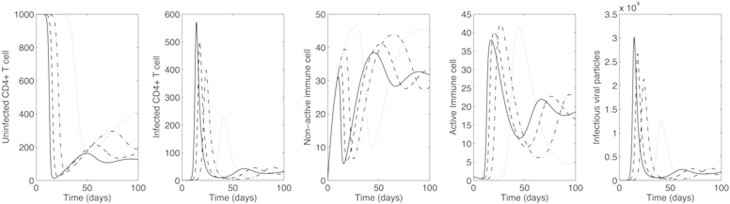
Figure 1 illustrates the HIV dynamics of a patient at an initial stage of infection with no drug treatment under four distinct values of
β. It is assumed the patient has a normal count of CD4
+ T-cells around 1000 cells per unit volume at the beginning. As we can see in the last panel of
Figure 1, it is typical to observe the viral particles reaches the peak at around between day 20 and 40, then, they decrease and remain low for the rest of the simulation time duration. Also, it is clear that as greater the value of
β, greater the average of infected CD4 T cells and viral particles. Also, the peak timing of infected CD4 T cells and viral particles occurs earlier as the value of
β gets larger.
Once the entrance of virus is perceived, the organism responds by activating immune response cells that fight against the virus as shown in the two middle panels of
Figure 1. As the dynamics of the infection is explored using four distinct values of
β, each one of results show different levels of intensity for active and inactive immune responses to help reduce infected virus cells. Next,
Figure 2 displays the dynamics of infection of a patient at an initial stage of infection when
R0 < 1. Reduction in
β (below a certain thresh hold number) leads to the reduction on the initial outbreak of infection. Therefore, when
R0 < 1, infection would not establish in the body (the number of infected virus goes to zero shown in the last panel of
Figure 2). More extensive and rigorous mathematical analysis and numerical simulations will be needed for clarifying the impact of active and inactive immune responses on the HIV dynamics.
Discussion
A primary focus of this paper has been on mathematical modeling of the HIV infection dynamics within a host in the presence of both active and inactive immune responses. The present study reviewed the previous mathematical models from the simple to the model with immune responses. We propose a new model, which is a natural extension of the existing model by taking account the immune response that should remain always in the body.
More rigorous mathematical analysis should be and will be done in our future research. An initial stage of the HIV dynamics is taken as a numerical example. When one is at an advanced stage of the disease, the HIV dynamics would be different from what we have shown in this study. Therefore, various scenarios will be further need to be investigated.
This work can suggest that more successful strategies to control HIV infection when the immune system is more efficient in eliminating infected cells. If the immune system is efficient (strong immune response), then it is possible to maintain the effectiveness of treatment for a longer time and at lower. Such strategies should contribute to build effective immune memory against the virus, and hence reduction of treatment costs and the side effects associated with the patient on multiple HIV therapies. The further study, which involves optimal drug interventions, will be carried out in our future research. It is certainly known that HIV dynamics is more complicated than the one reflected by this given model but the findings in this paper exhibit the different possibilities and approaches of using mathematical modeling and numerical simulations in order to achieve new insights in more effective drug treatments.
This result is important from the physiological point of view due to the fact that it ensures our mathematical model is biologically relevant. The positive invariance guarantees none of the populations, within the model, either goes below zero or growth without a limit. In other words, it assures that all populations are nonnegative and finite at every time t.
The proofs of the above propositions and rigorous mathematical analysis will be given in our future research.
All authors declare no conflicts of interest.