

| Heejoon Kim | 1 Article |
Objectives
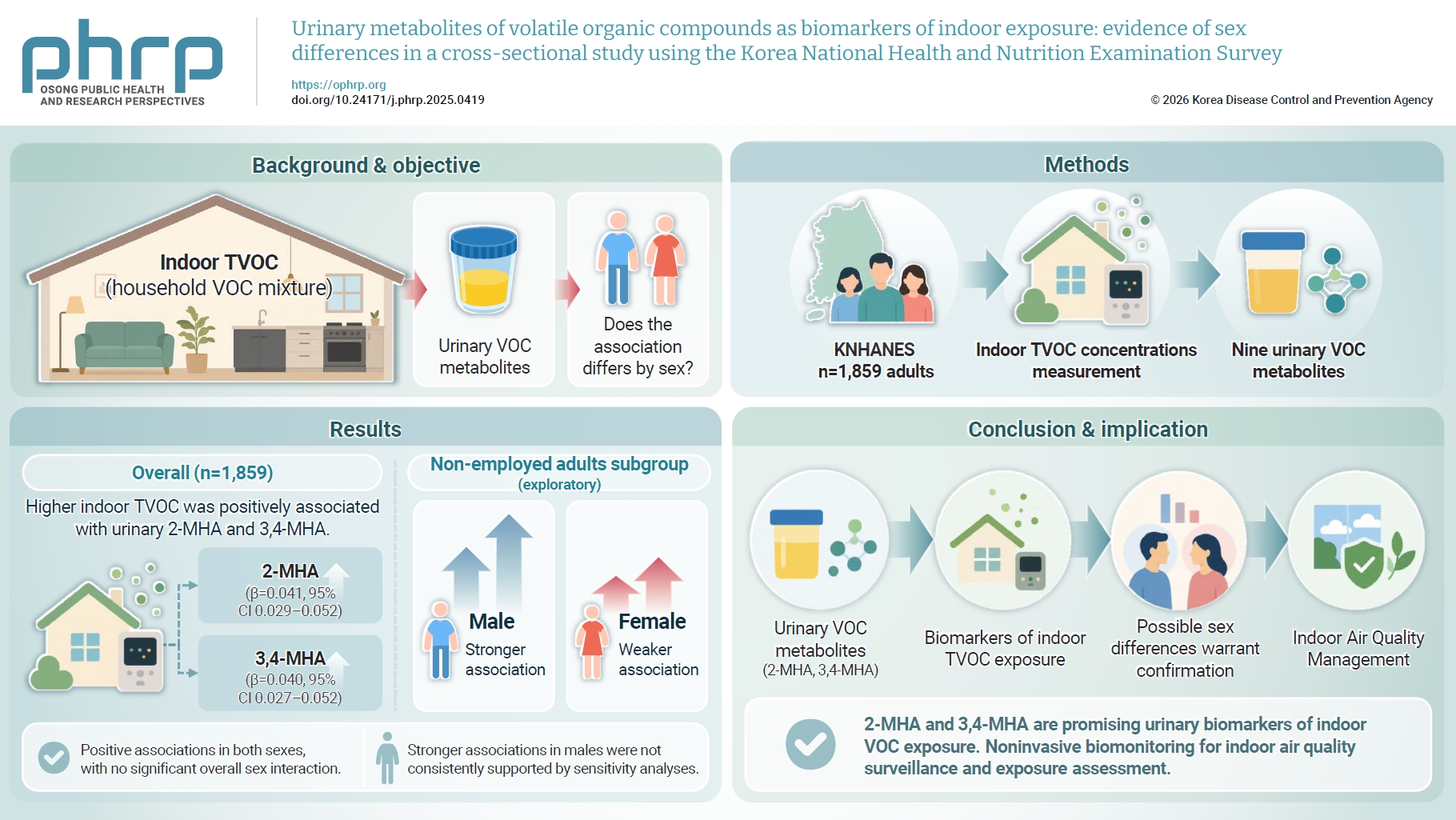
This study examined associations between indoor total volatile organic compound (TVOC) concentrations and urinary volatile organic compound (VOC) metabolites in Korean adults, focusing on potential sex-specific differences. We hypothesized that higher indoor TVOC exposure would be associated with higher urinary VOC metabolite concentrations and that these associations would differ by sex. Methods: We conducted a cross-sectional analysis of the 2020–2021 Korea National Health and Nutrition Examination Survey, which included the Republic of Korea’s first population-based indoor air quality survey. The analysis included 1,859 adults aged ≥19 years who participated in the indoor air quality survey from July 2020 to August 2021. Indoor TVOC concentrations (μg/m³) were measured using standardized protocols. Nine urinary VOC metabolites were quantified, creatinine-adjusted, and log-transformed. Multivariable linear regression with sex-stratified, exploratory subgroup (non-employed adults), and sensitivity analyses was performed. Results: Indoor TVOC concentrations were positively associated with urinary 2-methylhippuric acid (2-MHA; β= 0.041; 95% confidence interval [CI], 0.029–0.052) and 3- and 4-methylhippuric acid (3,4-MHA; β= 0.040; 95% CI, 0.027–0.052) in both sexes (p for interaction = 0.990 and 0.728), and these associations were robust to sensitivity analyses. Among non-employed adults, estimates were larger in males (2-MHA, β = 0.110 vs. 0.024; 3,4-MHA, β = 0.130 vs. 0.031; p for interaction = 0.016 and 0.008), but this interaction was inconsistent across sensitivity analyses. Conclusion: Urinary 2-MHA and 3,4-MHA may serve as biomarkers of indoor VOC exposure in both sexes; a possible sex difference among non-employed adults was inconsistent across sensitivity analyses and requires confirmation.
|
|


