

| Saerom Kim | 2 Articles |
Objectives
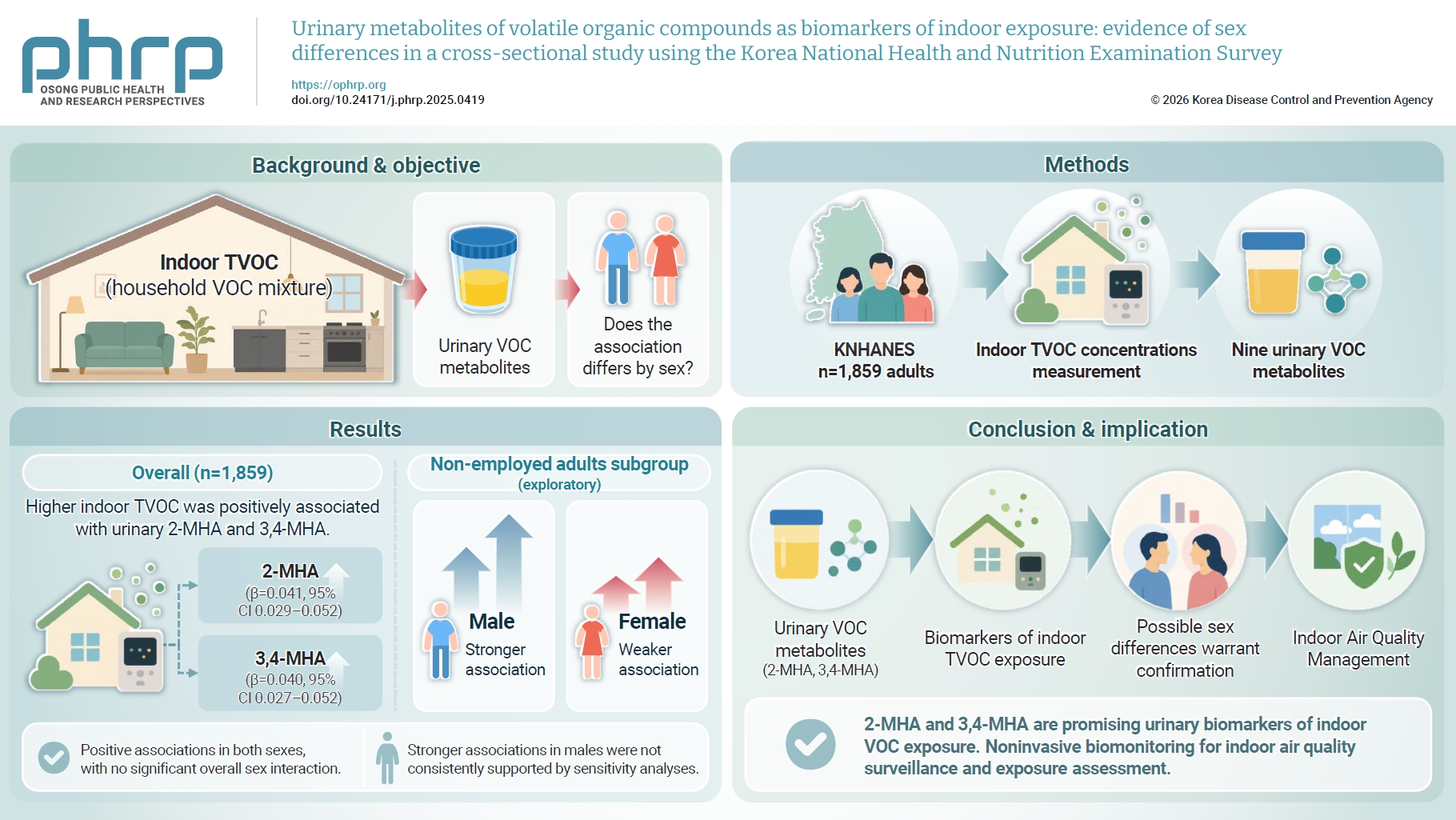
This study examined associations between indoor total volatile organic compound (TVOC) concentrations and urinary volatile organic compound (VOC) metabolites in Korean adults, focusing on potential sex-specific differences. We hypothesized that higher indoor TVOC exposure would be associated with higher urinary VOC metabolite concentrations and that these associations would differ by sex. Methods: We conducted a cross-sectional analysis of the 2020–2021 Korea National Health and Nutrition Examination Survey, which included the Republic of Korea’s first population-based indoor air quality survey. The analysis included 1,859 adults aged ≥19 years who participated in the indoor air quality survey from July 2020 to August 2021. Indoor TVOC concentrations (μg/m³) were measured using standardized protocols. Nine urinary VOC metabolites were quantified, creatinine-adjusted, and log-transformed. Multivariable linear regression with sex-stratified, exploratory subgroup (non-employed adults), and sensitivity analyses was performed. Results: Indoor TVOC concentrations were positively associated with urinary 2-methylhippuric acid (2-MHA; β= 0.041; 95% confidence interval [CI], 0.029–0.052) and 3- and 4-methylhippuric acid (3,4-MHA; β= 0.040; 95% CI, 0.027–0.052) in both sexes (p for interaction = 0.990 and 0.728), and these associations were robust to sensitivity analyses. Among non-employed adults, estimates were larger in males (2-MHA, β = 0.110 vs. 0.024; 3,4-MHA, β = 0.130 vs. 0.031; p for interaction = 0.016 and 0.008), but this interaction was inconsistent across sensitivity analyses. Conclusion: Urinary 2-MHA and 3,4-MHA may serve as biomarkers of indoor VOC exposure in both sexes; a possible sex difference among non-employed adults was inconsistent across sensitivity analyses and requires confirmation.

Objectives
This study aimed to examine the correlations between the regional characteristics of counties in Gangwon Province, Republic of Korea and the ratio of intracounty to extracounty sources of coronavirus disease 2019 (COVID-19) infection. Methods The region of the infectious contact was analysed for each COVID-19 case reported in Gangwon Province between February 22, 2020 and February 7, 2022. The population, population density, area, the proportion of urban residents, the proportion of older adults (>65 years), financial independence, and the number of adjacent counties were assessed for each of the 18 counties in Gangwon Province. Correlation coefficients between regional characteristics and the ratio of intracounty to extracounty infections were calculated. Results In total, 19,645 cases were included in this study. The population, population density, proportion of older adults, and proportion of urban residents were significantly correlated with the ratio of intracounty to extracounty infections. A stratified analysis with an age cut-point of 65 years showed that the proportion of older adults had a significant negative correlation with the ratio of intracounty to extracounty infections. In other words, the proportions of extracounty infections were higher in countries with higher proportions of older adults. Conclusion Regions with ageing populations should carefully observe trends in infectious disease outbreaks in other regions to prevent possible transmission. Citations
Citations to this article as recorded by

|
|


