Determinants of childhood immunization coverage in Somalia: evidence from the Somalia Demographic and Health Survey 2020 Sharmake Gaiye Bashir, Yakub Burhan Abdullahi, Yusuf Hared Abdi, Hiba Abdi Salad, Mohamed Sharif Abdi, Naima Ibrahim Ahmed, Nuradin Abdullahi Sheikh Rashid, Obasanjo Bolarinwa, Ahmed Abdinasir Abdulle Archives of Public Health.2026;[Epub] CrossRef
Objectives This systematic review describes the effectiveness of virtual reality (VR)-supported exercise therapy on upper limb motor function and activities of daily living after stroke. Methods: Studies published through January 24, 2022, were identified using CINAHL, Cochrane Library, Embase, Medline, and Web of Science. Randomized control trials comparing VR treatment with conventional therapy (CT) for upper extremity rehabilitation after stroke were included. Methodological quality was assessed using the Cochrane risk-of-bias tool. Results: Of 9 included studies, 5 concluded that the VR group outperformed control participants, 1 indicated the superiority of VR-supported exercises alone over CT, and 3 found VR comparable to CT in promoting upper limb motor function. Five studies analyzed independence in daily living, with 4 reporting no significant difference between VR and CT groups. No strong evidence indicated long-term benefits of VR-assisted exercise. All included studies demonstrated low risk of bias concerning random sequence generation, allocation concealment, outcome assessment blinding, incomplete outcome data, and selective reporting bias. However, a high risk of bias was observed regarding participant blinding due to the nature of the intervention. Conclusion: Most studies suggested that VR, used alongside CT, can improve motor function following stroke. However, the evidence was insufficient to conclude that VR outperforms conventional approaches.
Citations
Citations to this article as recorded by
Challenges and Benefits of Virtual Reality in Home-Based Poststroke Rehabilitation: Co-Design Qualitative Study Trust Saidi, Ann Marie Hestetun-Mandrup, Nenad Pavel, Ingvild Kristina Hurum Rosseland, Kathinka Granum Selmer-Olsen, Nora Synnøve Mørk, Åse Bergheim, Minna Annika Pikkarainen JMIR Human Factors.2026; 13: e78798. CrossRef
Neural correlates of virtual hand movements using ecologically valid tasks Silvia Erika Kober, Lisa Maria Berger, Daniela Kern, Guilherme Wood, Petra Schwingenschuh Frontiers in Virtual Reality.2026;[Epub] CrossRef
Artificial Intelligence in Stroke Rehabilitation: A 20‐Year Bibliometric Analysis of Digital Health Trends and Technologies Yuhua Li, Weixi Liu, Xiaomei Yuan Brain and Behavior.2026;[Epub] CrossRef
Promoting adapted physical activity through immersive virtual reality: a feasibility study in community organizations Aurélien Ramos, Sarah-Maude Ruest, Roxanne Périnet-Lacroix, Julien Marceaux, Keith Beaudoin, Danielle Levac, Martin Lemay, Marika Demers, Hubert D. Gascon, Martine Bordeleau, Krista L. Best, Maxime T. Robert Journal of Developmental and Physical Disabilities.2026;[Epub] CrossRef
Kinesiotherapy in medical rehabilitation and prevention of non-communicable diseases: the role of biofeedback, neuroplasticity, virtual reality and exoskeletons K. Korbel, A. Chalupka-Borowska, B. Depczyńska, A. Madziewicz, A. Bilska, A. Bartkowiak-Graczyk Fizjoterapia Polska.2026; 26(2/2026): 59. CrossRef
Advances in hemiplegia rehabilitation: modern therapeutic interventions to enhance activities of daily living Jing Xiong, Jin-Tian Wang, Shu Lin, Bao-Yuan Xie Frontiers in Neurology.2025;[Epub] CrossRef
Effect of virtual reality-based upper limb training on activity of daily living and quality of life among stroke survivors: a systematic review and meta-analysis Diriba Dereje Olana, Teklu Gemechu Abessa, Dheeraj Lamba, Lisa Tedesco Triccas, Bruno Bonnechere Journal of NeuroEngineering and Rehabilitation.2025;[Epub] CrossRef
Research on upper limb motor function evaluation and rehabilitation training system of stroke patients based on artificial intelligence: A usability and feasibility study from therapist and patient perspectives Qiurong Xie, Qi Zhang, Yanxin Zhang, Bo Sheng, Xiaoling Wang, Jia Luo, Jia Huang DIGITAL HEALTH.2025;[Epub] CrossRef
Efficacy of a Virtual Reality Rehabilitation Protocol Based on Art Therapy in Patients with Stroke: A Single-Blind Randomized Controlled Trial Gaetano Tieri, Marco Iosa, Antonio Fortini, Federica Aghilarre, Federico Gentili, Cristiano Rubeca, Tommaso Mastropietro, Gabriella Antonucci, Roberto De Giorgi Brain Sciences.2024; 14(9): 863. CrossRef
Elevating patient experience: Transformative strategies in hand therapy Jean Paul Brutus, Bianieff Tchiloemba, Anna Galstyan, Tom Lattré, Aviva Wolff, Alison Taylor Hand Surgery and Rehabilitation.2024; 43(5): 101764. CrossRef
Objectives The aim of this study was to investigate the relationship between the number of patient comorbidities and the delays in seeking treatment for coronary heart disease (CHD). Methods: This longitudinal study utilized secondary data from the Non-Communicable Disease Risk Factor (NCDRF) cohort study conducted in Bogor City. Individuals who participated in the NCDRF cohort study and were diagnosed with CHD within the 6-year study period met the inclusion criteria. Respondents who were not continuously monitored up to the 6th year were excluded. The final sample included data from respondents with CHD who participated in the NCDRF cohort study and were monitored for the full 6-year duration. The final logistic regression analysis was conducted on data collected from 812 participants. Results: Among the participants with CHD, 702 out of 812 exhibited a delay in seeking treatment. The risk of a delay in seeking treatment was significantly higher among individuals without comorbidities, with an odds ratio (OR) of 3.5 (95% confidence interval [CI], 1.735–7.036; p<0.001). Among those with a single comorbidity, the risk of delay in seeking treatment was still notable (OR, 2.6; 95% CI, 1.259–5.418; p=0.010) when compared to those with 2 or more comorbidities. These odds were adjusted for age, sex, education level, and health insurance status. Conclusion: The proportion of patients with CHD who delayed seeking treatment was high, particularly among individuals with no comorbidities. Low levels of comorbidity also appeared to correlate with a greater tendency to delay in seeking treatment.
Citations
Citations to this article as recorded by
Role of common mental disorders in uncontrolled hypertension: a longitudinal study in Bogor City, Indonesia Tri Wurisastuti, Indri Yunita Suryaputri, Rofingatul Mubasyiroh, Wahyu Pudji Nugraheni Korean Journal of Family Medicine.2026; 47(1): 81. CrossRef
2026 Heart Disease and Stroke Statistics: A Report of US and Global Data From the American Heart Association Latha P. Palaniappan, Norrina B. Allen, Zaid I. Almarzooq, Cheryl A.M. Anderson, Pankaj Arora, Christy L. Avery, Carissa M. Baker-Smith, Nisha Bansal, Maria E. Currie, Rebecca S. Earlie, Wenjun Fan, Jessica L. Fetterman, Bethany Barone Gibbs, Debra G. Hea Circulation.2026;[Epub] CrossRef
Blood Glucose Variability and Postoperative Organ Function in Coronary Artery Bypass Grafting: A Prospective Cohort Study of Microcirculatory Perfusion and Oxygenation Arif Mansjoer, Idrus Alwi, Em Yunir, Dita Aditianingsih, Kuntjoro Harimurti, Alida Roswita Harahap, Dudy Arman Hanafy, Taufik Indrajaya, Suhendro Suwarto Journal of Cardiothoracic and Vascular Anesthesia.2026; 40(11): 3648. CrossRef
Adherence to Inhalation Therapy Among COPD Patients: A Cross-Sectional Study in a Tertiary Hospital in Quito, Ecuador Juan Izquierdo-Condoy, Fernando Gualpa Álvarez, Estefania Morales-Lapo, Washington Arias Calvache, Jessica Bermúdez Moreira, Katherine Quinga-Chiguano, Esteban Ortiz-Prado International Journal of Chronic Obstructive Pulmo.2025; Volume 20: 399. CrossRef
Prevalence of Electrocardiographic Abnormalities in Patients with Acute Pulmonary Embolism: A Systematic Review and Meta-Analysis Sarunsorn Krintratun, Wuttipong Srichuachom, Wachira Wongtanasarasin Journal of Clinical Medicine.2025; 14(13): 4750. CrossRef
Prevalence and Factors Related to Pre-Hospital Delay in Young Patients with ST-Elevation of Myocardial Infarction (STEMI) Nooraniza Mohd Kassim, Rosna Abdul Raman, Soh Kim Lam Malaysian Journal of Medicine and Health Sciences.2025;[Epub] CrossRef
Gustavo Vital de Mendonça, Crispim Cerutti Junior, Alfredo Carlos Rodrigues Feitosa, Brígida Franco Sampaio de Mendonça, Lucia Helena Sagrillo Pimassoni
Osong Public Health Res Perspect 2024;15(3):212-220. Published online June 27, 2024
Objectives The objective of this study was to examine the hypothesis that periodontal disease is associated with chronic non-communicable diseases. Methods: In this cross-sectional study, we evaluated the periodontal health condition of the population, based on the community periodontal index, as well as the number of missing teeth and the presence of systemic health conditions. We quantified the association between oral health and the presence of chronic diseases using simple logistic regression, adjusting for confounding factors including age, smoking, and overweight. Results: The study population consisted of 334 volunteers, aged between 19 and 81 years. In patients over 45 years old, periodontal disease was found to be significantly associated with hypertension and diabetes. Furthermore, in female patients, periodontal disease was significantly associated with hypertension, diabetes, and cancer. Conclusion: Our findings indicate that periodontal disease is positively and significantly associated with both arterial hypertension and diabetes, independent of potential confounding factors.
Citations
Citations to this article as recorded by
Comparative Antimicrobial and Antibiofilm Activity of Antiseptics and Commercial Mouthwashes Against Porphyromonas gingivalis ATCC 33277 Marzena Korbecka-Paczkowska, Tomasz M. Karpiński, Marcin Ożarowski Journal of Clinical Medicine.2025; 14(24): 8909. CrossRef
Objectives This study investigated the association between living arrangements and healthrelated quality of life (HRQoL) in older people. Methods: A secondary analysis was conducted of 6,153 participants (aged ≥60 years) from the seventh Korean National Health and Nutrition Examination Survey (2016 to 2018). HRQoL was measured using the 3-level version of the EuroQol 5-dimensional questionnaire. The chi-square test, t-test, and multiple regression were used, applying sampling weights for the analysis. Results: The proportion of respondents living alone was 18.0%, with a higher prevalence among women and older age groups (p<0.001). The overall HRQoL was lower in groups living alone than in groups living with others (p<0.001). Older people living alone showed higher impairments in all dimensions of the 3-level version of the European Quality of Life 5-Dimensional Questionnaire (EQ-5D-3L) than those living with others, including mobility (p<0.001), self-care (p<0.001), usual activities (p<0.001), pain/discomfort (p<0.001), and depression/anxiety (p<0.001). Problems with mobility were most prevalent (42.8%), followed by pain/ discomfort (41.9%) in respondents living alone. Living alone was significantly associated with a lower HRQoL index score (b=–0.048, p<0.001) after adjusting for age, gender, education, exercise, perceived stress, and perceived health status. Conclusion: Living alone was negatively associated with HRQoL. Based on this study, future care planning for older people should consider their living arrangements. The need to strengthen and expand care programs targeting those living alone should also be addressed.
Citations
Citations to this article as recorded by
Quality of life in later years: A comprehensive review of elderly well-being in India Sandhya Bharathi Shanmugasundaram, Pitchaimani Govindharaj, Srihari Ramamoorthy, Vijayalakshmi Purusothaman International Journal of Noncommunicable Diseases.2026; 11(2): 82. CrossRef
Factors Related to Quality of Life Among Older Adults with Family Care Vulnerability in Semi-Urban Areas of Thailand Arun Boonsang, Laksanee Boonkhao, Nittaya Chakhamrun, Aree Butsorn, Sanga Tubtimhin, Pongsak Rattanachaikunsopon, Sanguansin Ratanalert Journal of Multidisciplinary Healthcare.2026; Volume 19: 1. CrossRef
Occupational Balance, Quality of Life, and Recovery Among Older Mental Health Service Users—A Cross-Sectional Study Carina Tordai, Steven M. Schmidt, Elisabeth Argentzell, Mona Eklund Occupational Therapy In Health Care.2026; : 1. CrossRef
Association between health-related quality of life and noncommunicable diseases in South Korea Seungjae Byun, Kyeongeun Kim, Min Seong Kim, Guillaume Fond, Laurent Boyer, Guillermo F. López Sánchez, Jiseung Kang, Dong Keon Yon Medicine.2026; 105(37): e50564. CrossRef
Preventing depression in older adults with chronic illnesses through the SMART Elderly Program: a quasi-experimental study in Central Thailand Phongsakorn Toopboochakorn, Nanthawan Nilpayak, Phornphimon Hotarat, Wanida Jaroensuk, Phannathat Tanthanapanyakorn Korean Journal of Family Medicine.2026; 47(5): 405. CrossRef
Convergent validity, reliability and responsiveness of the AP-7D and EQ-5D-5L based on the survey for the general people in five countries: a new cultural-specific preference-based measure developed in east and southeast asia Yuta Suzuki, Takeru Shiroiwa, Tatsunori Murata, Emi Kamono, Yasuhiro Morii, Takashi Fukuda Health and Quality of Life Outcomes.2025;[Epub] CrossRef
Objectives Post-coronavirus disease 2019 (COVID-19) symptoms were widely reported. However, data on post-COVID-19 conditions following infection with the Omicron variant remained scarce. This prospective study was conducted to understand the prevalence, patterns, and duration of symptoms in patients who had recovered from COVID-19. Methods: A prospective study was conducted across 11 districts of Delhi, India, among individuals who had recovered from COVID-19. Study participants were enrolled, and then returned for post-recovery follow-up at 3 months and 6 months interval. Results: The mean age of study participants was 42.07 years, with a standard deviation of 14.89 years. The majority of the participants (79.7%) reported experiencing post-COVID-19 symptoms. The most common symptoms included joint pain (36.0%), persistent dry cough (35.7%), anxiety (28.4%), and shortness of breath (27.1%). Other symptoms were persistent fatigue (21.6%), persistent headache (20.0%), forgetfulness (19.7%), and limb weakness (18.6%). The longest duration of symptom was observed to be anxiety (138.75±54.14 days), followed by fatigue (137.57±48.33 days), shortness of breath (131.89±60.21 days), and joint pain/swelling (131.59±58.76 days). At the first follow-up visit, 2.2% of participants presented with abnormal electrocardiogram readings, but no abnormalities were noticed during the second follow-up. Additionally, 4.06% of participants exhibited abnormal chest X-ray findings at the first followup, which decreased to 2.16% by the second visit. Conclusion: The most frequently reported post-COVID-19 symptoms were joint pain, dry cough, anxiety and shortness of breath. These clinical symptoms persisted for up to 6 months, with evidence of multi-system involvement. Consequently, findings highlighted the need for long-term follow-up during the post-COVID-19 period.
Citations
Citations to this article as recorded by
Prevalence of post-COVID symptoms across variants of concern and follow-up periods: A systematic review and meta-analysis Eiron John Lugtu, Delfin Ynigo Pilapil IV, Mikhail Harvey Cabunoc, Joshua Lawrence Bautista, Francis Matthew Pleta, Jeremy Ace Ng, Farid Shahid, Timothy Hudson David Culasino Carandang, Giuseppe Lippi, Brandon Michael Henry, César Fernández-de-las-Peñas, International Journal of Infectious Diseases.2026; 166: 108522. CrossRef
Factors involved in the improvement of prolonged symptoms in patients with COVID-19 treated with Japanese traditional (Kampo) medicine: A single-center, prospective, observational study Tsuyoshi Kawamura, Junko Kohno, Akiko Kikuchi, Ryutaro Arita, Shin Takayama, Tadashi Ishii Medicine.2026; 105(12): e48084. CrossRef
Post-COVID syndrome in Pakistan, India, and Bangladesh: a systematic narrative review of epidemiology, clinical manifestations, and healthcare system responses Amani S. Alrossies Frontiers in Public Health.2026;[Epub] CrossRef
Post-COVID-19 Manifestation Persistence and Its Resolution: A Prospective Comparative Study From Hazaribagh, Jharkhand, India Iqbal Farooqui, Mithilesh Kumar Cureus.2026;[Epub] CrossRef
Quality of life post-COVID recovery: A prospective observational study, North India Amod Laxmikant Borle, Mongjam Meghachandra Singh, Gurmeet Singh, Nidhi Bhatnagar, Shivani Rao, Tanya Singh, Binita Goswami, Sarika Singh, Sumeet Singla, Tanu Anand The Indian Journal of Medical Research.2025; 161: 722. CrossRef
Prevalence and pattern of post COVID-19 health problems among adults attending post COVID-19 clinics of selected tertiary care centres in Kolkata Uma Rani Adhikari, Manju Patra International Journal Of Community Medicine And Pu.2025; 12(10): 4443. CrossRef
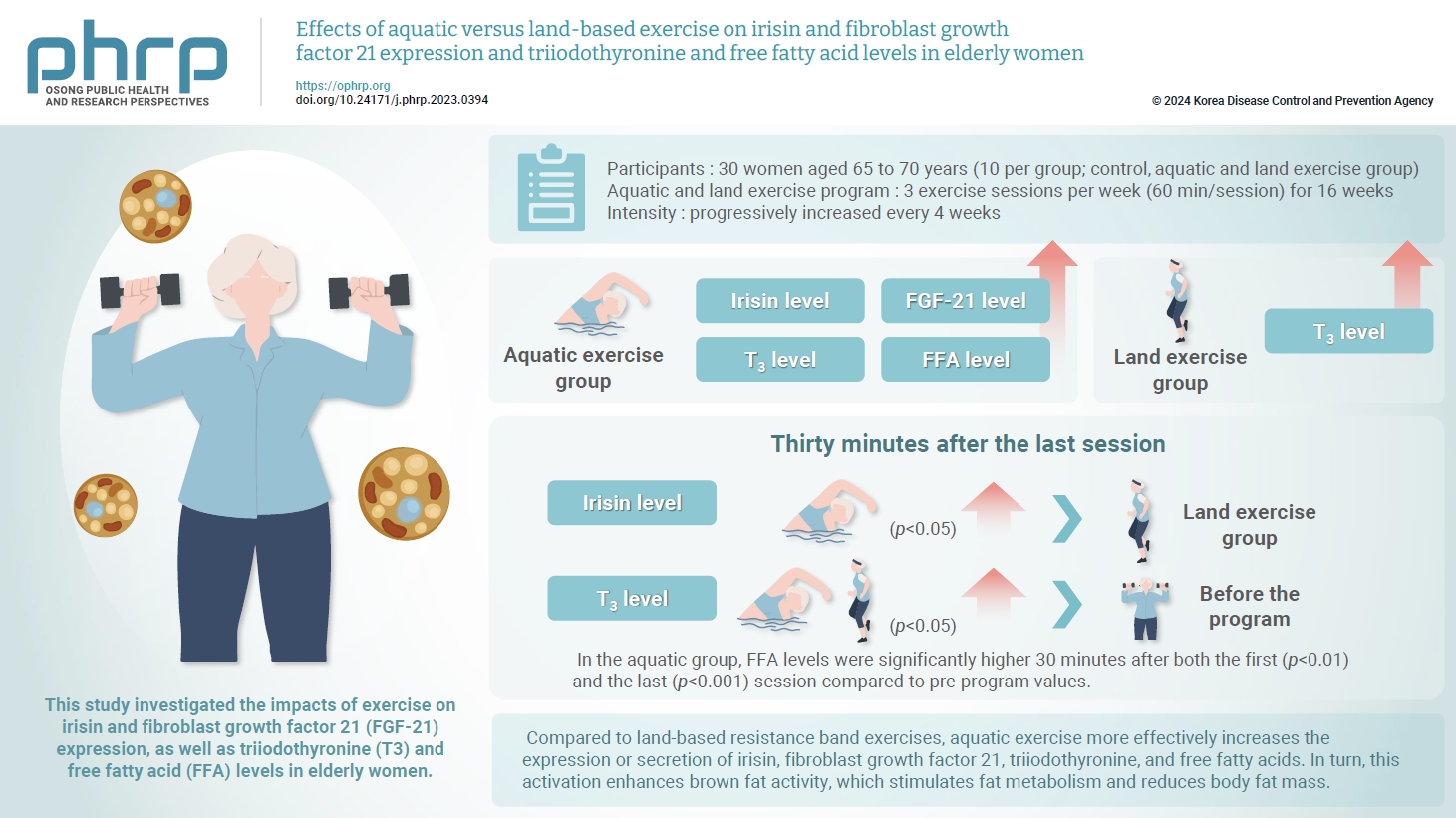
Objectives This study investigated the impacts of exercise on irisin and fibroblast growth factor 21 (FGF-21) expression, as well as triiodothyronine (T3 ) and free fatty acid (FFA) levels in elderly women. Methods: Thirty women aged 65 to 70 years (10 per group) were randomly assigned to aquatic exercise, land exercise, and control groups. The aquatic and land groups engaged in 3 exercise sessions per week (60 min/session) for 16 weeks. The intensity was progressively increased every 4 weeks. Results: Irisin and FGF-21 levels significantly increased in the aquatic exercise group. In the posttest, the aquatic exercise group had the highest irisin levels. Significant findings were observed for irisin and FGF-21 for the main effect between aquatic and band exercise groups (p<0.05 for both), the main effect between measurement times (p<0.01 and p<0.001, respectively), and the interaction effect (p<0.05 and p<0.001, respectively). The irisin level was significantly higher in the aquatic than in the land group 30 minutes after the last session (p<0.05). In both exercise groups, T3 levels were significantly higher 30 minutes after the final session (p<0.05) than before the program. The FFA level was significantly higher in the aquatic exercise group than the others. In the aquatic group, FFA levels were significantly higher 30 minutes after both the first (p<0.01) and the last (p<0.001) session compared to pre-program values. Conclusion: Differences in exercise type and environment can promote fat metabolism by stimulating hormonal changes that induce brown fat activity and browning.
Citations
Citations to this article as recorded by
Effects of aquatic exercise on improving body composition and muscle strength in the older adults: a systematic review and meta-analysis of randomized controlled trials Yuan Gao, Wenze Deng, Qiancheng Zeng, Yichen Liu, Xiaofu Tang, Sitian Fang, Liang Hao, Hongbo Li Frontiers in Public Health.2026;[Epub] CrossRef
Effects of Different Training Modalities on Circulating Irisin Levels in Overweight and Obesity Adults: A Systematic Review and Meta-analysis of Randomized Controlled Trials Keyvan Hejazi, Gholam Rasul Mohammad Rahimi, Ayoub Saeidi, Khadija Ayed, Ismail Laher, Juan Del Coso, Anthony C. Hackney, Urs Granacher, Hassane Zouhal Sports Medicine.2026; 56(9): 2231. CrossRef
Exerkines in precision management of metabolic diseases Leigang Jin, Yifen Lin, Yixuan Zheng, Anli Wang, Peng Liao, Yucheng Luo, Zhongheng Sui, Xiayun Ni, Jianan Zhang, Qing Shen, Aimin Xu Chinese Medical Journal.2026;[Epub] CrossRef
Irisin: Its significance in the diagnosis and treatment of post-stroke depression Chengyan Han, Ruixue Guan, Jianxing Zhao, Peng Sun Journal of Psychiatric Research.2025; 191: 285. CrossRef
Objectives Between July 2, 2021, and September 20, 2022, a Mycobacterium bovis outbreak occurred among exhibition animals at a zoo in the Republic of Korea. This study was conducted to assess the likelihood of M. bovis transmission to human contacts through a contact investigation and to implement preventive treatment for latent tuberculosis infection (LTBI). Methods: In this descriptive study, the Korea Disease Control and Prevention Agency conducted a contact investigation, which included interviews, interferon-gamma release assay (IGRA) tests, and chest X-rays. Contacts underwent IGRA testing on 2 occasions: initial testing of 29 contacts (15 in the first cluster of infection and 14 in the second cluster) and follow-up testing of the 15 contacts in the first cluster. Results: The study included 29 participants, 18 of whom were male (62.1%) and 11 female (37.9%). The mean participant age was 37.3 years (standard deviation, 9.6 years). In the initial IGRA tests, 6 of the 29 participants tested positive, indicating a prevalence of 20.7%. Following prolonged exposure, 1 additional positive case was detected in follow-up testing, raising the prevalence of LTBI to 24.1%. None of the contacts had active tuberculosis. Among the 7 individuals with positive results, 2 (28.6%) underwent treatment for LTBI. Conclusion: This study faced challenges in confirming the transmission of M. bovis infection from infected animals to humans in the Republic of Korea. Nevertheless, adopting a One Health approach necessitates the implementation of surveillance systems and infection control protocols, particularly for occupational groups at high risk of exposure.
Citations
Citations to this article as recorded by
First Report of Mycobacterium bovis and Nocardia spp. Co-Infection in a Roan Antelope Luca Botta, Matteo Cuccato, Neva Cormio, Veronica Crocchianti, Maria Goria, Emanuelle Bergeron, Delphine Mouniée, Veronica Rodriguez Nava, Frine Eleonora Scaglione Animals.2026; 16(11): 1721. CrossRef
Prevalence and molecular characterization of enteric zoonotic pathogens in zoo-housed mammals in Korea Hyo-Min Woo, In Jung Jung, Beoul Kim, You-Jeong Lee, Jae-Woo Choi, Insu Choi, Garam Kim, Weon-Hwa Jheong, Byoungcheun Lee, Kyoo-Tae Kim, Min-Goo Seo One Health.2026; 23: 101568. CrossRef
Identification of zoonotic pathogens in zoo animals in the Republic of Korea Jinho Um, Jeongho Kim, Seok-Jin Cho, Min-ho Park, Hyung-Chul Cho, Yu-Jin Park, Kyoung-Seong Choi International Journal for Parasitology: Parasites .2025; 27: 101067. CrossRef
First report of human Mycobacterium bovis infection in a veterinary laboratory worker in the Republic of Korea Ji-Yeon Lee, Seong Wook Pyo, Jieun Kim, Young-Joon Park Osong Public Health and Research Perspectives.2025; 16(3): 292. CrossRef
Objectives We analyzed the correlation between the infectivity and transmissibility of the severe acute respiratory syndrome coronavirus 2 Omicron sublineages BA.1, BA. 2, BA.4, and BA.5. Methods: We assessed viral replication kinetics and infectivity at the cellular level. Nasopharyngeal and oropharyngeal specimens were obtained from patients with coronavirus disease 2019, confirmed using whole-genome sequencing to be caused by the Omicron sublineages BA.1, BA.2, BA.4, or BA.5. These specimens were used to infect Vero E6 cells, derived from monkey kidneys, for the purpose of viral isolation. Viral stocks were then passaged in Vero E6 cells at a multiplicity of infection of 0.01, and culture supernatants were harvested at 12-hour intervals for 72 hours. To evaluate viral replication kinetics, we determined the cycle threshold values of the supernatants using real-time reverse transcription polymerase chain reaction and converted these values to genome copy numbers. Results: The viral load was comparable between BA.2, BA.4, and BA.5, whereas BA.1 exhibited a lower value. The peak infectious load of BA.4 was approximately 3 times lower than that of BA.2 and BA.5, while the peak load of BA.2 and BA.5 was about 7 times higher than that of BA.1. Notably, BA.1 demonstrated the lowest infectivity over the entire study period. Conclusion: Our results suggest that the global BA.5 wave may have been amplified by the higher viral replication and infectivity of BA.5 compared to other Omicron sublineages. These analyses could support the rapid assessment of the impact of novel variants on case incidence.
Citations
Citations to this article as recorded by
최근 코로나바이러스감염증-19 변이 바이러스 유행 현황 및 세포기반의 오미크론 세부계통 KP.3 감염성 분석 정민 김, 진선 노, 동주 김, 지영 노, 채영 이, 상희 우, 남주 이, 지은 이, 일환 김, 은진 김 Public Health Weekly Report.2024; 17(39): 1671. CrossRef





 First
 Prev


