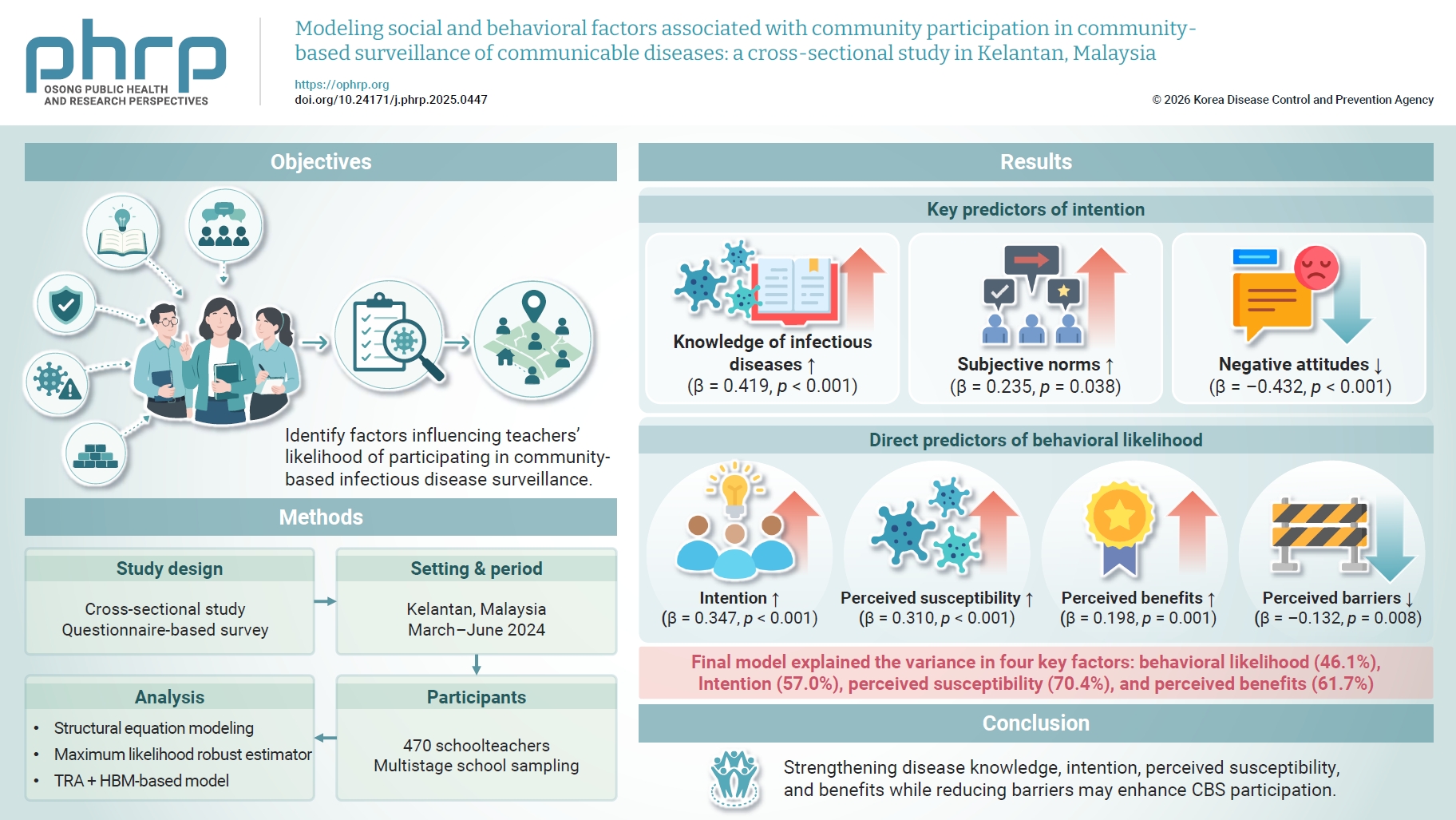
Objectives This study examined the social and behavioral factors influencing community leaders’ participation in community-based surveillance (CBS) of infectious diseases. We hypothesized that knowledge, attitudes, and perceptions significantly predict the behavioral likelihood of engaging in CBS activities. Methods: A cross-sectional study was conducted among 470 schoolteachers in Kelantan, Malaysia, from March to June 2024. Participants were selected using multistage sampling, with random selection of schools followed by convenience sampling of teachers. Data were collected using the validated KAP-CBS-ID questionnaire, which was based on the Theory of Reasoned Action and Health Belief Model. Structural equation modeling was used to analyze relationships among the study variables with the maximum likelihood robust estimator. Results: The final model demonstrated good fit (comparative fit index, 0.921; standardized root mean square residual, 0.071; root mean square error of approximation, 0.040 [90% confidence interval, 0.036–0.044]). Ten significant path relationships were identified, explaining 46.1% of the variance in behavioral likelihood. Knowledge of infectious diseases (β=0.419, p<0.001), subjective norms (β=0.235, p=0.038), and negative attitudes (β=–0.432, p<0.001) significantly influenced intention. Behavioral likelihood was directly predicted by intention (β =0.347, p<0.001), perceived susceptibility (β=0.310, p<0.001), perceived benefits (β=0.198, p=0.001), and perceived barriers (β=–0.132, p=0.008). Self-efficacy showed significant indirect effects through perceived benefits (β=0.785, p<0.001) and perceived susceptibility (β=0.765, p<0.001). Conclusion: Knowledge and psychosocial factors significantly inf luence community engagement in CBS of infectious diseases. Public health interventions should address these interconnected determinants to strengthen early disease detection and reporting systems.
Objectives
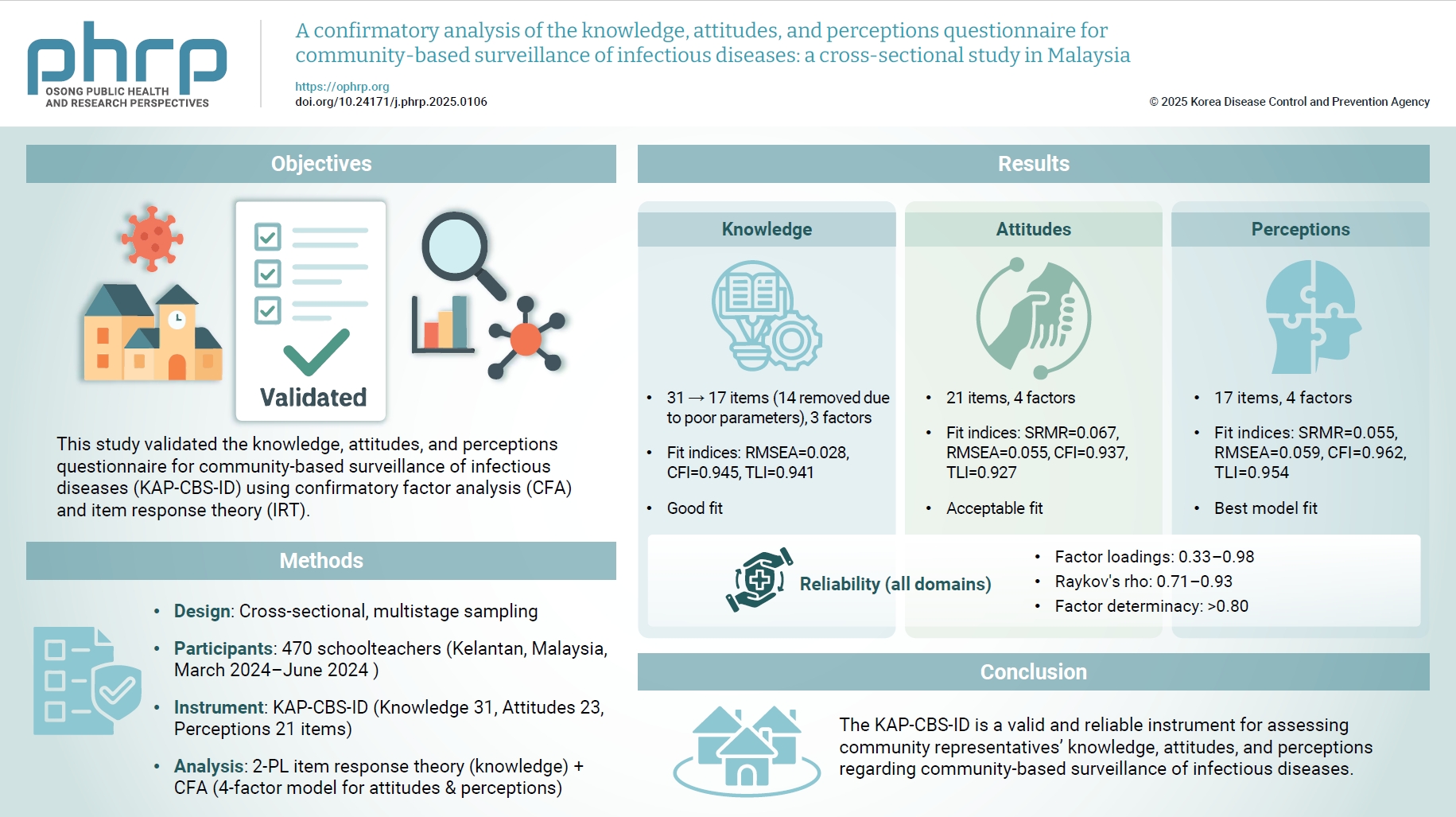
This study aimed to validate the psychometric properties of the recently developed knowledge, attitudes, and perceptions questionnaire for community-based surveillance of infectious diseases (KAP-CBS-ID questionnaire), using confirmatory factor analysis (CFA) and item response theory (IRT).
Methods
A cross-sectional study using multistage sampling recruited 470 schoolteachers from Kelantan, Malaysia. The self-administered KAP-CBS-ID questionnaire consists of 3 domains: knowledge (31 items), attitudes (23 items), and perceptions (21-items). Two-parameter logistic (2-PL) IRT analysis and CFA were performed to validate the knowledge section. For attitudes and perceptions sections, CFA proceeded using a 4-factor model to evaluate both model fit and construct validity.
Results
Two-PL IRT analysis of the knowledge section resulted in elimination of 14 items due to inadequate discrimination or difficulty parameters. The 3-factor CFA model demonstrated good fit indices for knowledge (root mean square error of approximation [RMSEA], 0.028; comparative fit index [CFI], 0.945; Tucker-Lewis index [TLI], 0.941) without any modifications. The attitudes section required re-specification, ultimately yielding 21 items across 4 factors with acceptable fit indices (standardized root mean square residual [SRMR], 0.067; RMSEA, 0.055; CFI, 0.937; TLI, 0.927). Similarly, the perceptions section was refined to 17 items across 4 factors, showing good model fit (SRMR, 0.055; RMSEA, 0.059; CFI, 0.962; TLI, 0.954). Factor loadings ranged from 0.33 to 0.98, while Raykov’s rho reliability estimates ranged from 0.71 to 0.93. Factor determinacy exceeded 80% for all factors.
Conclusion
The KAP-CBS-ID is a valid and reliable instrument for assessing community representatives’ knowledge, attitudes, and perceptions regarding community-based surveillance of infectious diseases.
Citations
Citations to this article as recorded by
Modeling social and behavioral factors associated with community participation in community-based surveillance of communicable diseases: a cross-sectional study in Kelantan, Malaysia Ahmed Azeez Hasan, Anis Kausar Ghazali, Norsa’adah Bachok, Najib Majdi Yaacob, Suhaily Mohd Hairon, Nur Amira Mohd Nadir, Fatimah Muhd Shukri Osong Public Health and Research Perspectives.2026; 17(3): 229. CrossRef



 First
 Prev


