Objectives Adherence to anti-tuberculosis treatment is essential for achieving successful outcomes and preventing the emergence of drug-resistant strains. This study aimed to evaluate adherence levels and identify factors associated with non-adherence among tuberculosis patients in the Béni Mellal-Khénifra region of Morocco. We hypothesized that sociodemographic, clinical, and behavioral factors influence adherence.
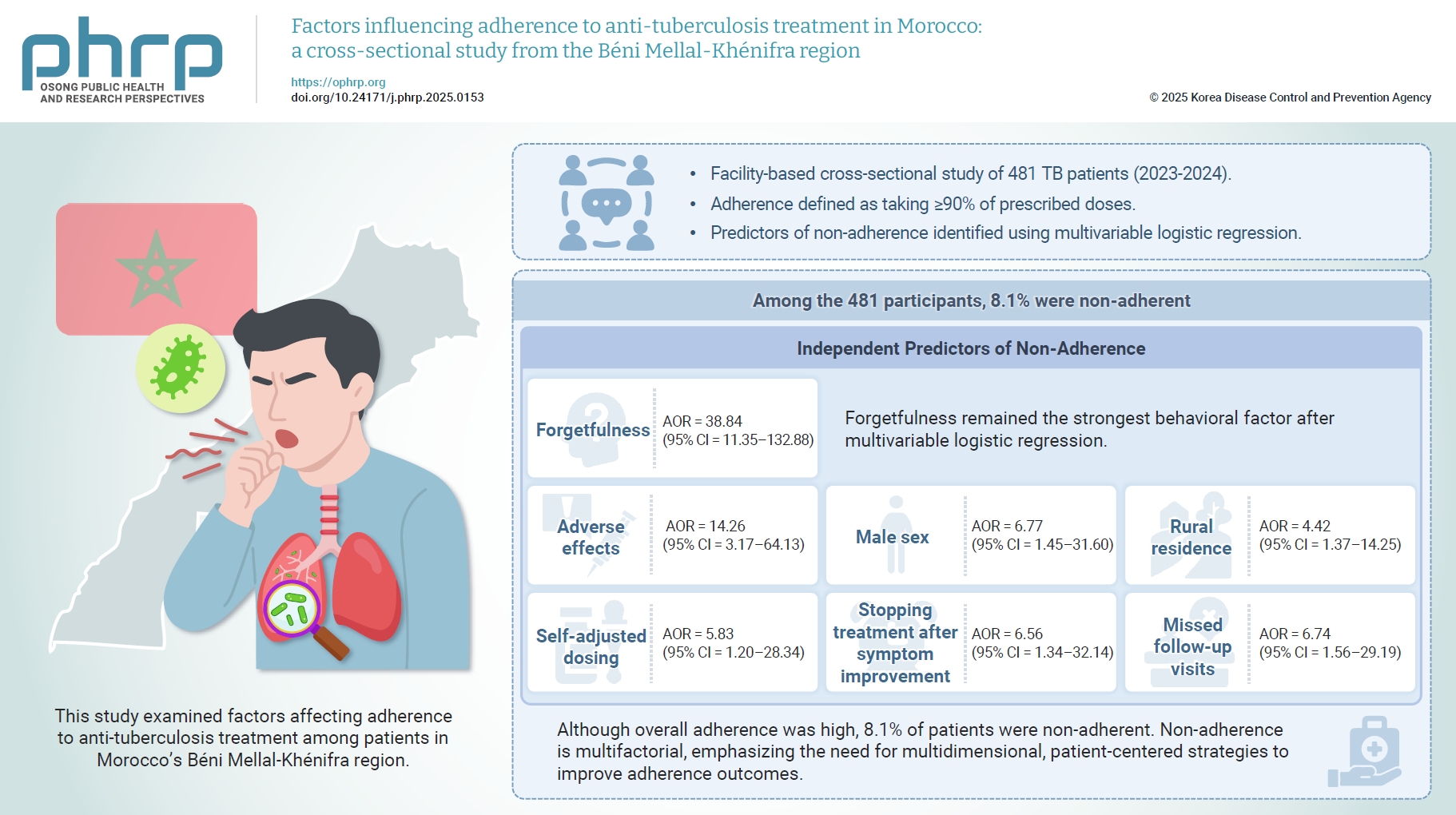
Methods A facility-based cross-sectional study was conducted from January 2023 to December 2024 in 2 Tuberculosis and Respiratory Disease Diagnostic Centers in the Béni Mellal-Khénifra region. A total of 481 patients who had been on treatment for at least 2 months were recruited using convenience sampling. Data were collected through structured, pre-tested questionnaires administered in face-to-face interviews and verified against treatment cards and medical records. Adherence was defined as taking ≥90% of prescribed doses. Multivariable logistic regression was used to identify independent predictors of non-adherence.
Results Among the 481 participants, 8.1% were non-adherent. Significant predictors of non-adherence included forgetfulness (adjusted odds ratio [AOR], 38.84; 95% confidence interval [CI], 11.35–132.88), adverse effects (AOR, 14.26; 95% CI, 3.17–64.13), male sex (AOR, 6.77; 95% CI, 1.45–31.60), rural residence (AOR, 4.42; 95% CI, 1.37–14.25), self-adjusted dosing (AOR, 5.83; 95% CI, 1.20–28.34), stopping treatment after symptom improvement (AOR, 6.56; 95% CI, 1.34–32.14), and missed follow-up visits (AOR, 6.74; 95% CI, 1.56–29.19).
Conclusion Although overall adherence was high, 8.1% of patients were non-adherent. Strategies to improve adherence should focus on addressing forgetfulness, managing side effects, enhancing access in rural areas, and reinforcing patient education and follow-up systems to improve treatment outcomes in this and similar settings.
Citations
Citations to this article as recorded by
Longitudinal Observation by Optical Coherence Tomography in Patients Treated with Ethambutol: A Systematic Review and Meta-Analysis Rui Luo, Jin Ma, Yong Zhong Journal of Clinical Medicine.2026; 15(3): 1230. CrossRef
Non-Adherence to Anti-Tuberculosis Treatment and Its Determinants Among Tuberculosis Patients in Tanzania Meshack Morice, Bernadetha Hugho Kimario, Indo Ndaigeze, Damas Dismas Nyabenda Journal of Community Health.2026; 51(4): 648. CrossRef



 First
 Prev


