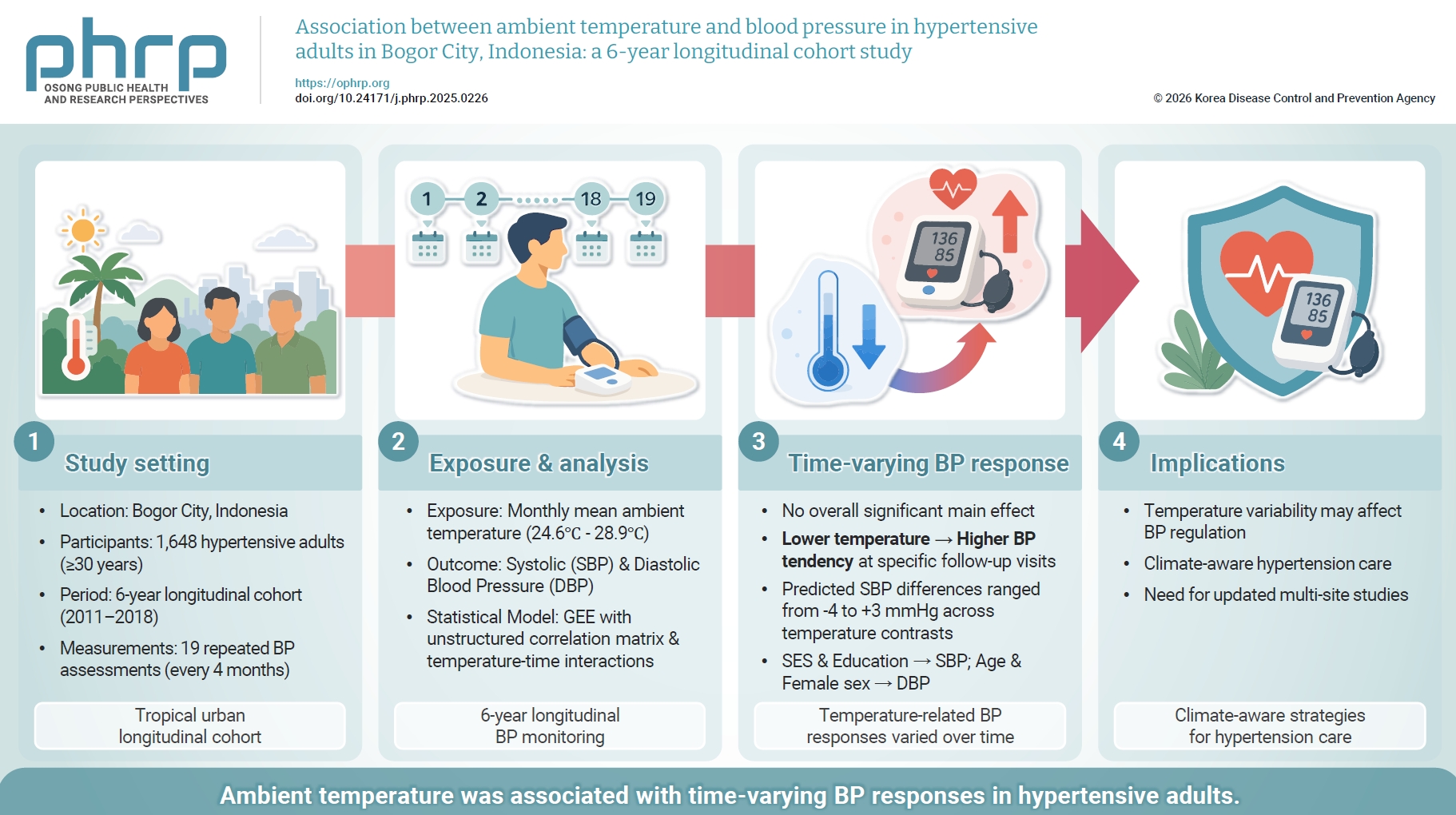
Objectives Climate variability, particularly ambient air temperature, is an emerging environmental determinant of blood pressure (BP); however, evidence from tropical lowand middle-income countries (LMICs) remains limited. We examined associations between monthly average ambient temperature with systolic BP (SBP) and diastolic BP (DBP) among adults in Bogor City, Indonesia. Methods: This longitudinal cohort analysis used secondary data collected between 2011 and 2018 from 1,648 participants with repeated BP measurements (19 assessments over 6 years). Average ambient temperature data were matched to the month of BP measurement. Generalized estimating equations models were used to assess the association between temperature and BP after adjustment for age, sex, education, and socioeconomic status. Results: Mean ambient temperature ranged from 24.6 °C to 28.9 °C. SBP varied more than DBP and tended to increase as ambient temperature decreased. The overall main effect of temperature on BP was not statistically significant. However, several visit-specific temperature–time interactions were negative and significant, suggesting inverse patterns between lower temperatures and higher SBP or DBP. Marginal effects plots demonstrated time-varying associations, with predicted SBP and DBP differences of approximately −4 to + 3 mmHg across follow-up visits at representative temperatures. Socioeconomic status and education were associated with SBP, whereas age and female sex were associated with DBP. Conclusion: Temperature variations were associated with time-varying BP changes among adults with hypertension in Bogor City during 2011–2018. Although the main temperature effect was non-significant, temperature–time interactions suggested modest inverse patterns within clinically plausible ranges. These findings support the need for updated, multi-site studies in tropical LMIC settings.
<sec>
<title>Objectives</title>
<p>This study aims to determine the prevalence, and associated factors of undiagnosed hypertension [Systolic Diastolic Hypertension (SDH), Isolated Systolic Hypertension (ISH) and Isolated Diastolic Hypertension (IDH)] in the Nepalese adult population.</p></sec>
<sec>
<title>Methods</title>
<p>Nepal Demographic and Health Survey 2016 data from adults (≥ 18 years) was used in this study. The final weighted sample size was 13,393. Blood pressure (BP) was measured 3 times and the average of the second and third measurement was reported. SDH (systolic BP (SBP) ≥ 140 mmHg and diastolic BP (DBP) ≥ 90 mmHg), ISH (SBP ≥ 140 mmHg and DBP < 90 mmHg), and IDH (SBP < 140 mmHg and DBP ≥ 90 mmHg) were measured. Multilevel logistic regression analyses were conducted to find the association between the independent variables and the covariates.</p></sec>
<sec>
<title>Results</title>
<p>The prevalence of SDH, IDH and ISH were 8.1%, 7.5%, and 3.3% respectively. The odds of having SDH and ISH increased with old age. However, the odds of having IDH decreased with increasing age. Females has lower odds of having SDH and IDH compared with male participants. Individuals that had been married, resided in Province 4 (<italic>p</italic> < 0.05) or 5 (<italic>p</italic> < 0.01) were statistically significantly associated with having IDH. Being overweight or obese was statistically significantly associated with all 3 HTN subtypes (<italic>p</italic> < 0.001).</p></sec>
<sec>
<title>Conclusion</title>
<p>The necessary steps should be taken so that public health promotion programs in Nepal may prevent and control undiagnosed hypertension.</p></sec>
Citations
Citations to this article as recorded by
Implications of the dissemination of healthy lifestyle advice for Afghan adults without histories of hypertension diagnosis or treatment Iftikhar Halimzai, Keiko Nakamura, Kaoruko Seino, Ayano Miyashita, Shafiqullah Hemat, Sharifullah Alemi, Sayed Ataullah Saeedzai Journal of Rural Medicine.2025; 20(2): 102. CrossRef
Global Prevalence of Isolated Systolic, Isolated Diastolic, and Systodiastolic Hypertension: A Systematic Review and Meta-Analysis Víctor Juan Vera-Ponce, Lupita Ana Maria Valladolid-Sandoval, Jhosmer Ballena-Caicedo, Fiorella E. Zuzunaga-Montoya Cardiovascular Medicine.2025; 28(1): 3. CrossRef
Hypertension subtypes at high altitude in Peru: Analysis of the Demographic and Family Health Survey 2016–2019 Brando Ortiz-Saavedra, Elizbet S. Montes-Madariaga, Oscar Moreno-Loaiza, Carlos J. Toro-Huamanchumo, Esteban Ortiz-Prado PLOS ONE.2024; 19(4): e0300457. CrossRef
Structural And Functional State Of Various Zones Of Skin Microcirculation In Men With Isolated Diastolic Hypertension Andrei I. Korolev, Andrei A. Fedorovich, Aleksander Yu. Gorshkov, Valida A. Dadaeva, Mikhail G. Chaschin, Anna V. Strelkova, Ksenia V. Omelyanenko, Maria A. Mikhailova, Oxana M. Drapkina Russian Open Medical Journal.2024;[Epub] CrossRef
Isolated diastolic hypertension and cardiovascular outcomes across different diagnostic guidelines: a systematic review and meta-analysis Abhimanyu Agarwal, Mohamed A. Mostafa, Muhammad Imtiaz Ahmad, Elsayed Z. Soliman The Egyptian Heart Journal.2024;[Epub] CrossRef
Correction to “Prevalence and Associated Factors of Hypertension Subtypes Among the Adult Population in Nepal: Evidence from Demographic and Health Survey Data” [Osong Public Health Res Perspect 2019;10(6):327–36] Rajat Das Gupta, Animesh Talukder, Shams Shabab Haider, Mohammad Rifat Haider Osong Public Health and Research Perspectives.2022; 13(1): 80. CrossRef
Is Isolated Diastolic Hypertension an Important Phenotype? Cesar A. Romero, Aldo H. Tabares, Marcelo Orias Current Cardiology Reports.2021;[Epub] CrossRef
Relationship between cigarette smoking and blood pressure in adults in Nepal: A population-based cross-sectional study Renqiao Lan, Max K. Bulsara, Prakash Dev Pant, Hilary Jane Wallace, Palash Chandra Banik PLOS Global Public Health.2021; 1(11): e0000045. CrossRef
<sec>
<title>Objectives</title>
<p>This study was performed to identify the distribution of undiagnosed isolated hypertension subtypes and their correlates amongst adults aged 35 years and older in Bangladesh using data from the Bangladesh Demography and Health Survey 2011.</p></sec>
<sec>
<title>Methods</title>
<p>Out of a total of 17,964 selected households, 7,880 were included in the final analysis for this study. Systolic and diastolic blood pressure (BP) were measured 3× at 10-minute intervals. Hypertension subtypes were defined for individuals not under antihypertensive treatment as systolic-diastolic hypertension (SDH): systolic BP (SBP) ≥ 140 mm Hg and diastolic BP (DBP) ≥ 90 mm Hg; isolated diastolic hypertension (IDH): SBP < 140 mm Hg and DBP ≥ 90 mm Hg, and isolated systolic hypertension (ISH): SBP ≥140 mm Hg and DBP < 90 mm Hg.</p></sec>
<sec>
<title>Results</title>
<p>The predominant hypertension subtypes were SDH and IDH [5.2%; 95% confidence interval (CI): 4.7–5.1] followed by ISH (3.8%; 95% CI: 3.4–4.2). Multiple logistic regression showed that age and gender were significant predictors of ISH. SDH was associated with females [odds ratio (OR): 1.8; 95% CI: 1.3–2.6], the older age group (OR-7.4; 95% CI: 4.3–12.7), and overweight or obese individuals (OR: 1.6; 95% CI: 1.1–2.4). Non-manual work (OR: 1.5; 95% CI: 1.0–2.0]) and being overweight or obese (OR: 1.9; 95% CI: 1.4–2.8) were factors associated with IDH.</p></sec>
<sec>
<title>Conclusion</title>
<p>ISH, IDH and SDH represent salient subtypes of hypertension in Bangladesh. To identify preventive intervention for averting adverse cardiovascular events, further research is needed.</p></sec>
Citations
Citations to this article as recorded by
Prevalence of Undiagnosed Hypertension in Bangladesh: A Systematic Review and Meta‐Analysis Nourin Sultana, Zeba Afia, Shamsuz Zoha, Md. Parvez Mosharaf, Md. Golam Hossain, Md. Kaderi Kibria The Journal of Clinical Hypertension.2025;[Epub] CrossRef
Global Prevalence of Isolated Systolic, Isolated Diastolic, and Systodiastolic Hypertension: A Systematic Review and Meta-Analysis Víctor Juan Vera-Ponce, Lupita Ana Maria Valladolid-Sandoval, Jhosmer Ballena-Caicedo, Fiorella E. Zuzunaga-Montoya Cardiovascular Medicine.2025; 28(1): 3. CrossRef
Obesity Accompanied by an Odd Lipid Profile is a Major Risk Factor for Hypertension Among Women Sahar Abdulaziz Al Sedairy International Journal of Pharmacology.2024; 20(1): 34. CrossRef
Disparities in Prevalence and Determinants of Hypertension amongst Bamiléké Adults Residing in Two Different Agroecological Zones of Cameroon Maxwell Wandji Nguedjo, Nanhah Kamga Jules Vidal, Alice Louise Woguia, Pauline Vervaine Hagbe, David Goda, Dany Joël Ngassa Ngoumen, Hippolyte Tene Mouafo, Boris Gabin Kingue Azantsa, Judith Laure Ngondi, Julius Enyong Oben Open Journal of Epidemiology.2024; 14(03): 419. CrossRef
Prevalence and risk factors of hypertension among bank employees in Dhaka city of Bangladesh Kamruzzaman Razibi, Rokshana Rabeya, Rashadul Islam, M. A. Rifat, Abdus Salam Mondol Cogent Public Health.2023;[Epub] CrossRef
Adiposity and insulin resistance mediate the inverse association between legume intake and blood pressure: a cross-sectional analysis in secondary cardiovascular prevention Alinne Paula de Almeida, Leidjaira Lopes Juvanhol, Ângela Cristine Bersch-Ferreira, Camila Ragne Torreglosa, Aline Marcadenti, Bernardete Weber, Josefina Bressan, Helen Hermana Miranda Hermsdorff British Journal of Nutrition.2022; 128(12): 2353. CrossRef
Prevalence of isolated diastolic hypertension and the risk of cardiovascular mortality among adults aged 40 years and older in northeast China: a prospective cohort study Ling Yue, Hongyun Chen, Qun Sun, Lei Shi, Jixu Sun, Guangxiao Li, Liying Xing, Shuang Liu BMJ Open.2022; 12(9): e061762. CrossRef
Hypertension and undiagnosed hypertension among Bangladeshi adults: Identifying prevalence and associated factors using a nationwide survey Ahmed Hossain, Shakib Ahmed Suhel, Saifur Rahman Chowdhury, Shofiqul Islam, Nayma Akther, Nipa Rani Dhor, Mohammad Zakir Hossain, Mohammad Anwar Hossain, Syed Azizur Rahman Frontiers in Public Health.2022;[Epub] CrossRef
Prevalence of Hypertension and Associated Risk Factors Among Women in a Rural Community in Bangladesh: A Cross-Sectional Study Anika Boitchia, Shabnam Naher, Sabbir Pervez, Moyazzem Hossainc Millennium Journal of Humanities and Social Scienc.2021; : 1. CrossRef
Distribution of hypertension subtypes in a hill tribe of Mizoram, Northeast India Prasanta K. Borah, J. Mahanta, H.C. Kalita, Chandra Kanta Bhattacharjee Indian Heart Journal.2020;[Epub] CrossRef
The different associations between platelet distribution width and hypertension subtypes in males and females Tingwei Li, Jiahui Jin, Zhaowei Meng, Wenjuan Zhang, Yongle Li, Xuefang Yu, Xin Du, Ming Liu, Qing Zhang, Ying Gao, Kun Song, Xing Wang, Yaguang Fan, Yan Wang Bioscience Reports.2020;[Epub] CrossRef
Prevalence and Associated Factors of Hypertension Subtypes Among the Adult Population in Nepal: Evidence from Demographic and Health Survey Data Rajat Das Gupta, Animesh Talukdar, Shams Shabab Haider, Mohammad Rifat Haider Osong Public Health and Research Perspectives.2019; 10(6): 327. CrossRef
<sec>
<title>Objectives</title>
<p>To investigate the effect of smoking upon cardiopulmonary function, maximal oxygen uptake, and obesity index, in middle-aged and older workers to propose guidelines on healthcare for these age groups.</p></sec>
<sec>
<title>Methods</title>
<p>This study analyzed medical data from 2,753 white-collar workers aged 50 years or older from workplaces located in Seoul, South Korea. Blood pressure (BP), resting heart rate, maximal oxygen uptake (VO<sub>2</sub>max), and body mass index (BMI) of each subject were measured. The collected data were analyzed using SPSS 21.0.</p></sec>
<sec>
<title>Results</title>
<p>In the smoking group BP and resting heart rate were significantly higher than in the non-smoking and smoking-cessation groups (<italic>p</italic> < 0.05). In addition, VO<sub>2</sub>max was lower in the smoking group compared to the other 2 groups. BP closely correlated with resting heart rate, abdominal fat ratio, and BMI. BMI was the highest in the group that stopped smoking and, BMI and abdominal fat ratio negatively correlated with VO<sub>2</sub>max.</p></sec>
<sec>
<title>Conclusion</title>
<p>Smoking increases the risk of cardiopulmonary disease but obesity may be caused by stopping smoking. Therefore, healthcare guidelines on smoking cessation should also include nutritional advice.</p></sec>
Citations
Citations to this article as recorded by
Body mass index and vital lung capacity as determinants of maximum oxygen volume (VO2 max): assessing fitness in a sedentary population Mulyati Sri Rahayu, Nora Maulina, Cut Sidrah Nadira, Siti Syifa, Oktaduta Muhammad Physical Activity and Nutrition.2026; 30(2): 72. CrossRef
Improved aerobic capacity in a randomized controlled trial of noncombustible nicotine and tobacco products Lucia Spicuzza, Francesco Pennisi, Grazia Caci, Fabio Cibella, Davide Campagna, Yusuff A. Adebisi, Claudio Saitta, Jacob George, Giulio Geraci, Riccardo Polosa Scientific Reports.2025;[Epub] CrossRef
Smoking Status on Bone Health and Osteoporosis Prevalence Vu H. Nguyen Osong Public Health and Research Perspectives.2018; 9(4): 213. CrossRef
<sec>
<title>Objectives</title>
<p>The purpose of this study was to evaluate hypertension with simple anthropometry data related to obesity in Korean adults and identify whether age specific waist circumference (WC) may be a useful screening tool for determining hypertension.</p></sec>
<sec>
<title>Methods</title>
<p>Subjects (<italic>n</italic> = 571) were classified into 3 groups by age; young (18–39 years), middle aged (40–64 years), and old aged (≥ 65 years). Correlations between demographic and anthropometric parameters and hypertension were performed using Spearman correlation analysis. Logistic regression analysis and ROC (receiver operating characteristics) curves were also analyzed for correlations with hypertension.</p></sec>
<sec>
<title>Results</title>
<p>Spearman correlation analyses, age, gender, WC, and body mass index were positively correlated with hypertension. When logistic regression analysis was performed, increased age and increased WC was associated with a higher incidence of hypertension, although gender and body mass index were not significantly related to hypertension. In ROC analysis of WC for hypertension demonstrated that patients in the old age group showed higher WC cutoff value than patients in the young and middle aged groups.</p></sec>
<sec>
<title>Conclusion</title>
<p>The findings of this study demonstrate that WC may be a useful predictor of hypertension incidence among demographic and anthropometric factors in Korean adults. In addition, WC in the young population was more sensitive to the incidence of hypertension than in the elderly population.</p></sec>
Citations
Citations to this article as recorded by
Body Mass Index and Waist Circumference Associations with Blood Pressure Bea Uljannatun Putri Fisis Paramanandi, Sri Lestari Utami, Jimmy Hadi Widjaja, Febtarini Rahmawati Academia Open.2026;[Epub] CrossRef
The association between obesity indices and hypertension in adults with different glycemic status Seyyed Mohammad Hashemi, Masoumeh Kheirandish, Arezoo Ghazalgoo, Elaheh Salarpour, Shokrollah Mohseni, Amir Nasrollahizadeh, Ehsan Amini-Salehi, Negin Letafatkar, Mohammad-Hossein Keivanlou, Shahin Abbaszadeh Medicine.2026; 105(33): e50182. CrossRef
The accuracy of anthropometric indices in detecting hypertension in Sudanese adults: a cross-sectional study Imad R. Musa, Osman E. Osman, Ahmed M. Khair, Ishag Adam BMC Public Health.2025;[Epub] CrossRef
A hybrid machine learning approach for hypertension risk prediction Min Fang, Yingru Chen, Rui Xue, Huihui Wang, Nilesh Chakraborty, Ting Su, Yuyan Dai Neural Computing and Applications.2023; 35(20): 14487. CrossRef
Relationship between Cardiometabolic Factors and the Response of Blood Pressure to a One-Year Primary Care Lifestyle Intervention in Metabolic Syndrome Patients Elisa Marin-Couture, Marie-Josée Filion, Ryma Boukari, Khursheed Jeejeebhoy, Rupinder Dhaliwal, Paula Brauer, Dawna Royall, David M. Mutch, Doug Klein, Angelo Tremblay, Caroline Rhéaume Metabolites.2022; 12(9): 861. CrossRef
The Role of Lifestyle Factors in Controlling Blood Pressure among Hypertensive Patients in Two Health Facilities in Urban Ghana: A Cross‐Sectional Study Emefa Modey Amoah, Darlene Esinam Okai, Adom Manu, Amos Laar, Joseph Akamah, Kwasi Torpey, Tomohiro Katsuya International Journal of Hypertension.2020;[Epub] CrossRef
Obesity and hypertension: the role of criteria D P Tsygankova, K E Krivoshapova, S A Maksimov, E V Indukaeva, E B Shapovalova, G V Artamonova, O L Barbarash Systemic Hypertension.2019; 16(1): 32. CrossRef
Watch Your Waistline Hae-Wol Cho, Chaeshin Chu Osong Public Health and Research Perspectives.2018; 9(2): 43. CrossRef
<sec><title>Objectives</title><p>Our study aims to provide basic scientific data on the importance of obesity management in middle-aged Korean women by analyzing its effects on blood pressure and arterial stiffness. In addition, we examined the correlations of these two parameters.</p></sec><sec><title>Methods</title><p>The study participants were 40 middle-aged female volunteers, who were classified into obesity group (n = 20) and normal weight group (n = 20). Statistical analysis was performed using independent <italic>t</italic>-test and the Pearson correlation coefficient was used to correlate blood pressure and arterial stiffness.</p></sec><sec><title>Results</title><p>This study evaluated the systolic blood pressure, diastolic blood pressure, and pulse wave velocity (PWV). These results were higher in the obesity group than the normal weight group. Furthermore, blood pressure and arterial stiffness (PWV, augmentation pressure) were static correlated.</p></sec><sec><title>Conclusion</title><p>Obesity is closely related to blood pressure and arterial stiffness. Therefore, indices for blood pressure and arterial stiffness may play a vital role in predicting and preventing obesity and its sequelae.</p></sec>
Citations
Citations to this article as recorded by
Markers of Vascular Function and Future Coronary Artery Disease Risk Among Malaysians with Individual Cardiovascular Risk Factors Amilia Aminuddin, Nina Diyana Rusanuar, Md Rizman Md Lazin Md Lazim, Azizah Ugusman, Izzat Zulhilmi Abd Rahman, Kalaivani Chellappan, Mohd Shawal Faizal Mohamad, Wan Amir Nizam Wan Ahmad, Wan Yus Haniff Wan Isa Biomedicines.2025; 13(4): 899. CrossRef
Physical activity and cardiovascular risk in obese older Korean women: effects on obesity, hypertension, and arterial stiffness Woo-Hyeon Son, Yi-Sub Kwak, Min-Seong Ha Frontiers in Public Health.2025;[Epub] CrossRef
Obesity awareness reduces food craving and improves metabolic parameters: A study on adults with overweight and obesity Kevser Tari Selcuk, Ramazan Mert Atan, Nursel Dal, Sedat Arslan Mediterranean Journal of Nutrition and Metabolism.2025; 18(3): 184. CrossRef
Food readjustment plus exercise training improves cardiovascular autonomic control and baroreflex sensitivity in high‐fat diet‐fed ovariectomized mice Bruno Nascimento‐Carvalho, Adriano Dos‐Santos, Nicolas Da Costa‐Santos, Sabrina L. Carvalho, Oscar A. de Moraes, Camila P. Santos, Katia De Angelis, Erico C. Caperuto, Maria‐Claudia Irigoyen, Katia B. Scapini, Iris C. Sanches Physiological Reports.2023;[Epub] CrossRef
Associations between body composition and cardiovascular disease risk in pre- and postmenopausal women Nirmala Rathnayake, Gayani Alwis, Janaka Lenora, Sarath Lekamwasam Journal of Health, Population and Nutrition.2023;[Epub] CrossRef
Comparison of Vascular Function, Cardiometabolic Parameters, Hemorheological Function, and Cardiorespiratory Fitness Between Middle-Aged Korean Women With and Without Obesity—A Pilot Study Hun-Young Park, Won-Sang Jung, Sung-Woo Kim, Kyounghwa Jung, Kiwon Lim Frontiers in Physiology.2022;[Epub] CrossRef
Comparison of femoral and carotid arteries in terms of pulse check in cardiopulmonary resuscitation: A prospective observational study Gökhan Yılmaz, Oğuzhan Bol Resuscitation.2021; 162: 56. CrossRef
Effect of yoga on pulse rate and blood pressure among women G. Kaleeswari, C. Vasantha Kalyani, J. S. Jayarani, Kusum K. Rohilla Journal of Family Medicine and Primary Care.2021; 10(10): 3670. CrossRef
Association of obesity with arterial stiffness: The Multi-Ethnic Study of Atherosclerosis (MESA) Jeongok G. Logan, Hyojung Kang, Soyoun Kim, Daniel Duprez, Younghoon Kwon, David R. Jacobs, Nketi Forbang, Jennifer Mason Lobo, Min-Woong Sohn Vascular Medicine.2020; 25(4): 309. CrossRef
The Feasibility and Applications of Non-invasive Cardiac Monitoring in Obese Patients Undergoing Day-case Surgery: Results of a Prospective Observational Study P. Sansone, L.G. Giaccari, U. Colella, F. Coppolino, M.C. Pace, M.B. Passavanti, V. Pota, C. Aurilio The Open Anesthesia Journal.2020; 14(1): 80. CrossRef
The Impact of Obesity on Nighttime Blood Pressure Dipping Beata Moczulska, Maciej Zechowicz, Sylwia Leśniewska, Karolina Osowiecka, Leszek Gromadziński Medicina.2020; 56(12): 700. CrossRef
Greater Adherence to Life’s Simple 7 Is Associated With Less Arterial Stiffness: the Atherosclerosis Risk in Communities (ARIC) Study Abayomi O Oyenuga, Aaron R Folsom, Susan Cheng, Hirofumi Tanaka, Michelle L Meyer American Journal of Hypertension.2019; 32(8): 769. CrossRef



 First
 Prev


