Objectives To examine how national innovation and policy configurations enabled vaccine development in Brazil, Cuba, India, and Iran, and to distil lessons for low- and middle-income country (LMIC) vaccine sovereignty.
Methods Narrative review of peer-reviewed and grey literature (2020–2023), guided by a structured search and screening approach; synthesis mapped to national and sectoral innovation system perspectives and technology readiness levels.
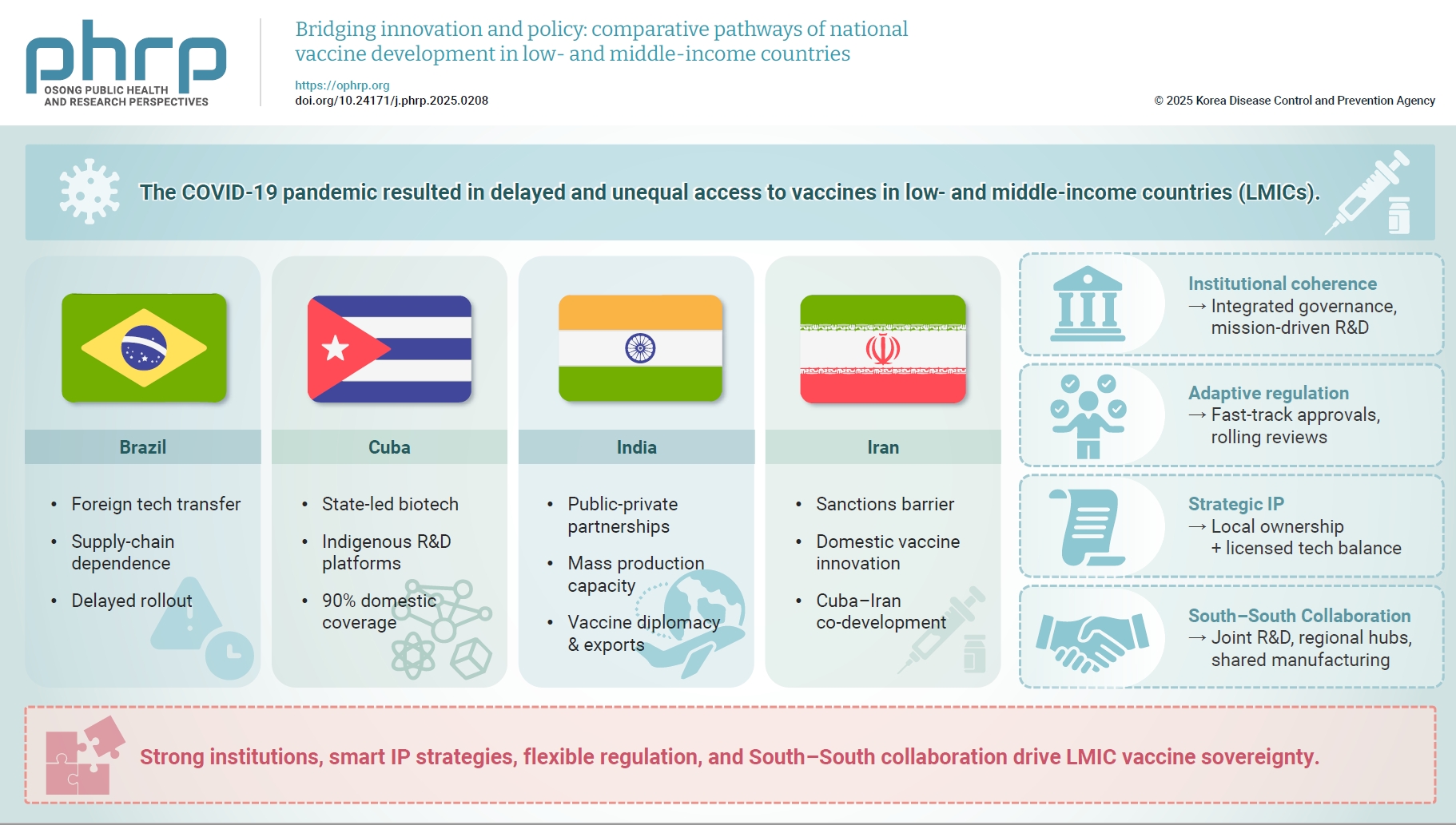
Results Cuba and Iran leveraged mission-oriented public research and development (R&D) and domestic platforms; India combined indigenous R&D with large-scale licensed manufacturing; Brazil’s scientific capacity was constrained by fragmented governance and supply-chain dependence. Adaptive regulation (e.g., emergency use authorization/conditional approvals), targeted technology transfer, and South–South partnerships accelerated progress but raised longer-term questions about intellectual property (IP) control and economic sustainability.
Conclusion Institutional coherence, strategic IP management, and regional manufacturing alliances are as critical as scientific capacity for LMIC vaccine self-reliance. Policy priorities include pre-negotiated tech-transfer frameworks, regulatory preparedness, and investment in public R&D linked to distributed manufacturing.
Citations
Citations to this article as recorded by
Next-Generation Vaccines Leveraging T Cell-Centric Design, Mucosal Immunity, and Trained Innate Immunity for Respiratory and Enteric Pathogens Md. Abdus Salam, Md. Yusuf Al-Amin, Kasireddy Sudarshan, Aidan Lynch, Victor Reyes, Madeline Stevenson Vaccines.2026; 14(5): 462. CrossRef
From Global Insights to Local Action: Bridging Vaccine Design and Manufacturing Gaps in H5N1 Pandemic Readiness María Alicia Delfino, Jimena Borgo, Luciano Chaneton, Natacha Cerny, Augusto Ernesto Bivona, Pierre Gsell, Fernando Lobos, Ike James, Martin Friede, German Sánchez Alberti, Andrés Sánchez Alberti Vaccines.2026; 14(6): 519. CrossRef
Harnessing trained immunity for next-generation vaccines: from rational adjuvant design to self-adjuvanting antigens Jing Wang, Xiao-Yong Fan, Zhidong Hu Expert Review of Vaccines.2026;[Epub] CrossRef
Vigilancia tecnológica de vacunas contra arbovirus en Latinoamérica Diana Priscila Estrella-Santiago, Rubén Oliver Espinoza Entreciencias diálogos en la Sociedad del Conocimi.2026; 14(28): 1. CrossRef
Role of Academia and Research Institutions in Advancing Indigenous Vaccine Development Saira Afzal, Muhammad Maaz Arif Pakistan BioMedical Journal.2026; : 01. CrossRef
Objectives This study aimed to describe and compare health-related quality of life (QoL) as measured by the World Health Organization Quality of Life–BREF (WHOQoL-BREF) and the EuroQol-5 Dimensions (EQ-5D) among the Malaysian population, examining differences by sociodemographic characteristics including age, income, sex, ethnicity, educational level, and occupation. Methods: This cross-sectional study used data from 19,402 individuals collected as part of a health and demographic surveillance system survey conducted in the Segamat district of Malaysia in 2018–2019. Descriptive statistics and measures of central tendency were produced. Differences in QoL among demographic sub-groups were examined using the t-test and analysis of variance, while the correlations between the WHOQoL-BREF and EQ-5D were evaluated using Pearson correlation coefficients. Results: Based on complete case analysis (n=19,129), the average scores for the 4 WHOQoLBREF domains were 28.2 (physical), 24.1 (psychological), 12.0 (social relationships), and 30.4 (environment). The percentages of participants not in full health for each EQ-5D dimension were 12.8% (mobility), 3.1% (self-care), 6.9% (usual activities), 20.9% (pain/discomfort), and 6.8% (anxiety/depression). Correlations between the 4 WHOQoL-BREF domains and the 5 EQ-5D dimensions were relatively weak, ranging from –0.06 (social relationships with self-care and pain/discomfort; p<0.001) to –0.42 (physical with mobility; p<0.001). Conclusion: Although health-related QoL as measured by the WHOQoL-BREF and the EQ-5D are correlated, these 2 measures should not be considered interchangeable. The choice between them should be guided by the specific research questions and the intended use of the data.
Citations
Citations to this article as recorded by
Promoting mental health among at-risk adolescents in Malaysia (MyHeRo): study protocol for a cluster randomised controlled trial to evaluate the effectiveness and cost-effectiveness of a school-based intervention compared with study skills condition for a Cecilia A. Essau, Suwaibah Zakaria, Chuong Hock Ting, Julia Ai Cheng Lee, Alejandro de la Torre-Luque, Alvin Lai Oon Ng, Hazreen Abdul Majid, Helen Dodd, Nik Daliana Nik Farid, Noor Azimah Muhammad, Suzaily Wahab Trials.2026;[Epub] CrossRef
Sociodemographic, lifestyle and health factors associated with psychological health among adults in Malaysia: An ethnic comparison Yong Kang Cheah, Hamimatunnisa Johar, Tin Tin Su Archives of Psychiatric Nursing.2026; 61: 152081. CrossRef
Validating cancer-specific and generic quality of life (QoL) instruments among patients with head and neck cancers: incorporating the European Organization for Research and Treatment of Cancer Quality of Life Questionnaire-Head and Neck Module with generi Mohsen Saffari, Tzu-Yen Chang, Musheer A. Aljaberi, Kah Ying Yap, An-Chi Li, Jung-Sheng Chen, Shi-Qing Wang, Mark D. Griffiths, Chung-Ying Lin Psicologia: Reflexão e Crítica.2026;[Epub] CrossRef
AVALIAÇÃO INTEGRADA DO PERFIL SOCIODEMOGRÁFICO, ESTADO NUTRICIONAL, APTIDÃO FÍSICA E QUALIDADE DE VIDA DE IDOSOS ACOMPANHADOS NA ATENÇÃO PRIMÁRIA À SAÚDE Gustavo Bonfim Rocha, Luzia Vitória Sousa Brito, Maria Francidenes de Souza Melo, Edney Souto Pinto, Kathleen Nascimento Carvalho da Silva , Maryanne Marques de Sousa, Pedro Cicero de Sousa, Layza Karyne Farias Mendes, Aldaisa Pereira Lopes , Victor RECIMA21 - Revista Científica Multidisciplinar - .2026; 7(8): e788688. CrossRef
A comparative analysis of structural equation modeling and traditional regression analysis in investigating factors affecting health-related quality of life in general Thai population Krittaphas Kangwanrattanakul, Apinya Ingard Health and Quality of Life Outcomes.2025;[Epub] CrossRef




 First
 Prev


