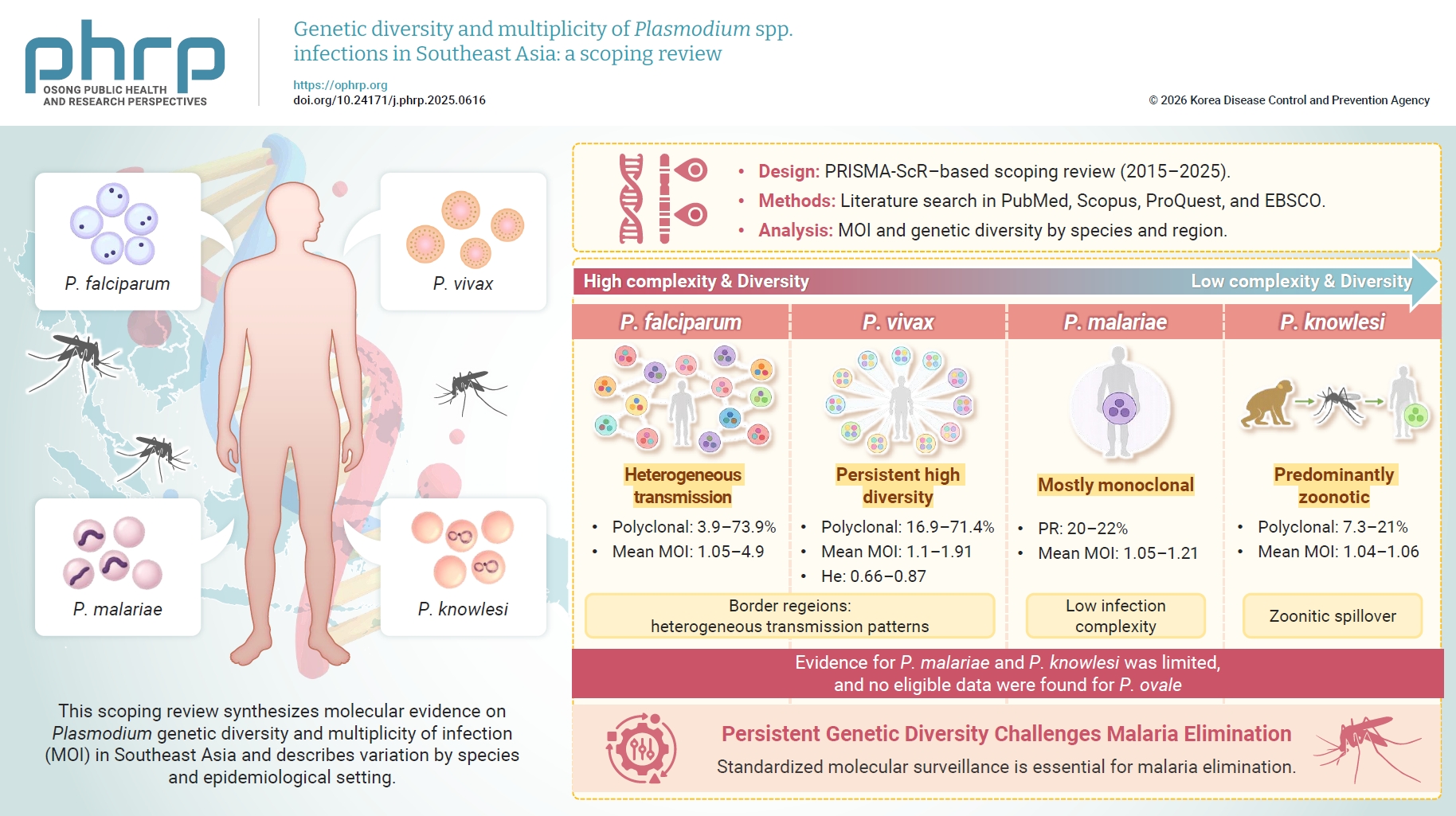
Objectives This scoping review synthesizes molecular evidence on Plasmodium genetic diversity and multiplicity of infection (MOI) in Southeast Asia and describes variation by species and epidemiological setting. Methods: Following Preferred Reporting Items for Systematic Reviews and Meta-Analyses Extension for Scoping Reviews guidelines, we searched PubMed, Scopus, ProQuest, and EBSCO for English language, open-access observational studies published between January 1, 2015 until October 11, 2025. Included studies involved laboratory-confirmed human malaria and reported MOI and genetic diversity data derived from appropriate molecular genotyping methods. Findings were summarized by species, geography, markers, and clinical categories. Results: Sixteen studies were included, comprising 1,609 genotyped Plasmodium falciparum infections, 1,526 Plasmodium vivax infections, 37 Plasmodium malariae infections, and 188 human Plasmodium knowlesi infections. P. falciparum exhibited marked heterogeneity, with polyclonal infection rates ranging from 3.9% to 73.9% and mean MOI ranging from 1.05 to 4.9. P. vivax consistently showed high diversity, with polyclonal infection rates ranging from 16.9% to 71.4% and mean MOI ranging from 1.1 to 1.91, alongside expected heterozygosity values of 0.66–0.87. P. malariae displayed low MOI, whereas P. knowlesi showed polyclonal infection rates ranging from 7.3% to 21% and mean MOI ranging from 1.04 to 1.06. No data were available for Plasmodium ovale. Conclusion: P. falciparum and P. vivax remain genetically diverse across Southeast Asia, with heterogeneous transmission patterns, particularly in border regions. Limited data on P. malariae, human P. knowlesi, and P. ovale highlight the need for standardized molecular surveillance to support targeted elimination efforts.
Objectives This review and meta-analysis examined the effectiveness of non-pharmacological therapies delivered through school-based interventions for smoking cessation among adolescents in South and Southeast Asian countries.
Methods A systematic search was conducted across PubMed, Scopus, Science Direct, BioMed Central, the Cochrane Library, and ProQuest Dissertations & Theses Global from inception to October 2024. Eligible studies comprised randomized controlled trials and quasi-experimental studies that compared non-pharmacological smoking cessation interventions delivered in schools or other educational institutions. Data on smoking abstinence outcomes were extracted from published studies, and odds ratios (ORs) with 95% confidence intervals (CIs) were pooled using a random-effects model via the Mantel-Haenszel estimator.
Results Seven studies involving 1,260 participants were included. The meta-analysis demonstrated that non-pharmacological school-based therapies significantly increased smoking abstinence compared to controls (OR, 2.83; 95% CI, 1.83–4.40; p<0.001. Subgroup analyzes revealed benefits across both randomized controlled trials and quasi-experimental studies with varying abstinence rates. Studies utilizing biochemical verification showed significant positive effects despite substantial heterogeneity, and short-term (<3 months) abstinence was significantly higher in intervention groups compared to controls. Overall, no differences were found between subgroups regarding intervention effectiveness.
Conclusion This meta-analysis indicates that non-pharmacological school-based interventions positively impact smoking abstinence rates, although effectiveness may vary based on study design, follow-up duration, and use of biochemical verification. The findings underscore the need for further research with larger sample sizes, extended follow-up periods, and improved methodological rigor in these regions.
Citations
Citations to this article as recorded by
Global disease burden of laryngeal cancer attributable to smoking from 1990 to 2021 Xiao Han, Shanchun Gong, Chao Wang, Yulin Zhang, Yufei Pan, Jing Li, Kai Liu, Zhenkun Yu European Journal of Cancer Prevention.2026; 35(4): 291. CrossRef
Adapting and Implementing a School-Based “Implementation Intentions” Program Within FRESHAIR4Life to Prevent Smoking Initiation Among Adolescents in Greece: A Study Protocol Izolde Bouloukaki, Antonios Christodoulakis, Sevasti Peraki, Floor A. Van Den Brand, Faraz Siddiqui, Theodoros Krasanakis, Antonia Aravantinou-Karlatou, Purva Abhyankar, Siân Williams, Julia van Koeveringe, Rianne MJJ van der Kleij, Ioanna Tsiligianni Healthcare.2026; 14(7): 938. CrossRef
This study aimed to establish a foundation for future collaborations aimed at preparing for and responding to infectious diseases by examining the vaccine injury compensation programs (VICPs) of East Asian countries. We reviewed the current status of VICPs in the Republic of Korea, Japan, and Taiwan by searching national government websites and reviewing relevant literature. Additionally, we conducted email inquiries targeting experts from Japan and Taiwan. Through the comprehensive analysis of VICPs in these 3 countries covered various aspects, we identified several similarities and differences in the VICPs across these countries. While the governments of the Republic of Korea, Japan, and Taiwan play a central role in supporting investigations into vaccine injuries and managing compensation procedures based on legal statutes, they differ in terms of financial resources for compensation, the range of vaccines covered, and the criteria for assessing causality. In the Republic of Korea, Japan, and Taiwan, compensation is typically paid in a lump sum, although the specific benefits available vary by country. This study on VICPs in the Republic of Korea, Japan, and Taiwan provides valuable insights for the further development and management of domestic systems.
Citations
Citations to this article as recorded by
The Vaccine That Was Never Mentioned: A Comparative Medico-Legal Analysis of the Duty to Inform and Document Preventive Immunization, with Proposed Practice Guidelines Sanit Thongsriratch, Therdpong Thongseiratch, Saratis Pairoh, Puttichart Khantee Vaccines.2026; 14(8): 664. CrossRef
Local Vaccine Manufacturing in Saudi Arabia: Examining the Role of National Legal Frameworks and Strategic Policies Tareq S. Alshammari Beijing Law Review.2025; 16(04): 2147. CrossRef
Objectives This study compared the research output of Association of Southeast Asian Nations (ASEAN) countries to understand research trends and clarify past, present, and future patterns using scientometric techniques.
Methods This scientometric study systematically mined health and social science publications from the Web of Science and Scopus databases using keywords associated with infectious disease. The analysis included only English-language articles and review articles by authors from any ASEAN country. Publication, citation, and text co-occurrence network analyses were performed. R Studio and VOSviewer enabled data management, analysis, and visualization.
Results Searches identified 12,511 articles published between 1925 and 2022, with a notable increase in research publications since 2003. The leading journals on infectious disease were associated with established publishing houses, including BMC, BMJ, and The Lancet. The most-cited articles were primarily global burden of disease studies, with 7,367 citations. Among ASEAN countries, Thailand, Malaysia, and Singapore had the most publications and collaborative efforts on the topic. Analysis of keyword co-occurrence revealed clusters related to global health, dengue, bacterial studies, non-dengue viral topics, and diagnostics. Most early studies examined diagnostics, gene and sequencing methodologies, and virology; later, the focus shifted toward herbal and alternative medicine.
Conclusion Recently, the research capacity of Southeast Asia has expanded dramatically, with substantial contributions from high-income countries. Intense cooperation between member states is essential, emphasizing the role of HICs in supporting their neighbors. Increased research efforts and collaboration must be dedicated to innovative approaches to combat persistent health conditions, along with emerging issues like climate change.
Citations
Citations to this article as recorded by
Epidemiological Trends and Predictive Modeling of Dengue Fever in the Association of Southeast Asian Nations (ASEAN) Countries Qian Ren, Ruoxi Li, Xiaojun Liu, Wei Hao, Xiaojie Zhou, Meide Liu, Hongjiang Zhang, Xinying Feng, Xiaogui Li, Ziwen Zhao, Weiwei Hu, Jianjun Zhang, Zhenjiang Xin Tropical Medicine and Infectious Disease.2025; 10(12): 329. CrossRef
Mangrove in Biodiversitas: A Systematic Review of Biodiversity, Blue Carbon, and Ecosystem Services in Southeast Asia (2020-2025) Rustam Anwar, Fitryane Lihawa, Dewi Wahyuni K Baderan, Marike Mahmud, Abdul Hafidz Olii, Hasim . International Journal of Research and Review.2020; : 51. CrossRef
<sec>
<title>Objectives</title>
<p>It was supposed to analyze status and affecting factors in water and food-borne communicable disease by screening entrants with diarrhea symptom at the point of entry in Korea</p></sec>
<sec>
<title>Methods</title>
<p>Symptomatic travelers with water and food-borne communicable diseases who entered Korea were diagnosed by a health declaration and detection of causative agents in water and food using laboratory tests. Among those entered in 2017, the affecting factors in the incidence of communicable diseases among those who had diarrhea at the entry into Korea, were analyzed, with frequency and chi-square test.</p></sec>
<sec>
<title>Results</title>
<p>The number of travel entrants with gastrointestinal communicable diseases increased by 40.19% from 2013 to 2017. The percentage of causative agents of water and food-borne communicable diseases was the highest at 69.2% from July to September. The rate of detection of causative agents of communicable disease pathogens in travelers from Southeast Asia entering Korea was 70.2%, which was higher than people arriving from East Asia and Central Asia (57.5%; <italic>p</italic> < 0.001).</p></sec>
<sec>
<title>Conclusion</title>
<p>The positive ratio of causative agents of water and food-borne communicable diseases was high among travelers that had entered Korea from July to September, with a high number among entrants from Southeast Asia. Based on the positive detection of causative agents, the entry period and countries visited were statistically significant affecting factors (<italic>p</italic> < 0.001).</p></sec>




 First
 Prev


