Objectives This study examined associations between indoor total volatile organic compound (TVOC) concentrations and urinary volatile organic compound (VOC) metabolites in Korean adults, focusing on potential sex-specific differences. We hypothesized that higher indoor TVOC exposure would be associated with higher urinary VOC metabolite concentrations and that these associations would differ by sex.
Methods We conducted a cross-sectional analysis of the 2020–2021 Korea National Health and Nutrition Examination Survey, which included the Republic of Korea’s first population-based indoor air quality survey. The analysis included 1,859 adults aged ≥19 years who participated in the indoor air quality survey from July 2020 to August 2021. Indoor TVOC concentrations (µg/m³) were measured using standardized protocols. Nine urinary VOC metabolites were quantified, creatinine-adjusted, and log-transformed. Multivariable linear regression, sex-stratified analyses, and subgroup analyses among unemployed adults were performed to reduce potential confounding from occupational exposure.
Results Indoor TVOC concentrations were positively associated with urinary 2-methylhippuric acid (2-MHA; β=0.041; 95% confidence interval [CI], 0.029–0.052) and 3,4-MHA (β=0.040; 95% CI, 0.027–0.052), with no evident sex difference in the overall sample. However, among unemployed adults, sex-by-TVOC interaction terms were statistically significant for both metabolites, and associations were stronger in males for both 2-MHA (β=0.110 vs. 0.024) and 3,4-MHA (β=0.130 vs. 0.031) than in females.
Conclusion Indoor TVOC concentrations were associated with urinary VOC metabolites, particularly 2-MHA and 3,4-MHA. These findings support considering sex-specific patterns in VOC-related risk assessment and indoor air quality surveillance, interventions, and management.
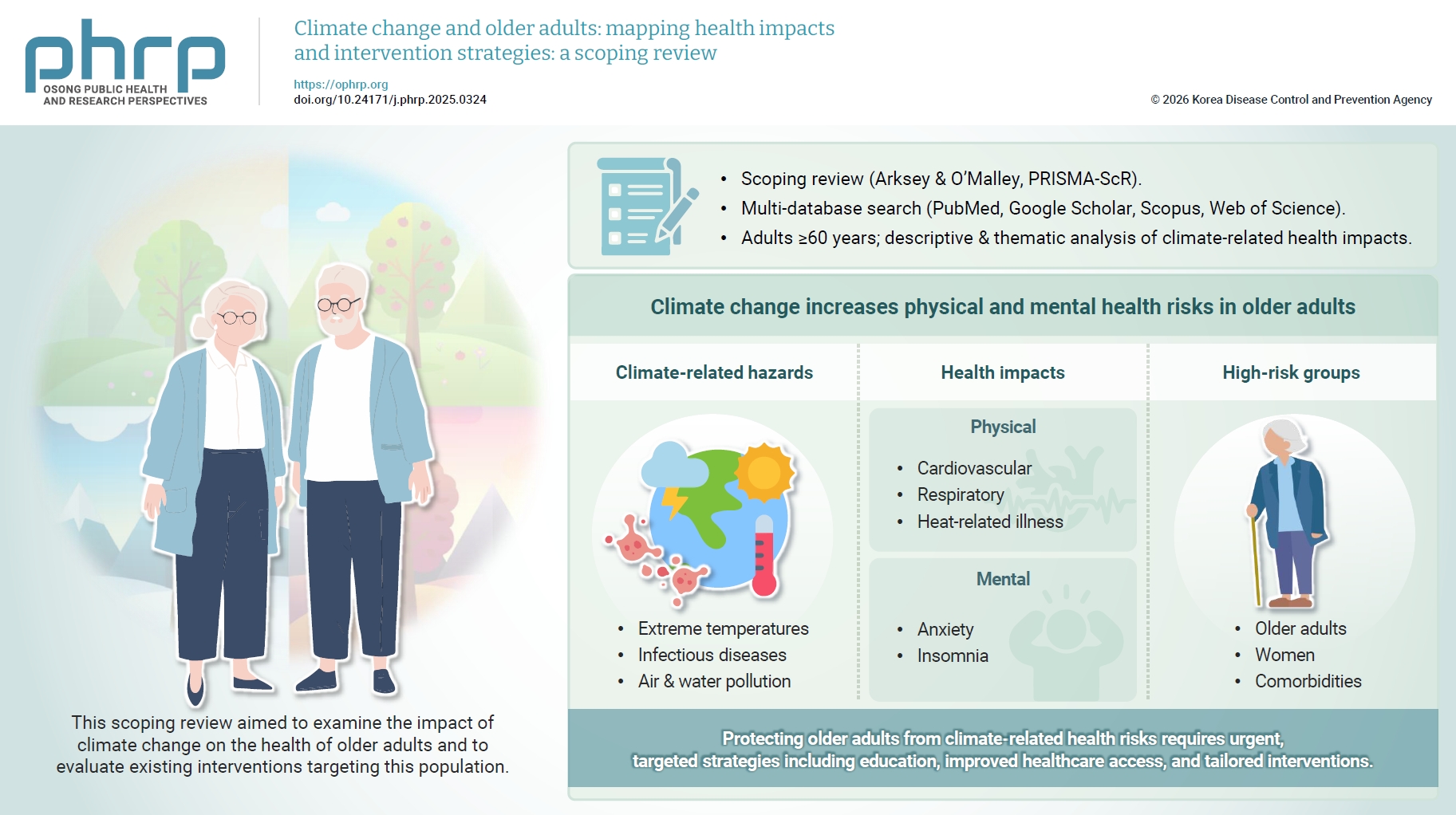
Objectives This scoping review aimed to examine the impact of climate change on the health of older adults and to evaluate existing interventions targeting this population. Methods: The review followed Arksey and O’Malley’s framework and the PRISMA-ScR guidelines. A comprehensive search was conducted across PubMed, Google Scholar, Scopus, and Web of Science. Eligible studies included those focusing on adults aged 60 years and older that examined the physical and mental health impacts of climate change across any geographic setting or level of care. Descriptive and thematic analyses were performed to identify key findings and knowledge gaps. Results: Climate change adversely affects the physical and mental health of older adults through increased exposure to infectious diseases, extreme temperatures, and poor air and water quality. Older adults are particularly vulnerable to heat-related illnesses, cardiovascular events, and respiratory conditions, with women and individuals with comorbidities at higher risk. Climate change is also associated with increased anxiety, insomnia, and other mental health concerns in this population. Social support and targeted interventions—such as community awareness programs and subsidized cooling costs—are associated with reduced risk. Community-based initiatives have demonstrated potential in reducing mortality and enhancing resilience among older adults during extreme weather events. Conclusion: Healthcare professionals should be educated about climate-related health outcomes affecting older adults. Protecting this vulnerable population requires urgent, inclusive, and targeted strategies, including education, improved healthcare access, and tailored interventions.
<sec><title>Objectives</title><p>This study aimed to analyze changes in hematologic parameters in the residents of the areas highly contaminated by the Hebei Spirit Oil Spill in 2007 and those who participated in the clean-up activities.</p></sec><sec><title>Methods</title><p>According to demographic characteristics, health status and behavior, and level of exposure to oil, we compared the hematologic results in 2009 and 2012 among 701 residents. The hematologic parameters were composed of white blood cell (WBC) count, and levels of hemoglobin, hematocrit (Hct), aspartate aminotransferase (AST), alanine aminotransferase (ALT), glucose, glycosylated hemoglobin (HbA1c), blood urea nitrogen (BUN), creatinine (Cr), total cholesterol (T-chol), high-density lipoprotein (HDL), and triglyceride (TG).</p></sec><sec><title>Results</title><p>Paired <italic>t</italic>-test revealed that the WBC count and levels of Hct, AST, ALT, glucose, and HbA1c significantly increased, whereas the BUN, Cr, HDL, and TG levels significantly decreased. Multiple linear regression modelling showed a relationship between the level of exposure to oil and temporal changes in Hct, glucose, HbA1c, and BUN levels.</p></sec><sec><title>Conclusion</title><p>Our results suggest a relationship between level of exposure to oil and changes in hematologic parameters over 3 years. Further studies should be conducted to determine the impact of oil spill on health such as the occurrence of diseases.</p></sec>
Citations
Citations to this article as recorded by
Individual and mixture effects of BTEX occupational exposure with hematologic and hepatic profiles in petrochemical workers and the metabolic mechanism Rujian He, Hongjie Zhong, Chang He, Hailing Li, Zhanxiang Wang, Jing Zheng, Guiying Li, Taicheng An Journal of Environmental Sciences.2025; 154: 163. CrossRef
Single and mixed effects of multiple volatile organic compounds exposure on hematological parameters in the U.S. adult population Yan Zhuang, Laifu Li, Yanqi Zhang, Xuna Liu, Beibei Zeng, Boxu Zhu, Fei Dai Chemosphere.2024; 355: 141825. CrossRef
Technological disasters in Asia: Epidemiological profile from the year 2000 to 2021 Andrea Fernández García, Rick Kye Gan, José Antonio Cernuda Martínez, Pedro Arcos González Public Health Nursing.2024; 41(6): 1544. CrossRef
Latent Trajectories of Haematological, Hepatic, and Renal Profiles after Oil Spill Exposure: A Longitudinal Analysis Benjamin Atta Owusu, Apiradee Lim, Nitinun Pongsiri, Chanthip Intawong, Sunthorn Rheanpumikankit, Saijit Suksri, Thammasin Ingviya International Journal of Environmental Research an.2023; 20(4): 2871. CrossRef
Haematological, renal, and hepatic function changes among Rayong oil spill clean-up workers: a longitudinal study Benjamin Atta Owusu, Apiradee Lim, Chanthip Intawong, Sunthorn Rheanpumikankit, Saijit Suksri, Thammasin Ingviya International Archives of Occupational and Environ.2022; 95(7): 1481. CrossRef
Association between BTEX (benzene, toluene, ethylbenzene and xylene) concentration in ambient air with hematological and spirometric indices: a population-based study Hosna Moradkhani, Mostafa Leili, Jalal Puralajal, Ashraf Mazaheri Tehrani, Ayat Hossein Panahi, Mohammd Taghi Samadi, Sara Beheshtifar Human and Ecological Risk Assessment: An Internati.2022; 28(5-6): 490. CrossRef
Combine effect of exposure to petrol, kerosene and diesel fumes: On hepatic oxidative stress and haematological function in rats Solomon E Owumi, Bidemi N Oladimeji, Tobiloba C Elebiyo, Uche O Arunsi Toxicology and Industrial Health.2021; 37(6): 336. CrossRef
Associations between blood volatile organic compounds, and changes in hematologic and biochemical profiles, in a population-based study Sabit Cakmak, Christie Cole, Chris Hebbern, Julie Andrade, Robert Dales Environment International.2020; 145: 106121. CrossRef
Developing Large-Scale Research in Response to an Oil Spill Disaster: a Case Study Richard K. Kwok, Aubrey K. Miller, Kaitlyn B. Gam, Matthew D. Curry, Steven K. Ramsey, Aaron Blair, Lawrence S. Engel, Dale P. Sandler Current Environmental Health Reports.2019; 6(3): 174. CrossRef
Health effect research on Hebei Spirit Oil Spill (HEROS) in Korea: a cohort profile Myung Sook Park, Kyung-Hwa Choi, Seung-Hwa Lee, Jong-Il Hur, Su Ryeon Noh, Woo-Chul Jeong, Hae-Kwan Cheong, Mina Ha BMJ Open.2019; 9(8): e026740. CrossRef



 First
 Prev


