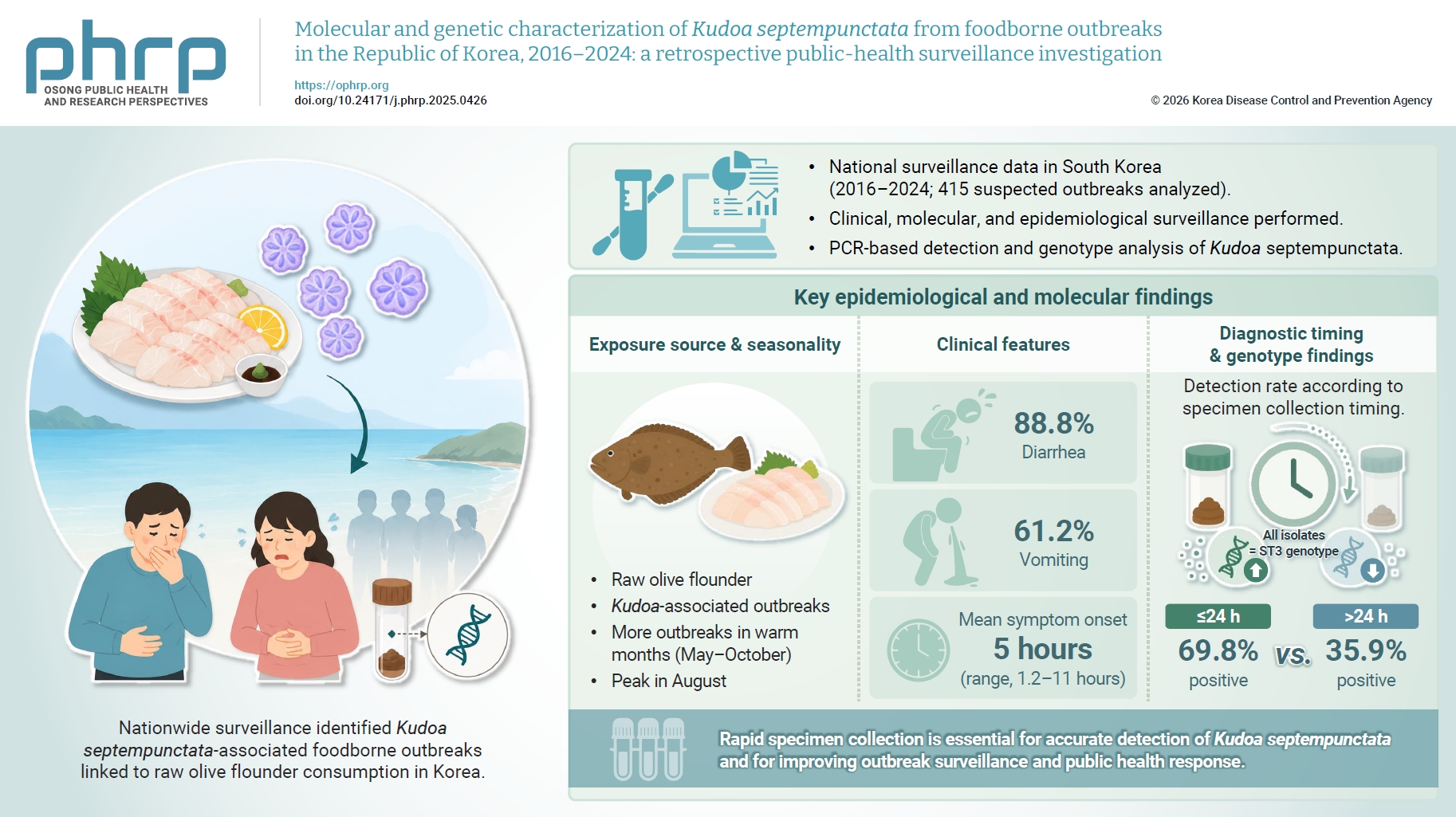
Objectives Kudoa septempunctata is a marine myxosporean parasite implicated in seafood-borne acute gastroenteritis, predominantly associated with the consumption of raw olive flounder. This study aimed to characterize the molecular and genetic features of K. septempunctata-associated with foodborne outbreaks in the Republic of Korea from 2016 to 2024. Methods: We reviewed 415 suspected foodborne outbreaks reported through national surveillance between 2016 and 2024. Among these, 37 outbreaks with complete clinical, epidemiological, and laboratory data from 2020 to 2024—including K. septempunctata testing and genotyping—were analyzed in detail. Results: Diarrhea (88.8%) and vomiting (61.2%) were the most common symptoms. The detection rate of K. septempunctata was significantly higher in specimens collected ≤24 hours after raw fish consumption (69.8%) than in those collected > 24 hours after consumption (35.9%). Outbreak occurrence was higher during warmer months (May–October) than during other periods, although this difference was not statistically significant. All sequences obtained from patient specimens belonged to sequence type 3 (ST3) of K. septempunctata. Conclusion: Since 2020, the proportion of reported outbreaks associated with Kudoa has increased, indicating its continued public health relevance. The timing of specimen collection is a key determinant of K. septempunctata detection, as diagnostic yield declines significantly when specimens are collected more than 24 hours after exposure. These findings highlight the need for standardized rapid investigation protocols and an integrated surveillance system linking clinical data with seafood supply-chain information.
<sec><title>Objectives</title><p>The objective of this review is to propose an appropriate course of action for improving the guidelines followed by food handlers for control of infection. For this purpose, previous epidemiological reports related to acute gastroenteritis in food service businesses mediated by food handlers were intensively analyzed.</p></sec><sec><title>Methods</title><p>Relevant studies were identified in international databases. We selected eligible papers reporting foodborne infectious disease outbreaks. Among primary literature collection, the abstract of each article was investigated to find cases that absolutely identified a causative factor to be food handlers’ inappropriate infection control and the taxon of causative microbial agents by epidemiological methodologies. Information about the sites (type of food business) where the outbreaks occurred was investigated.</p></sec><sec><title>Results</title><p>A wide variety of causative microbial agents has been investigated, using several epidemiological methods. These agents have shown diverse propagation pathways based on their own molecular pathogenesis, physiology, taxonomy, and etiology.</p></sec><sec><title>Conclusion</title><p>Depending on etiology, transmission, propagation, and microbiological traits, we can predict the transmission characteristics of pathogens in food preparation areas. The infected food workers have a somewhat different ecological place in infection epidemiology as compared to the general population. However, the current Korean Food Safety Act cannot propose detailed guidelines. Therefore, different methodologies have to be made available to prevent further infections.</p></sec>
Citations
Citations to this article as recorded by
Risk Awareness and Protective Behaviors of Food Service Workers Against Communicable Diseases in a District Center Talha Pekel, Hasibe Kadıoğlu Bandırma Onyedi Eylül Üniversitesi Sağlık Bilimler.2025; 7(2): 373. CrossRef
Pilot study for the development of a screening questionnaire to detect sarcopenic obesity D. J. Bissonnette, B. N. Burk, M. Hadley, P. Knoblich International Journal of Obesity.2022; 46(7): 1328. CrossRef
Worker Protection Scenarios for General Analytical Testing Facility under Several Infection Propagation Risks: Scoping Review, Epidemiological Model and ISO 31000 Jong-Myong Park, Joong-Hee Cho, Nam-Soo Jun, Ki-In Bang, Ji-Won Hong International Journal of Environmental Research an.2022; 19(19): 12001. CrossRef
Assessment of potential factors that support the endemicity of cholera in Nigeria from food handlers, health workers and the environment Olufemi Samuel Amoo, Oluwatoyin Awoderu, Jacob Yisau, David Oladele, Aghata Nkiru David, Toyosi Raheem, Mabel Uwandu, Moses Bamidele , Toun Wuraola Fesobi, Adeshina AbdusSalam, Samuel Nduaga, Chinedum Taahie Oparaugo, Morakinyo Ajayi, Francisc Microbiologia Medica.2021;[Epub] CrossRef
The Korean food franchise industry: Diverse development and conceptual definitions of a food safety managing body Jong Myong Park, Jong Mun Kim, Ah Reum Lee, Hyun Min Cho, Ji Won Hong, Sa‐Youl Ghim Journal of Food Safety.2019;[Epub] CrossRef
Microbial risks in food franchise: A step forward in establishing ideal cleaning and disinfection practices in SSOPs Jong Myong Park, Ah Reum Lee, Ji Won Hong, Sa‐Youl Ghim Journal of Food Safety.2019;[Epub] CrossRef
New procedures for food handlers under infectious gastrointestinal disease: To control emerging microbial problems Jong Myong Park, Hyun Min Cho, Jong Mun Kim, Sa‐Youl Ghim Journal of Food Safety.2018;[Epub] CrossRef
Objectives
The purpose of this study was to examine the diversity of the <i>G</i> and <i>P</i> types of human rotavirus strains isolated in South Korea during 2000 to 2004. Methods
We selected 38 Group A rotavirus isolates among 652 fecal samples, which were collected from infants and children < 5 years of age with acute gastroenteritis or diarrhea admitted in 8 hospitals representative of five provinces of South Korea between 2000 and 2004. Rotavirus <i>P</i>- and <i>G</i>-genotypes were determined by nucleotide sequencing and phylogenetic analysis was performed. Results
One <i>G1P[4]</i> consisted <i>G1-Id-P[4]-V</i>; one <i>G1P[6]</i> consisted <i>G1-Id-P[6]-Ia</i>; nine <i>G1P[8]</i> consisted <i>G1-Ib-P[8]-Ia</i> (<i>n</i>=3), <i>G1-Ic-P[8]-Ia</i> (<i>n</i>=1), and <i>G1-Id-P[8]-Ia</i> (<i>n</i>=5); 13 <i>G2P[4]</i> consisted <i>G2-V-P[4]-V</i>; two <i>G3P[4]</i> consisted <i>G3-IIId-P[4]-V</i>; five <i>G3P[8]</i> consisted <i>G3-IIId-P[8]-Ia</i>; four <i>G4P[6]</i> consisted <i>G4-Ie-P[6]-Ia</i>; two <i>G4P[8]</i> consisted <i>G4-Ie-P[8]-II</i>; one <i>G9P[6]</i> consisted <i>G9-III-P[6]-Ia</i>. Conclusions
A considerable amount of rotavirus genotypic diversity was detected in South Korea from 2000 to 2004. These findings are important to develop the effective vaccines and to undertake epidemiologic studies.
Citations
Citations to this article as recorded by
Molecular typing of rotaviruses in gastroenteritis cases detected in foreign-born children aged 0–5 years Salam Charbak, Mustafa Sağlam, Tekin Karsligil, Christopher Aaron Rice Microbiology Spectrum.2026;[Epub] CrossRef
Long-term monitoring of G1P[8] rotaviruses circulating without vaccine pressure in Nizhny Novgorod, Russia, 1984-2019 N. A. Novikova, T. A. Sashina, N. V. Epifanova, A. U. Kashnikov, O. V. Morozova Archives of Virology.2020; 165(4): 865. CrossRef
Prevalence, risk factors, and clinical characteristics of rotavirus and adenovirus among Lebanese hospitalized children with acute gastroenteritis Rasha Zaraket, Ali Salami, Marwan Bahmad, Ali El Roz, Batoul Khalaf, Ghassan Ghssein, Hisham F. Bahmad Heliyon.2020; 6(6): e04248. CrossRef
Prevalence and Genotypic Distribution of Rotavirus in Thailand: A Multicenter Study Pimmada Sakpaisal, Sasikorn Silapong, Amara Yowang, Gaysorn Boonyasakyothin, Boonyaorn Yuttayong, Umaporn Suksawad, Siriporn Sornsakrin, Paphavee Lertsethtakarn, Ladaporn Bodhidatta, John M. Crawford, Carl J. Mason The American Journal of Tropical Medicine and Hygi.2019; 100(5): 1258. CrossRef
Monitoring Shedding of Five Genotypes of RotaTeq Vaccine Viruses by Genotype-Specific Real-Time Reverse Transcription-PCR Assays Yuki Higashimoto, Masaru Ihira, Yu Miyazaki, Ayumi Kuboshiki, Sayaka Yoshinaga, Hiroyuki Hiramatsu, Ryota Suzuki, Masafumi Miyata, Hiroki Miura, Satoshi Komoto, Jun Yukitake, Koki Taniguchi, Yoshiki Kawamura, Tetsushi Yoshikawa, Yi-Wei Tang Journal of Clinical Microbiology.2018;[Epub] CrossRef
Molecular analysis of group A rotaviruses detected in hospitalized children from Rawalpindi, Pakistan during 2014 Massab Umair, Bilal Haider Abbasi, Nadia Nisar, Muhammad Masroor Alam, Salmaan Sharif, Shahzad Shaukat, Muhammad Suleman Rana, Adnan Khurshid, Ghulam Mujtaba, Uzma Bashir Aamir, Syed Sohail Zahoor Zaidi Infection, Genetics and Evolution.2017; 53: 160. CrossRef
Analysis of rotavirus genotypes in Korea during 2013: An increase in the G2P[4] genotype after the introduction of rotavirus vaccines Jae-Seok Kim, Hyun Soo Kim, Jungwon Hyun, Han-Sung Kim, Wonkeun Song, Kyu Man Lee, Seon-Hee Shin Vaccine.2014; 32(48): 6396. CrossRef



 First
 Prev


