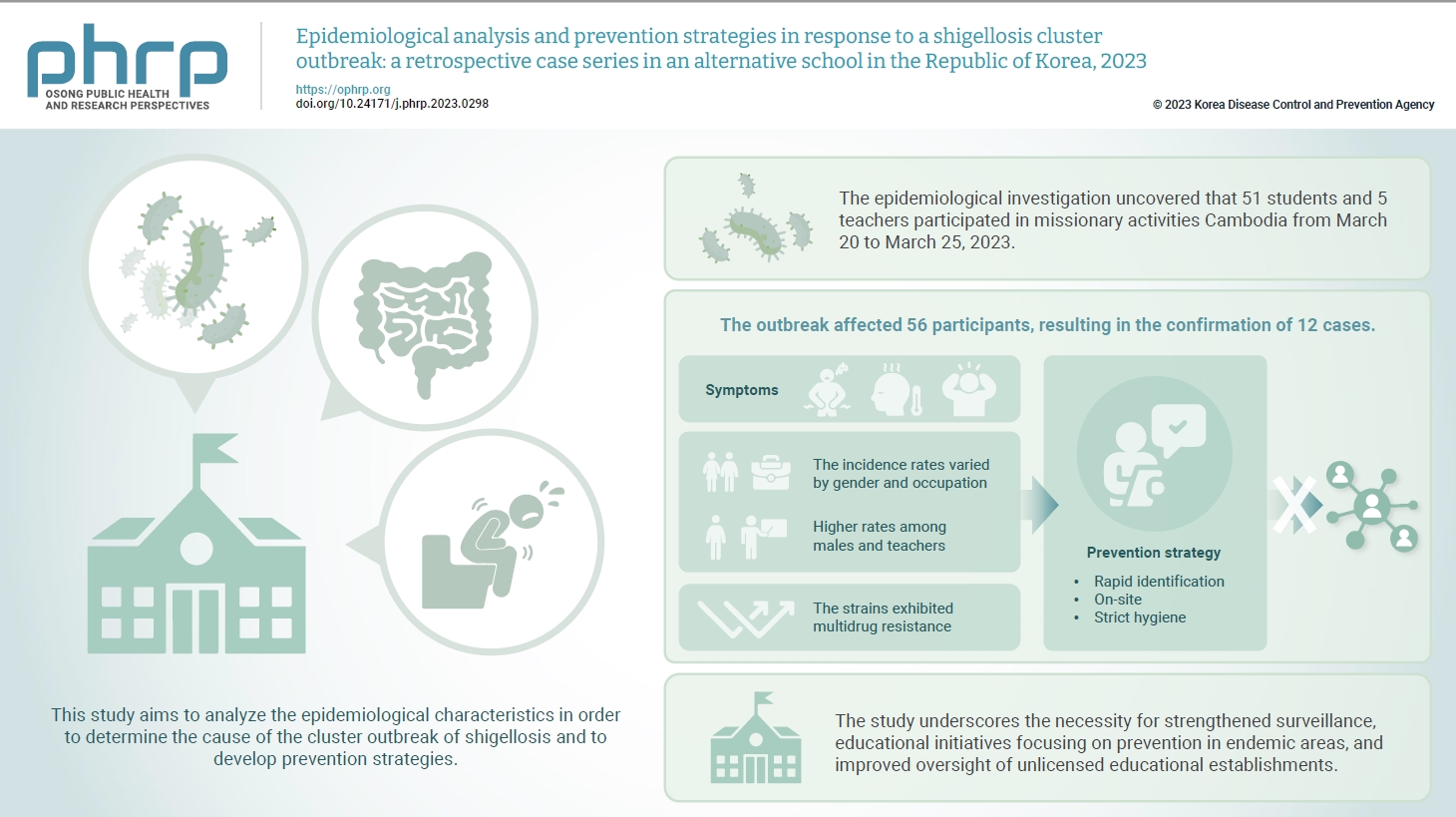
Objectives In March 2023, an alternative school in the Republic of Korea reported 12 cases of shigellosis. This study aims to analyze the epidemiological characteristics in order to determine the cause of the cluster outbreak of shigellosis and to develop prevention strategies. Methods: This study focused on 12 patients with confirmed Shigella infection and investigated their demographics, clinical features, epidemiology, diagnostics, and antimicrobial susceptibility. Following the identification of Shigella, we conducted follow-up rectal smear cultures to manage patients, implementing isolation and control measures. Results: This study investigated the emergence of multidrug-resistant Shigella following missionary activities in Cambodia, documenting a cluster infection within an alternative school in Daejeon, the Republic of Korea. The outbreak affected 56 participants, resulting in the confirmation of 12 cases. The incidence rates varied by gender and occupation, with higher rates among males and teachers. All 12 cases demonstrated multidrug resistance. Challenges included delayed pathogen confirmation and suboptimal adherence to isolation criteria. The incident prompted revisions in the criteria for isolation release, focusing on symptom resolution. The study underscores the necessity for strengthened surveillance, educational initiatives focusing on prevention in endemic areas, and improved oversight of unlicensed educational establishments. Conclusion: Successful response strategies included swift situation assessment, collaborative efforts, effective infection control measures, and modified criteria for isolation release. Continued surveillance of multidrug-resistant strains is recommended, especially in regions with a high prevalence.
Citations
Citations to this article as recorded by
A One Health Scoping Review of Antimicrobial Resistance in Cambodia: Evidence Mapping and Insights into Klebsiella pneumoniae Sao Puth, Chanroth Chhoung, Limmuy Hav, Chandy Rin, Kennarey Seang, Luis Sagaon-Teyssier, Vonthanak Saphonn Microorganisms.2026; 14(10): 2161. CrossRef
Shigella flexneri Outbreak at a Rehabilitation Center: First Report from Saudi Arabia Khalifa Binkhamis, Sarah Alangari, Fatema Juma, Sahar Althawadi, Ahmed A. Al-Qahtani, Marie Fe F. Bohol, Fatimah S. Alshahrani, Fawzia Alotaibi Healthcare.2025; 13(9): 971. CrossRef
Objectives The household secondary attack rate (SAR) of severe acute respiratory syndrome coronavirus 2 (SARS-CoV-2) is an important indicator for community transmission. This study aimed to characterize transmission by comparing household SARs and identifying risk factors during the periods of Delta and Omicron variant predominance in Republic of Korea.
Methods We defined the period of Delta variant predominance (Delta period) as July 25, 2021 to January 15, 2022, and the period of Omicron variant predominance (Omicron period) as February 7 to September 3, 2022. The number of index cases included was 214,229 for the Delta period and 5,521,393 for the Omicron period. To identify the household SARs and risk factors for each period, logistic regression was performed to determine the adjusted odds ratio (aOR).
Results The SAR was 35.2% for the Delta period and 43.1% for the Omicron period. The aOR of infection was higher in 2 groups, those aged 0 to 18 years and ≥75 years, compared to those aged 19 to 49 years. Unvaccinated individuals (vs. vaccinated individuals) and individuals experiencing initial infection (vs. individuals experiencing a second or third infection) had an increased risk of infection with SARS-CoV-2.
Conclusion This study analyzed the household SARs and risk factors. We hope that the results can help develop age-specific immunization plans and responses to reduce the SAR in preparation for emerging infectious diseases or potential new variants of SARS-CoV-2.
Citations
Citations to this article as recorded by
Current Impact of COVID-19 in Long-Term Care Facilities in the United States: A Systematic Literature Review Stefan Gravenstein, Catherine E. Cooke, Daniel Verdi, Mark J. Fedele, Sohini Ganguli, Stephan Martin, Florin Draica The Senior Care Pharmacist.2026; 41(5): 167. CrossRef
Lower Levels of Household Transmission of SARS-CoV-2 Omicron Variant of Concern vs Wild Type: An Interplay Between Transmissibility and Immune Status Angelique M A M Winkel, Eva Kozanli, Mildred E Haverkort, Sjoerd M Euser, Judith G C Sluiter-Post, Rob Mariman, Afke Vogelzang, Jordy de Bakker, Coen R Lap, Marianne A van Houten, Dirk Eggink, Steven F L van Lelyveld The Journal of Infectious Diseases.2025; 231(3): 653. CrossRef
Impact of disease severity, age, sex, comorbidity, and vaccination on secondary attack rates of SARS-CoV-2: a global systematic review and meta-analysis Dewan Md. Sumsuzzman, Yang Ye, Zhen Wang, Abhishek Pandey, Joanne M. Langley, Alison P. Galvani, Seyed M. Moghadas BMC Infectious Diseases.2025;[Epub] CrossRef
SARS-CoV-2 secondary attack rates and risks for transmission among agricultural workers and their households in Guatemala, 2022-2023 Joseph Daniel Carreon, Molly M. Lamb, Anna N. Chard, Diva M. Calvimontes, Chelsea Iwamoto, Neudy Rojop, Jose Monzon, Ian D. Plumb, Edgar Barrios, Julio del Cid-Villatoro, Kareen Arias, Melissa Gomez, Claudia Maribel Paiz Reyes, Maria Renee Lopez, May Chu, IJID Regions.2025; 16: 100676. CrossRef




 First
 Prev


