Objectives To systematically review and meta-analyze the prevalence and genetic diversity of rotavirus A (RVA) in humans, animals, and environmental water samples in West Africa and to describe its geographic distribution and circulation patterns.
Methods PubMed, Scopus, Web of Science, African Journals Online, ScienceDirect, SpringerLink, JSTOR, clinical trial registries, and global health libraries were searched for observational studies published from January 1, 2010, to December 20, 2025, reporting molecular RVA genotyping data from West Africa. Two reviewers independently screened studies, extracted data, assessed risk of bias using the Joanna Briggs Institute and SYRCLE tools, and summarized genotype distributions narratively. Random-effects meta-analyses were used to estimate pooled prevalence by source category.
Results Fifty-four studies were included, comprising 21,532 samples and 2,080 RVA-positive cases. The overall pooled prevalence was 12.6% (95% confidence interval [CI], 9.9%–15.6%). Prevalence was highest in animals (19.77%; 95% CI, 5.4%–40.1%), followed by environmental water samples (14.81%; 95% CI, 3.5%–31.1%) and humans (11.37%; 95% CI, 9.0%–14.0%). Overall heterogeneity was very high (I²=97.1%). In human studies, G1P[8], G9P[8], and G2P[4] were among the most frequently detected and geographically widespread genotype combinations.
Conclusion RVA circulates widely in humans, animals, and environmental water samples across West Africa, although evidence is characterized by substantial heterogeneity, uneven geographic representation, and limited animal and environmental water data. These findings support integrated One Health surveillance, monitoring for genotype shifts, and stronger water, sanitation, and hygiene interventions.
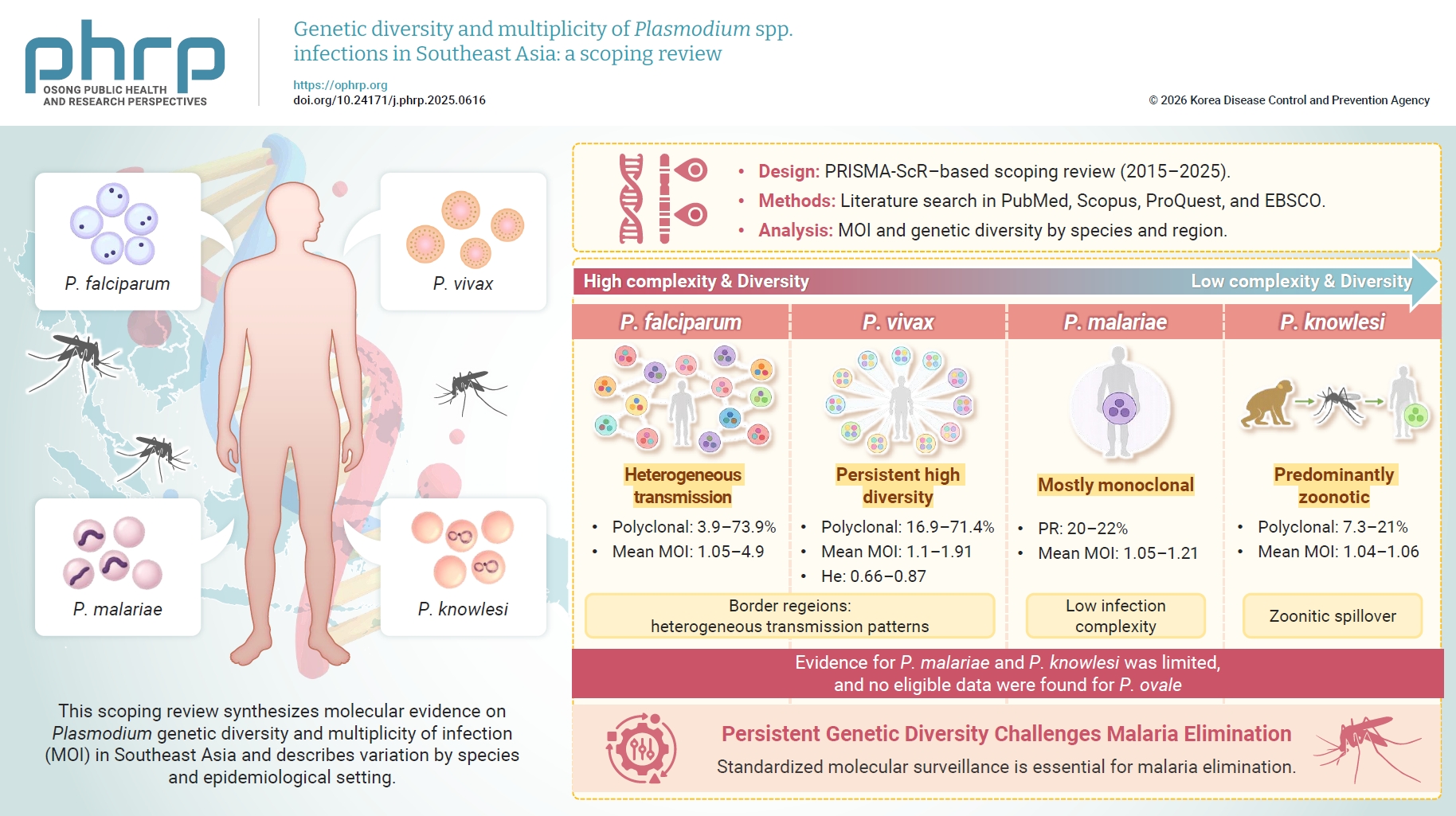
Objectives This scoping review synthesizes molecular evidence on Plasmodium genetic diversity and multiplicity of infection (MOI) in Southeast Asia and describes variation by species and epidemiological setting. Methods: Following Preferred Reporting Items for Systematic Reviews and Meta-Analyses Extension for Scoping Reviews guidelines, we searched PubMed, Scopus, ProQuest, and EBSCO for English language, open-access observational studies published between January 1, 2015 until October 11, 2025. Included studies involved laboratory-confirmed human malaria and reported MOI and genetic diversity data derived from appropriate molecular genotyping methods. Findings were summarized by species, geography, markers, and clinical categories. Results: Sixteen studies were included, comprising 1,609 genotyped Plasmodium falciparum infections, 1,526 Plasmodium vivax infections, 37 Plasmodium malariae infections, and 188 human Plasmodium knowlesi infections. P. falciparum exhibited marked heterogeneity, with polyclonal infection rates ranging from 3.9% to 73.9% and mean MOI ranging from 1.05 to 4.9. P. vivax consistently showed high diversity, with polyclonal infection rates ranging from 16.9% to 71.4% and mean MOI ranging from 1.1 to 1.91, alongside expected heterozygosity values of 0.66–0.87. P. malariae displayed low MOI, whereas P. knowlesi showed polyclonal infection rates ranging from 7.3% to 21% and mean MOI ranging from 1.04 to 1.06. No data were available for Plasmodium ovale. Conclusion: P. falciparum and P. vivax remain genetically diverse across Southeast Asia, with heterogeneous transmission patterns, particularly in border regions. Limited data on P. malariae, human P. knowlesi, and P. ovale highlight the need for standardized molecular surveillance to support targeted elimination efforts.


 First
 Prev


