Objectives This study aimed to assess the contact tracing outcomes of severe acute respiratory syndrome coronavirus 2 (SARS-CoV-2) Omicron sub-lineages BA.4, BA.5, and BA.2.75 within Republic of Korea, and to generate foundational data for responding to future novel variants.
Methods We conducted investigations and contact tracing for 79 confirmed BA.4 cases, 396 confirmed BA.5 cases, and 152 confirmed BA.2.75 cases. These cases were identified through random sampling of both domestically confirmed and imported cases, with the goal of evaluating the pattern of occurrence and transmissibility.
Results We detected 79 instances of Omicron sub-lineage BA.4 across a span of 46 days, 396 instances of Omicron sub-lineage BA.5 in 46 days, and 152 instances of Omicron sub-lineage BA.2.75 over 62 days. One patient with severe illness was confirmed among the BA.5 cases; however, there were no reports of severe illness in the confirmed BA.4 and BA.2.75 cases. The secondary attack risk among household contacts were 19.6% for BA.4, 27.8% for BA.5, and 24.3% for BA.2.75. No statistically significant difference was found between the Omicron sub-lineages.
Conclusion BA.2.75 did not demonstrate a higher tendency for transmissibility, disease severity, or secondary attack risk within households when compared to BA.4 and BA.5. We will continue to monitor major SARS-CoV-2 variants, and we plan to enhance the disease control and response systems.
Citations
Citations to this article as recorded by
Severity of COVID-19 Omicron Variants: A Global Systematic Review Deepa Malhotra, Rajeev M. Nepal, Irini Zografaki, Moe H. Kyaw, Pinelopi Nikolopoulou, Rodrigo Sini de Almeida, Santiago M. C. Lopez, Stephen Wiblin, Fraser Williams, Sophie Pope, Isabelle Whittle, Fiona Pearson, Daniel Curcio Infectious Diseases and Therapy.2026; 15(7): 1827. CrossRef
Monitoring the 2023 Omicron waves in Morocco: Trends in incidence, variants, and testing disparities El Kamouni Youssef, Almaggoussi Rim, Arsalane Lamiae, Merabet Moad, El Youbi Mohammed, Zouhair Said IJID Regions.2026; 20: 100948. CrossRef
Impact of disease severity, age, sex, comorbidity, and vaccination on secondary attack rates of SARS-CoV-2: a global systematic review and meta-analysis Dewan Md. Sumsuzzman, Yang Ye, Zhen Wang, Abhishek Pandey, Joanne M. Langley, Alison P. Galvani, Seyed M. Moghadas BMC Infectious Diseases.2025;[Epub] CrossRef
Replication kinetics and infectivity of SARS-CoV-2 Omicron variant sublineages recovered in the Republic of Korea Jeong-Min Kim, Dongju Kim, Jee Eun Rhee, Cheon Kwon Yoo, Eun-Jin Kim Osong Public Health and Research Perspectives.2024; 15(3): 260. CrossRef
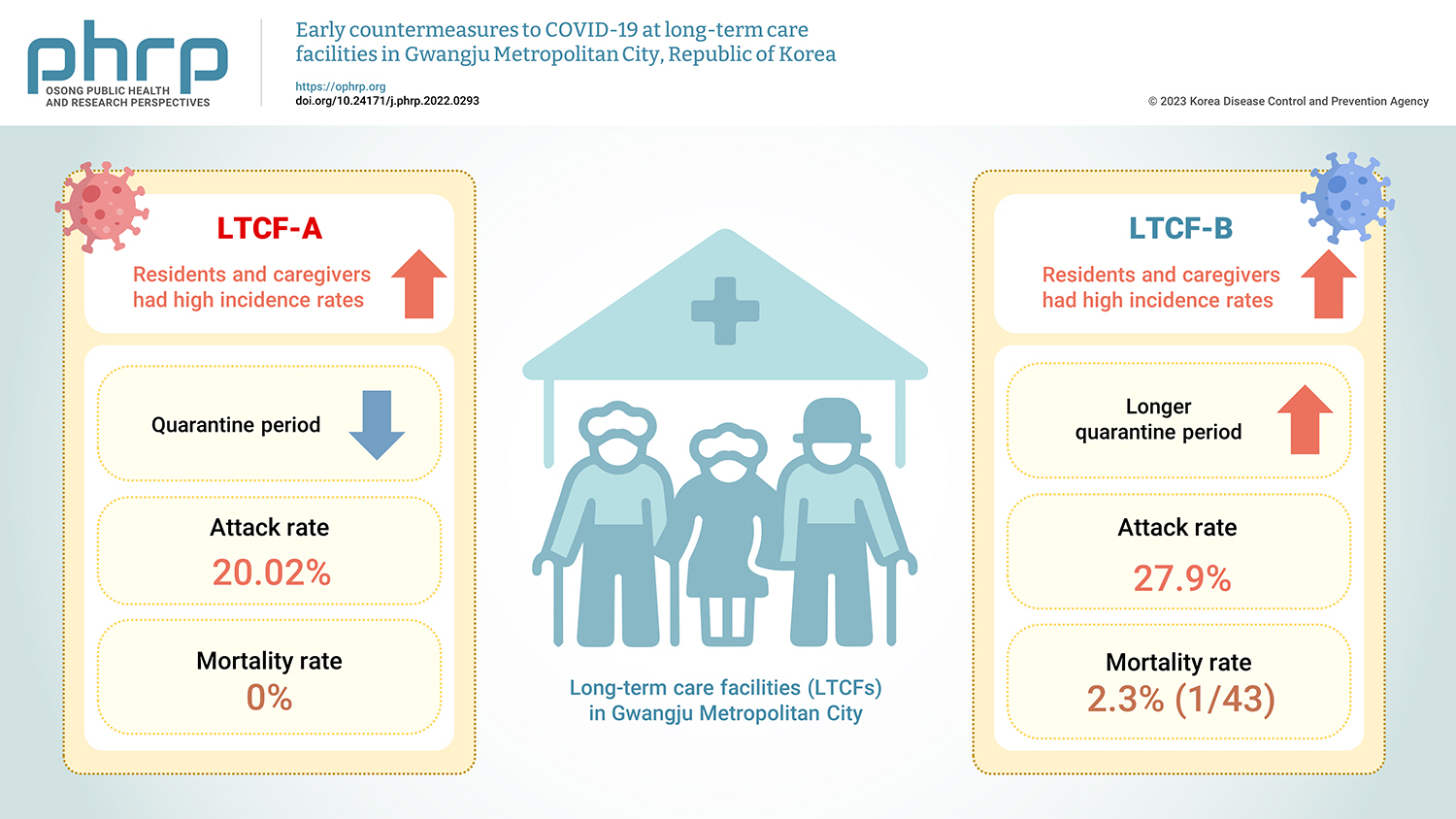
Objectives The coronavirus disease 2019 (COVID-19) pandemic has continued since its first detection in the Republic of Korea on January 20, 2020. This study describes the early countermeasures used to minimize the risk of COVID-19 outbreaks during cohort quarantine and compares the epidemiological characteristics of 2 outbreaks in long-term care facilities (LTCFs) in Gwangju Metropolitan City in summer 2020. Methods: An epidemiological investigation was conducted via direct visits. We investigated epidemiological characteristics, including incidence, morbidity, and mortality rates, for all residents and staff members. Demographic characteristics were analyzed using a statistical program. Additionally, the method of managing infection in LTCFs is described. Results: Residents and caregivers had high incidence rates in LTCF-A and LTCF-B, respectively. LTCF-B had a longer quarantine period than LTCF-A. The attack rate was 20.02% in LTCF-A and 27.9% in LTCF-B. The mortality rate was 2.3% (1/43) in LTCF-B, the only facility in which a COVID-19 death occurred. Conclusion: Extensive management requires contact minimization, which involves testing all contacts to mitigate further transmission in the early stages of LTCF outbreaks. The findings of this study can help inform and prepare public health authorities for COVID-19 outbreaks, particularly for early control in vulnerable facilities.
Citations
Citations to this article as recorded by
Healthcare workers' views on the response to COVID-19 in long-term care hospitals in Korea: a mixed-method study Eun Kyoung Yun, In Seo La, Sunmi Kim, Seongyu Han, Hyungran Lee Frontiers in Public Health.2025;[Epub] CrossRef



 First
 Prev


