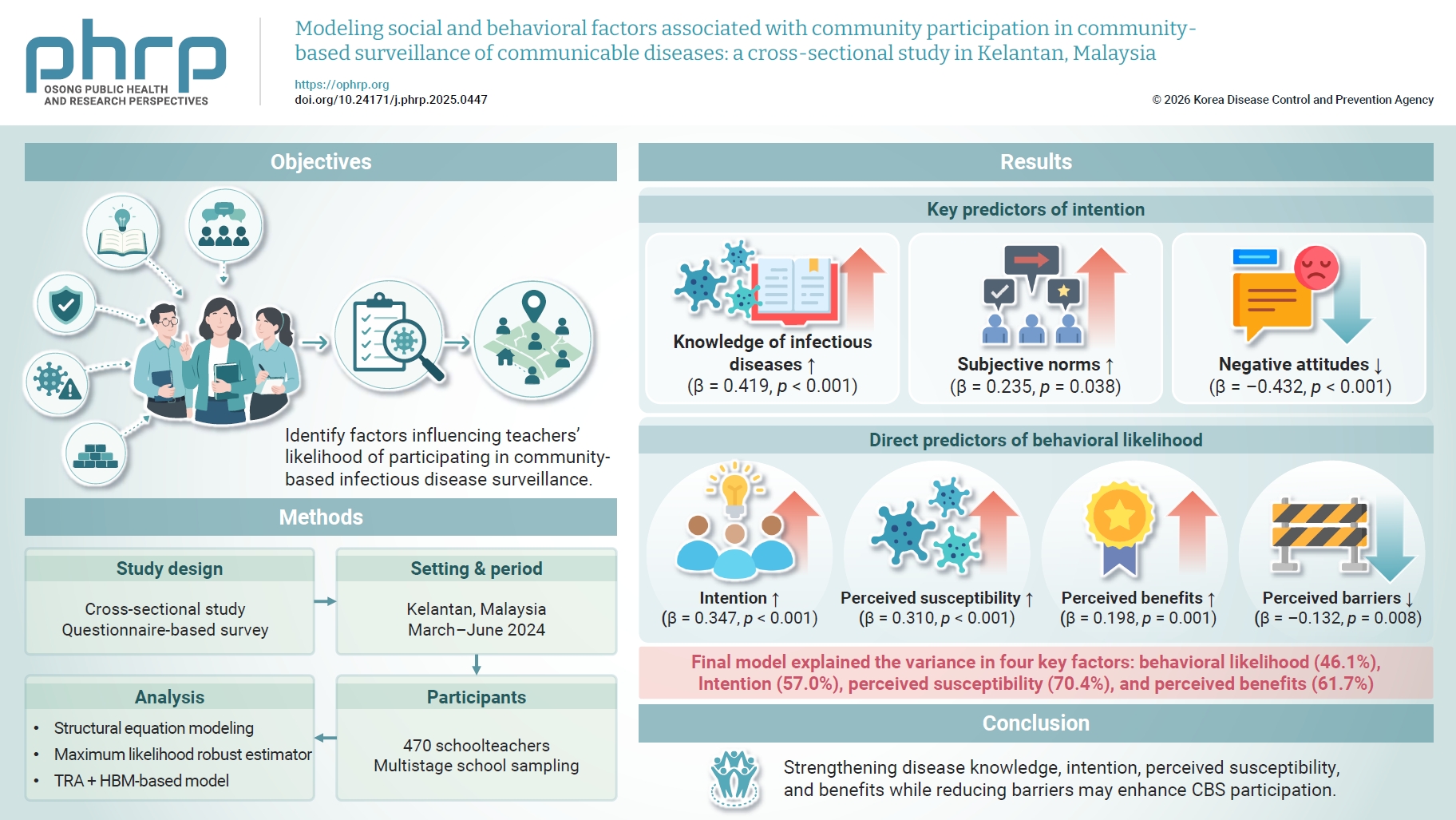
Objectives This study examined the social and behavioral factors influencing community leaders’ participation in community-based surveillance (CBS) of infectious diseases. We hypothesized that knowledge, attitudes, and perceptions significantly predict the behavioral likelihood of engaging in CBS activities. Methods: A cross-sectional study was conducted among 470 schoolteachers in Kelantan, Malaysia, from March to June 2024. Participants were selected using multistage sampling, with random selection of schools followed by convenience sampling of teachers. Data were collected using the validated KAP-CBS-ID questionnaire, which was based on the Theory of Reasoned Action and Health Belief Model. Structural equation modeling was used to analyze relationships among the study variables with the maximum likelihood robust estimator. Results: The final model demonstrated good fit (comparative fit index, 0.921; standardized root mean square residual, 0.071; root mean square error of approximation, 0.040 [90% confidence interval, 0.036–0.044]). Ten significant path relationships were identified, explaining 46.1% of the variance in behavioral likelihood. Knowledge of infectious diseases (β=0.419, p<0.001), subjective norms (β=0.235, p=0.038), and negative attitudes (β=–0.432, p<0.001) significantly influenced intention. Behavioral likelihood was directly predicted by intention (β =0.347, p<0.001), perceived susceptibility (β=0.310, p<0.001), perceived benefits (β=0.198, p=0.001), and perceived barriers (β=–0.132, p=0.008). Self-efficacy showed significant indirect effects through perceived benefits (β=0.785, p<0.001) and perceived susceptibility (β=0.765, p<0.001). Conclusion: Knowledge and psychosocial factors significantly inf luence community engagement in CBS of infectious diseases. Public health interventions should address these interconnected determinants to strengthen early disease detection and reporting systems.
Objectives This study aimed to describe and compare health-related quality of life (QoL) as measured by the World Health Organization Quality of Life–BREF (WHOQoL-BREF) and the EuroQol-5 Dimensions (EQ-5D) among the Malaysian population, examining differences by sociodemographic characteristics including age, income, sex, ethnicity, educational level, and occupation. Methods: This cross-sectional study used data from 19,402 individuals collected as part of a health and demographic surveillance system survey conducted in the Segamat district of Malaysia in 2018–2019. Descriptive statistics and measures of central tendency were produced. Differences in QoL among demographic sub-groups were examined using the t-test and analysis of variance, while the correlations between the WHOQoL-BREF and EQ-5D were evaluated using Pearson correlation coefficients. Results: Based on complete case analysis (n=19,129), the average scores for the 4 WHOQoLBREF domains were 28.2 (physical), 24.1 (psychological), 12.0 (social relationships), and 30.4 (environment). The percentages of participants not in full health for each EQ-5D dimension were 12.8% (mobility), 3.1% (self-care), 6.9% (usual activities), 20.9% (pain/discomfort), and 6.8% (anxiety/depression). Correlations between the 4 WHOQoL-BREF domains and the 5 EQ-5D dimensions were relatively weak, ranging from –0.06 (social relationships with self-care and pain/discomfort; p<0.001) to –0.42 (physical with mobility; p<0.001). Conclusion: Although health-related QoL as measured by the WHOQoL-BREF and the EQ-5D are correlated, these 2 measures should not be considered interchangeable. The choice between them should be guided by the specific research questions and the intended use of the data.
Citations
Citations to this article as recorded by
Promoting mental health among at-risk adolescents in Malaysia (MyHeRo): study protocol for a cluster randomised controlled trial to evaluate the effectiveness and cost-effectiveness of a school-based intervention compared with study skills condition for a Cecilia A. Essau, Suwaibah Zakaria, Chuong Hock Ting, Julia Ai Cheng Lee, Alejandro de la Torre-Luque, Alvin Lai Oon Ng, Hazreen Abdul Majid, Helen Dodd, Nik Daliana Nik Farid, Noor Azimah Muhammad, Suzaily Wahab Trials.2026;[Epub] CrossRef
Sociodemographic, lifestyle and health factors associated with psychological health among adults in Malaysia: An ethnic comparison Yong Kang Cheah, Hamimatunnisa Johar, Tin Tin Su Archives of Psychiatric Nursing.2026; 61: 152081. CrossRef
Validating cancer-specific and generic quality of life (QoL) instruments among patients with head and neck cancers: incorporating the European Organization for Research and Treatment of Cancer Quality of Life Questionnaire-Head and Neck Module with generi Mohsen Saffari, Tzu-Yen Chang, Musheer A. Aljaberi, Kah Ying Yap, An-Chi Li, Jung-Sheng Chen, Shi-Qing Wang, Mark D. Griffiths, Chung-Ying Lin Psicologia: Reflexão e Crítica.2026;[Epub] CrossRef
AVALIAÇÃO INTEGRADA DO PERFIL SOCIODEMOGRÁFICO, ESTADO NUTRICIONAL, APTIDÃO FÍSICA E QUALIDADE DE VIDA DE IDOSOS ACOMPANHADOS NA ATENÇÃO PRIMÁRIA À SAÚDE Gustavo Bonfim Rocha, Luzia Vitória Sousa Brito, Maria Francidenes de Souza Melo, Edney Souto Pinto, Kathleen Nascimento Carvalho da Silva , Maryanne Marques de Sousa, Pedro Cicero de Sousa, Layza Karyne Farias Mendes, Aldaisa Pereira Lopes , Victor RECIMA21 - Revista Científica Multidisciplinar - .2026; 7(8): e788688. CrossRef
A comparative analysis of structural equation modeling and traditional regression analysis in investigating factors affecting health-related quality of life in general Thai population Krittaphas Kangwanrattanakul, Apinya Ingard Health and Quality of Life Outcomes.2025;[Epub] CrossRef
Objectives Social activities are important and influential factors for healthy aging. However, limited information is available regarding the associations of the type and intensity of social participation with health and well-being. This study aimed to investigate how various types of social activities are associated with several dimensions of health outcomes. Methods: This cross-sectional study utilized data from the Seventh Korean Longitudinal Study of Aging, which included 5,526 adults aged 60 years and older. Multivariate linear regression analysis was employed to analyze the associations of social activities with depression, self-rated health, and life satisfaction. Additionally, subgroup analyses by sex and age were performed. Results: Among the participants, 73.5% reported involvement in at least 1 of the 4 types of social engagement. After adjustment for all covariates, individuals who participated in any social activity reported better self-rated health and higher life satisfaction compared to those who did not participate. However, the intensity of engagement in different social activities had varying impacts on subjective health outcomes. An increased level of participation was associated with a lower rate of depression and improved self-rated health. However, no significant differences were observed in the relationship between the intensity of participation in activities (with the exception of alumni societies or family councils) and life satisfaction. Conclusion: This study suggests that to improve their health, older adults in the Republic of Korea should not only engage in social activities but also do so actively and regularly.
Citations
Citations to this article as recorded by
Impact of Depression on Self-Rated Health Status among Community-Dwelling Older Adults: Moderating Effects of Subjective Social Status and Formal Social Participation Using Data from the Ninth Korean Longitudinal Study of Aging (2022) Sohee Jung, Eunhee Yang, Soyoung Cha, Wonhee Baek Journal of Fundamental Nursing Science.2026; 33(1): 147. CrossRef
Disaggregating Digital Competence: Social Activity Participation and Depressive Symptoms Among Korean Older Adults Young-Mi Jung, NakHyeok Choi Behavioral Sciences.2026; 16(10): 1742. CrossRef
Gender differences in advanced activities of daily living: evidence from the longitudinal study of health and aging in Mexico 2012–2018 Martha A. Sánchez-Rodríguez, Mariano Zacarías-Flores, Lesly Estefanía Castañeda-Sánchez, Víctor Manuel Mendoza-Núñez Frontiers in Aging.2025;[Epub] CrossRef
The Associations Between Physical Activity, Body Perception, and Self-Rated Health in Korean Adults: An Analysis of the 2023 Korean Community Health Survey Geun-Kook Kim, Su-Yeon Roh, Sung-Ho Hwang Medicina.2025; 61(11): 1898. CrossRef
Objectives
Providing high service quality is one of the main functions of health systems. Measuring service quality is the basic prerequisite for improving quality. The aim of this study was to evaluate the quality of service in teaching hospitals using importance–performance analysis matrix. Methods
A descriptive–analytic study was conducted through a cross-sectional method in six academic hospitals of Qazvin, Iran, in 2012. A total of 360 patients contributed to the study. The sampling technique was stratified random sampling. Required data were collected based on a standard questionnaire (SERVQUAL). Data analysis was done through SPSS version 18 statistical software and importance–performance analysis matrix. Results
The results showed a significant gap between importance and performance in all five dimensions of service quality (<i>p</i> < 0.05). In reviewing the gap, “reliability” (2.36) and “assurance” (2.24) dimensions had the highest quality gap and “responsiveness” had the lowest gap (1.97). Also, according to findings, reliability and assurance were in Quadrant (I), empathy was in Quadrant (II), and tangibles and responsiveness were in Quadrant (IV) of the importance–performance matrix. Conclusion
The negative gap in all dimensions of quality shows that quality improvement is necessary in all dimensions. Using quality and diagnosis measurement instruments such as importance–performance analysis will help hospital managers with planning of service quality improvement and achieving long-term goals.
Citations
Citations to this article as recorded by
Assessing the Role of Wetlands in Ecosystem Services: A Valuation and Importance-Performance Analysis in Kolkata Metropolitan Area Sk Mohibul, Ahmed Ali Bindajam, Hoang Thi Hang, Md Nawaj Sarif, Neha Parveen, Lubna Siddiqui Water, Air, & Soil Pollution.2026;[Epub] CrossRef
Service Quality Assessment of Smart Campus Dining Services: Combining SERVQUAL and IPA Models Ju-Jung Lin, Jung Yu Lai Sustainability.2026; 18(4): 1822. CrossRef
Assessing Dental Service Quality Using the SERVQUAL Model: A Cross‐Sectional Study Among Perspectives of Students, Professors, and Nurses at Kerman School of Dentistry Fatemeh Sadat Sajadi, Zahra Salari, Keyhaneh Ebrahimi, Maryam Rad, Hossein Akbari‐Hooye, Milad Mollaali Health Science Reports.2026;[Epub] CrossRef
Pharmacy-Based Atrial Fibrillation Screening Model Coordinated by a Regional Stroke and Cardiovascular Disease Support Center ― The Catch AF Project ― Toshiaki Sakamoto, Yohei Tateishi, Masaya Kurobe, Hiroki Yahata, Mana Miyakoda, Yukinobu Kodama, Akira Tsujino, Koji Maemura, Kaname Ohyama, Satoshi Ikeda Circulation Reports.2026; 8(7): 1131. CrossRef
Quality Assessment of Educational Services from the Perspective of Students at Bushehr University of Medical Sciences Using the SERVQUAL Model: A Cross-Sectional Study Hedayat Salari, Hamid Ebrahimi, Atefeh Esfandiari, Satar Rezaei, Mohammad soheili, Peyman Zand Iranian South Medical Journal.2026; 28(4): 785. CrossRef
Evaluation of Patient Satisfaction with Service Quality at Hasim Dental Center, CBD Polonia, Medan, Indonesia Bryan Julio Hasim, Susanna Halim, Alamsyah Jurnal Penelitian Pendidikan IPA.2026; 12(10): 217. CrossRef
Measuring total productive maintenance success: a new industrial evaluation using fuzzy SERVQUAL Zineb Mouhib, Maryam Gallab, Youssef Lamrani Alaoui, Safae Merzouk, Mario Di Nardo, Brahim El Bhiri, Aziz Soulhi Journal of Industrial and Production Engineering.2025; 42(1): 14. CrossRef
Importance-performance analysis in the tertiary healthcare centres: evidence from India Karthik Padamata, Rama Devi Vangapandu International Journal of Productivity and Performa.2025; 74(6): 2071. CrossRef
Analysis of the level of service quality with health services in the nusantara capital buffer area Sigit Rahmat Rizalmi, Cicilia Tiara Putri Sarbrina, Christopher Davito Prabandewa Hertadi, Putri Gesan Prabawa Anwar IOP Conference Series: Earth and Environmental Sci.2025; 1454(1): 012061. CrossRef
Patient satisfaction with healthcare services and associated factors at public health centers in Addis Ababa, Ethiopia Getachew Tollera, Mulumebet Tadesse Retta, Aderajew Mekonnen Girmay Discover Social Science and Health.2025;[Epub] CrossRef
The role of service customisation and process innovation in enhancing customer satisfaction and engagement in pet care services: Evidence from India and the UAE Subburaj Alagarsamy, Vasudevan Moorthy, Jayanta Banerjee Quality Management Journal.2025; 32(3): 129. CrossRef
Importance – Performance Analysis in assessing LoS (Level of Service): A study on the ferry service of Kolkata-Howrah twin city Subham Pramanick, Utpal Roy Case Studies on Transport Policy.2025; 21: 101524. CrossRef
Systematic search and assessment of quality indicators in dental implantology L. Verstraete, T-M. Croonenborghs, P-J. Verhelst, E. Coeckelberghs, K. Vanhaecht, C. Politis, J. Meeus Journal of Stomatology Oral and Maxillofacial Surg.2025; 126(5): 102494. CrossRef
A New Model to Consolidate Long-Term Intersectoral Partnerships in Humanitarian and Social Crises Management Anderson Nunes da Silva, Marcele Elisa Fontana Public Organization Review.2024; 24(1): 27. CrossRef
Using Importance–Performance Analysis to Reveal Priorities for Multifunctional Landscape Optimization in Urban Parks Xiaomin Xiao, Qiaoru Ye, Xiaobin Dong Land.2024; 13(5): 564. CrossRef
Understanding International Students’ Perspective of Health Service Quality: A Cross-Sectional Study in a Hungarian University Putu Ayu Indrayathi, Luh Putu Ulandari, Putu Pradnyani, Inge Dhamanti, Marilynne Kirshbaum, Csongor Szepesi, Nora Horvath, Laszlo Kolozsvari Risk Management and Healthcare Policy.2024; Volume 17: 1757. CrossRef
Improving the academic resilience of hospital nursing interns through a hybrid multi-criteria decision analysis model Mao Ye, Weifang Xu, Lili Feng, Siqi Liu, Jianhong Yang, Yen-Ching Chuang, Fuqin Tang Health Informatics Journal.2024;[Epub] CrossRef
Evaluation of the quality of safe dental services based on the perception of patients with the IPA approach: a powerful diagnostic tool for managers Leila Keikavoosi-Arani, Javad Moghadasi BMC Health Services Research.2024;[Epub] CrossRef
Evaluación de la calidad del servicio en los establecimientos de salud pública Janis Alonso Martínez Miraval Saber Servir: revista de la Escuela Nacional de Ad.2024; (12): 93. CrossRef
Evaluation of outpatient service quality: What do patients and providers think? Pouria Farrokhi, Aidin Aryankhesal, Rafat Bagherzadeh, Asgar Aghaei Hashjin International Journal of Healthcare Management.2023; 16(3): 394. CrossRef
Assessing the Challenges and Opportunities of Agricultural Information Systems to Enhance Farmers’ Capacity and Target Rice Production in Indonesia Agung Budi Santoso, Setia Sari Girsang, Budi Raharjo, Arlyna Budi Pustika, Yanter Hutapea, Mahargono Kobarsih, Agus Suprihatin, Erpina Delina Manurung, Deddy Romulo Siagian, Sidiq Hanapi, Tommy Purba, Dorkas Parhusip, Sri Wahyuni Budiarti, Yeyen Prestyani Sustainability.2023; 15(2): 1114. CrossRef
Patients’ views on health promotion and disease prevention services provided by healthcare workers in a South African tertiary hospital Herbert I. Melariri, Chester Kalinda, Moses J. Chimbari BMC Health Services Research.2023;[Epub] CrossRef
Telecommunication service quality analysis using integration of SIPA and modified Kano Hanny Kanavika Rizky Munawar, Annisa Kesy Garside, Adhi Nugraha, Amelia Khoidir Jurnal Sistem dan Manajemen Industri.2023; 7(1): 53. CrossRef
Identifying service quality gaps between patients and providers in a Native American outpatient clinic Robert Dorsey, David Claudio, María A. Velázquez, Polly Petersen BMC Health Services Research.2022;[Epub] CrossRef
Assessing the Utility and Patient Satisfaction of Virtual Retina Clinics During COVID-19 Pandemic Leire Juaristi, Cristina Irigoyen, Jaione Chapartegui, Ane Guibelalde, Javier Mar Clinical Ophthalmology.2022; Volume 16: 311. CrossRef
A social-media-based improvement index for urban renewal Zhifang Wang, Hua Jie, Hongpeng Fu, Lu Wang, Hezhishi Jiang, Lu Ding, Yingjie Chen Ecological Indicators.2022; 137: 108775. CrossRef
On the comparative use of social media data and survey data in prioritizing ecosystem services for cost-effective governance Zhifang Wang, Hongpeng Fu, Yuqing Jian, Salman Qureshi, Hua Jie, Lu Wang Ecosystem Services.2022; 56: 101446. CrossRef
Quality Assessment Methods of Hospital Services from the Viewpoint of Patients Based on Standard Assessment Models in Iran: A Narrative Review Mehdi Rahimi, Fateme Solymani Modern Care Journal.2022;[Epub] CrossRef
Responsiveness level and its effect on services quality from the viewpoints of the older adults hospitalized during COVID-19 pandemic Ali Reza Yusefi, Esmat Rezabeigi Davarani, Salman Daneshi, Misagh Bastani, Gholamhossein Mehralian, Peivand Bastani BMC Geriatrics.2022;[Epub] CrossRef
Ranking Hospital Hoteling Services from Patients’ Perspective Using Importance-Performance Analysis Amir Karimkhany, Ehsan Zarei, Samira Arabi, Elahe Navvabi, Somayeh Anisi Shiraz E-Medical Journal.2022;[Epub] CrossRef
Using the Kano model to associate the number of confirmed cases of COVID-19 in a population of 100,000 with case fatality rates: An observational study Sheng-Yao Hsu, Tsair-Wei Chien, Yu-Tsen Yeh, Willy Chou Medicine.2022; 101(37): e30648. CrossRef
Patient satisfaction with quality of care in public hospitals in Albania Rezarta Kalaja, Marsida Krasniqi Frontiers in Public Health.2022;[Epub] CrossRef
A Crisis in the Health System and Quality of Healthcare in Economically Developed Countries Magdalena Biel, Katarzyna Grondys, Ane-Mari Androniceanu International Journal of Environmental Research an.2022; 20(1): 469. CrossRef
An integrated approach for evaluating hospital service quality with linguistic preferences Xiaobing Li, Zhen He International Journal of Production Research.2021; 59(6): 1776. CrossRef
Rethinking health services operations to embrace patient experience of healthcare journey Mahdi Mahdavi, Leila Doshmangir, Ebrahim Jaafaripooyan The International Journal of Health Planning and M.2021; 36(6): 2020. CrossRef
A STUDY ON QUALITY OF SERVICES IN THE OUTPATIENT DEPARTMENT OF A MULTISPECIALTY TEACHING HOSPITAL Nirmala Kumari, Keerthana Maria Pinto GLOBAL JOURNAL FOR RESEARCH ANALYSIS.2021; : 117. CrossRef
The Effect Of Health Service On Patient Satisfaction In Haji Hospital, Medan City Nidya Andani, Mappeaty Nyorong, Asriwati . Journal of Biomedical Engineering and Medical Imag.2021; 8(4): 14. CrossRef
Variation in compliance with safe surgery checklist in hospitals with different levels of patient safety culture Saeed Asefzadeh, Sima Rafiei, Masoomeh Karimi International Journal of Healthcare Management.2020; 13(sup1): 12. CrossRef
Assessment of Quality of Services Delivered to Iranian Patients with Cataract Zahra Hashemi Dehaghi, Soad Mahfoozpour, Mahmoud Modiri, Fateme Alipour Iranian Red Crescent Medical Journal.2020;[Epub] CrossRef
Gap between patient expectation and perception during pharmacist–patient communication at community pharmacy Myeong Gyu Kim, Na Eun Lee, Hyun Soon Sohn International Journal of Clinical Pharmacy.2020; 42(2): 677. CrossRef
Validating Service Quality (SERVQUAL) in Healthcare: Measuring Patient Satisfaction Using their Perceptions in Jordan Mohammed Shaker Ibrahim Journal of Information & Knowledge Management.2020; 19(01): 2040021. CrossRef
Evaluating the environmental protection strategy of a printed circuit board manufacturer using a T fuzzy importance performance analysis with Google Trends Kuen-Suan Chen, Kuo-Ping Lin, Li-Ju Lin Expert Systems with Applications.2020; 156: 113483. CrossRef
Methodologies for Determining the Service Quality of the Intercity Rail Service Based on Users’ Perceptions and Expectations in Thailand Sajjakaj Jomnonkwao, Thanapong Champahom, Vatanavongs Ratanavaraha Sustainability.2020; 12(10): 4259. CrossRef
Patients’ Views on Service Quality in Selected Iranian Hospitals: An Importance-Performance Analysis Ehsan Zarei, Ali Bagheri, Abbas Daneshkohan, Soheila Khodakarim Shiraz E-Medical Journal.2020;[Epub] CrossRef
Identification of quality gaps in healthcare services using the SERVQUAL instrument and importance-performance analysis in medical intensive care: a prospective study at a medical center in Taiwan Shu-Ju Lu, Hsiu-O Kao, Bao-Lin Chang, Shu-Ing Gong, Shu-Mei Liu, Shih-Chi Ku, Jih-Shuin Jerng BMC Health Services Research.2020;[Epub] CrossRef
Importance – Performance Analysis (IPA) of bus service attributes: A case study in a developing country Javad Esmailpour, Kayvan Aghabayk, Mohammad Abrari Vajari, Chris De Gruyter Transportation Research Part A: Policy and Practic.2020; 142: 129. CrossRef
The Effect of Quality Service Towards Outpatients Satisfaction at Poasia Community Health Centre Adryan Fristiohady, La Ode Muhammad Fitrawan, Yusniati Dwi Pemudi, Ruslin Ruslin, Sunandar Ihsan, Ruslan Ruslan, La Ode Muhammad Julian Purnama Borneo Journal of Pharmacy.2020; 3(4): 270. CrossRef
Gap of services quality expectation and perception based on SERVQUAL model in the selected hospital outpatient clinics affiliated with Iran University of Medical Sciences asgar Aghaei Hashjin, Pouria Farrokhi, Aidin Aryankhesal Journal of Health Administration.2020; 23(3): 55. CrossRef
Policies and Procedures in Providing Competent Customer Service in Urgent Care Centers Marcus Caster Open Journal of Business and Management.2020; 08(03): 1164. CrossRef
An empirical study of willingness to renewable energy installation using importance-performance analysis: the case of Taiwan Wei-Chuan Chen, Wen-Kuo Chen, Chien-Wen Chen, Chien-Cheng Lo Journal of Industrial and Production Engineering.2019; 36(7): 451. CrossRef
Assessing management performance of the national forest park using impact range-performance analysis and impact-asymmetry analysis Pin-Zheng Chen, Wan-Yu Liu Forest Policy and Economics.2019; 104: 121. CrossRef
Do patients really perceive better quality of service in private hospitals than public hospitals in India? Swapnarag Swain Benchmarking: An International Journal.2019; 26(2): 590. CrossRef
Percepción de los usuarios frente a la calidad de atención en salud del servicio de consulta externa según el modelo SERVQUAL Angélica Viviana Boada-Niño, Adriana Mayeth Barbosa-López, Elisa Andrea Cobo-Mejía Revista Investigación en Salud Universidad de Boya.2019; 6(1): 55. CrossRef
Application of the SERVQUAL model to evaluate the quality in the transportation service in Morelia, Mexico Marco Alberto Valenzo-Jiménez, Daniel Adan Lazaro-López, Jaime Apolinar Martínez- Arroyo DYNA.2019; 86(211): 64. CrossRef
Konya İlinde Bulunan Özel Hastanelerdeki Hizmet Kalitesinin Ölçülmesi: Akademik Personele Yönelik Araştırma Büşra Güler, Saadettin Erhan Kesen Selçuk Üniversitesi Sosyal Bilimler Meslek Yükseko.2019; 22(2): 526. CrossRef
A Study on Service Quality and Customer Satisfaction in Nigerian Healthcare Sector Rajasekhara Mouly Potluri, Gift Angiating Journal of Industrial Distribution & Business.2018; 9(12): 7. CrossRef
Analysis of customer satisfaction in hospital by using Importance-Performance Analysis (IPA) and Customer Satisfaction Index (CSI) Vembri Noor Helia, Cahya Putra Abdurrahman, Fety Ilma Rahmillah, S. Ma’mun, H. Tamura, M.R.A. Purnomo MATEC Web of Conferences.2018; 154: 01098. CrossRef
Evaluating health service quality: using importance performance analysis Azar Izadi, Younes Jahani, Sima Rafiei, Ali Masoud, Leila Vali International Journal of Health Care Quality Assur.2017; 30(7): 656. CrossRef
Societal perception toward transportation modes based on online (Go-Jek) In Malang City D M Buamona IOP Conference Series: Earth and Environmental Sci.2017; 70: 012007. CrossRef
The Role of Subjective Culture on Consumer Perception towards Service Quality Delivery Tiara Turay Journal of Business and Social Review in Emerging .2016; 2(2): 175. CrossRef
Objectives
In light of the importance of physical activity, the aim of the present study is to examine the factors affecting participation in physical activity among adults in Malaysia. Methods
A logistic regression model and the Third National Health and Morbidity Survey consisting of 30,992 respondents were used. Results
Age, income, gender, education, marital status, region, house locality, job characteristics, and medical conditions are significantly associated with participation in physical activity. In particular, old individuals, high income earners, females, the well-educated, widowed or divorced individuals, East Malaysians, urban dwellers, the unemployed, and individuals who are not diagnosed with hypercholesterolemia are less likely to be physically active than others. Conclusion
Because sociodemographic and health factors play an important role in determining physical activity, the government should take them into account when formulating policy.
Citations
Citations to this article as recorded by
Development of a high-copy target enhanced multiplexed crRNA-based, amplification-free detection assay (HiTECT) for Brucella spp Moon Moon Satpathy, Bablu Kumar, Prasad Thomas, Abhishek, Karam Pal Singh, O. R. Vinodhkumar Molecular Biology Reports.2026;[Epub] CrossRef
Strength Training and Body Image Among Middle-Aged Women in Malaysia: A Narrative Review Using the Health Belief Model Jasveen K.G. Singh, Nisha Nambiar Journal of Health Research.2026;[Epub] CrossRef
Trend of physical activity and sedentary time during pregnancy and related determinants Seyede Shahrbanoo Daniali, Maryam Abdoli, Motahar Heidari-Beni, Mehri Khoshhali, Roya Kelishadi Journal of Public Health.2025; 33(4): 831. CrossRef
A Comparative Study of Physical Activity Levels Between Rural and Urban Settings in Zimbabwe Norman Manyeruke, Kerry Vermaak, Nicholas Mudonhi, Wilfred Njabulo Nunu Health Services Insights.2025;[Epub] CrossRef
Exploring the Mediating Role of Theory of Planned Behavior (TPB) Components in Facilitating Health Behavior Change: A Comprehensive Conceptual Framework Nurul Amyra Mat Isa, Nor Tasik Misbah, Fatin Athirah Mohd Fazi Information Management and Business Review.2025; 17(1(I)): 1. CrossRef
Association between physical activity, socioeconomic status, blood biomarkers, and diet in lebanese adults Elie-Jacques Fares, Maria Abou Mourad, Marco Bardus, Sarah Zaki, Marie Claire Chamieh, Mabel Aoun PLOS One.2025; 20(4): e0321884. CrossRef
EVALUATION OF INDIVIDUALS’ HEALTH BELIEF ATTITUDES TOWARD EXERCISE Yasemin Aslan, Merve Tutar İnönü Üniversitesi Sağlık Hizmetleri Meslek Yüksek.2025; 13(3): 854. CrossRef
Being a Chinese while fighting against China: badminton and the nationalist identity construction of Malaysian Chinese Li Wen Frank Teo, Xiaoqian Richard Hu, Xin Yu May Teo Sport in Society.2025; : 1. CrossRef
The Psychometric Properties of the Health Belief Model Scale for Exercise in the Turkish Population Melissa KÖPRÜLÜOĞLU, Elvan FELEKOĞLU, İlknur NAZ GÜRŞAN Journal of Basic and Clinical Health Sciences.2024; 8(1): 119. CrossRef
How do individuals rate their health compared to others? findings based on a nationally representative sample in Germany André Hajek, Hans-Helmut König BMC Public Health.2024;[Epub] CrossRef
WALKING FOR HEALTH & WELLBEING: THE EFFECT OF STEP FREQUENCY Nurain Mohd Talmizi, Nor Eeda Haji Ali, Muhammad Rijal Mohamad, Nurhidayah Samsul Rijal, An Nisha Nur Welliana Abd Rased PLANNING MALAYSIA.2024;[Epub] CrossRef
Analisis Aktivitas Fisik Pekerja Mal Pelayanan Publik Kota Cilegon Muhammad Syifa Abdy Mulya, Indri Hapsari Hapsari Susilowati National Journal of Occupational Health and Safety.2024; 5(1): 28. CrossRef
Can the association between hypertension and physical activity be moderated by age? Yong Kang Cheah, Kuang Kuay Lim, Hasimah Ismail, Muhammad Fadhli Mohd Yusoff, Chee Cheong Kee Journal of Taibah University Medical Sciences.2023; 18(4): 844. CrossRef
Physical Activity among Rural Residents in Eastern, Central, and Western Provinces of China: A Cross‐Sectional Survey Cheng-Yao Liang, Zhi-Yuan Zheng, Yu-Gao Wu, Zhuo-Yang Li, Ping Wang, Yi-Yang Wang, Bai-Xue Lin, Jing Fang, Georgian Badicu BioMed Research International.2023;[Epub] CrossRef
A comparison of low and high dose of moderate intensity aerobic exercise on heart rate recovery of the sedentary adults: a pragmatic randomized controlled trial Zulkarnain Jaafar, Yi Z. Lim The Journal of Sports Medicine and Physical Fitnes.2023;[Epub] CrossRef
Physical Activity as a Health Determinant in Tropical Built Environments: A Multifaceted Intervention Nur Dalilah Dahlan, Mainur Kurmanbekova, Wardah Fatimah Mohammad Yusoff, Saliza Mohd Elias Environment and Urbanization ASIA.2023; 14(1): 39. CrossRef
Status of Workers’ Health Behavior and the Association between Occupational Characteristics and Health Behavior Seung-Yeon Lee, Saemi Jung, Wanhyung Lee International Journal of Environmental Research an.2022; 19(20): 13021. CrossRef
Socio-demographic factors and healthy lifestyle behaviours among Malaysian adults: National Health and Morbidity Survey 2019 Wan-Fei Khaw, Nur Hamizah Nasaruddin, Nazirah Alias, Yee Mang Chan, LeeAnn Tan, Siew Man Cheong, Shubash Shander Ganapathy, Muhammad Fadhli Mohd Yusoff, Heng Yaw Yong Scientific Reports.2022;[Epub] CrossRef
Motivation and Hesitation Factors associated with Physical Activity (PA) among Adults in Kuantan, Pahang, Malaysia Siti Zuhaidah Shahadan, Effah Zali, Mohamad Firdaus Mohamad Ismail, Nurvita Risdiana INTERNATIONAL JOURNAL OF CARE SCHOLARS.2022; 5(3): 29. CrossRef
Motivations, barriers and preferences to exercise among overweight and obese desk-based employees Zahara Abdul Manaf, Abdul Hadi Ruslan, Arimi Fitri Mat Ludin, Siti Munirah Abdul Basir International Journal of Sport and Exercise Psycho.2021; 19(5): 723. CrossRef
Rate of achievement of therapeutic outcomes and factors associated with control of non-communicable diseases in rural east Malaysia: implications for policy and practice Zhi Yi Keng, Yu Mon Saw, Senk Chung Thung, Woon Wee Chong, Amanda Albert, Tetsuyoshi Kariya, Eko Yamamoto, Nobuyuki Hamajima Scientific Reports.2021;[Epub] CrossRef
Relationship between Physical Activity and Cardiovascular Risk Factors: A Cross-Sectional Study among Low-Income Housewives in Kuala Lumpur Nur Zakiah Mohd Saat, Siti Aishah Hanawi, Nor M. F. Farah, Hazilah Mohd Amin, Hazlenah Hanafiah, Nur Shazana Shamsulkamar International Journal of Environmental Research an.2021; 18(11): 6090. CrossRef
Goal content and attitudes toward physical activity among primary school students during COVID-19 conditional movement control order Chin Ngien Siong, Jeswenny Fresshila John Asian Journal of Sport and Exercise Psychology.2021; 1(2-3): 103. CrossRef
Mind-Body Health Benefits of Traditional Chinese Qigong on Women: A Systematic Review of Randomized Controlled Trials Kin-Chung Wilson Leung, Yi-Jian Yang, Stanley Sai-Chuen Hui, Jean Woo, Shuya Chen Evidence-Based Complementary and Alternative Medic.2021; 2021: 1. CrossRef
Gender differences in related influential factors of regular exercise behavior among people in Taiwan in 2007: A cross-sectional study Hsin-Yu Mao, Hui-Chuan Hsu, Shin-Da Lee, Kathryn L. Weston PLOS ONE.2020; 15(1): e0228191. CrossRef
The economic and social determinants of participation in physical activity in Brazil Luan Vinicius Bernardelli, Camila Pereira, Michael A. Kortt International Review of Applied Economics.2020; 34(2): 252. CrossRef
Type 2 Diabetes Risk Among University Students in Malaysia Aishairma Aris, Mohd Zulhilmy Md Khalid, Hasnah Yahaya, Lee Onn Yoong, Ng Qiu Ying Current Diabetes Reviews.2020; 16(4): 387. CrossRef
Physical exercise among radiologists in Saudi Arabia: a cross-sectional study Mohammed Al Gadeeb, Ali Hassan, Omran Al Dandan, Malak Al Shammari, Mawaheb Kalalah, Najwa Zabeeri, Abdulaziz Farea, Danya Gari, Hind S. Alsaif Archives of Public Health.2020;[Epub] CrossRef
Physical Inactivity among Ghanaians in Ghana and Ghanaian Migrants in Europe ERNEST AFRIFA-ANANE, AMA DE-GRAFT AIKINS, KARLIJN A. C. MEEKS, ERIK BEUNE, JULIET ADDO, LIAM SMEETH, SILVER BAHENDEKA, KARIEN STRONKS, CHARLES AGYEMANG Medicine & Science in Sports & Exercise.2020; 52(10): 2152. CrossRef
Vigorous and moderate physical activity among overweight and obese adults in Malaysia: Sociodemographic correlates Yong Kang Cheah, Mohd Azahadi, Siew Nooi Phang, Noor Hazilah Abd Manaf Obesity Medicine.2019; 15: 100114. CrossRef
Work disability in a multi‐ethnic Malaysian systemic lupus erythematosus cohort: A cross‐sectional study Fakhriah Abu Bakar, Syahrul Sazliyana Shaharir, Rozita Mohd, Lydia Kamaruzaman, Mohd Shahrir Mohamed Said International Journal of Rheumatic Diseases.2019; 22(6): 1002. CrossRef
Factors influencing women in physical activity programs in Malaysia C Hanlon, S Khoo, T Morris, R Eime Health Promotion International.2019; 34(3): 389. CrossRef
Associations between self-reported and objectively measured physical activity and overweight/obesity among adults in Kota Bharu and Penang, Malaysia Yi Yi Lee, Khairil Shazmin Kamarudin, Wan Abdul Manan Wan Muda BMC Public Health.2019;[Epub] CrossRef
Relationship Between Physical Activity Level and Cardiovascular Risk Factors among Teachers Zuraini Zulkepli, Nur Zakiah Moh, Nor Farah Moha, Siti Aishah Han, Noraziah Md. Zin Asian Journal of Epidemiology.2018; 12(1): 1. CrossRef
Demographic and lifestyle determinants of time spent in physical activity among Malaysian adolescents Yong Kang Cheah, Hock Kuang Lim, Chee Cheong Kee International Journal of Pediatrics and Adolescent.2018; 5(2): 49. CrossRef
Effect of physical activity on fasting blood glucose and lipid profile among low income housewives in the MyBFF@home study Azahadi Omar, Mohd Normazlan Husain, Ahmad Taufik Jamil, Noor Safiza Mohamad Nor, Rashidah Ambak, Mansor Fazliana, Nur Liyana Ahamad Zamri, Tahir Aris BMC Women's Health.2018;[Epub] CrossRef
LC-MS/MS method development and validation of an antihistaminic, calcium channel blocker, di-phenyl-methyl-piperazine group containing cinnarizine in human plasma with an application to BA/BE studies in Indian volunteer Tapan Kumar Pal, Shubhasis Dan, Anirbandeep Bose, Suparna Bag, Arunava Biswas, Jasmina Khanam, Pallab Mandal Pharmacy & Pharmacology International Journal.2018;[Epub] CrossRef
Does Health Literacy Predict Preventive Lifestyle on Metabolic Syndrome? A Population-Based Study in Sarawak Malaysia S. Froze, M. T. Arif, R. Saimon Open Journal of Preventive Medicine.2018; 08(06): 169. CrossRef
Modelling spa-goers' choices of therapeutic activities Charles Atanga Adongo, Francis E. Amuquandoh, Edem Kwesi Amenumey Journal of Hospitality and Tourism Management.2017; 31: 105. CrossRef
Factors affecting participation decision and amount of physical activity among urban dwellers in Malaysia Y.K. Cheah, M. Azahadi, S.N. Phang, N. Hazilah Public Health.2017; 146: 84. CrossRef
The Income and Demographic Determinants of Physical Activity Intensity: Evidence from a Developing Country Yong Kang Cheah, Mohd Azahadi, Siew Nooi Phang, Noor Hazilah Margin: The Journal of Applied Economic Research.2017; 11(3): 348. CrossRef
Physical activity level and fall risk among community-dwelling older adults Sok Teng Low, Thirumalaya Balaraman Journal of Physical Therapy Science.2017; 29(7): 1121. CrossRef
Factors associated with participation in physical activity among adolescents in Malaysia Yong Kang Cheah, Hock Kuang Lim, Chee Cheong Kee, Sumarni Mohd Ghazali International Journal of Adolescent Medicine and H.2016; 28(4): 419. CrossRef




 First
 Prev


