Objectives This systematic review aimed to identify perinatal risk factors associated with obesity in children aged ≤5 years.
Methods This studyfollowed the Preferred Reporting Items for Systematic Reviews and Meta-Analyses guidelines. Medline (via PubMed), Embase, and Cochrane CENTRAL were searched from inception, without language or date restrictions. In addition, gray literature sources, including LILACS and CNKI, were screened for comprehensive evidence synthesis. Meta-analyses were conducted to estimate pooled risk ratios. Study quality was independently assessed by 2 reviewers using the Joanna Briggs Institute critical appraisal tool.
Results A total of 24,643 articles were screened, and 39 cohort studies were included in the final analysis. Sample sizes ranged from 169 to 333,353 participants. Meta-analysis results indicated that high gestational weight gain (adjusted risk ratio [aRR], 1.46; 95% confidence interval [CI], 1.17–1.82), history of cesarean section (aRR, 1.25; 95% CI, 1.17–1.33), macrosomia (aRR, 1.88; 95% CI, 1.55–2.27), antibiotic use (aRR, 1.31; 95% CI, 1.14–1.51), pre-pregnancy obesity (aRR, 1.82; 95% CI, 1.21–2.73), and female sex (aRR, 1.46; 95% CI, 1.32–1.61) were associated with an increased risk of obesity in children aged ≤5 years. Exclusive breastfeeding (aRR, 0.74; 95% CI, 0.64–0.85) was identified as a protective factor..
Conclusion Perinatal factors and pre-pregnancy obesity played important roles in increasing the risk of obesity in children aged ≤5 years. Breastfeeding was associated with a protective effect against childhood obesity. Therefore, obesity prevention efforts should begin during pregnancy, and maintaining appropriate maternal weight before conception is equally essential.
Citations
Citations to this article as recorded by
Multi-class urinary antibiotic exposure, dietary sources, and childhood overweight and obesity risk through lipid metabolic disruption: evidence from multicenter cohorts in China Xinli Song, Jieyu Liu, Li Chen, Yi Zhang, Ruolin Wang, Jianuo Jiang, Lan Zhang, Yanle Xiong, Jingyang Su, Ziqi Dong, Yang Qin, Dengcheng Zhang, Zhenting Lu, Zhiying Song, Jinghong Liang, Jun Ma, Yanhui Dong Environmental Pollution.2026; 408: 128907. CrossRef
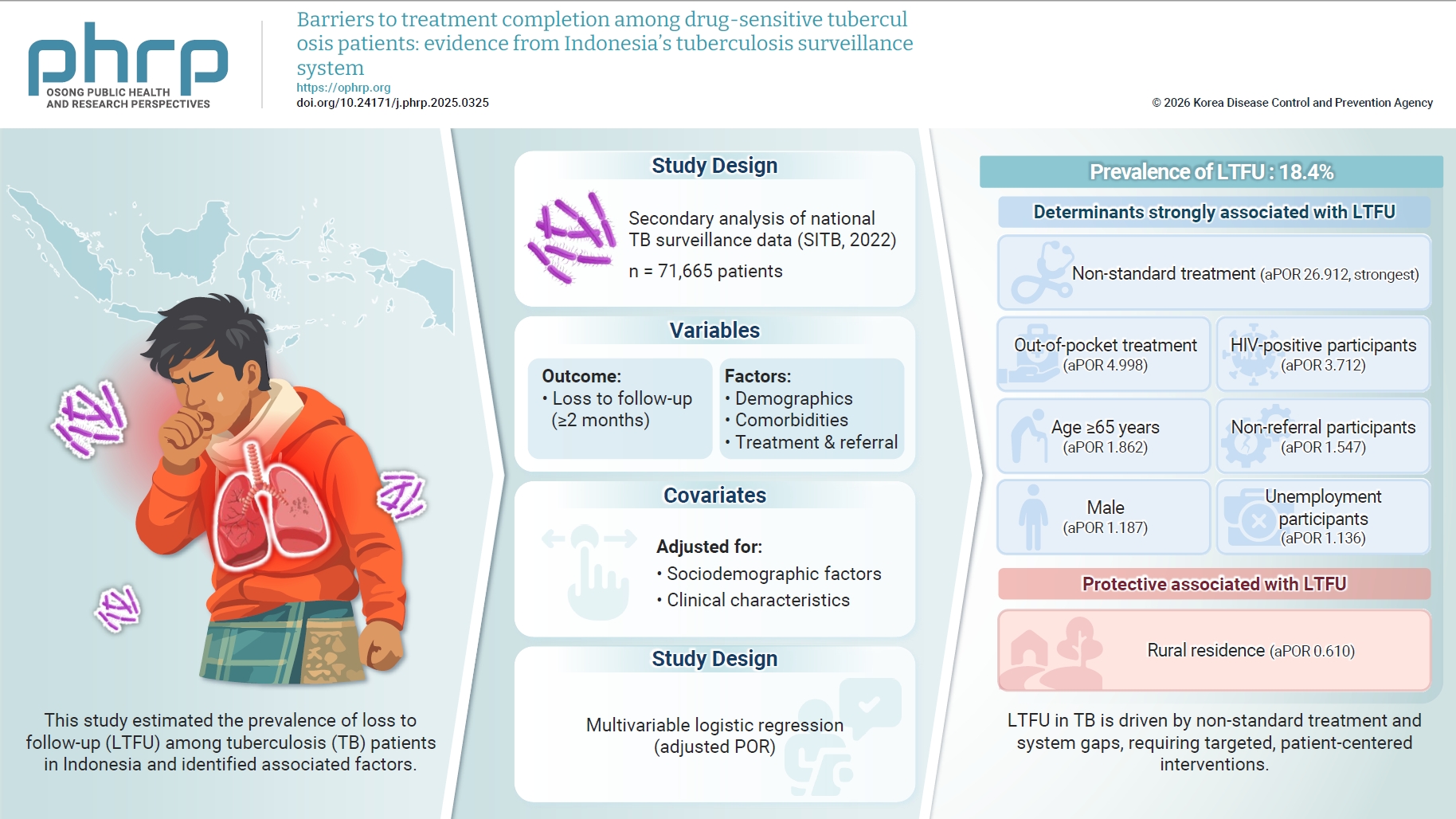
Objectives This study aimed to estimate the prevalence of loss to follow-up (LTFU) among tuberculosis (TB) patients in Indonesia and to identify associated factors.
Methods This study analyzed data from the 2022 Tuberculosis Information System in Indonesia. A total of 71,665 drug-sensitive TB patients were included in the analysis. Age, sex, employment status, diagnosis type, human immunodeficiency virus (HIV) status, diabetes mellitus, TB type, mode of treatment, treatment standard, referral status, and type of residence. Categorical variables were analyzed using chi-square tests, followed by multivariable logistic regression to identify confounder-adjusted independent predictors of LTFU.
Results The prevalence of LTFU was 18.4%. A higher likelihood of LTFU was observed among older adults aged ≥65 years (adjusted-prevalence-odds-ratio [aPOR], 1.862), men (aPOR, 1.187), unemployed individuals (aPOR, 1.136), non-referred patients (aPOR, 1.547), patients with HIV (aPOR, 3.712), and those obtaining TB drugs out of pocket (aPOR, 4.998). The strongest predictor was receipt of non-standard treatment, which was associated with a markedly increased likelihood of LTFU (aPOR, 26.912). In contrast, rural residence demonstrated a protective association (aPOR, 0.610). All associations were statistically significant (p<0.001).
Conclusion This study highlights a substantial burden of LTFU among TB patients in Indonesia, with nearly one in five patients discontinuing treatment. Multiple sociodemographic and clinical factors—particularly non-standard treatment, non-referral status, and HIV co-infection—were strongly associated with LTFU, underscoring gaps in the TB care continuum. These findings emphasize the need for targeted, patient-centered interventions, strengthened referral pathways, improved communication, and enhanced care coordination to reduce LTFU in high-risk groups.



 First
 Prev


