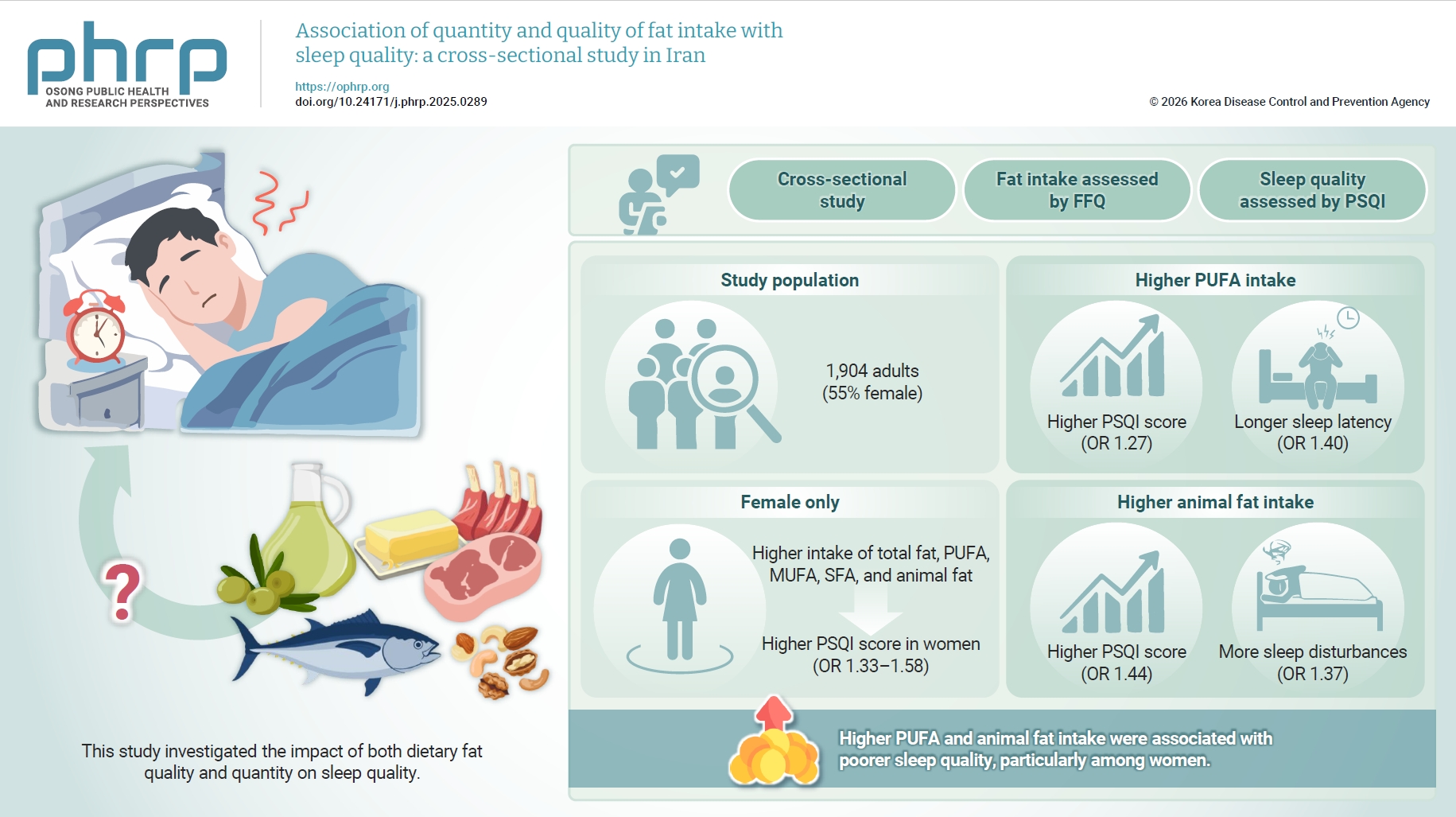
Objectives The association between dietary fat intake and sleep quality remains unclear. This study investigated the impact of both dietary fat quality and quantity on sleep quality.
Methods In this cross-sectional study, participants completed a food frequency questionnaire and Pittsburgh Sleep Quality Index to assess quantity and quality of fat intake and sleep quality.
Results A total of 1,904 participants (55% female) were included in the study. Participants in the highest tertile of polyunsaturated fatty acids (PUFA) intake, compared with those in the lowest tertile, had significantly higher total sleep quality scores (odds ratio [OR], 1.27; 95% confidence interval [CI], 1.01–1.62) and longer sleep onset latency (OR, 1.40; 95% CI, 1.08–1.83). Participants with higher animal fat intake exhibited higher total sleep quality scores (OR, 1.44; 95% CI, 1.09–1.89) and increased sleep disturbances (OR, 1.37; 95% CI, 1.02–1.83). Among women, those in the highest tertile compared with the lowest tertile showed increased odds of higher total sleep quality scores with total fat (OR, 1.37; 95% CI, 1.04–1.82), PUFA (OR, 1.41; 95% CI, 1.07–1.87), monounsaturated fatty acids (OR, 1.44; 95% CI, 1.09–1.90), saturated fatty acid (OR, 1.33; 95% CI, 1.01–1.77), and animal fat (OR, 1.58; 95% CI, 1.18–2.11).
Conclusion These findings suggest that higher intakes of PUFA and animal fat are associated with higher total sleep quality scores. When stratified by sex, higher intake of total fat and unsaturated fats was associated with higher total sleep quality scores in women only.


 First
 Prev


