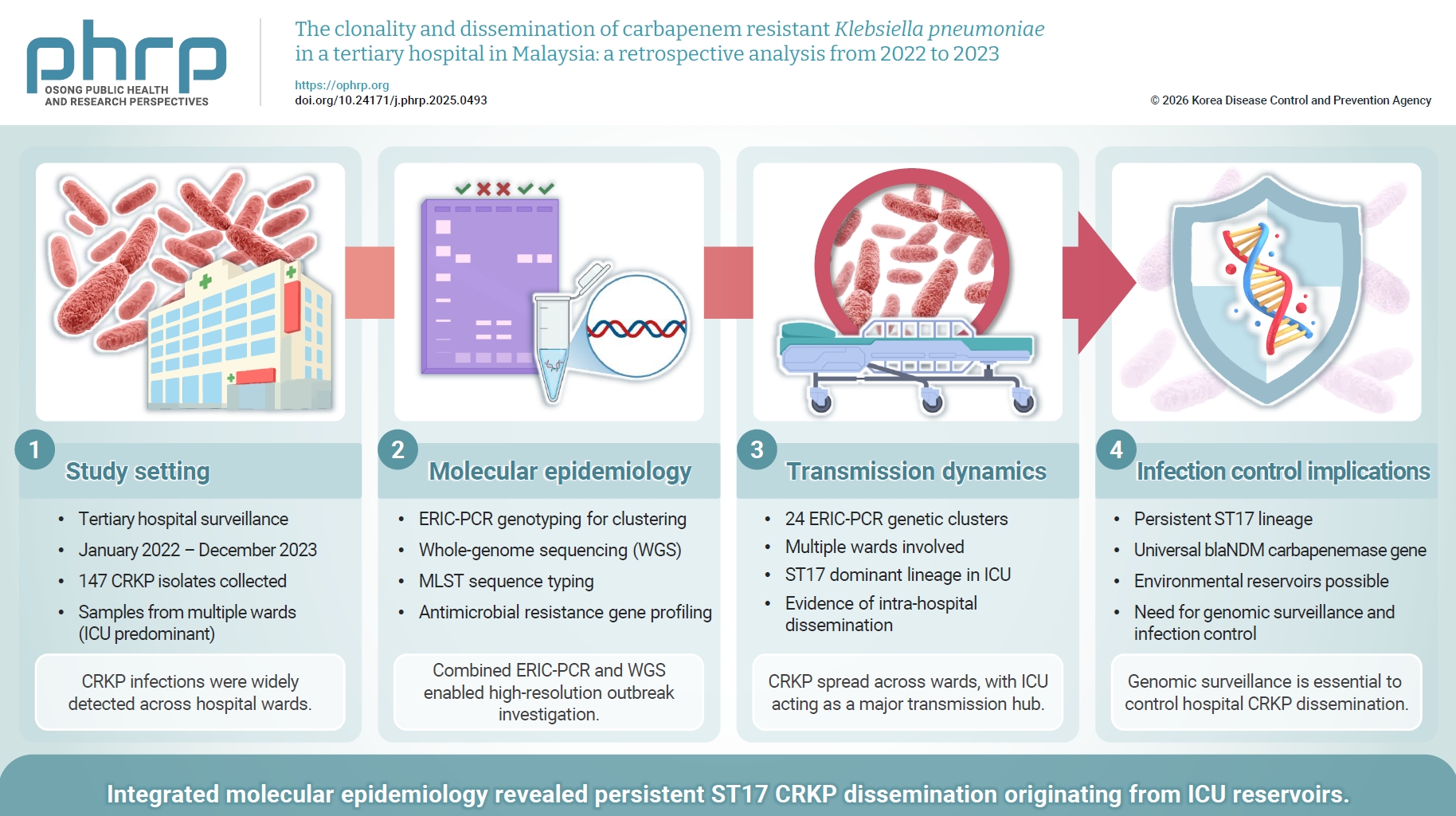
Objectives Cases of nosocomial carbapenem-resistant Klebsiella pneumoniae (CRKP) have been increasing steadily since the 1990s. In this study, we sought to assess CRKP clonal diversity and patterns of dissemination at Hospital Canselor Tuanku Muhriz (HCTM), a tertiary university hospital located in Kuala Lumpur, Malaysia. Methods: From January 2022 to December 2023, all CRKP isolates from HCTM were included in the investigation. Associated patient demographic data and clinical histories were retrieved from hospital records. Antibiotic susceptibility data for the collected isolates were obtained from the HCTM diagnostic laboratory. Molecular typing was performed using enterobacterial repetitive intergenic consensus polymerase chain reaction (ERIC-PCR) to identify genetic clusters. Based on ERIC-PCR clustering results and epidemiological investigations, selected CRKP isolates were subjected to whole-genome sequencing (WGS) to validate clonal relatedness, identify antimicrobial resistance genes, and establish phylogenomic relationships. Results: During the study period, a total of 147 CRKP isolates were recovered from various wards across HCTM. All isolates exhibited resistance to imipenem, meropenem, or ertapenem, with 124 isolates confirmed as carbapenemase producers. ERIC-PCR identified 24 genetic clusters disseminated across 23 wards within HCTM. Twelve CRKP isolates were selected for WGS based on integrated epidemiological investigation and ERIC-PCR genotyping; sequence typing revealed ST17 as the dominant circulating CRKP lineage in the intensive care unit, ward 6E, and possibly across the hospital. The carbapenemase gene bla_NDM was detected in all WGS-analyzed CRKP isolates. Conclusion: Integrating epidemiological investigation, phenotypic testing, molecular typing, and WGS is essential to understand resistance dynamics, map transmission, and guide hospital infection prevention strategies.
Objectives
<i>Vibrio vunificus</i> is known to cause septicemia and severe wound infections in patients with chronic liver diseases or an immuno-compromised condition. We carried out the molecular characterization of <i>V. vulnificus</i> isolates from human <i>Vibrio</i> septicemia cases based on pulsed-field gel electrophoresis (PFGE) using NotI and SfiI. Methods and Results
PFGE was used to characterize a total of 78 strains from clinical cases after NotI or SfiI digestion. The geographical distribution of PFGE patterns for the strains from the southern part of Korea, a high-risk region for <i>Vibrio</i> septicemia, indicated that the isolates from southeastern Korea showed a comparatively higher degree of homology than those from southwestern Korea. Conclusions
We report the genetic distribution of <i>V. vulnficus</i> isolated from <i>Vibrio</i> septicemia cases during 2000–2004 in Korea. This method has potential use as a subspecies-typing tool for <i>V. vulnificus</i> strains isolated from distant geographic regions.
Citations
Citations to this article as recorded by
Effect of Seawater Temperature Increase on the Occurrence of Coastal Vibrio vulnificus Cases: Korean National Surveillance Data from 2003 to 2016 Jungsook Kim, Byung Chul Chun International Journal of Environmental Research an.2021; 18(9): 4439. CrossRef
PCR-based evidence showing the presence of Vibrio vulnificus in wound infection cases in Mangaluru, India Caroline D’Souza, Ballamoole Krishna Kumar, Sachidananda Kapinakadu, Ranjith Shetty, Indrani Karunasagar, Iddya Karunasagar International Journal of Infectious Diseases.2018; 68: 74. CrossRef
Genotypic Diversity and Population Structure of Vibrio vulnificus Strains Isolated in Taiwan and Korea as Determined by Multilocus Sequence Typing Hye-Jin Kim, Jae-Chang Cho, Paul J Planet PLOS ONE.2015; 10(11): e0142657. CrossRef
The Road Less Traveled Chaeshin Chu Osong Public Health and Research Perspectives.2011; 2(1): 1. CrossRef



 First
 Prev


