Objectives The objectives of this review and meta-analysis were twofold: first, to determine the prevalence of substance use among school-going children in Arab and African countries; and second, to highlight the considerable influence of variables such as the nation’s region and the timeframe of the study on the prevalence of substance use.
Methods Research was sourced from Science Direct, Scopus, Web of Science, Google Scholar, and PubMed. Thirty-seven articles were incorporated in accordance with the PRISMA guidelines. This review included studies published from 2013 to 2023. The statistical meta-analysis was performed using Comprehensive Meta-Analysis ver. 3 software. Across 37 studies, the total number of study participants was 73,508.
Results The meta-analysis revealed that tobacco was the most commonly used substance, with a prevalence of 16% (95% confidence interval [CI], 12.7%–20.02%). This was closely followed by alcohol, which had a prevalence of 15% (95% CI, 10.5%–22.8%), stimulants at 11.4% (95% CI, 7.4%–17%), khat at 10% (95% CI, 5.7%–15%), and cannabis at 8% (95% CI, 3.3%–18.4%). Notably, alcohol was the only substance that showed an increasing trend in prevalence from before to after 2019, rising from 13.3% (95% CI, 6.2%–26.1%) to 17% (95% CI, 10.2%–27%) (p<0.001). Additionally, the prevalence of substance use varied significantly between Arab and African countries (p<0.001).
Conclusion Although the prevalence of substance use among school-going populations has significantly decreased over time, with the exception of alcohol, it is imperative that both African and Arab countries implement comprehensive measures and stringent laws to address the production and marketing of substances.
Citations
Citations to this article as recorded by
Association of Substance Use Pattern and Family Factors With Use-Related Problems According to Arabic Drug Abuse Screening Test-10: A Cross-Sectional Study Hussam Aly Sayed Murad, Marwan Bakarman Substance Use: Research and Treatment.2026;[Epub] CrossRef
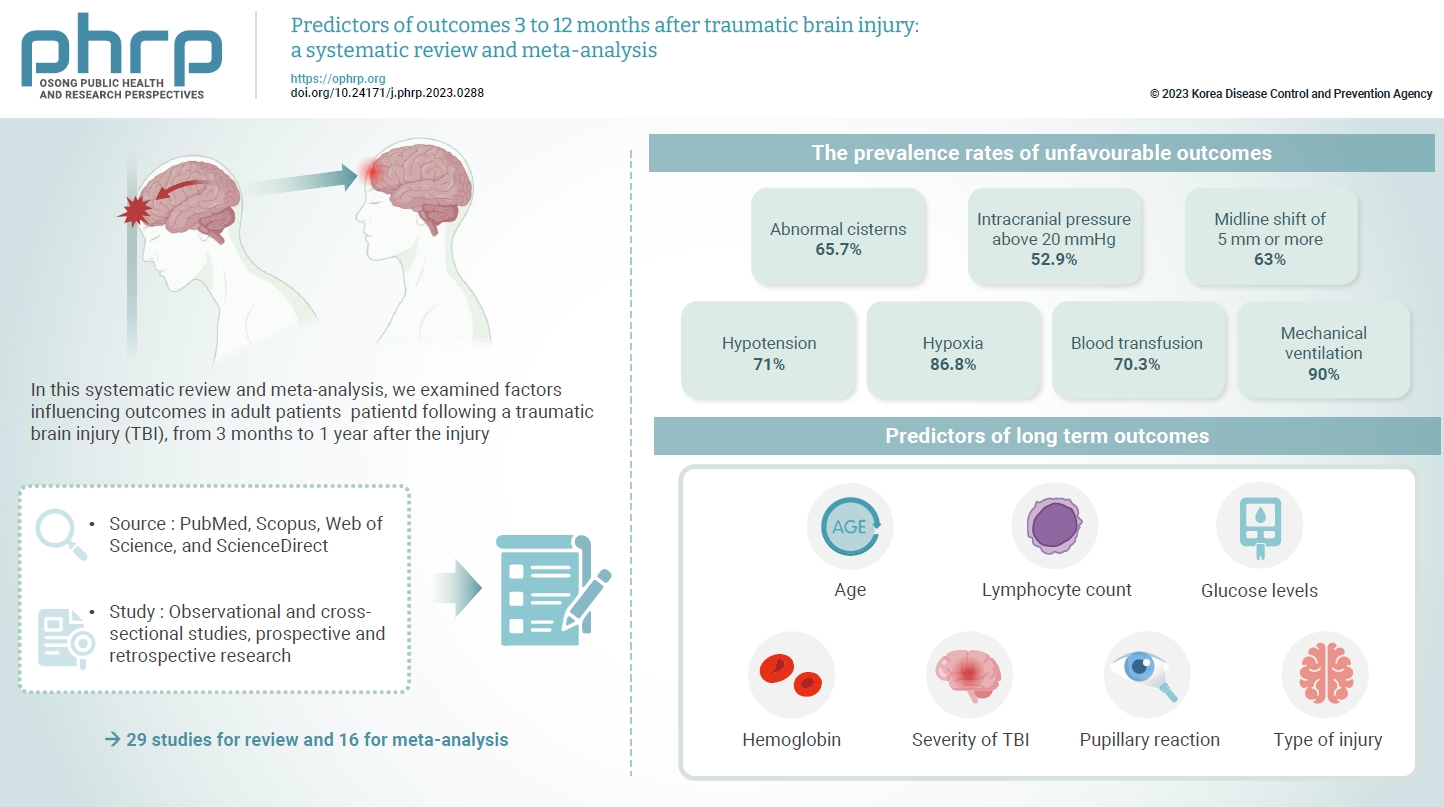
The exact factors predicting outcomes following traumatic brain injury (TBI) remain elusive. In this systematic review and meta-analysis, we examined factors influencing outcomes in adult patients with TBI, from 3 months to 1 year after injury. A search of four electronic databases—PubMed, Scopus, Web of Science, and ScienceDirect—yielded 29 studies for review and 16 for meta-analysis, in accordance with the Preferred Reporting Items for Systematic Reviews and Meta-Analysis guidelines. In patients with TBI of any severity, mean differences were observed in age (8.72 years; 95% confidence interval [CI], 4.77–12.66 years), lymphocyte count (−0.15 109/L; 95% CI, −0.18 to −0.11), glucose levels (1.20 mmol/L; 95% CI, 0.73–1.68), and haemoglobin levels (−0.91 g/dL; 95% CI, −1.49 to −0.33) between those with favourable and unfavourable outcomes. The prevalence rates of unfavourable outcomes were as follows: abnormal cisterns, 65.7%; intracranial pressure above 20 mmHg, 52.9%; midline shift of 5 mm or more, 63%; hypotension, 71%; hypoxia, 86.8%; blood transfusion, 70.3%; and mechanical ventilation, 90%. Several predictors were strongly associated with outcome. Specifically, age, lymphocyte count, glucose level, haemoglobin level, severity of TBI, pupillary reaction, and type of injury were identified as potential predictors of long-term outcomes.
Citations
Citations to this article as recorded by
Premorbid physical activity and recovery following an isolated acute traumatic brain injury: an exploratory study Naomie Maltais, Elaine de Guise, Maude Laguë-Beauvais, Laurence Trépanier, Jehane H. Dagher Global Neurological Insights.2026; 1(1): 100003. CrossRef
Association Between Sex and Mortality After Traumatic Brain Injury: A Systematic Review and Meta-Analysis Elise Beijer, Floor J. Mansvelder, Romein W. G. Dujardin, Nicole P. Juffermans, Linda J. Schoonmade, Leo M. G. Geeraedts, Frank W. Bloemers, Charissa E. van den Brom, Patrick Schober Neurocritical Care.2026; 45(1): 395. CrossRef
The severity of traumatic brain injury impacts the response to non-pharmacological treatment for post-traumatic amnesia: A retrospective observational study Èlia Vilageliu-Jordà, Antonia Enseñat-Cantallops, Alberto García-Molina Applied Neuropsychology: Adult.2026; : 1. CrossRef
Predictors of In-Hospital Mortality in Traumatic Acute Subdural Hematoma: The Role of Admission International Normalized Ratio, Imaging Parameters and Neurological Severity Serban Iancu Papacocea, Miruna Ioana Lazăr, Romica Cergan, Ioana Anca Badarau, Toma Marius Papacocea Biomedicines.2026; 14(6): 1388. CrossRef
A Systematic Review of Clinical Outcome Trajectories from 3 to 12 Months Following Mild or Moderate Traumatic Brain Injury Carl Marincowitz, Fiona Lecky, Abdullah Pandor, Ruth Wong, Thomas Shanahan, Michael Tonkins, Rajiv Singh, James Piercy, Andrew Maas, Lindsay Wilson Journal of Neurotrauma.2026;[Epub] CrossRef
Distinct Five-Year Latent Class Trajectories and Predictors of Functional Cognitive Independence Following Traumatic Brain Injury: A TBI Model Systems Study Evan D. Feigel, Charlotte B. Luster, Chris W. Lewis, Brenna Finegan, Michael J. Mastrodicasa, Maëlle-Marie Troadec, David Guo, Ben Olsen, Ignacio Fuentes, Joseph T. Giacino, Regina Barzilay, Daniel H. Daneshvar Neurotrauma Reports.2026;[Epub] CrossRef
Traumatic Brain Injury and Artificial Intelligence: Shaping the Future of Neurorehabilitation—A Review Seun Orenuga, Philip Jordache, Daniel Mirzai, Tyler Monteros, Ernesto Gonzalez, Ahmed Madkoor, Rahim Hirani, Raj K. Tiwari, Mill Etienne Life.2025; 15(3): 424. CrossRef



 First
 Prev


