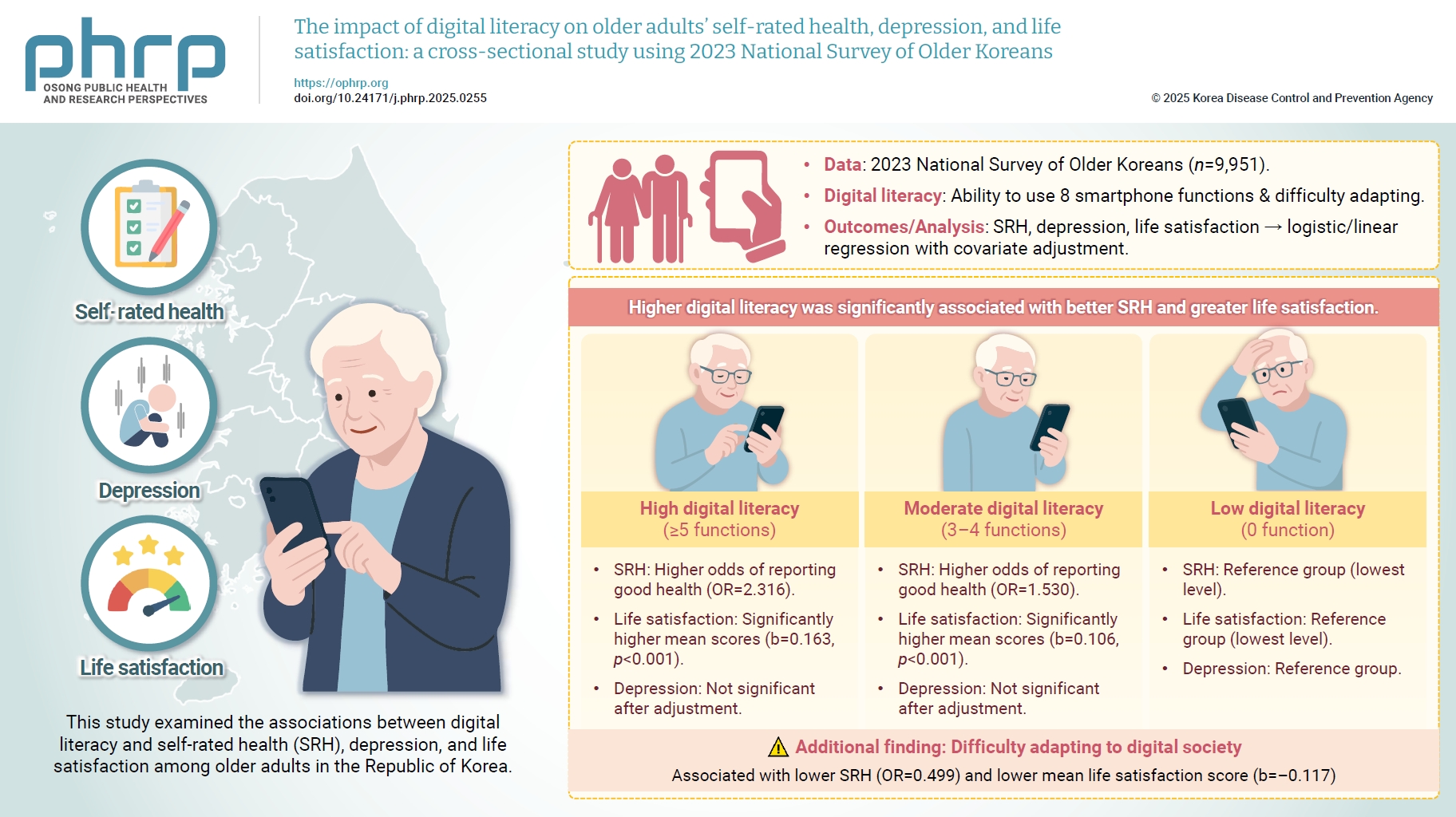
Objectives This study examined the associations between digital literacy and self-rated health (SRH), depression, and life satisfaction among older adults in the Republic of Korea.
Methods Data were obtained from the 2023 National Survey of Older Koreans (n=9,951). Digital literacy was evaluated based on participants’ ability to use 8 smartphone functions and their perceived difficulty adapting to a digital society. Dependent variables included SRH, depression (measured using the short form of Geriatric Depression Scale), and life satisfaction (assessed through a composite score across 7 domains). Multiple logistic regression was applied for SRH and depression, while linear regression was conducted for life satisfaction, adjusting for sociodemographic and health-related covariates.
Results Higher digital literacy was significantly associated with better SRH and greater life satisfaction. Compared to participants with no digital skills, those with moderate or high digital literacy had higher odds of reporting good SRH and significantly higher life satisfaction scores. Older adults who reported difficulty adapting to a digital society demonstrated significantly lower SRH and life satisfaction. However, after adjusting for covariates, the association between digital literacy and depression was not statistically significant.
Conclusion Higher digital literacy is linked to better SRH and greater life satisfaction. Moreover, digital literacy reduced the explanatory power of socioeconomic variables, suggesting that it serves as an important behavioral determinant. These findings underscore the importance of promoting digital literacy as a means of improving health equity and well-being in aging populations.
Citations
Citations to this article as recorded by
The Effect of Digital Literacy on Depression Among Older Adults With Chronic Diseases: The Moderating Role of Self-Rated Health Hyein Seo, Subin Yu The International Journal of Aging and Human Devel.2026; 103(4): 480. CrossRef
Digital device use and disparities in health literacy among older adults Heeran Chun, Cheong-Seok Kim, Il-Ho Kim Korean Journal of Health Education and Promotion.2026; 43(2): 87. CrossRef
Impact of an Interaction-Oriented, Information and Communication Technology-Based Community Care Service on Nutritional Status and Dietary Behavior of Community-Dwelling Older Adults: A Quasi-Experimental Study Seojin Yun, Seulgi Lee, Eun Young Lee, Kirang Kim Preventive Nutrition and Food Science.2026;[Epub] CrossRef
Predicting longitudinal depressive symptom trajectories among older Chinese adults with chronic health conditions: An interpretable machine learning study Zhan Yu, Anao Zhang, Kaipeng Wang, Qiuling An, Meiyan Chen, Yuting Wang, Zeqiang Wang International Psychogeriatrics.2026; : 100270. CrossRef
Sustaining Social Connection in a Super-Aged Society: Changes in the Association Between Social Ties and Life Satisfaction Among Korean Older Adults, 2011–2023 Seonmi Choi, Junghyun Kim Sustainability.2026; 18(18): 9449. CrossRef
Digital Ageism and Ageism Among Middle-Aged and Older Adults and the Mediating Role of Expectations Regarding Aging: A Cross-Sectional Study Gahye Kim, Aeri Jung Research in Community and Public Health Nursing.2026; 37: 403. CrossRef
Disaggregating Digital Competence: Social Activity Participation and Depressive Symptoms Among Korean Older Adults Young-Mi Jung, NakHyeok Choi Behavioral Sciences.2026; 16(10): 1742. CrossRef
The impact of digitalisation on the development of physical activity of older people (through the example of European Union countries) Zhaxat Kenzhin, Tursynzada Kuangaliyeva, Assem Aitkaliyeva, Yerbol Myrzabossynov, Aigerim Zhunussova, Odiljon Dadabayev Frontiers in Public Health.2026;[Epub] CrossRef
Objectives Social activities are important and influential factors for healthy aging. However, limited information is available regarding the associations of the type and intensity of social participation with health and well-being. This study aimed to investigate how various types of social activities are associated with several dimensions of health outcomes. Methods: This cross-sectional study utilized data from the Seventh Korean Longitudinal Study of Aging, which included 5,526 adults aged 60 years and older. Multivariate linear regression analysis was employed to analyze the associations of social activities with depression, self-rated health, and life satisfaction. Additionally, subgroup analyses by sex and age were performed. Results: Among the participants, 73.5% reported involvement in at least 1 of the 4 types of social engagement. After adjustment for all covariates, individuals who participated in any social activity reported better self-rated health and higher life satisfaction compared to those who did not participate. However, the intensity of engagement in different social activities had varying impacts on subjective health outcomes. An increased level of participation was associated with a lower rate of depression and improved self-rated health. However, no significant differences were observed in the relationship between the intensity of participation in activities (with the exception of alumni societies or family councils) and life satisfaction. Conclusion: This study suggests that to improve their health, older adults in the Republic of Korea should not only engage in social activities but also do so actively and regularly.
Citations
Citations to this article as recorded by
Impact of Depression on Self-Rated Health Status among Community-Dwelling Older Adults: Moderating Effects of Subjective Social Status and Formal Social Participation Using Data from the Ninth Korean Longitudinal Study of Aging (2022) Sohee Jung, Eunhee Yang, Soyoung Cha, Wonhee Baek Journal of Fundamental Nursing Science.2026; 33(1): 147. CrossRef
Disaggregating Digital Competence: Social Activity Participation and Depressive Symptoms Among Korean Older Adults Young-Mi Jung, NakHyeok Choi Behavioral Sciences.2026; 16(10): 1742. CrossRef
Gender differences in advanced activities of daily living: evidence from the longitudinal study of health and aging in Mexico 2012–2018 Martha A. Sánchez-Rodríguez, Mariano Zacarías-Flores, Lesly Estefanía Castañeda-Sánchez, Víctor Manuel Mendoza-Núñez Frontiers in Aging.2025;[Epub] CrossRef
The Associations Between Physical Activity, Body Perception, and Self-Rated Health in Korean Adults: An Analysis of the 2023 Korean Community Health Survey Geun-Kook Kim, Su-Yeon Roh, Sung-Ho Hwang Medicina.2025; 61(11): 1898. CrossRef




 First
 Prev


