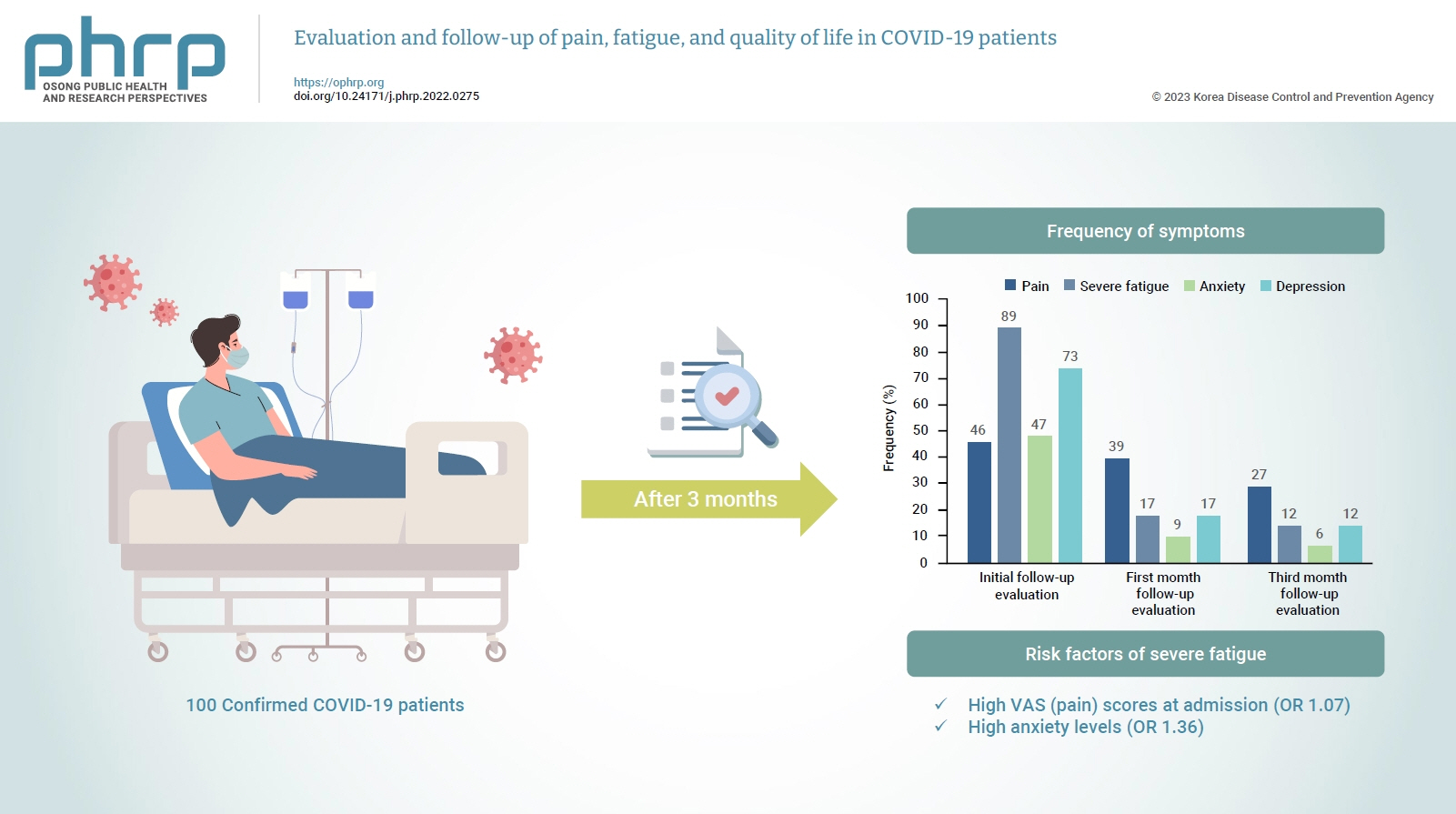
Objectives We evaluated pain, fatigue, anxiety, depression, and quality of life in patients hospitalized for coronavirus disease 2019 (COVID-19) and observed them over a period of 3 months. We also investigated the relationship of these symptoms to age, sex, disease severity, and levels of anxiety and depression. Methods: The study included 100 confirmed COVID-19 patients (i.e., positive on a polymerase chain reaction test) between the ages of 18 and 75 years. Pain (visual analog scale [VAS]), fatigue (fatigue severity scale), anxiety, and depression (hospital anxiety and depression scales) were evaluated on the first day of hospitalization and at 1-month and 3-month follow-ups. The short form-12 questionnaire was used to measure quality of life at the 1-month and 3-month followups. Results: No differences were found in pain, fatigue, anxiety levels, depression levels, and quality of life according to disease severity. High VAS scores at hospital admission were related to continued pain at the 3-month follow-up (odds ratio [OR], 1.067; p<0.001). High VAS (OR, 1.072; p=0.003) and anxiety levels (OR, 1.360; p=0.007) were related to severe fatigue at the 3-month evaluation. Conclusion: Pain, fatigue, anxiety, and depression appear to be long-term sequelae of COVID-19 and can affect quality of life. High VAS and anxiety levels were found to be associated with long-term fatigue.
Citations
Citations to this article as recorded by
Estimating the prevalence of persistent symptoms after SARS-CoV-2 infection (post-COVID-19 syndrome): a regional cross-sectional study protocol Lindybeth Sarmiento Varón, Hermy Alvarez, Leyla Carolina Huirimilla Casanova, Maria Paz Díaz Mora, Luis Alfredo Muñoz Cuevas, Jorge Gonzalez-Puelma, Karena Espinoza, Lidia Amarales, Jonathan Lühr Henriquez, Felipe Retamal-Matus, Roberto Uribe-Paredes, Cri BMJ Open.2025; 15(5): e093844. CrossRef
Changes in prevalence of anxiety and depression among COVID-19 patients during a two-year recovery period: A systematic review and meta-analysis Qingxiang Shang, Ke Xu, Hong Ji, Qigang Dai, Hao Ju, Haodi Huang, Jianli Hu, Changjun Bao Journal of Psychosomatic Research.2024; 178: 111602. CrossRef
The Prevalence and Associated Factors of Post-COVID-19 Fatigue: A Systematic Review and Meta-Analysis Wangjuan Hu, Rongzhu Tang, Siyuan Gong, Jihong Liu, Jia Li, Chunlian Liao Cureus.2024;[Epub] CrossRef
Predicting higher risk factors for COVID-19 short-term reinfection in patients with rheumatic diseases: a modeling study based on XGBoost algorithm Yao Liang, Siwei Xie, Xuqi Zheng, Xinyu Wu, Sijin Du, Yutong Jiang Journal of Translational Medicine.2024;[Epub] CrossRef
Covid-19 Salgını Sürecinde Sağlık Personelinin Fiziksel Aktivite Düzeyi, Yaşam Kalitesi ve Yorgunluk Düzeyi Arasındaki İlişki Kağan Üstün, Zeynep Yıldız Kızkın, Masoud Amır Rashedı Bonab, Mehmet Armağan, Yusuf Hasırcı, Tuğba Kuru Çolak Sakarya Üniversitesi Holistik Sağlık Dergisi.2023; 6(3): 419. CrossRef



 First
 Prev


