Dayoung Kim, Sooyoung Kim, Jin Myoung Seok, Kyong Jin Shin, Eungseok Oh, Mi Young Jeon, Joungkyu Park, Hee Jin Chang, Jinyoung Youn, Jeeyoung Oh, Eunhee Sohn, Jinse Park, Jin Whan Cho, Byoung Joon Kim
Osong Public Health Res Perspect 2024;15(2):174-181. Published online April 30, 2024
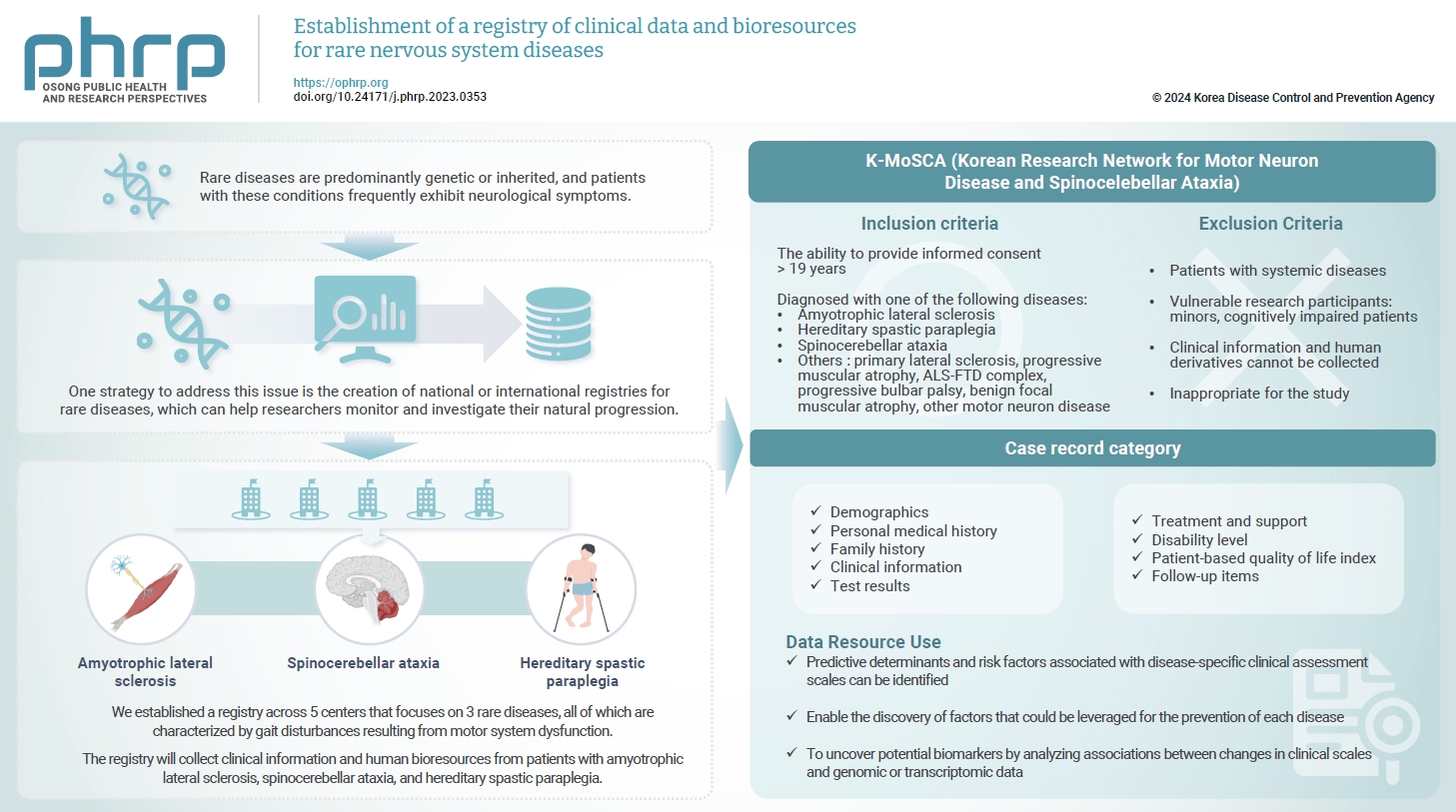
Rare diseases are predominantly genetic or inherited, and patients with these conditions frequently exhibit neurological symptoms. Diagnosing and treating many rare diseases is a complex challenge, and their low prevalence complicates the performance of research, which in turn hinders the advancement of therapeutic options. One strategy to address this issue is the creation of national or international registries for rare diseases, which can help researchers monitor and investigate their natural progression. In the Republic of Korea, we established a registry across 5 centers that focuses on 3 rare diseases, all of which are characterized by gait disturbances resulting from motor system dysfunction. The registry will collect clinical information and human bioresources from patients with amyotrophic lateral sclerosis, spinocerebellar ataxia, and hereditary spastic paraplegia. These resources will be stored at ICreaT and the National Biobank of Korea. Once the registry is complete, the data will be made publicly available for further research. Through this registry, our research team is dedicated to identifying genetic variants that are specific to Korean patients, uncovering biomarkers that show a strong correlation with clinical symptoms, and leveraging this information for early diagnosis and the development of treatments.
<sec>
<title>Objectives</title>
<p>Despite all the efforts and increased knowledge of rabies, the exact mechanisms of infection and mortality from the rabies virus are not well understood. To understand the mechanisms underlying the pathogenicity of rabies virus infection, it is crucial to study the tissue that the rabies virus naturally infects in humans.</p></sec>
<sec>
<title>Methods</title>
<p>Cerebellum brain tissue from 9 human post mortem cases from Iran, who had been infected with rabies virus, were examined histopathologically and immunohistochemically to evaluate the innate immune responses against the rabies virus.</p></sec>
<sec>
<title>Results</title>
<p>Histopathological examination revealed inflammation of the infected cerebellum and immunohistochemical analyses showed an increased immunoreactivity of heat shock protein 70, interleukin-6, interleukin-1, tumor necrosis factor-alpha, caspase-3, caspase-9, toll-like receptor3 and toll-like receptor4 in the infected brain tissue.</p></sec>
<sec>
<title>Conclusion</title>
<p>These results indicated the involvement of innate immunity in rabies infected human brain tissue, which may aggravate the progression of this deadly disease.</p></sec>
Citations
Citations to this article as recorded by
Evaluation of the effectiveness of cerium nanoparticles as a potential adjuvant in veterinary rabies vaccine Milad Zandi, Javad Malakootikhah, Mohammad Sadeq Khosravy, Shohreh Shahmahmoudi, Abbas Mirshafiey, Rouzbeh Bashar, Behzad Pourhossein, Firouzeh Farahtaj, Reza Ahangari Cohan, Maryam Fazeli Microbial Pathogenesis.2026; 213: 108366. CrossRef
The Critical Role of Rabies Prevention in Public Health Nazanin Shabansalmani, Maryam Fazeli, Hesamoddin Ahmadi Afzadi, Behzad Pourhossein, Rouzbeh Bashar International Journal of Environmental Health Engi.2026;[Epub] CrossRef
Peripheral human mAb therapy yields modulation of neuroinflammation and long-term functional recovery from lyssavirus infection Celeste Huaman, Yan Xu, Nathaniel M. Lott, Elise M. Santorella, Madeline Rader, Allison M. Strazzella, Caitlyn Clouse, Jocelyn M. King, Mattie Melnyk, Junping Hong, Lianying Yan, Adrian C. Paskey, Andrea E. Luquette, Francisco Malagon, Regina Z. Cer, Kimb Emerging Microbes & Infections.2026;[Epub] CrossRef
Knowledge, attitudes, and preventive behaviors toward rabies among urban residents in Bangkok, Thailand: Implications for targeted One Health rabies elimination strategies Kittithat Luenglertamorn, Taksaporn Borvornpadungkitti, Rapee Luangyawee, Siwat Choksuchat, Atithan Paoya, Anisa Techakunpongkorn, Seema Vijay Medhe, Manoj Tukaram Kamble, Saharuetai Jeamsripong Veterinary World.2026; : 4159. CrossRef
Morphological features of central and peripheral nervous system involvement in rabies with perivascular changes L.V. Moroz, A.M. Berezovskyi, O.S. Androsova, S.M. Kulias, O.O. Popovych, I.Yu. Bondaruk, V.S. Sherstiuk Reports of Morphology.2026; 32(3): 24. CrossRef
A comparative analysis of the dendritic cell response upon exposure to different rabies virus strains Keshia Kroh, Merel R. te Marvelde, Lars W. van Greuningen, Brigitta M. Laksono, Marion P. G. Koopmans, Thijs Kuiken, Corine H. GeurtsvanKessel, Carmen W. E. Embregts, Husain Poonawala PLOS Neglected Tropical Diseases.2025; 19(4): e0012994. CrossRef
Postmortem diagnosis of human rabies viral encephalitis: Insights into pathogenesis through the vigilant lens of the forensic pathologist! Ravi H Phulware, Akash Dhiman, Yashpal Sindhu, Ravi P Meshram, Salu Chandran, Arvind Kumar Medico-Legal Journal.2025; 93(4): 244. CrossRef
Molecular Mechanisms Associated with Neurodegeneration of Neurotropic Viral Infection Prapimpun Wongchitrat, Theerawut Chanmee, Piyarat Govitrapong Molecular Neurobiology.2024; 61(5): 2881. CrossRef
Systematic development of immunohistochemistry protocol for large cryosections-specific to non-perfused fetal brain Karthika Pandurangan, Jaikishan Jayakumar, Stephen Savoia, Reetuparna Nanda, S. Lata, E. Harish Kumar, Suresh S., Sudha Vasudevan, Chitra Srinivasan, Jayaraj Joseph, Mohanasankar Sivaprakasam, Richa Verma Journal of Neuroscience Methods.2024; 405: 110085. CrossRef
Biosensor as an alternative diagnostic method for rabies virus detection: A literature review Milad Zandi, Sajad Zandi, Ramin Mohammadi, Parastoo Hosseini, Samane Teymouri, Saber Soltani, Azadeh Rasouli Biotechnology and Applied Biochemistry.2022; 69(4): 1348. CrossRef
Immunohistochemical diagnosis of human infectious diseases: a review Hamadou Oumarou Hama, Gérard Aboudharam, Rémi Barbieri, Hubert Lepidi, Michel Drancourt Diagnostic Pathology.2022;[Epub] CrossRef
Mitochondrial Dysfunction in Rabies Virus-Infected Human and Canine Brains Pulleri Kandi Harsha, Sathyanarayanan Ranganayaki, Gowri Yale, Gourav Dey, Kiran K. Mangalaparthi, Anusha Yarlagadda, B. K. Chandrasekhar Sagar, Anita Mahadevan, M. M. Srinivas Bharath, Reeta S. Mani Neurochemical Research.2022; 47(6): 1610. CrossRef
A rare fatal case of rabies coexisting with COVID-19 Rabi Narayan Hota, Shalendra Singh, Rakesh Sharma, Pallavi Khandare Journal of Acute Disease.2022; 11(3): 129. CrossRef
Enhancement of immune responses by co-stimulation of TLR3 - TLR7 agonists as a potential therapeutics against rabies in mouse model Firouzeh Farahtaj, Alireza Gholami, Mohammad Sadeq Khosravy, Safoora Gharibzadeh, Hamid Mahmoudzadeh Niknam, Amir Ghaemi Microbial Pathogenesis.2021; 157: 104971. CrossRef
Establishment of Human-Induced Pluripotent Stem Cell-Derived Neurons—A Promising In Vitro Model for a Molecular Study of Rabies Virus and Host Interaction Thanathom Chailangkarn, Nathiphat Tanwattana, Thanakorn Jaemthaworn, Sira Sriswasdi, Nanchaya Wanasen, Sithichoke Tangphatsornruang, Kantinan Leetanasaksakul, Yuparat Jantraphakorn, Wanapinun Nawae, Penpicha Chankeeree, Porntippa Lekcharoensuk, Boonlert L International Journal of Molecular Sciences.2021; 22(21): 11986. CrossRef
Beneficial and Detrimental Effects of Regulatory T Cells in Neurotropic Virus Infections Malgorzata Ciurkiewicz, Vanessa Herder, Andreas Beineke International Journal of Molecular Sciences.2020; 21(5): 1705. CrossRef
Characterization of the Th17 profile immune response in cases of human rabies transmitted by dogs and its interference in the disease pathogenesis. L.B. Santos, F. Guedes, S.M. Achkar, M.I.S. Duarte, I.S.S. Katz, S.R. Silva, E.R. Fernandes Journal of Neuroimmunology.2020; 344: 577263. CrossRef
Quantitative proteomics leads to identify dog brain proteins involved in rabies virus infection: implication in understanding viral pathophysiology Suchismita Behera, Rajesh Raghunath Pharande, R. Rajendra Reddy, Sharmila B. Majee, Sandeepan Mukherjee, Amol Ratnakar Suryawanshi Journal of Proteins and Proteomics.2020; 11(4): 241. CrossRef
Feral dog bite causing paralytic rabies: Difficult diagnosis and failure of prevention Hussein Algahtani, Bader Shirah, Emna Chtourou, Osama Abuhawi, Nawal Abdelghaffar, Mohammad Alshehri Saudi Journal for Health Sciences.2020; 9(3): 260. CrossRef



 First
 Prev


