Objectives To develop and evaluate forecasting models using the Holt-Winters statistical approach and the long short-term memory (LSTM) deep learning method for weekly seasonal influenza-like illness (ILI) incidences in Saudi Arabia. The study compares model performance and assesses the predictive value added by incorporating region-specific exogenous variables within Middle Eastern epidemiological modeling.
Methods This study compared the performance of Holt-Winters and LSTM models in forecasting weekly ILI cases in Saudi Arabia, using data collected from 2017 to 2022. Time series analysis integrated exogenous variables including climatic conditions and population mobility trends. The Holt-Winters model employed both additive and multiplicative seasonal components. Model performance was evaluated using root mean squared error (RMSE), mean absolute percentage error, and R2.
Results The best-performing model, LSTM with exogenous variables, achieved an RMSE of 28.55, mean absolute error (MAE) of 0.14, R2 of 0.96, and percent bias (PBIAS) of +2.1%, indicating negligible systematic error. The LSTM model without exogenous variables demonstrated slightly lower accuracy (RMSE of 34.07, MAE of 0.18, R2 of 0.93, PBIAS of +5.8%), indicating strong predictive capability but less precision in determining peak ILI cases. The Holt-Winters model effectively captured seasonal and long-term trends, but showed a moderate performance with an RMSE of 82.57, MAE of 0.38, R2 of 0.58, and a high PBIAS of +14.2%, revealing significant unexplained variability during periods of high incidence fluctuation.
Conclusion This study highlights the respective strengths and limitations of statistical and machine learning approaches for ILI forecasting.
Citations
Citations to this article as recorded by
Early-warning prediction of visceral leishmaniasis mortality using a multivariate STL–deep learning hybrid approach on 20 years of monthly time series Fathelrhman El Guma, Maaweya Awadalla, Halah Z. Al Rawi, Bashayer Saeed, Huda M. Alshanbari, Alshaikh A. Shokeralla, Bandar Alosaimi Frontiers in Public Health.2026;[Epub] CrossRef
A hybrid STL–LightGBM framework with probabilistic forecasting for Influenza A incidence in the post-pandemic Saudi Arabia Reham M. Alahmadi, Maaweya Awadalla, Bashayer Saeed, Huda M. Alshanbari, Alshaikh A. Shokeralla, Ali Atif Yassin, Bandar Alosaimi, Fathelrhman El Guma Frontiers in Public Health.2026;[Epub] CrossRef
Bayesian inference for modeling seasonal influenza transmission under control measures Rania Saadeh, Naseam Al-Kuleab, Fathelrhman EL Guma, Alshaikh A. Shokeralla, Suliman Jamiel M. Abdalla, Mohamed A. Abdoon, Mohamed Hafez Results in Control and Optimization.2026; 23: 100714. CrossRef
Machine Learning-Based Prediction of Seasonal Influenza Trends in Saudi Arabia: A Tool for Regional Public Health Planning Alshaikh A. Shokeralla, Fathelrhman El Guma, Ali H. Abdalla, Amal E.Y. Hagsddig, Rahma AbuBakr Musa, M.A.M. Eltaweel, Abdelaziz H. Elawad, Ibrahim Elshamy International Journal of Statistics in Medical Res.2025; 14: 688. CrossRef
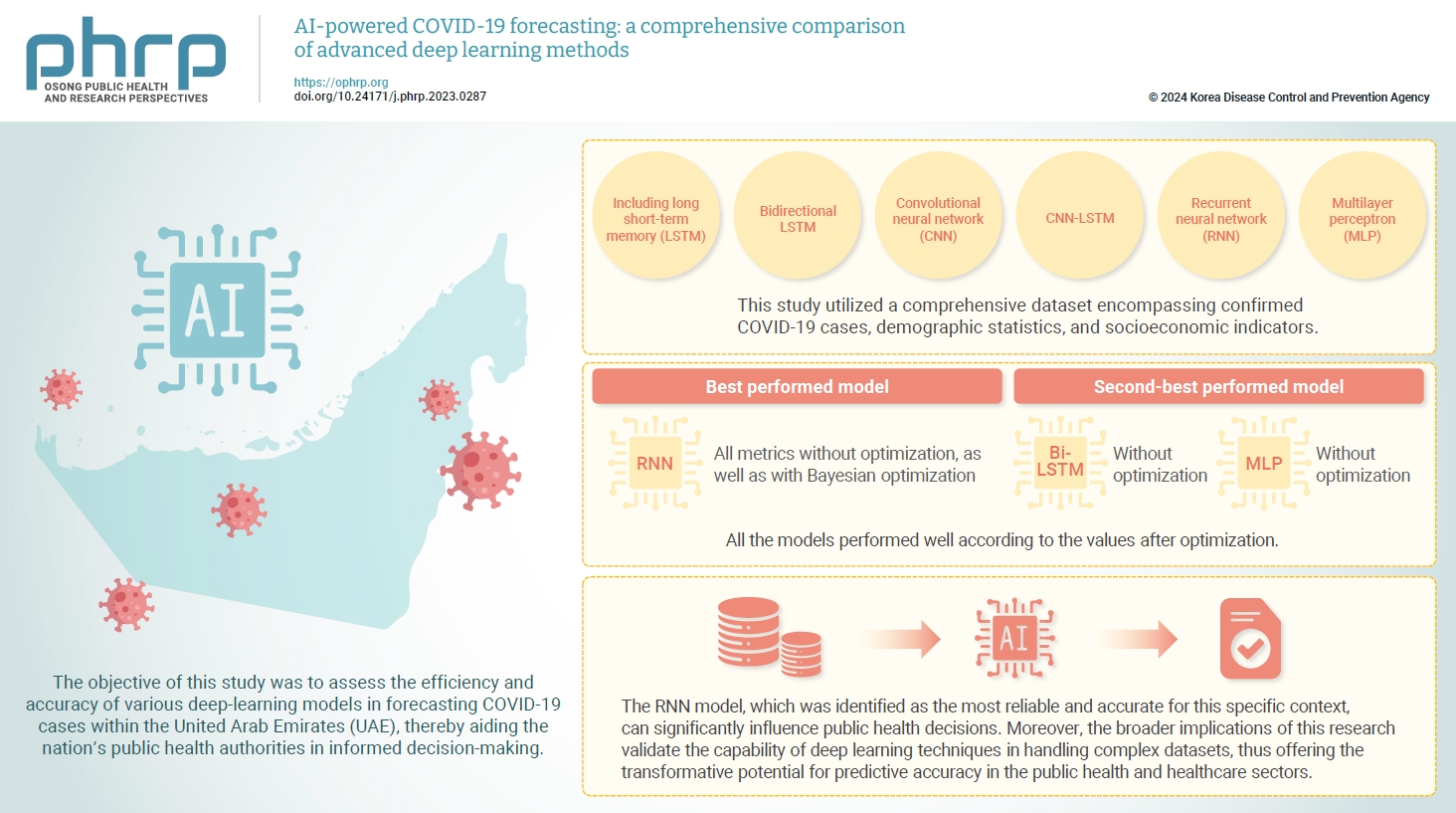
Objectives The coronavirus disease 2019 (COVID-19) pandemic continues to pose significant challenges to the public health sector, including that of the United Arab Emirates (UAE). The objective of this study was to assess the efficiency and accuracy of various deep-learning models in forecasting COVID-19 cases within the UAE, thereby aiding the nation’s public health authorities in informed decision-making. Methods: This study utilized a comprehensive dataset encompassing confirmed COVID-19 cases, demographic statistics, and socioeconomic indicators. Several advanced deep learning models, including long short-term memory (LSTM), bidirectional LSTM, convolutional neural network (CNN), CNN-LSTM, multilayer perceptron, and recurrent neural network (RNN) models, were trained and evaluated. Bayesian optimization was also implemented to fine-tune these models. Results: The evaluation framework revealed that each model exhibited different levels of predictive accuracy and precision. Specifically, the RNN model outperformed the other architectures even without optimization. Comprehensive predictive and perspective analytics were conducted to scrutinize the COVID-19 dataset. Conclusion: This study transcends academic boundaries by offering critical insights that enable public health authorities in the UAE to deploy targeted data-driven interventions. The RNN model, which was identified as the most reliable and accurate for this specific context, can significantly influence public health decisions. Moreover, the broader implications of this research validate the capability of deep learning techniques in handling complex datasets, thus offering the transformative potential for predictive accuracy in the public health and healthcare sectors.
Citations
Citations to this article as recorded by
Opportunities and challenges of artificial intelligence in public health: a systematic review on technological efficacy, ethical dilemmas, and governance pathways Qin Gao, Lin Chen, Zhenyu Huang Frontiers in Public Health.2026;[Epub] CrossRef
Enhancing Influenza-Like Illness forecasting: An ensemble approach combining mathematical and deep learning models amidst the COVID-19 pandemic Ganghyun Yoon, Amanda Bleichrodt, Gerardo Chowell, Sunmi Lee Epidemics.2026; 54: 100901. CrossRef
Artificial Intelligence during a Public Health Crisis: A Trend Analysis of COVID-19 Research Sunghye Choi, Chang Kil Lee, Dohyeong Kim Journal of Environmental Health Sciences.2025; 51(3): 109. CrossRef
Detecting outbreaks using a spatial latent field Cosmin Safta, Jaideep Ray, Wyatt Bridgman, Yoo Min Park PLOS One.2025; 20(7): e0328770. CrossRef
Wastewater as an early indicator for short-term forecasting COVID-19 hospitalization in Germany Jonas Radermacher, Steffen Thiel, Aimo Kannt, Holger Fröhlich BMC Public Health.2025;[Epub] CrossRef
Potential impacts of socio-economic changes on urban acoustic environment: evidence from 20 cities in Southern China Ping Lu, Kai Yuan Zhan, Wei Zhen Xu, Wei Ren, Jiang Liu, Xin-Chen Hong Environment, Development and Sustainability.2025;[Epub] CrossRef
Bridging statistics and deep learning: a causal data-fusion framework for epidemic prediction Vasileios E. Papageorgiou, Georgios Petmezas, Aristeidis Georgakis, Nicos Maglaveras, George Tsaklidis Communications in Statistics - Simulation and Comp.2025; : 1. CrossRef




 First
 Prev


