Objectives To increase the efficiency of hemodialysis, an appropriate vascular pathway must be created, and its function must be maintained. This study aimed to identify the effects of an arteriovenous fistula (AVF) stenosis prevention program on upper muscular strength, blood flow, physiological indexes, and self-efficacy among patients receiving hemodialysis.
Methods The participants were patients receiving hemodialysis at Keimyung University Dongsan Medical Center in Daegu, Republic of Korea. They were divided into experimental and control groups based on the day of the week they received hemodialysis at the outpatient department and included 25 participants each. The study was conducted for 8 weeks.
Results The AVF stenosis prevention program was effective in improving upper extremity muscle strength (F=15.23, p<0.001) and blood flow rate (F=36.00, p<0.001). As a result of the program, the phosphorus index level, which is a physiological indicator in hemodialysis patients, decreased (F=8.64, p<0.001). Encouragement and support through text messages and practice lists also resulted in an increase in self-efficacy (F=18.62, p<0.001).
Conclusion The AVF stenosis prevention program in this study resulted in an increase in upper extremity muscle strength through grip strength exercises and was effective in preventing AVF stenosis by increasing the blood flow rate.
Citations
Citations to this article as recorded by
Matrix Metalloproteinase-9 as a Marker for Arteriovenous Fistula Stenosis in Chronic Kidney Disease Muhamad Taufik Ismail, Jumadi Sihura, Diandra Nisitasari, Balqis Khoirunnisa, Tinanda Tarigan, Yohanes William, I. Putu Aditio Artayasa, Galih Ramadhan, Afif Ramadhan, Rizkan Triatmaja, Nabila Assakinah, Laely Amalia, Yulia Wardhani, Hariadi Hariawan, Met International Journal of Angiology.2026;[Epub] CrossRef
Observation of patency rates in patients with arteriovenous fistula stenosis treated with paclitaxel-coated high-pressure balloon angioplasty Wenbin Mao, Xiaoping Li Langenbeck's Archives of Surgery.2026;[Epub] CrossRef
Scope review of self-management intervention for arteriovenous fistula in hemodialysis patients Yi Pan, Huimin Dong, Jie Yu, Xiaoping Wu Frontiers in Public Health.2026;[Epub] CrossRef
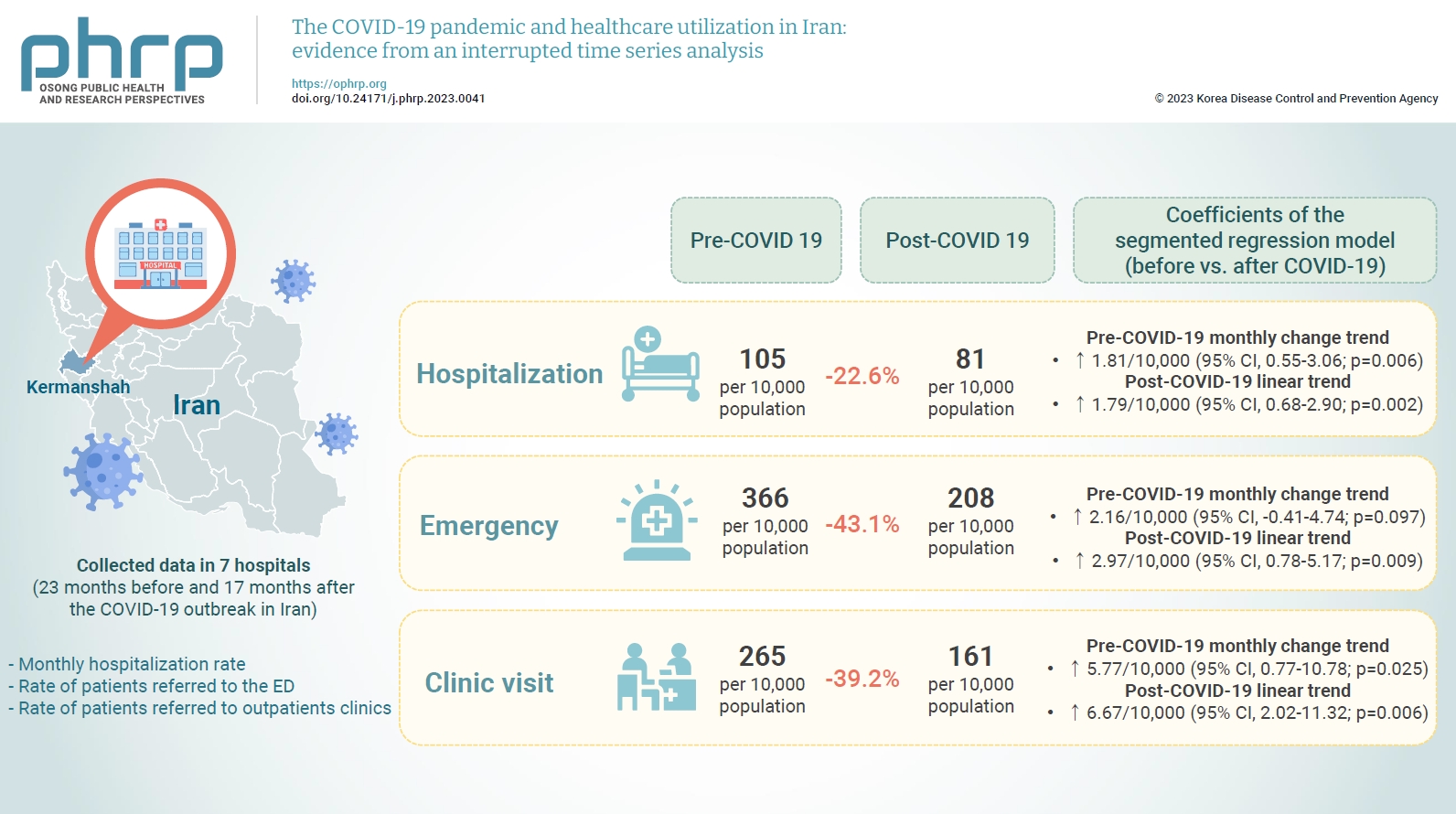
Objectives This study aimed to examine the effect of the coronavirus disease 2019 (COVID-19) outbreak on the hospitalization rate, emergency department (ED) visits, and outpatient clinic visits in western Iran.
Methods We collected data on the monthly hospitalization rate, rate of patients referred to the ED, and rate of patients referred to outpatient clinics for a period of 40 months (23 months before and 17 months after the COVID-19 outbreak in Iran) from all 7 public hospitals in the city of Kermanshah. An interrupted time series analysis was conducted to examine the impact of COVID-19 on the outcome variables in this study.
Results A statistically significant decrease of 38.11 hospitalizations per 10,000 population (95% confidence interval [CI], 24.93–51.29) was observed in the first month of the COVID-19 outbreak. The corresponding reductions in ED visits and outpatient visits per 10,000 population were 191.65 (95% CI, 166.63–216.66) and 168.57 (95% CI, 126.41–210.73), respectively. After the initial reduction, significant monthly increases in the hospitalization rate (an increase of 1.81 per 10,000 population), ED visits (an increase of 2.16 per 10,000 population), and outpatient clinic visits (an increase of 5.77 per 10,000 population) were observed during the COVID-19 pandemic.
Conclusion Our study showed that the utilization of outpatient and inpatient services in hospitals and clinics significantly declined after the COVID-19 outbreak, and use of these services did not return to pre-outbreak levels as of June 2021.
Citations
Citations to this article as recorded by
Changes in usual source of care utilization during the COVID-19 pandemic: a comparative analysis by chronic disease status Seokmin Ji, Sewon Park, Munjae Lee BMC Health Services Research.2026;[Epub] CrossRef
Impact of COVID-19 on consumption patterns and healthcare expenditures in general dentistry and outpatient physician visits Arman Ghafourian, Sara Emamgholipour, Ali Akbar Fazaeli BMC Health Services Research.2026;[Epub] CrossRef
An Investigation of the Factors Reducing the Use of Hospital Services: A Systematic Review Sedighe Sadat Tabatabaei Far, Majid Alizadeh, Erfan Kharazmi, Zahra Kavosi Health Science Reports.2026;[Epub] CrossRef
Changes and backlogs in the provision and utilization of essential health services in Afghanistan during and after the COVID-19 pandemic Narges Neyazi, Ali Mirzazadeh, Abdul Ghani Ibrahimi, Mirwais Ahmadzai, Jamshed Ali Tanoli BMC Health Services Research.2025;[Epub] CrossRef
Utilization of upper gastrointestinal tumor inpatient services affected by COVID-19 in China 2018–2021: an interrupted time series analysis Xue Yang, Mengying Liu, Hui Lu Frontiers in Public Health.2025;[Epub] CrossRef
A Holt-Winter Approach to Forecasting Admission in the Psychiatric Department Mariathy Karim, Nur Syuhada Muhammat Pazil Information Management and Business Review.2025; 17(4(I)): 28. CrossRef
The strongest predictors of compliance with health protocols among marketers and guilds based on the transtheoretical model Shandiz Moslehi, Asghar Tavan, Sajjad Narimani, Fardin shahbazzadeh, Nadia Sedri, Sama Sabahi BMC Public Health.2024;[Epub] CrossRef
Time series analysis of COVID-19's impact on physician and dentist visits in Iran Satar Rezaei, Hesam Ghiasvand, Heather Brown Scientific Reports.2024;[Epub] CrossRef
A tale of two times: an exploration of healthcare utilization patterns before and during COVID-19 in Iran Satar Rezaei, Masoud Mohammadnezhad BMC Public Health.2024;[Epub] CrossRef
From Routine to Crisis: The Impact of COVID‐19 Pandemic on Antibiotic Consumption in Iran Satar Rezaei, Mohammad Bazyar, Sina Ahmadi, Abdolvahed Khodamoradi Health Science Reports.2024;[Epub] CrossRef



 First
 Prev


