Objectives This review and meta-analysis examined the effectiveness of non-pharmacological therapies delivered through school-based interventions for smoking cessation among adolescents in South and Southeast Asian countries.
Methods A systematic search was conducted across PubMed, Scopus, Science Direct, BioMed Central, the Cochrane Library, and ProQuest Dissertations & Theses Global from inception to October 2024. Eligible studies comprised randomized controlled trials and quasi-experimental studies that compared non-pharmacological smoking cessation interventions delivered in schools or other educational institutions. Data on smoking abstinence outcomes were extracted from published studies, and odds ratios (ORs) with 95% confidence intervals (CIs) were pooled using a random-effects model via the Mantel-Haenszel estimator.
Results Seven studies involving 1,260 participants were included. The meta-analysis demonstrated that non-pharmacological school-based therapies significantly increased smoking abstinence compared to controls (OR, 2.83; 95% CI, 1.83–4.40; p<0.001. Subgroup analyzes revealed benefits across both randomized controlled trials and quasi-experimental studies with varying abstinence rates. Studies utilizing biochemical verification showed significant positive effects despite substantial heterogeneity, and short-term (<3 months) abstinence was significantly higher in intervention groups compared to controls. Overall, no differences were found between subgroups regarding intervention effectiveness.
Conclusion This meta-analysis indicates that non-pharmacological school-based interventions positively impact smoking abstinence rates, although effectiveness may vary based on study design, follow-up duration, and use of biochemical verification. The findings underscore the need for further research with larger sample sizes, extended follow-up periods, and improved methodological rigor in these regions.
Citations
Citations to this article as recorded by
Global disease burden of laryngeal cancer attributable to smoking from 1990 to 2021 Xiao Han, Shanchun Gong, Chao Wang, Yulin Zhang, Yufei Pan, Jing Li, Kai Liu, Zhenkun Yu European Journal of Cancer Prevention.2026; 35(4): 291. CrossRef
Adapting and Implementing a School-Based “Implementation Intentions” Program Within FRESHAIR4Life to Prevent Smoking Initiation Among Adolescents in Greece: A Study Protocol Izolde Bouloukaki, Antonios Christodoulakis, Sevasti Peraki, Floor A. Van Den Brand, Faraz Siddiqui, Theodoros Krasanakis, Antonia Aravantinou-Karlatou, Purva Abhyankar, Siân Williams, Julia van Koeveringe, Rianne MJJ van der Kleij, Ioanna Tsiligianni Healthcare.2026; 14(7): 938. CrossRef
Objectives This study aimed to comprehensively outline the methodological approaches used in published research comparing the vaccine effectiveness (VE) of coronavirus disease 2019 (COVID-19) vaccines.
Methods A systematic search was conducted on June 13, 2024, to identify comparative studies evaluating the effectiveness of mRNA versus non-mRNA and monovalent versus bivalent COVID-19 vaccines. We screened titles, abstracts, and full texts, collecting data on publication year, country, sample size, study population composition, study design, VE estimates, outcomes, and covariates. Studies that reported relative VE (rVE) were analyzed separately from those that did not.
Results We identified 25 articles comparing rVE between mRNA and non-mRNA COVID-19 vaccines, as well as between monovalent and bivalent formulations. Among the studies assessing VE by vaccine type, 126 did not provide rVE estimates. Comparative VE studies frequently employed retrospective cohort designs. Among the definitions of rVE used, the most common were hazard ratio and absolute VE, calculated as (1−odds ratio)×100. Studies were most frequently conducted in the United Kingdom and the United States, and the most common outcome was infection. Most targeted the general population and assessed the VE of mRNA vaccines using the AstraZeneca vaccine as a reference. A small proportion, 7.3% (n=11), did not adjust for any variables. Only 3 studies (2.0%) adjusted for all core confounding variables recommended by the World Health Organization.
Conclusion Few comparative studies of COVID-19 vaccines have incorporated rVE methodologies. Reporting rVE and employing a consistent set of covariates can broaden our understanding of COVID-19 vaccines.
Citations
Citations to this article as recorded by
Protection from second booster vaccines and natural immunity against SARS-CoV-2 infections, 2022–2023 Dritan Bejko, Anne Vergison, Saverio Stranges, Joël Mossong, Maurice Zeegers Epidemiology and Infection.2026;[Epub] CrossRef
Objectives This systematic review describes the effectiveness of virtual reality (VR)-supported exercise therapy on upper limb motor function and activities of daily living after stroke. Methods: Studies published through January 24, 2022, were identified using CINAHL, Cochrane Library, Embase, Medline, and Web of Science. Randomized control trials comparing VR treatment with conventional therapy (CT) for upper extremity rehabilitation after stroke were included. Methodological quality was assessed using the Cochrane risk-of-bias tool. Results: Of 9 included studies, 5 concluded that the VR group outperformed control participants, 1 indicated the superiority of VR-supported exercises alone over CT, and 3 found VR comparable to CT in promoting upper limb motor function. Five studies analyzed independence in daily living, with 4 reporting no significant difference between VR and CT groups. No strong evidence indicated long-term benefits of VR-assisted exercise. All included studies demonstrated low risk of bias concerning random sequence generation, allocation concealment, outcome assessment blinding, incomplete outcome data, and selective reporting bias. However, a high risk of bias was observed regarding participant blinding due to the nature of the intervention. Conclusion: Most studies suggested that VR, used alongside CT, can improve motor function following stroke. However, the evidence was insufficient to conclude that VR outperforms conventional approaches.
Citations
Citations to this article as recorded by
Challenges and Benefits of Virtual Reality in Home-Based Poststroke Rehabilitation: Co-Design Qualitative Study Trust Saidi, Ann Marie Hestetun-Mandrup, Nenad Pavel, Ingvild Kristina Hurum Rosseland, Kathinka Granum Selmer-Olsen, Nora Synnøve Mørk, Åse Bergheim, Minna Annika Pikkarainen JMIR Human Factors.2026; 13: e78798. CrossRef
Neural correlates of virtual hand movements using ecologically valid tasks Silvia Erika Kober, Lisa Maria Berger, Daniela Kern, Guilherme Wood, Petra Schwingenschuh Frontiers in Virtual Reality.2026;[Epub] CrossRef
Artificial Intelligence in Stroke Rehabilitation: A 20‐Year Bibliometric Analysis of Digital Health Trends and Technologies Yuhua Li, Weixi Liu, Xiaomei Yuan Brain and Behavior.2026;[Epub] CrossRef
Promoting adapted physical activity through immersive virtual reality: a feasibility study in community organizations Aurélien Ramos, Sarah-Maude Ruest, Roxanne Périnet-Lacroix, Julien Marceaux, Keith Beaudoin, Danielle Levac, Martin Lemay, Marika Demers, Hubert D. Gascon, Martine Bordeleau, Krista L. Best, Maxime T. Robert Journal of Developmental and Physical Disabilities.2026;[Epub] CrossRef
Kinesiotherapy in medical rehabilitation and prevention of non-communicable diseases: the role of biofeedback, neuroplasticity, virtual reality and exoskeletons K. Korbel, A. Chalupka-Borowska, B. Depczyńska, A. Madziewicz, A. Bilska, A. Bartkowiak-Graczyk Fizjoterapia Polska.2026; 26(2/2026): 59. CrossRef
Advances in hemiplegia rehabilitation: modern therapeutic interventions to enhance activities of daily living Jing Xiong, Jin-Tian Wang, Shu Lin, Bao-Yuan Xie Frontiers in Neurology.2025;[Epub] CrossRef
Effect of virtual reality-based upper limb training on activity of daily living and quality of life among stroke survivors: a systematic review and meta-analysis Diriba Dereje Olana, Teklu Gemechu Abessa, Dheeraj Lamba, Lisa Tedesco Triccas, Bruno Bonnechere Journal of NeuroEngineering and Rehabilitation.2025;[Epub] CrossRef
Research on upper limb motor function evaluation and rehabilitation training system of stroke patients based on artificial intelligence: A usability and feasibility study from therapist and patient perspectives Qiurong Xie, Qi Zhang, Yanxin Zhang, Bo Sheng, Xiaoling Wang, Jia Luo, Jia Huang DIGITAL HEALTH.2025;[Epub] CrossRef
Efficacy of a Virtual Reality Rehabilitation Protocol Based on Art Therapy in Patients with Stroke: A Single-Blind Randomized Controlled Trial Gaetano Tieri, Marco Iosa, Antonio Fortini, Federica Aghilarre, Federico Gentili, Cristiano Rubeca, Tommaso Mastropietro, Gabriella Antonucci, Roberto De Giorgi Brain Sciences.2024; 14(9): 863. CrossRef
Elevating patient experience: Transformative strategies in hand therapy Jean Paul Brutus, Bianieff Tchiloemba, Anna Galstyan, Tom Lattré, Aviva Wolff, Alison Taylor Hand Surgery and Rehabilitation.2024; 43(5): 101764. CrossRef
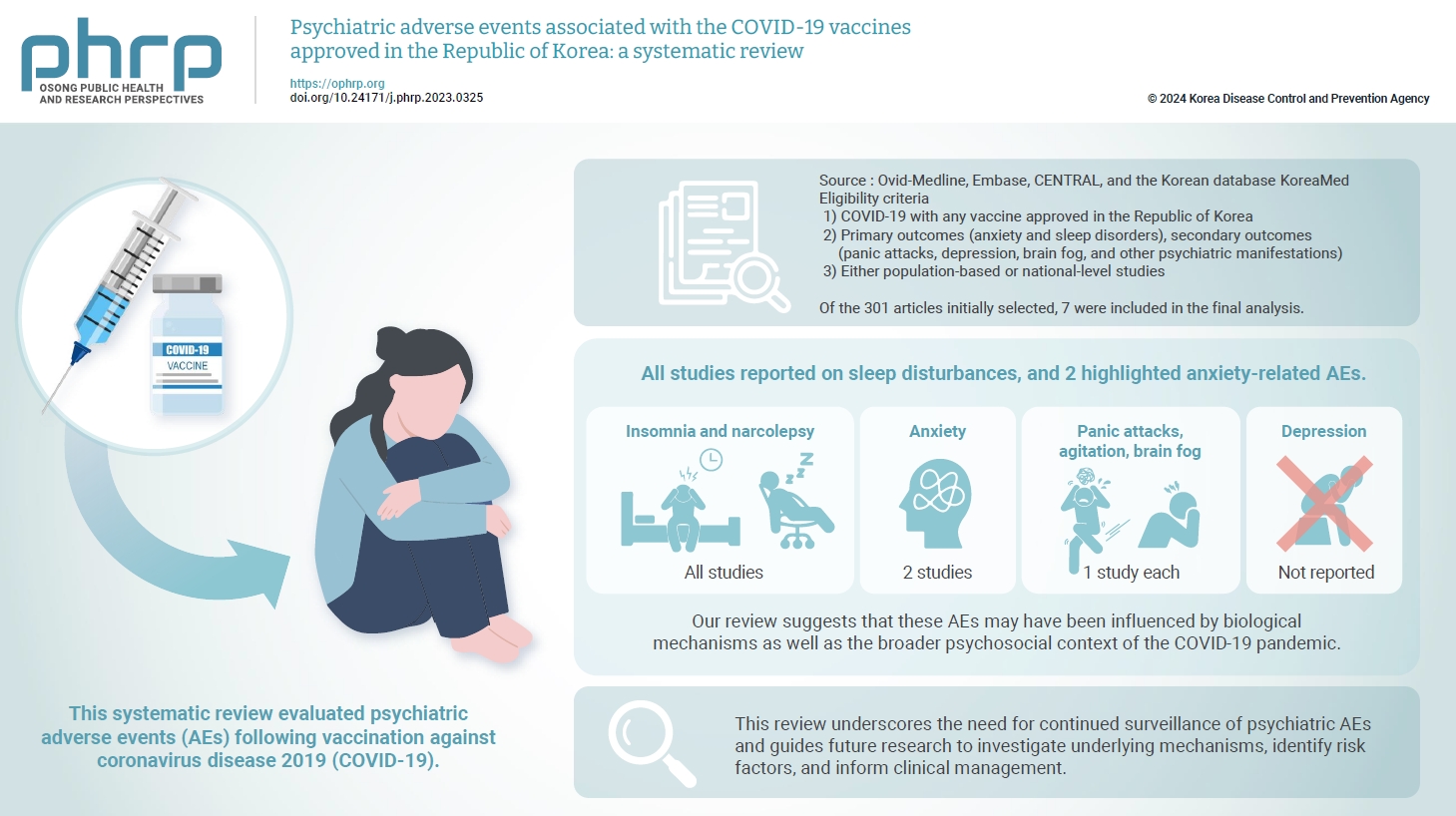
This systematic review evaluated psychiatric adverse events (AEs) following vaccination against coronavirus disease 2019 (COVID-19). We included studies that reported or investigated psychiatric AEs in individuals who had received an approved COVID-19 vaccine in the Republic of Korea. Systematic electronic searches of Ovid-Medline, Embase, CENTRAL, and KoreaMed databases were conducted on March 22, 2023. Risk of bias was assessed using the Risk of Bias Assessment Tool for Non-randomized Studies 2.0. The study protocol was registered in the International Prospective Register of Systematic Reviews (CRD42023449422). Of the 301 articles initially selected, 7 were included in the final analysis. All studies reported on sleep disturbances, and 2 highlighted anxiety-related AEs. Sleep disorders like insomnia and narcolepsy were the most prevalent AEs, while depression was not reported. Our review suggests that these AEs may have been influenced by biological mechanisms as well as the broader psychosocial context of the COVID-19 pandemic. Although this study had limitations, such as a primary focus on the BNT162b2 vaccine and an observational study design, it offered a systematic, multi-vaccine analysis that fills a critical gap in the existing literature. This review underscores the need for continued surveillance of psychiatric AEs and guides future research to investigate underlying mechanisms, identify risk factors, and inform clinical management.
Citations
Citations to this article as recorded by
Risk of anxiety disorders and insomnia following COVID-19 vaccination Haerin Cho, Joon Hyung Jung, Hwoyeon Seo, Won Chul Shin, Jung-Ick Byun, Suvin Park, Na-Young Jeong, Sanghoon Oh, Nam-Kyong Choi Journal of Psychiatric Research.2026; 192: 109. CrossRef
A review of the scientific literature on experimental toxicity studies of COVID-19 vaccines, with special attention to publications in toxicology journals Jose L. Domingo Archives of Toxicology.2024; 98(11): 3603. CrossRef
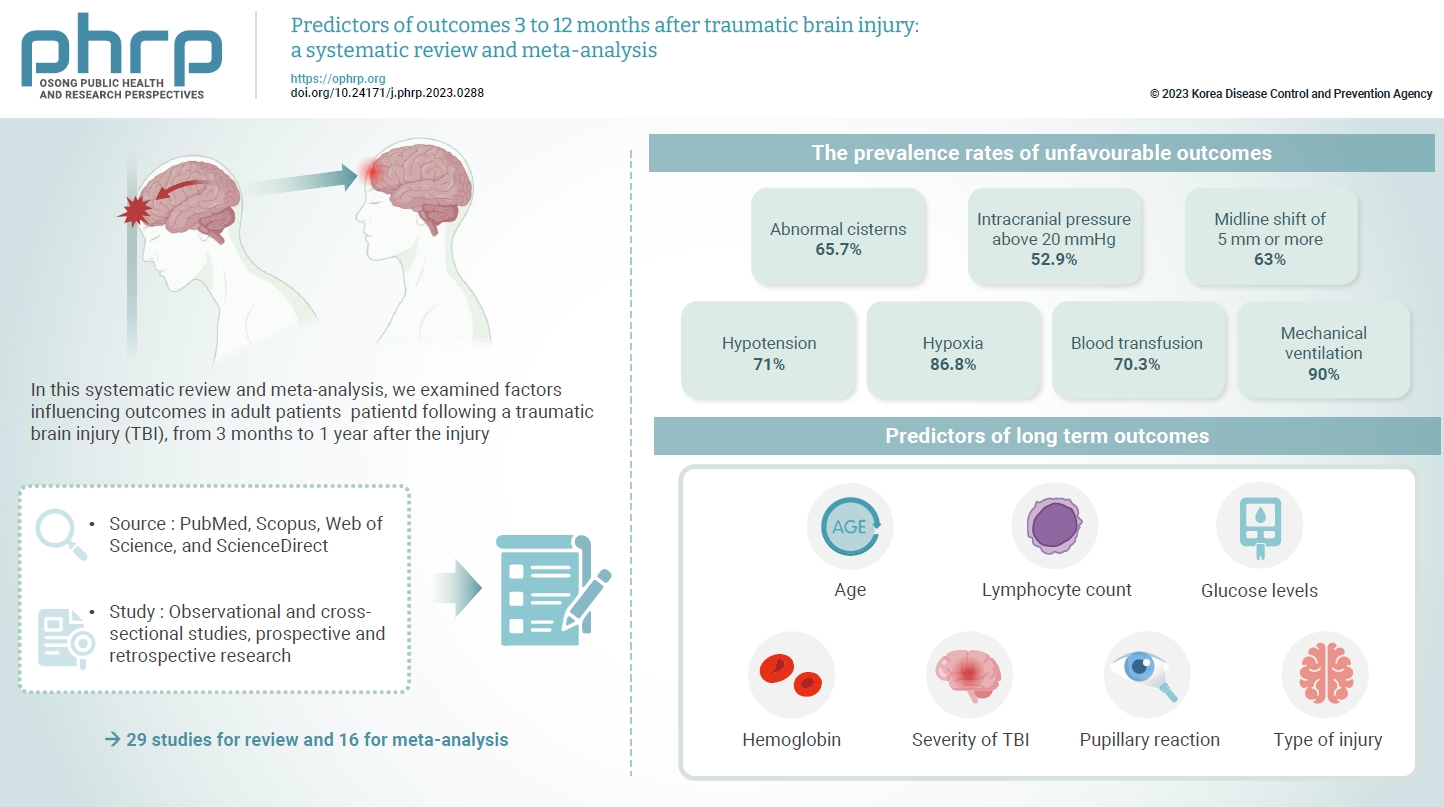
The exact factors predicting outcomes following traumatic brain injury (TBI) remain elusive. In this systematic review and meta-analysis, we examined factors influencing outcomes in adult patients with TBI, from 3 months to 1 year after injury. A search of four electronic databases—PubMed, Scopus, Web of Science, and ScienceDirect—yielded 29 studies for review and 16 for meta-analysis, in accordance with the Preferred Reporting Items for Systematic Reviews and Meta-Analysis guidelines. In patients with TBI of any severity, mean differences were observed in age (8.72 years; 95% confidence interval [CI], 4.77–12.66 years), lymphocyte count (−0.15 109/L; 95% CI, −0.18 to −0.11), glucose levels (1.20 mmol/L; 95% CI, 0.73–1.68), and haemoglobin levels (−0.91 g/dL; 95% CI, −1.49 to −0.33) between those with favourable and unfavourable outcomes. The prevalence rates of unfavourable outcomes were as follows: abnormal cisterns, 65.7%; intracranial pressure above 20 mmHg, 52.9%; midline shift of 5 mm or more, 63%; hypotension, 71%; hypoxia, 86.8%; blood transfusion, 70.3%; and mechanical ventilation, 90%. Several predictors were strongly associated with outcome. Specifically, age, lymphocyte count, glucose level, haemoglobin level, severity of TBI, pupillary reaction, and type of injury were identified as potential predictors of long-term outcomes.
Citations
Citations to this article as recorded by
Premorbid physical activity and recovery following an isolated acute traumatic brain injury: an exploratory study Naomie Maltais, Elaine de Guise, Maude Laguë-Beauvais, Laurence Trépanier, Jehane H. Dagher Global Neurological Insights.2026; 1(1): 100003. CrossRef
Association Between Sex and Mortality After Traumatic Brain Injury: A Systematic Review and Meta-Analysis Elise Beijer, Floor J. Mansvelder, Romein W. G. Dujardin, Nicole P. Juffermans, Linda J. Schoonmade, Leo M. G. Geeraedts, Frank W. Bloemers, Charissa E. van den Brom, Patrick Schober Neurocritical Care.2026; 45(1): 395. CrossRef
The severity of traumatic brain injury impacts the response to non-pharmacological treatment for post-traumatic amnesia: A retrospective observational study Èlia Vilageliu-Jordà, Antonia Enseñat-Cantallops, Alberto García-Molina Applied Neuropsychology: Adult.2026; : 1. CrossRef
Predictors of In-Hospital Mortality in Traumatic Acute Subdural Hematoma: The Role of Admission International Normalized Ratio, Imaging Parameters and Neurological Severity Serban Iancu Papacocea, Miruna Ioana Lazăr, Romica Cergan, Ioana Anca Badarau, Toma Marius Papacocea Biomedicines.2026; 14(6): 1388. CrossRef
A Systematic Review of Clinical Outcome Trajectories from 3 to 12 Months Following Mild or Moderate Traumatic Brain Injury Carl Marincowitz, Fiona Lecky, Abdullah Pandor, Ruth Wong, Thomas Shanahan, Michael Tonkins, Rajiv Singh, James Piercy, Andrew Maas, Lindsay Wilson Journal of Neurotrauma.2026;[Epub] CrossRef
Distinct Five-Year Latent Class Trajectories and Predictors of Functional Cognitive Independence Following Traumatic Brain Injury: A TBI Model Systems Study Evan D. Feigel, Charlotte B. Luster, Chris W. Lewis, Brenna Finegan, Michael J. Mastrodicasa, Maëlle-Marie Troadec, David Guo, Ben Olsen, Ignacio Fuentes, Joseph T. Giacino, Regina Barzilay, Daniel H. Daneshvar Neurotrauma Reports.2026;[Epub] CrossRef
Traumatic Brain Injury and Artificial Intelligence: Shaping the Future of Neurorehabilitation—A Review Seun Orenuga, Philip Jordache, Daniel Mirzai, Tyler Monteros, Ernesto Gonzalez, Ahmed Madkoor, Rahim Hirani, Raj K. Tiwari, Mill Etienne Life.2025; 15(3): 424. CrossRef
This systematic review and meta-analysis aimed to understand the characteristics of medication adherence interventions for older adults with chronic illnesses, and to investigate the average effect size by combining the individual effects of these interventions. Data from studies meeting the inclusion criteria were systematically collected in accordance with the Preferred Reporting Items for Systematic Reviews and Meta-Analysis guidelines. The results showed that the average effect size (Hedges’ g) of the finally selected medication adherence interventions for older adults with chronic illnesses calculated using a random-effects model was 0.500 (95% confidence interval [CI], 0.342−0.659). Of the medication adherence interventions, an implementation intention intervention (using face-to-face meetings and telephone monitoring with personalized behavioral strategies) and a health belief model–based educational program were found to be highly effective. Face-to-face counseling was a significantly effective method of implementing medication adherence interventions for older adults with chronic illnesses (Hedges’ g=0.531, 95% CI, 0.186−0.877), while medication adherence interventions through education and telehealth counseling were not effective. This study verified the effectiveness of personalized behavioral change strategies and cognitive behavioral therapy based on the health belief model, as well as face-to-face meetings, as medication adherence interventions for older adults with chronic illnesses.
Citations
Citations to this article as recorded by
Impact of telemedicine on chronic disease patients: An overview of systematic reviews Kun Zhang, Yanhua Chen, Peicheng Wang, Yanrong He, Yanrong Du, Hailun Liang, Weiguo Zhu, Xiao Long, Leiyu Shi, Jiming Zhu Intelligent Medicine.2026; 6(2): 226. CrossRef
Updating Interventions to Enhance Medication Adherence among Community-Dwelling Older Adults with Chronic Diseases Luu Thi Thuy, Nguyen Thi Yen Hoai, Diep Thi Tieu Mai Home Healthcare Now.2026; 44(1): 40. CrossRef
Treatment Adherence and Persistence of Anti-Fibrotic Drugs in Real Life in Greece Georgia Kourlaba, Stylianos Ravanidis, Garyfallia Stefanou, Konstantinos Mathioudakis, Anastasios Tsolakidis, Dimitrios Zografopoulos Advances in Respiratory Medicine.2026; 94(1): 6. CrossRef
Reasons for delayed medical treatment among cholelithiasis patients: a qualitative study based on the health belief model Min Jiang, Yajie Shi, Jiao Liu, Yan Liu, Yanzhang Tian, Fang He BMC Health Services Research.2026;[Epub] CrossRef
Can We Predict Older Adults’ Long-Term Healthy Behavior Maintenance? Identifying the Optimal Machine Learning Model HeSen Li, WeiCheng Pan, Hong Chen, YiZhuo Hou International Journal of Human–Computer Interactio.2026; 42(20): 17782. CrossRef
Medication adherence trajectories and association with risk factors and clinical outcomes in type 2 diabetes treatment Sara Mucherino, Valentina Orlando, Marcia Vervloet, Yvette Weesie, Liset van Dijk, Enrica Menditto, Yee Gary Ang PLOS One.2026; 21(2): e0342056. CrossRef
Designing age-friendly interfaces and wearable–environment integrations to enhance medication adherence: a discrete choice experiment among older adults Jialin Qin, Zeyu Wu, Hao Zhang, Xiaopan Qi Frontiers in Medicine.2026;[Epub] CrossRef
Psychosocial predictors of non-adherence to antihypertensive medication among Korean adults: A nationwide cross-sectional study Kunhee Han, Hwa Sun Kim, Young Lee, Chung-woo Lee, Muhammad Haroon Stanikzai PLOS One.2026; 21(3): e0345509. CrossRef
Nurse-led interventions in enhancing outcomes for patients with tuberculosis: a scoping review Nita Arisanti Yulanda, Hidayat Arifin, Titan Ligita, Lestari Makmuriana, Alfi Syahri, Susanti Susanti, Komang Ardidhana Nugraha Putra, Andri Setiya Wahyudi, Somsak Thojampa, Tintin Sukartini Journal of Research in Nursing.2026;[Epub] CrossRef
Bedside Cognitive Behavioral Therapy Techniques in Primary Care Meredith L.C. Williamson, Danielle L. Terry, Kaylee J. Jackson Primary Care: Clinics in Office Practice.2026; 53(2): 251. CrossRef
Mobile health apps for older adults: real-world evidence on engagement and medication adherence Elyssa Wiecek, Scott Taylor, Hugo Rourke, Fiona Hammond, Noelia Amador-Fernandez Frontiers in Digital Health.2026;[Epub] CrossRef
Medication adherence in older adults with chronic diseases: a scoping review of barriers, facilitators, and effective interventions Doris Cardona-Arango, Valeria Santacruz-Restrepo, Alejandra Rendón-Montoya, Juliana Madrigal-Cadavid, Alejandra Segura-Cardona, Jorge Iván Estrada-Acevedo Frontiers in Aging.2026;[Epub] CrossRef
A pilot feasibility study of a tablet-based virtual community application with shared avatars for promoting health behavior change in older adult care facilities Kenji Nakamura, Keiichi Yamazaki, Akiko Yamazaki, Yoshiaki Ohyama Frontiers in Digital Health.2026;[Epub] CrossRef
Chrono-modulated drug delivery systems for oncology: Mechanisms, translational evidence, and pharmaceutical innovations Santoshini Nayak, Rajat Kumar Kar, Prasanta Kumar Biswal, Ranjit Prasad Swain, Snehamayee Mohapatra Chronobiology International.2026; 43(11): 1728. CrossRef
Medication Adherence Interventions for Older Adults: A National Mixed‐Methods Study of Implementation Across Italian Healthcare Settings Sara Mucherino, Luca Pasina, Manuela Casula, Monia Donati, Carlotta Lunghi, Elena Olmastroni, Valentina Orlando, Emanuel Raschi, Stefano Scotti, Marco Salluzzo, Elisabetta Poluzzi, Alessandro Nobili, Enrica Menditto Journal of the American Geriatrics Society.2026;[Epub] CrossRef
Yaşlılarda ilaç uyumunun geliştirilmesine yönelik stratejiler Soner Mete, Kamuran Özdil Mersin Üniversitesi Sağlık Bilimleri Dergisi.2026; 19(2): 415. CrossRef
Confronting finitude and treatment adherence in older adults with chronic diseases: a qualitative study Leovaldo Alcântara, Luís Midão, Elísio Costa, Constança Paúl BMC Geriatrics.2026;[Epub] CrossRef
Adherencia terapéutica en pacientes con hipertensión arterial en segundo nivel de atención Vidal Marcelino Villanueva Pérez, Daniel Canaán Pérez, Diego Sánchez Rodríguez REDSA Revista Ecuatoriana de Desarrollo Social y A.2026; 1(3): 268. CrossRef
Medication adherence in older people: Predictors and strategies for improvement Vladimir Petković, Jelena Horvat, Svitlica Brestovački Timocki medicinski glasnik.2025; 50(1-2): 32. CrossRef
Educational intervention for mental health and health behaviors in elderly Iranian women randomized controlled trial Razieh Asadi, Mahin Nazari, Abdolrahim Asadollahi, Narges Mobasheri Scientific Reports.2025;[Epub] CrossRef
Religious, Belief Medication, and Adherence Among Elderly with Chronic Diseases: A Multicenter Cross-Sectional Study in Papua, Indonesia AZ Izzah, DA Perwitasari, ES Sinaga, FE Appa, EI Sianturi Nigerian Journal of Clinical Practice.2025; 28(11): 1269. CrossRef
EXAMINING PRESCRIPTION DRUG USE AND HEALTH CARE ACCESS AMONG OLDER ADULTS IN RURAL AREAS: A CROSS-SECTIONAL STUDY BASED ON THE HEALTH BELIEF MODEL Yağmur ÖZKAYA, Büşra DEMİR ÇETİNKAYA, Gülden HAKVERDİ, Eyüp Can POLAT, Gülbin ÖZÇELİKAY Turkish Journal of Geriatrics.2025;[Epub] CrossRef
Health Behavior Change to Mitigate Dementia Risk: An Updated Review Victoria Sanborn, Jennifer D. Davis, Laura E. Korthauer Current Geriatrics Reports.2024; 13(3): 162. CrossRef
Relationship Between Depression and Medication Adherence Among Chronic Disease Patients in the Middle East Abdulrahman O Alomar, Rakan H Khushaim, Shahad K Al-Ghanem, Abeer T Bin Jumaiah, Suhail M Albaqami, Lujain A Alleft, Eman A Abahussain Cureus.2024;[Epub] CrossRef
Development and Preliminary Psychometric Testing of a Brief Tool to Measure Medication Adherence in Older Populations Paolo Iovino, Paola Obbia, Vincenzo De Luca, Clara Donnoli, Lola Patumi, Lisa Leonardini, Ernesto Palummeri, Manuela Ruatta, Anna Basso, Yari Longobucco, Laura Rasero, Giuseppe Liotta, Maddalena Illario Clinical Interventions in Aging.2024; Volume 19: 1765. CrossRef
Objectives
This study aimed to assess the effectiveness of relapse prevention interventions involving behavioral and pharmacological treatment among abstinent smokers.
Methods
This rapid review was conducted using MEDLINE, Cochrane CENTRAL, CINAHL, Embase, KMbase, and KoreaMed to identify studies published until June 20, 2020. The participants were abstinent smokers who quit smoking on their own, due to pregnancy, hospitalization, or by participating in a smoking cessation program. We found a systematic review that fit the objective of this study and included 81 randomized controlled trials (RCTs). Studies that did not present information on smoking cessation status, had no control group, or used reward-based interventions were excluded. Random effect and fixed effect meta-analyses were used to estimate the relative risk (RR) and 95% confidence interval (CI). In subgroup analyses, differences between subgroups were verified based on the participant setting, characteristics, intervention type, and intensity.
Results
Following screening, 44 RCTs were included in the meta-analysis. The review reported no differences in the success rate of relapse prevention between the behavioral interventions. Pharmacotherapy interventions showed higher success rates (RR, 1.15; 95% CI, 1.05−1.26; <i>I</i><sup>2</sup>=40.71%), depending on prior abstinence duration and the drug type. Conclusions: The results indicated that pharmacotherapy has a significant effect on preventing relapse among abstinent smokers.
Citations
Citations to this article as recorded by
Hippocampal mtDNA depletion promotes nicotine addiction by suppressing mitochondrial biogenesis through oxidative stress Shuhong Zhang, Hongjuan Wang, Guanglin Liu, Huan Chen, Hongwei Hou Neurobiology of Disease.2026; 222: 107353. CrossRef
Knowledge user involvement is still uncommon in published rapid reviews—a meta-research cross-sectional study Barbara Nussbaumer-Streit, Dominic Ledinger, Christina Kien, Irma Klerings, Emma Persad, Andrea Chapman, Claus Nowak, Arianna Gadinger, Lisa Affengruber, Maureen Smith, Gerald Gartlehner, Ursula Griebler Research Synthesis Methods.2025; 16(6): 876. CrossRef
A Survey of the Clinical Practice of Korean Medicine for Smoking Cessation in Public Health Centers: A Web-Based Survey of Public Health Doctors of Korean Medicine Gyoungeun Park, Jeong-Hyun Moon, Eun-Jung Kim, Byung-Kwan Seo, Yong-Hyeon Baek, Won-Suk Sung Perspectives on Integrative Medicine.2024; 3(1): 45. CrossRef
Objectives
The aim of this study was to evaluate the effectiveness of behavioral smoking cessation interventions among adolescents.
Methods
MEDLINE, CENTRAL, Embase, CINAHL, KoreaMed, and KMbase were searched from inception to June 2020. Systematic reviews (SRs) or meta-analyses of randomized controlled trials (RCTs) were initially searched to perform a rapid SR. After selecting the final SR, RCTs after the publication year of the selected SR were searched. The primary outcome was smoking status after at least 6 months of follow-up, and the secondary outcome was smoking status at 4 weeks. Two reviewers independently assessed the selected studies’ quality using the Cochrane risk of bias tool. The meta-analysis utilized a Mantel-Haenszel fixed-effect model reporting the relative risk (RR) and 95% confidence interval (CI). The subgroup analysis utilized Cochrane’s Q.
Results
Thirty-two RCTs (11,637 participants) from a single SR were meta-analyzed. After 6 months of follow-up, the intervention group had significantly higher abstinence rates (RR, 1.30; 95% CI, 1.20−1.41; I2=26.46%). At 4 weeks of follow-up, the intervention group also had significantly higher abstinence rates (RR, 1.92; 95% CI, 1.49–2.47; I2=0.00%). The subgroup analysis indicated a significant difference in the abstinence rate according to the study setting and the period between intervention completion and follow-up.
Conclusion
This review showed that adolescent behavioral smoking cessation intervention programs significantly increased abstinence rates compared to the usual care.
Citations
Citations to this article as recorded by
Adapting and Implementing a School-Based “Implementation Intentions” Program Within FRESHAIR4Life to Prevent Smoking Initiation Among Adolescents in Greece: A Study Protocol Izolde Bouloukaki, Antonios Christodoulakis, Sevasti Peraki, Floor A. Van Den Brand, Faraz Siddiqui, Theodoros Krasanakis, Antonia Aravantinou-Karlatou, Purva Abhyankar, Siân Williams, Julia van Koeveringe, Rianne MJJ van der Kleij, Ioanna Tsiligianni Healthcare.2026; 14(7): 938. CrossRef
Helping teens quit: A systematic review and network meta-analysis of smoking cessation interventions Kansak Boonpattharatthiti, Kanchana Mueangfa, Natchaya Aiumtanaporn, Chanchanok Koomsri, Junpen Chantara, Teerapon Dhippayom Public Health in Practice.2026; 11: 100789. CrossRef
The transtheoretical model and smoking cessation: findings from a youth-friendly clinic Alkim Oden Akman, Furkan Kalayci, Serap Karakus, Eda Özaydın, Demet Tas BMC Public Health.2026;[Epub] CrossRef
Effectiveness of non-pharmacological school-based therapies for cigarette smoking cessation among adolescents in South and Southeast Asian countries: a systematic review and meta-analysis Fahad Ali Mangrio, Penpaktr Uthis, Suwimon Rojnawee, Alicia K Matthews Osong Public Health and Research Perspectives.2025; 16(3): 195. CrossRef
Effectiveness of Healthcare Interventions on Smoking Cessation in Adolescents in Low- and Middle-Income Countries: A Narrative Review Janhvi Thakur, Sonali G Choudhari Cureus.2024;[Epub] CrossRef
Non-combustible nicotine product cessation interventions in adolescents and young adults: A systematic review Sofie K. Bergman Rasmussen, Charlotta Pisinger Tobacco Use Insights.2024;[Epub] CrossRef
Non-pharmacological interventions for smoking cessation: analysis of systematic reviews and meta-analyses Tao Nian, Kangle Guo, Wendi Liu, Xinxin Deng, Xiaoye Hu, Meng Xu, Fenfen E, Ziyi Wang, Guihang Song, Kehu Yang, Xiuxia Li, Wenru Shang BMC Medicine.2023;[Epub] CrossRef
Behavioral Interventions for Smoking Cessation in Adolescents: Korea Preventive Services Task Force Guidance Younglee Choi, Cheol Min Lee, Jae Moon Yun, Eon Sook Lee, Seung-Won Oh, Naae Lee, Belong Cho Journal of the Korean Society for Research on Nico.2021; 12(1): 1. CrossRef
Tobacco Control Policy in Period of Epidemic “COVID 19” Eon Sook Lee Journal of the Korean Society for Research on Nico.2021; 12(1): 34. CrossRef
<p>This review compared coronavirus disease 2019 (COVID-19) laboratory findings, comorbidities, and clinical outcomes in patients from the general population versus medical staff to aid diagnosis of COVID-19 in a more timely, efficient, and accurate way. Electronic databases were searched up to 23<sup>rd</sup> March, 2020. The initial search yielded 6,527 studies. Following screening, 24 studies were included [18 studies (11,564 cases) of confirmed COVID-19 cases in the general public, and 6 studies (394 cases) in medical staff] in this review. Significant differences were observed in white blood cell counts (<italic>p</italic> < 0.001), lymphocyte counts (<italic>p</italic> < 0.001), platelet counts (<italic>p</italic> = 0.04), procalcitonin levels (<italic>p</italic> < 0.001), lactate dehydrogenase levels (<italic>p</italic> < 0.001), and creatinine levels (<italic>p</italic> = 0.03) when comparing infected medical staff with the general public. The mortality rate was higher in the general population than in medical staff (8% versus 2%). This review showed that during the early stages of COVID-19, laboratory findings alone may not be significant predictors of infection and may just accompany increasing C-reactive protein levels, erythrocyte sedimentation rates, and lactate dehydrogenase levels. In the symptomatic stage, the lymphocyte and platelet counts tended to decrease. Elevated D-dimer fibrin degradation product was associated with poor prognosis.</p>
Citations
Citations to this article as recorded by
Quality indicators for appropriate inpatient antibiotic use: results from two national surveys in Italy, 2016–2022 C. Vicentini, A. Russotto, R. Bussolino, M. Castagnotto, C. Gastaldo, S. Bazzolo, D. Gamba, S. Corcione, F.G. De Rosa, F. D'Ancona, C.M. Zotti Journal of Hospital Infection.2025; 160: 34. CrossRef
Efficacy and limitations of SARS-CoV-2 vaccines - A systematic review Muhammad Azeem, Patrizia Cancemi, Farwa Mukhtar, Sefora Marino, Emanuela Peri, Giulia Di Prima, Viviana De Caro Life Sciences.2025; 371: 123610. CrossRef
A comprehensive review of recent advances in research on COVID in communication studies Barbara Cyrek, Jenna Peltonen Discover Public Health.2024;[Epub] CrossRef
microRNA-185 Inhibits SARS-CoV-2 Infection through the Modulation of the Host’s Lipid Microenvironment Nadine Ahmed, Magen E. Francis, Noreen Ahmed, Alyson A. Kelvin, John Paul Pezacki Viruses.2023; 15(9): 1921. CrossRef
Protective action of natural and induced immunization against the occurrence of delta or alpha variants of SARS-CoV-2 infection: a test-negative case-control study Giovanni Corrao, Matteo Franchi, Federico Rea, Danilo Cereda, Antonio Barone, Catia Rosanna Borriello, Petra Giulia Della Valle, Michele Ercolanoni, Ida Fortino, Jose Jara, Olivia Leoni, Francesco Mazziotta, Elisabetta Pierini, Giuseppe Preziosi, Marcello BMC Medicine.2022;[Epub] CrossRef
Balancing Benefits and Harms of COVID-19 Vaccines: Lessons from the Ongoing Mass Vaccination Campaign in Lombardy, Italy Giovanni Corrao, Federico Rea, Matteo Franchi, Danilo Cereda, Antonio Barone, Catia Rosanna Borriello, Giulia Petra Della Valle, Michele Ercolanoni, Jose Jara, Giuseppe Preziosi, Manuel Maffeo, Francesco Mazziotta, Elisabetta Pierini, Francesco Lecis, Pie Vaccines.2022; 10(4): 623. CrossRef
Vulnerability Predictors of Post-Vaccine SARS-CoV-2 Infection and Disease—Empirical Evidence from a Large Population-Based Italian Platform Giovanni Corrao, Matteo Franchi, Danilo Cereda, Francesco Bortolan, Olivia Leoni, Catia Rosanna Borriello, Petra Giulia Della Valle, Marcello Tirani, Giovanni Pavesi, Antonio Barone, Michele Ercolanoni, Jose Jara, Massimo Galli, Guido Bertolaso Vaccines.2022; 10(6): 845. CrossRef
Factors associated with severe or fatal clinical manifestations of SARS‐CoV‐2 infection after receiving the third dose of vaccine Giovanni Corrao, Matteo Franchi, Danilo Cereda, Francesco Bortolan, Olivia Leoni, Jose Jara, Giuseppina Valenti, Giovanni Pavesi Journal of Internal Medicine.2022; 292(5): 829. CrossRef
Role of multiresolution vulnerability indices in COVID-19 spread in India: a Bayesian model-based analysis Rupam Bhattacharyya, Anik Burman, Kalpana Singh, Sayantan Banerjee, Subha Maity, Arnab Auddy, Sarit Kumar Rout, Supriya Lahoti, Rajmohan Panda, Veerabhadran Baladandayuthapani BMJ Open.2022; 12(11): e056292. CrossRef
A novel multi-omics-based highly accurate prediction of symptoms, comorbid conditions, and possible long-term complications of COVID-19 Debmalya Barh, Sandeep Tiwari, Bruno Silva Andrade, Marianna E Weener, Aristóteles Góes-Neto, Vasco Azevedo, Preetam Ghosh, Kenneth Blum, Nirmal Kumar Ganguly Molecular Omics.2021; 17(2): 317. CrossRef
Clinical and laboratory factors associated with coronavirus disease 2019 (Covid‐19): A systematic review and meta‐analysis Le Huu Nhat Minh, Ali Ahmed‐Fouad Abozaid, Nam Xuan Ha, Loc Le Quang, Abdelrahman Gamil Gad, Ranjit Tiwari, Tran Nhat‐Le, Dinh Kim Quyen, Balqees AL‐Manaseer, Nguyen Dang Kien, Nguyen Lam Vuong, Ahmad Helmy Zayan, Le Huu Hanh Nhi, Kadek Agus Surya Dila, J Reviews in Medical Virology.2021;[Epub] CrossRef
Epidemiologic and Clinic Characteristics of the First Wave of the COVID-19 Pandemic in Hospitalized Patients from Galați County Mihaela-Camelia Vasile, Anca-Adriana Arbune, Gabriela Lupasteanu, Constantin-Marinel Vlase, George-Cosmin Popovici, Manuela Arbune Journal of Clinical Medicine.2021; 10(18): 4210. CrossRef
Human Amniotic Fluid for the Treatment of Hospitalized, Symptomatic, and Laboratory-verified SARS-CoV-2 Patients Mojgan Barati, Fakher Rahim The Open Biology Journal.2021; 9(1): 36. CrossRef
Stratification of the risk of developing severe or lethal Covid-19 using a new score from a large Italian population: a population-based cohort study Giovanni Corrao, Federico Rea, Flavia Carle, Salvatore Scondotto, Alessandra Allotta, Vito Lepore, Antonio D'Ettorre, Cinzia Tanzarella, Patrizia Vittori, Sabrina Abena, Marica Iommi, Liana Spazzafumo, Michele Ercolanoni, Roberto Blaco, Simona Carbone, Cr BMJ Open.2021; 11(11): e053281. CrossRef
Objectives
Numerous studies have reported the epidemiological and clinical features of Malta fever incidence in Iran. Review and synthesis of the related literature through meta-analysis can provide an appropriate measurement for aforementioned indices. Therefore, the present study aimed to determine the epidemiological and clinical features of people with Malta fever in Iran. Methods
The required documents were obtained through searching national and international databases. In each study, standard deviation of the indices was calculated using binomial distribution formulas. Finally, the heterogeneity index was determined between studies using Cochran (Q) and <i>I</i><sup>2</sup> tests. Results
Combining the results of 47 articles in the meta-analysis indicated that 57.6% (55.02–60.1%) and 42.3% (49.8–44.9%) of the patients were male and female, respectively. Most of the patients lived in rural areas; 68.4% (63.6–73.2%) compared to 31.4% (26.7–36.3%). In addition, 20.8% (17.4–24.2%) of the patients were ranchers and farmers, 16.9% (14.5–19.4%) were students, and 31.6% (27–36.2%) were housewives. Of the patients studies, 50.5% (35.6–65.2%) experienced contact with animals and 57.1% (46.4–67.9%) used unpasteurized dairy products. Fever, joint pain, and sweating were detected among 65.7% (53.7–77.8%) and 55.3% (44.4–66.2%), respectively. Conclusion
The present study revealed that the frequency of male patients with brucellosis was considerably more than that of female patients. The number of patients with Malta fever in rural areas was significantly more than in urban areas. High-risk behavior, unprotected contact with animals, and using unpasteurized dairy products were among the most significant factors affecting Malta fever incidence in Iran. Fever, joint pain, and sweating were detected among most of the patients with Malta fever.
Citations
Citations to this article as recorded by
Epidemiological characteristics of brucellosis in non-occupational population in Zhejiang Province, China, 2018–2024: epidemic trend and infection analysis Xuguang Shi, Yong Yang, Ying Liu, Jiangping Ren, Rong Zhang, Song Guo, Huimin Ma, Jimin Sun One Health Outlook.2026;[Epub] CrossRef
An ultrasensitive double-antigen sandwich time-resolved fluorescent immunochromatographic assay for quantification of Brucella antibodies Guanti Lai, Jinhui Lu, Enhui Zhang, Qi Wang, Yueyang Tian, Ling Zhang, Yuguang Li, Tingting Li, Wenjing Wang Microchimica Acta.2026;[Epub] CrossRef
Comprehensive study on human brucellosis seroprevalence and Brucella species distribution in Iran (1970–2023) Maryam Dadar, Saeed Alamian, Esmail Zowghi Microbial Pathogenesis.2025; 198: 107137. CrossRef
Differences analysis between spinal tuberculosis and brucella spondylitis with preoperative non-invasive differential diagnosis Zhong Ma, Xin Liu, Mingtao Zhang, Zuolong Wu, Xianxu Zhang, Shicheng Li, Jiangdong An, Zhiqiang Luo European Spine Journal.2025; 34(2): 675. CrossRef
Protocol for a randomized controlled trial on the impact of a health action process approach model-based mobile health intervention via WeChat on health behaviors of brucellosis patients Jing Wang, Yang Jiang, Zhenjie Yu, Jiawei Chen Frontiers in Public Health.2025;[Epub] CrossRef
Detection and differentiation of Brucella abortus and Brucella melitensis by multiplex real-time polymerase chain reaction in patients with pyrexia of unknown origin at a tertiary care centre in Northern India Renu Kumari, Raj Kumar Kalyan, Kamlesh Kumar Gupta, Sanjeev Kumar Verma International Journal of Research in Medical Scien.2025; 13(12): 5328. CrossRef
A study of rural populations’ knowledge, attitude, and practice about brucellosis: a descriptive, cross-sectional, multicenter study Zahra Montaseri, Zahra Mohebi, Rahil Masoumi, Azizallah Dehghan, Mostafa Bijani BMC Research Notes.2024;[Epub] CrossRef
Brucellosis infection complicated with myelitis: a case report and literature review Xiaoyu Ma, Ying Wang, Qiong Wu, Xiaomei Ma, Qiang Wang, Qinghong Guo Frontiers in Cellular and Infection Microbiology.2024;[Epub] CrossRef
Investigated of Epidemiological and Incidence of Human Brucellosis in Southwest of Iran, a Retrospective Study from 2014 to 2021 Parisa Asban, Fatemeh Kiani, Mohammad Javad Mohammadi, Saeed Ghanbari, Homayoon Amiri, Razieh Kazemi Bareh Bichast Archives of Clinical Infectious Diseases.2024;[Epub] CrossRef
Diagnostic significance of hematological parameters in brucellosis Mehmet Çelik, Mehmet Reşat Ceylan, Deniz Altındağ, Nevin Güler Dinçer, Sevil Alkan Journal of Clinical Medicine of Kazakhstan.2023; 20(1): 50. CrossRef
Presence of Brucella spp. in Milk and Dairy Products: A Comprehensive Review and Its Perspectives Md. Sadequl Islam, Md. Ariful Islam, Md. Moshiur Rahman, Khaleda Islam, Md. Mominul Islam, Md. Murtuza Kamal, Md. Nazrul Islam, Gianfranco Picone Journal of Food Quality.2023; 2023: 1. CrossRef
Predicting of Bacteremia in Patients with Brucellosis Using Machine Learning Methods Mehmet ÇELİK, Mehmet Reşat CEYLAN, Deniz ALTINDAĞ, Sait Can YÜCEBAŞ, Nevin GÜLER DİNCER, Sevil ALKAN Journal of Contemporary Medicine.2023; 13(3): 459. CrossRef
Toponyms in Dermatology Heera Ramesh, Sachin Somashekar Indian Journal of Dermatology.2022; 67(3): 279. CrossRef
Brucella pleurisy: An extremely rare complication of brucellosis Ahmad Alikhani, Hamideh Abbaspour Kasgari, Haadi Majidi, Zahra Nekoukar Clinical Case Reports.2022;[Epub] CrossRef
Design and validation of brucellosis prevention questionnaire focused on animal vaccination Farhad Bahadori, Fazlollah Ghofranipour, Saeideh Ghaffarifar, Reza Ziaei BMC Public Health.2021;[Epub] CrossRef
Forecasting the monthly incidence rate of brucellosis in west of Iran using time series and data mining from 2010 to 2019 Hadi Bagheri, Leili Tapak, Manoochehr Karami, Zahra Hosseinkhani, Hamidreza Najari, Safdar Karimi, Zahra Cheraghi, Esteban Tlelo-Cuautle PLOS ONE.2020; 15(5): e0232910. CrossRef
Epidemiologically characteristics of human brucellosis and antimicrobial susceptibility pattern of Brucella melitensis in Hinggan League of the Inner Mongolia Autonomous Region, China Hai-Tao Yuan, Cheng-Ling Wang, Li-Na Liu, Dan Wang, Dan Li, Zhen-Jun Li, Zhi-Guo Liu Infectious Diseases of Poverty.2020;[Epub] CrossRef
Brucellosis: Evaluation of Two Hundred and Ten Cases with Different Clinical Features Esma Eroglu, Bahar Kandemir Annals of the Academy of Medicine, Singapore.2020; 49(7): 462. CrossRef
A comparison of three data mining time series models in prediction of monthly brucellosis surveillance data Nasrin Shirmohammadi‐Khorram, Leili Tapak, Omid Hamidi, Zohreh Maryanaji Zoonoses and Public Health.2019; 66(7): 759. CrossRef
Human brucellosis caused by raw dairy products: A review on the occurrence, major risk factors and prevention Maryam Dadar, Youcef Shahali, Adrian M. Whatmore International Journal of Food Microbiology.2019; 292: 39. CrossRef
Epidemiological, Clinical and Paraclinical Evaluation of Recorded Cases with Brucellosis in Kermanshah Province Health Center 2012 - 2016 Hossein Hatami, Ali Ramezankhani, Farahnaz Shekarchi Journal of Kermanshah University of Medical Scienc.2019;[Epub] CrossRef
Epidemiological, Risk Factors, Clinical, and Laboratory Features of Brucellosis in the Southwest of Iran within 2009–2015 Mahmood Nabavi, Hossein Hatami, Hedayatollah Jamaliarand International Journal of Preventive Medicine.2019;[Epub] CrossRef
Meta-Analysis of the Changes of Peripheral Blood T Cell Subsets in Patients with Brucellosis Rongjiong Zheng, Songsong Xie, Shaniya Niyazi, Xiaobo Lu, Lihua Sun, Yan Zhou, Yuexin Zhang, Kai Wang Journal of Immunology Research.2018; 2018: 1. CrossRef
A Systematic Review and Meta-Analysis of Epidemiology and Clinical Manifestations of Human Brucellosis in China Rongjiong Zheng, Songsong Xie, Xiaobo Lu, Lihua Sun, Yan Zhou, Yuexin Zhang, Kai Wang BioMed Research International.2018; 2018: 1. CrossRef
The clinical features of 590 patients with brucellosis in Xinjiang, China with the emphasis on the treatment of complications Bin Jia, Fengbo Zhang, Ying Lu, Wenbao Zhang, Jun Li, Yuexin Zhang, Jianbing Ding, Mazin Barry PLOS Neglected Tropical Diseases.2017; 11(5): e0005577. CrossRef
Objectives
This study extended and updated a meta-analysis of the association between exposure to dichlorodiphenyltrichloroethane (DDT) and the risk of breast cancer. Methods
We reviewed the published literature on exposure to DDE and breast cancer risk to update a meta-analysis from 2004. The total of 35 studies included 16 hospital-based case–control studies, 11 population-based case–control studies, and 10 nested case–control studies identified through keyword searches in the PubMed and EMBASE databases. Results
The summary odds ratio (OR) for the identified studies was 1.03 (95% confidence interval 0.95–1.12) and the overall heterogeneity in the OR was observed (<i>I</i><sup>2</sup> = 40.9; <i>p</i> = 0.006). Subgroup meta-analyses indicated no significant association between exposure to DDE and breast cancer risk by the type of design, study years, biological specimen, and geographical region of the study, except from population-based case–control studies with estimated DDE levels in serum published in 1990s. Conclusion
Existing studies do not support the view that DDE increases the risk of breast cancer in humans. However, further studies incorporating more detailed information on DDT exposure and other potential risk factors for breast cancer are needed.
Citations
Citations to this article as recorded by
Organochlorines and breast cancer risk: revisiting evidence through a meta-analytic approach Priyanka Jena, Sakti P. Pattnayak, Aditya K. Panda, B. Anjan Kumar Prusty, B.D. Banerjee International Journal of Environmental Health Rese.2026; 36(7): 1940. CrossRef
The impacts of organochlorine pesticides on adverse human health outcomes: A second-order synthesis of mean effects and heterogeneity Kyle Morrison, Lorenzo Ricolfi, Yefeng Yang, Ayumi Mizuno, Pietro Pollo, Malgorzata Lagisz, Shinichi Nakagawa Journal of Hazardous Materials.2026; 509: 141794. CrossRef
Bisphenol A and DDT disrupt adipocyte function in the mammary gland: implications for breast cancer risk and progression Sarah M. Bernhardt, Carrie D. House Frontiers in Oncology.2025;[Epub] CrossRef
Biological concentrations of DDT metabolites and breast cancer risk: an updated systematic review and meta-analysis Rodrigo Ugalde-Resano, Brenda Gamboa-Loira, Ángel Mérida-Ortega, Alma Rincón-Rubio, Gisela Flores-Collado, Maricela Piña-Pozas, Lizbeth López-Carrillo Reviews on Environmental Health.2025; 40(1): 225. CrossRef
Breast adipose tissue level of organochlorine pesticides as a risk factor in breast cancer: A cross sectional study in North Indian females Krishna Latha Thammineni, Gaurav K. Thakur, Basu Dev Banerjee, Navneet Kaur Chemosphere.2025; 377: 144339. CrossRef
Endocrine disrupting chemicals exposure and health: An umbrella review Junhao Chen, Pan Song, Chao Li, Hengjia Liu, Lei Zhang, Yi Zhou, Zhien Zhou, Weigang Yan Ecotoxicology and Environmental Safety.2025; 302: 118574. CrossRef
Risk factors for breast cancer: an umbrella review of observational cohort studies and causal relationship analysis Zhuo Wang, Lei Feng, Yuqing Xia, Zheming Zhu, Lina Wu, Song Gao Frontiers in Oncology.2025;[Epub] CrossRef
Isolation and Characterization of Propoxur-Degrading Bacteria, Brucella pseudintermedia LED 6 from a Pineapple Plantation in Lampung Taufiq Hidayat, Rahayu Widyastuti, Gunawan Djajakirana, Sarjiya Antonius, Tirta Kumala Dewi Jurnal Ilmu Pertanian Indonesia.2025; 30(4): 725. CrossRef
Causes and Risk Factors of Breast Cancer, What Do We Know for Sure? An Evidence Synthesis of Systematic Reviews and Meta-Analyses Borghild Løyland, Ida Hellum Sandbekken, Ellen Karine Grov, Inger Utne Cancers.2024; 16(8): 1583. CrossRef
Breast cancer immunophenotypes and serum organochlorine pesticides in Mexican women: Mixture exposure approach Rodrigo Ugalde-Resano, Ángel Mérida-Ortega, Mariano E. Cebrián, Lizbeth López-Carrillo Environmental Pollution.2024; 358: 124495. CrossRef
Non-genetic factors and breast cancer: an umbrella review of meta-analyses Anneza Yiallourou, Katerina Pantavou, Georgios Markozannes, Antonis Pilavas, Andrea Georgiou, Andria Hadjikou, Mary Economou, Neophytos Christodoulou, Konstantinos Letsos, Elina Khattab, Chrystalleni Kossyva, Maria Constantinou, Melanie Theodoridou, Danie BMC Cancer.2024;[Epub] CrossRef
Validation and green profile assessment of a binary solvent liquid phase microextraction method for the determination of chlorbenside and fenobucarb in lake and wastewater samples by GC–MS Dotse Selali Chormey Environmental Science and Pollution Research.2023; 30(15): 44697. CrossRef
Putative interactions between transthyretin and endosulfan II and its relevance in breast cancer Saurabh Sharma, Lakshay Malhotra, Paromita Mukherjee, Navneet Kaur, Thammineni Krishanlata, Chittur V. Srikanth, Vandana Mishra, Basu Dev Banerjee, Abdul Samath Ethayathulla, Radhey Shyam Sharma International Journal of Biological Macromolecules.2023; 235: 123670. CrossRef
Exposure to Organochlorine Pesticides and Female Breast Cancer Risk According to Molecular Receptors Expression: a Systematic Review and Meta-analysis of Epidemiological Evidence Rodrigo Ugalde-Resano, Brenda Gamboa-Loira, Ángel Mérida-Ortega, Alma Rincón-Rubio, Gisela Flores-Collado, Maricela Piña-Pozas, Lizbeth López-Carrillo Current Environmental Health Reports.2023; 10(4): 442. CrossRef
Mosquito control exposures and breast cancer risk: analysis of 1071 cases and 2096 controls from the Ghana Breast Health Study Naomie Olivos, Jim E. Banta, Rhonda Spencer-Hwang, Daniel Ansong, Laura E. Beane Freeman, Joe-Nat Clegg-Lamptey, Beatrice Wiafe-Addai, Lawrence Edusei, Ernest Adjei, Nicholas Titiloye, Florence Dedey, Francis Aitpillah, Joseph Oppong, Verna Vanderpuye, Er Breast Cancer Research.2023;[Epub] CrossRef
Endocrine disrupting chemicals and breast cancer: a systematic review of epidemiological studies Murphy Lam Yim Wan, Vanessa Anna Co, Hani El-Nezami Critical Reviews in Food Science and Nutrition.2022; 62(24): 6549. CrossRef
Epidemiology beyond its limits Lauren E. McCullough, Maret L. Maliniak, Avnika B. Amin, Julia M. Baker, Davit Baliashvili, Julie Barberio, Chloe M. Barrera, Carolyn A. Brown, Lindsay J. Collin, Alexa A. Freedman, David C. Gibbs, Maryam B. Haddad, Eric W. Hall, Sarah Hamid, Kristin R. V Science Advances.2022;[Epub] CrossRef
Plasma concentrations of chlorinated persistent organic pollutants and their predictors in the general population of Algiers, Algeria El Hadia Mansouri, Mohamed Reggabi Emerging Contaminants.2021; 7: 35. CrossRef
Association between type 2 diabetes and exposure to chlorinated persistent organic pollutants in Algeria: A case-control study El Hadia Mansouri, Mohamed Reggabi Chemosphere.2021; 264: 128596. CrossRef
Extraction of Chlorobenzenes and PCBs from Water by ZnO Nanoparticles Yuntao Zhang, Ran Chen, Jim E. Riviere, Jeffrey Comer Processes.2021; 9(10): 1764. CrossRef
Two Cases of Possible Familial Chronic Myeloid Leukemia in a Family with Extensive History of Cancer Marisa J.L. Aitken, Christopher B. Benton, Ghayas C. Issa, Koji Sasaki, Musa Yilmaz, Nicholas J. Short Acta Haematologica.2021; 144(5): 585. CrossRef
In utero DDT exposure and breast density before age 50 Nickilou Y. Krigbaum, Piera M. Cirillo, Julie D. Flom, Jasmine A. McDonald, Mary Beth Terry, Barbara A. Cohn Reproductive Toxicology.2020; 92: 85. CrossRef
DDT exposure during pregnancy and DNA methylation alterations in female offspring in the Child Health and Development Study Hui-Chen Wu, Barbara A. Cohn, Piera M. Cirillo, Regina M. Santella, Mary Beth Terry Reproductive Toxicology.2020; 92: 138. CrossRef
Prediagnostic serum concentrations of organochlorine pesticides and non-Hodgkin lymphoma: A nested case–control study in the Norwegian Janus Serum Bank Cohort Dazhe Chen, Tom K. Grimsrud, Hilde Langseth, Dana B. Barr, Bryan A. Bassig, Aaron Blair, Kenneth P. Cantor, Marilie D. Gammon, Qing Lan, Nathaniel Rothman, Lawrence S. Engel Environmental Research.2020; 187: 109515. CrossRef
Global trends in pesticides: A looming threat and viable alternatives Akanksha Sharma, Ananya Shukla, Kriti Attri, Megha Kumar, Puneet Kumar, Ashish Suttee, Gurpal Singh, Ravi Pratap Barnwal, Neha Singla Ecotoxicology and Environmental Safety.2020; 201: 110812. CrossRef
Exposure to Endocrine Disrupting Chemicals and Risk of Breast Cancer Louisane Eve, Béatrice Fervers, Muriel Le Romancer, Nelly Etienne-Selloum International Journal of Molecular Sciences.2020; 21(23): 9139. CrossRef
Breast Cancer and Exposure to Organochlorines in the CECILE Study: Associations with Plasma Levels Measured at the Time of Diagnosis and Estimated during Adolescence Delphine Bachelet, Marc-André Verner, Monica Neri, Émilie Cordina Duverger, Corinne Charlier, Patrick Arveux, Sami Haddad, Pascal Guénel International Journal of Environmental Research an.2019; 16(2): 271. CrossRef
Risk of breast cancer and adipose tissue concentrations of polychlorinated biphenyls and organochlorine pesticides: a hospital-based case-control study in Chinese women Wenlong Huang, Yuanfang He, Jiefeng Xiao, Yuanni Huang, Anna Li, Meirong He, Kusheng Wu Environmental Science and Pollution Research.2019; 26(31): 32128. CrossRef
Serum levels of Organochlorine Pesticides and Breast Cancer Risk in Iranian Women Parisa Paydar, Gholamreza Asadikaram, Hossein Fallah, Hamid Zeynali Nejad, Hamed Akbari, Moslem Abolhassani, Vahid Moazed, Payam Khazaeli, Mahmoud Reza Heidari Archives of Environmental Contamination and Toxico.2019; 77(4): 480. CrossRef
DDT exposure in early childhood and female breast cancer: Evidence from an ecological study in Taiwan Simon Chang, Sonia El-Zaemey, Jane Heyworth, Meng-chi Tang Environment International.2018; 121: 1106. CrossRef
Chiral pharmaceuticals: Environment sources, potential human health impacts, remediation technologies and future perspective Yaoyu Zhou, Shikang Wu, Hao Zhou, Hongli Huang, Jia Zhao, Yaocheng Deng, Hua Wang, Yuan Yang, Jian Yang, Lin Luo Environment International.2018; 121: 523. CrossRef
Organochlorine pesticides accumulation and breast cancer: A hospital-based case–control study Ting-Ting He, An-Jun Zuo, Ji-Gang Wang, Peng Zhao Tumor Biology.2017; 39(5): 101042831769911. CrossRef
Correlation between toxic organochlorine pesticides and breast cancer SA Eldakroory, DA El Morsi, RH Abdel-Rahman, S Roshdy, MS Gouida, EO Khashaba Human & Experimental Toxicology.2017; 36(12): 1326. CrossRef
Breast cancer and persistent organic pollutants (excluding DDT): a systematic literature review Tafzila Akter Mouly, Leisa-Maree Leontjew Toms Environmental Science and Pollution Research.2016; 23(22): 22385. CrossRef
Objectives
Obesity is one of the most serious health problems in the world today. Asian Americans are usually less overweight and obese than African Americans and Hispanic Americans, but the rate of obesity in Asian Americans is still increasing, especially in younger generations. This research examines Asian American obesity using existing research, as a means of finding the need for greater emphasis on Asian American obesity intervention research. Methods
In this research literature review, Asian American obesity using existing research as a means of finding the need for greater emphasis on Asian American obesity intervention research is examined. A systematic review is done in order to find Asian American obesity research, due to the minimal amount of existing studies. In total, there were only nine papers which were not duplicates and which still met the criteria for inclusion, from an initial 106 papers. Results
There is very little research on obesity in Asian Americans. Although the rate of obesity among Asian Americans is increasing, there are few related articles, projects, and surveys, and there is little information. There is a need for more specific and in-depth analysis of Asian American obesity. Asian Americans are associated with a lower waist circumference (WC) and BMI, while Hawaiian/Pacific Islanders are associated with a higher WC and BMI. Typically, Asian Americans who were born in the United States (US) tend to be overweight and more obese than those born in foreign countries. Conclusion
Based on this literature review, it is concluded that there is a shortage of Asian American obesity research, even though there is an evident need for particular obesity intervention programs that target Asian Americans.
Citations
Citations to this article as recorded by
Turning the Health Equity Lens to Diversity in Asian American Health Profiles Lan N. Ðoàn, Michelle M. Chau, Naheed Ahmed, Jiepin Cao, Sze Wan Celine Chan, Stella S. Yi
Annual Review of Public Health
.2024; 45(1): 169. CrossRef
Southern California Asian Americans and the Obesity Epidemic: A Qualitative Study to Improve Understanding and Cultural Competence Alyssa Mae Carlos, Kathleen Doll American Journal of Health Education.2023; 54(6): 463. CrossRef
The posterior tibial artery free flap for head and neck reconstruction Alexandra E. Kejner Current Opinion in Otolaryngology & Head & Neck Su.2022; 30(5): 358. CrossRef
Heterogeneity in Obesity Prevalence Among Asian American Adults Nilay S. Shah, Cecily Luncheon, Namratha R. Kandula, Sadiya S. Khan, Liping Pan, Cathleen Gillespie, Fleetwood Loustalot, Jing Fang Annals of Internal Medicine.2022; 175(11): 1493. CrossRef
Fruit and Vegetable Consumption Behavior Among Asian Americans: A Thematic Analysis Chia-Liang Dai, Manoj Sharma, Taj Haider, Hema Sunchu Journal of Primary Care & Community Health.2021;[Epub] CrossRef
The effect of racial discrimination on mental and physical health: A propensity score weighting approach Shanting Chen, Allen B. Mallory Social Science & Medicine.2021; 285: 114308. CrossRef
Ethnic Enclaves and Pregnancy and Behavior Outcomes Among Asian/Pacific Islanders in the USA Andrew D. Williams, Lynne C. Messer, Jenna Kanner, Sandie Ha, Katherine L. Grantz, Pauline Mendola Journal of Racial and Ethnic Health Disparities.2020; 7(2): 224. CrossRef
Developing a Socioculturally Nuanced Systems Model of Childhood Obesity in Manhattan’s Chinese American Community via Group Model Building Ewelina Swierad, Terry T.-K. Huang, Ellis Ballard, Karen Flórez, Sheng Li Journal of Obesity.2020; 2020: 1. CrossRef
Healthy Living Behaviors Among Chinese–American Preschool-Aged Children: Results of a Parent Survey Virginia Rall Chomitz, Alison Brown, Victoria Lee, Aviva Must, Kenneth Kwan Ho Chui Journal of Immigrant and Minority Health.2018; 20(4): 926. CrossRef
Obesity Prevention Behaviors in Asian Indian Adolescent Girls: A Pilot Study Annie Thomas, Linda Janusek Journal of Pediatric Nursing.2018; 42: 9. CrossRef
RETRACTED: Filipinos Fit and Trim - A feasible and efficacious DPP-based intervention trial Melinda S. Bender, Bruce A. Cooper, Elena Flowers, Raymond Ma, Shoshana Arai Contemporary Clinical Trials Communications.2018; 12: 76. CrossRef
The neighborhood environment and obesity: Understanding variation by race/ethnicity Michelle S. Wong, Kitty S. Chan, Jessica C. Jones-Smith, Elizabeth Colantuoni, Roland J. Thorpe, Sara N. Bleich Preventive Medicine.2018; 111: 371. CrossRef
STRIVE, San Diego! Methodology of a Community-Based Participatory Intervention to Enhance Healthy Dining at Asian and Pacific Islander Restaurants Sarah Oropeza, Mary Grace Sadile, Chantine Nguyen Phung, Moana Cabiles, Sandy Spackman, Myleen Abuan, Fe Seligman, Maria Rosario Araneta Journal of Nutrition Education and Behavior.2018; 50(3): 297. CrossRef
Geographic differences in obesity prevalence and its risk factors among Asian Americans: findings from the 2013–2014 California Health Interview Survey Shaoqing Gong, Kesheng Wang, Ying Li, Arsham Alamian Scientific Reports.2018;[Epub] CrossRef
American Heart Association’s Ideal Cardiovascular Health Metrics in Under-Represented Asian Americans Freda Patterson, Guo Zhang, Adam Davey, Yin Tan, Grace X. Ma Journal of Community Health.2016; 41(6): 1282. CrossRef
Genes and the intergenerational transmission of BMI and obesity Timothy J. Classen, Owen Thompson Economics & Human Biology.2016; 23: 121. CrossRef



 First
 Prev


