Objectives This study examined associations between indoor total volatile organic compound (TVOC) concentrations and urinary volatile organic compound (VOC) metabolites in Korean adults, focusing on potential sex-specific differences. We hypothesized that higher indoor TVOC exposure would be associated with higher urinary VOC metabolite concentrations and that these associations would differ by sex.
Methods We conducted a cross-sectional analysis of the 2020–2021 Korea National Health and Nutrition Examination Survey, which included the Republic of Korea’s first population-based indoor air quality survey. The analysis included 1,859 adults aged ≥19 years who participated in the indoor air quality survey from July 2020 to August 2021. Indoor TVOC concentrations (µg/m³) were measured using standardized protocols. Nine urinary VOC metabolites were quantified, creatinine-adjusted, and log-transformed. Multivariable linear regression, sex-stratified analyses, and subgroup analyses among unemployed adults were performed to reduce potential confounding from occupational exposure.
Results Indoor TVOC concentrations were positively associated with urinary 2-methylhippuric acid (2-MHA; β=0.041; 95% confidence interval [CI], 0.029–0.052) and 3,4-MHA (β=0.040; 95% CI, 0.027–0.052), with no evident sex difference in the overall sample. However, among unemployed adults, sex-by-TVOC interaction terms were statistically significant for both metabolites, and associations were stronger in males for both 2-MHA (β=0.110 vs. 0.024) and 3,4-MHA (β=0.130 vs. 0.031) than in females.
Conclusion Indoor TVOC concentrations were associated with urinary VOC metabolites, particularly 2-MHA and 3,4-MHA. These findings support considering sex-specific patterns in VOC-related risk assessment and indoor air quality surveillance, interventions, and management.
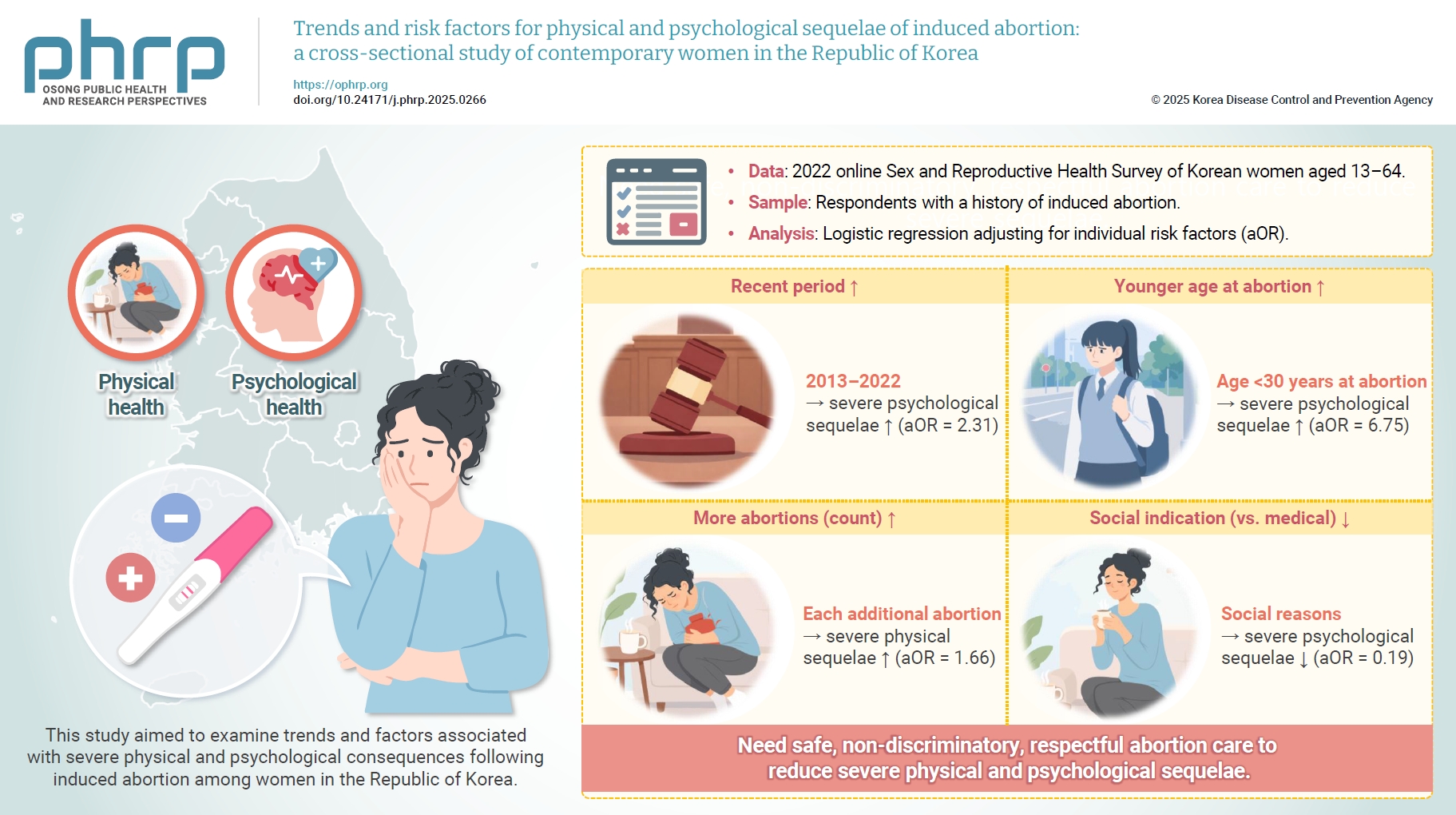
Objectives This study aimed to examine trends and factors associated with severe physical and psychological consequences following induced abortion among women in the Republic of Korea.
Methods An online survey was conducted of adolescent and adult Korean women aged 13 to 64 years, termed the 2022 Sex and Reproductive Health Survey. Respondents who reported a history of induced abortion were analyzed. Logistic regression models that accounted for individual risk factors were fitted to calculate adjusted odds ratios (aOR).
Results The prevalence of induced abortion was 20.1% (914 of 4,552 respondents). The most frequent indications for abortion were social reasons, and across all periods, approximately half of the women or more reported non-medical challenges at the time of their most recent abortion. Severe physical and psychological sequelae after abortion increased 5-fold from 1980–1992 to 2013–2022. Among those whose most recent abortion occurred in 2003 or later, the risk of severe psychological sequelae was higher in 2013–2022, after the Korean Constitutional Court upheld the existing criminal codes, than in 2003–2012 (aOR, 2.31; 95% confidence interval, 1.09–4.91).
Conclusion In the absence of institutionalized safe and respectful abortion services, severe physical and psychological sequelae among women who underwent induced abortion were more likely to occur. These findings highlight the importance of safe, affordable, nondiscriminatory, and respectful abortion care.
Objectives This study aimed to comprehensively outline the methodological approaches used in published research comparing the vaccine effectiveness (VE) of coronavirus disease 2019 (COVID-19) vaccines.
Methods A systematic search was conducted on June 13, 2024, to identify comparative studies evaluating the effectiveness of mRNA versus non-mRNA and monovalent versus bivalent COVID-19 vaccines. We screened titles, abstracts, and full texts, collecting data on publication year, country, sample size, study population composition, study design, VE estimates, outcomes, and covariates. Studies that reported relative VE (rVE) were analyzed separately from those that did not.
Results We identified 25 articles comparing rVE between mRNA and non-mRNA COVID-19 vaccines, as well as between monovalent and bivalent formulations. Among the studies assessing VE by vaccine type, 126 did not provide rVE estimates. Comparative VE studies frequently employed retrospective cohort designs. Among the definitions of rVE used, the most common were hazard ratio and absolute VE, calculated as (1−odds ratio)×100. Studies were most frequently conducted in the United Kingdom and the United States, and the most common outcome was infection. Most targeted the general population and assessed the VE of mRNA vaccines using the AstraZeneca vaccine as a reference. A small proportion, 7.3% (n=11), did not adjust for any variables. Only 3 studies (2.0%) adjusted for all core confounding variables recommended by the World Health Organization.
Conclusion Few comparative studies of COVID-19 vaccines have incorporated rVE methodologies. Reporting rVE and employing a consistent set of covariates can broaden our understanding of COVID-19 vaccines.
Citations
Citations to this article as recorded by
Protection from second booster vaccines and natural immunity against SARS-CoV-2 infections, 2022–2023 Dritan Bejko, Anne Vergison, Saverio Stranges, Joël Mossong, Maurice Zeegers Epidemiology and Infection.2026;[Epub] CrossRef




 First
 Prev


