Objectives Severe trauma remains a leading cause of death in the Republic of Korea. In response, regional trauma centers were established in 2012. This study evaluated the impact of direct prehospital transport to trauma centers on in-hospital mortality among patients with severe trauma using the national trauma registry. Methods: This nationwide observational study utilized data from the Korean community-based trauma registry between 2016 and 2020. Patients with an injury severity score >15 who were directly transported from the prehospital setting were included. Variables analyzed encompassed demographics, injury mechanism, transport time, hospital level, and outcomes. The primary outcome was in-hospital mortality. Both logistic regression and decision tree models were employed. Results: A total of 24,567 patients were included. Overall mortality decreased by 5.2% during the study period. Patients transported to level 1 or 2 trauma centers had a lower mortality rate (23.6%) compared to those transported to level 3 or 4 hospitals (28.0%). The proportion of direct transports to high-level centers increased from 46.7% to 64.1% between 2016 and 2020. Despite longer transport times, patients transported to high-level institutions exhibited improved survival, particularly when transport exceeded 30 minutes, suggesting that hospital selection may be more critical than minimizing transport time. Conclusion: Direct transport to high-level trauma centers improves survival among patients with severe trauma, even when transport times are prolonged. These findings support the importance of a well-organized trauma system that emphasizes hospital capability in prehospital triage decisions.
Citations
Citations to this article as recorded by
Geospatial Optimization of Trauma Care Resource Allocation and Timely Access for Severely Injured Patients Ryan B. Choi, Deeksha Bidare, Byung Hee Kang, Junsik Kwon, Kyungwon Jung, Jeff Choi JAMA Network Open.2026; 9(9): e2636840. CrossRef
Prehospital transport prioritization and time-varying selection bias in traffic-related multi-patient incidents: a nationwide retrospective cohort study Atsushi Kubo, Shinobu Tamura, Atsushi Hiraide, Daigo Morioka, Ryu Murakami, Kenko Fukui, Shigeaki Inoue Critical Care.2026;[Epub] CrossRef
Artificial intelligence and biohealth: the Republic of Korea’s emerging priorities in health care R&D Jong-Koo Lee Osong Public Health and Research Perspectives.2025; 16(4): 309. CrossRef
Objectives We analyzed the demographic and clinical characteristics of patients diagnosed with coronavirus disease 2019 (COVID-19), focusing specifically on severe/critical cases, and assessed the trends and rates of severity and fatality among these patients in the Republic of Korea.
Methods Clinical data on patients with COVID-19 from January 20, 2020 to August 30, 2023 were collected from the Korea Disease Control and Prevention Agency’s database. We identified patients who progressed to severe/critical conditions and analyzed their demographic and clinical profiles. Severity and fatality rates were calculated and compared annually to track the disease progression over time.
Results During the surveillance period, 34,572,554 COVID-19 cases were confirmed, among whom 38,112 (0.11%) progressed to severe/critical conditions. Most severe/critical cases occurred in individuals aged ≥60 years, with a notable increase in patients aged ≥80 years from 2022. The overall severity rate was 0.19%, with a fatality rate of 0.10%. However, the severity of cases gradually diminished during the study period. In 2022, the severity and fatality rates decreased to 0.14% and 0.09%, respectively. In 2023, while the severity rate remained stable at 0.15%, the fatality rate further decreased to 0.06%. Notably, throughout the study period, individuals aged ≥80 years had a significantly higher severity rate (2.44%), with a fatality rate of 1.75%.
Conclusion These findings underscore the importance of prioritizing protection and management strategies for older adults and high-risk groups to mitigate the impact of COVID-19. Continued surveillance and analysis are essential to effectively control COVID-19 and minimize its burden on public health.
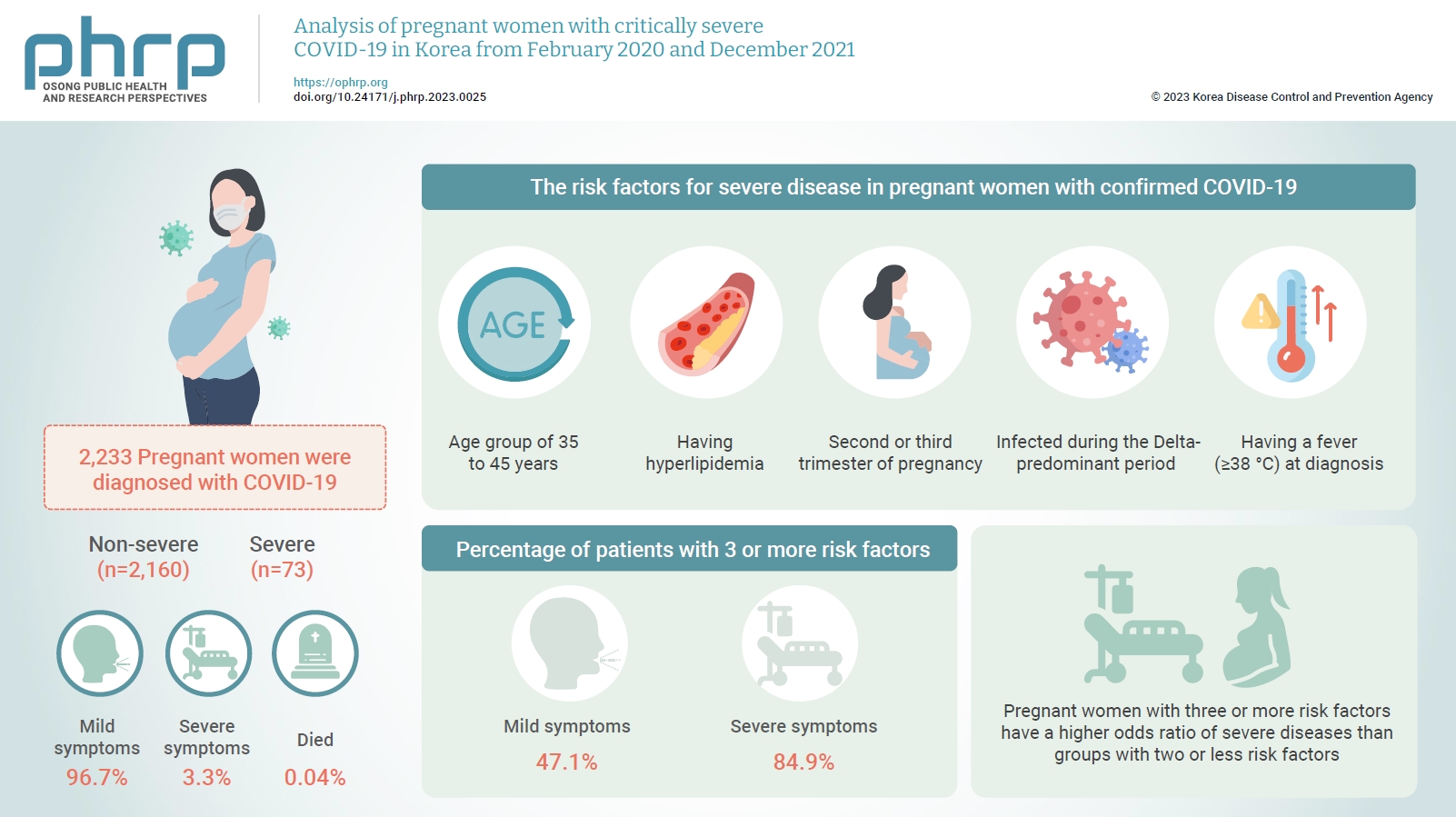
Objectives This study aimed to describe the characteristics and risk factors for severe disease in pregnant women infected with coronavirus disease 2019 (COVID-19) from the early days of the COVID-19 epidemic in Korea to the predominant period of the Delta variant.
Methods A retrospective cohort study was conducted among pregnant women diagnosed with COVID-19 between February 2020 and December 2021. Logistic regression analysis was performed to compare severe and mild cases after adjusting for pregnant women’s age, nationality, infection route, outbreak area, infection period, symptoms, underlying disease, smoking status, trimester, and COVID-19 vaccination status.
Results In total, 2,233 pregnant women were diagnosed with COVID-19 by December 2021. Among these, 96.7% had mild symptoms, 3.3% had severe symptoms, and 0.04% died. The risk factors for severe disease in pregnant women with confirmed COVID-19 were being in the age group of 35 to 45 years, having hyperlipidemia, being in the second or third trimester of pregnancy at the time of COVID-19 diagnosis, being infected during the Delta-predominant period, and having a fever (≥38 °C) at diagnosis. Furthermore, 47.1% of patients in the mild group and 84.9% of patients in the severe group had 3 or more risk factors.
Conclusion Pregnant women with COVID-19 mainly experienced mild symptoms, but those with risk factors were at a higher risk of developing severe symptoms. Therefore, treatment and follow-up management should be thoroughly implemented.



 First
 Prev


