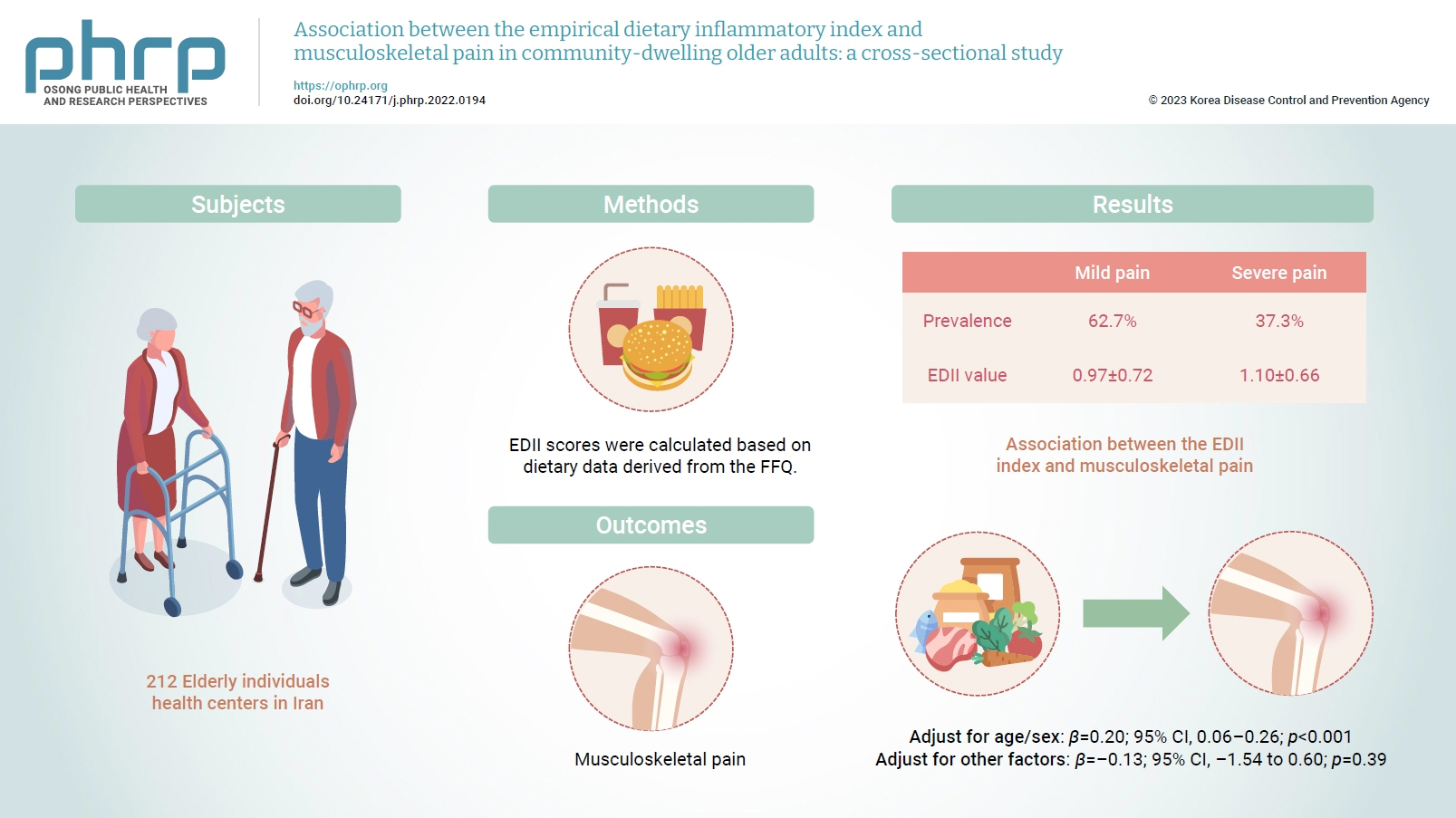
Objectives Inflammation has been proposed to be one of the main causes of musculoskeletal pain. Diet is a lifestyle factor that plays an important role in managing inflammation; thus, we assessed the inflammatory potential of diets using the empirical dietary inflammatory index (EDII) to investigate the relationship between diet and musculoskeletal pain.
Methods This cross-sectional study included 212 elderly individuals who were selected from health centers in Tehran, Iran. Dietary intake was evaluated using a valid and reliable 147-item food frequency questionnaire. To measure the intensity of pain, a visual analogue scale was used. Multiple linear regression was applied to assess the association between the EDII and musculoskeletal pain.
Results In total, 62.7% and 37.3% of participants had mild and severe pain, respectively. The EDII values were 0.97±0.72 and 1.10±0.66, respectively, in those with mild and severe pain. A higher EDII score was associated with more intense musculoskeletal pain after adjusting for age and sex (β=0.20; 95% confidence interval [CI], 0.06–0.26; p<0.001), but not after adjustment for other confounders (β=–0.13; 95% CI, –1.54 to 0.60; p=0.39).
Conclusion Our findings indicated that higher dietary inflammation might not be associated with musculoskeletal pain in older adults. However, further investigations are required to confirm these findings.
Citations
Citations to this article as recorded by
Skeletal Muscle Disorders: Navigating Management and Natural Products Hesham M. El‐Sayed, Khaled Hussien, Heba R. Ghaiad, Mai A. Abd‐Elmawla, Nourhan M. Abdelmaksoud, Asmaa Ramadan, Riham A. El‐Shiekh, Mohamed Bakr Zaki Chemistry & Biodiversity.2026;[Epub] CrossRef
Proinflammatory diet is associated with higher pain, disease severity and biochemical parameters associated with inflammation in fibromyalgia Nursena Ersoy Söke, Hansa İnceöz, İlker Solmaz, Hülya Yardımcı Pain Medicine.2025; 26(3): 131. CrossRef
Exploring the association between dietary Inflammatory Index and chronic pain in US adults using NHANES 1999–2004 Lunxue Qing, Yingying Zhu, Changhe Yu, Yang Zhang, Jinxia Ni Scientific Reports.2024;[Epub] CrossRef
The dietary inflammatory index and cardiometabolic parameters in US firefighters Andria Christodoulou, Costas A. Christophi, Mercedes Sotos-Prieto, Steven Moffatt, Longgang Zhao, Stefanos N. Kales, James R. Hébert Frontiers in Nutrition.2024;[Epub] CrossRef
Association between dietary inflammatory index and musculoskeletal disorders in adults Firoozeh Khamoushi, Davood Soleimani, Farid Najafi, Neshat Ahmadi, Neda Heidarzadeh-Esfahani, Bita Anvari, Ebrahim Shakiba, Yahya Pasdar Scientific Reports.2023;[Epub] CrossRef



 First
 Prev


