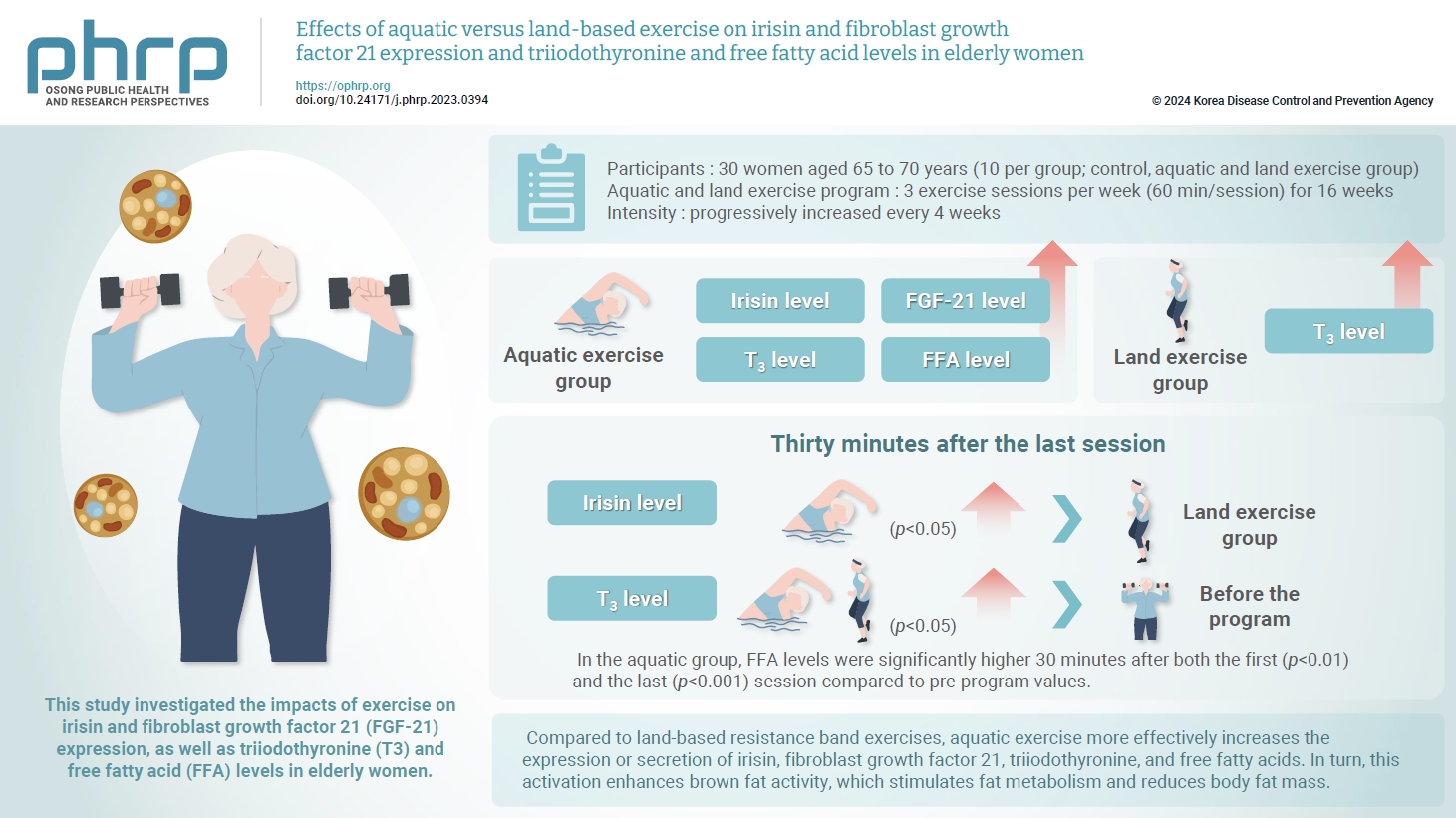
Objectives This study investigated the impacts of exercise on irisin and fibroblast growth factor 21 (FGF-21) expression, as well as triiodothyronine (T3 ) and free fatty acid (FFA) levels in elderly women. Methods: Thirty women aged 65 to 70 years (10 per group) were randomly assigned to aquatic exercise, land exercise, and control groups. The aquatic and land groups engaged in 3 exercise sessions per week (60 min/session) for 16 weeks. The intensity was progressively increased every 4 weeks. Results: Irisin and FGF-21 levels significantly increased in the aquatic exercise group. In the posttest, the aquatic exercise group had the highest irisin levels. Significant findings were observed for irisin and FGF-21 for the main effect between aquatic and band exercise groups (p<0.05 for both), the main effect between measurement times (p<0.01 and p<0.001, respectively), and the interaction effect (p<0.05 and p<0.001, respectively). The irisin level was significantly higher in the aquatic than in the land group 30 minutes after the last session (p<0.05). In both exercise groups, T3 levels were significantly higher 30 minutes after the final session (p<0.05) than before the program. The FFA level was significantly higher in the aquatic exercise group than the others. In the aquatic group, FFA levels were significantly higher 30 minutes after both the first (p<0.01) and the last (p<0.001) session compared to pre-program values. Conclusion: Differences in exercise type and environment can promote fat metabolism by stimulating hormonal changes that induce brown fat activity and browning.
Citations
Citations to this article as recorded by
Effects of aquatic exercise on improving body composition and muscle strength in the older adults: a systematic review and meta-analysis of randomized controlled trials Yuan Gao, Wenze Deng, Qiancheng Zeng, Yichen Liu, Xiaofu Tang, Sitian Fang, Liang Hao, Hongbo Li Frontiers in Public Health.2026;[Epub] CrossRef
Effects of Different Training Modalities on Circulating Irisin Levels in Overweight and Obesity Adults: A Systematic Review and Meta-analysis of Randomized Controlled Trials Keyvan Hejazi, Gholam Rasul Mohammad Rahimi, Ayoub Saeidi, Khadija Ayed, Ismail Laher, Juan Del Coso, Anthony C. Hackney, Urs Granacher, Hassane Zouhal Sports Medicine.2026; 56(9): 2231. CrossRef
Exerkines in precision management of metabolic diseases Leigang Jin, Yifen Lin, Yixuan Zheng, Anli Wang, Peng Liao, Yucheng Luo, Zhongheng Sui, Xiayun Ni, Jianan Zhang, Qing Shen, Aimin Xu Chinese Medical Journal.2026;[Epub] CrossRef
Irisin: Its significance in the diagnosis and treatment of post-stroke depression Chengyan Han, Ruixue Guan, Jianxing Zhao, Peng Sun Journal of Psychiatric Research.2025; 191: 285. CrossRef



 First
 Prev


