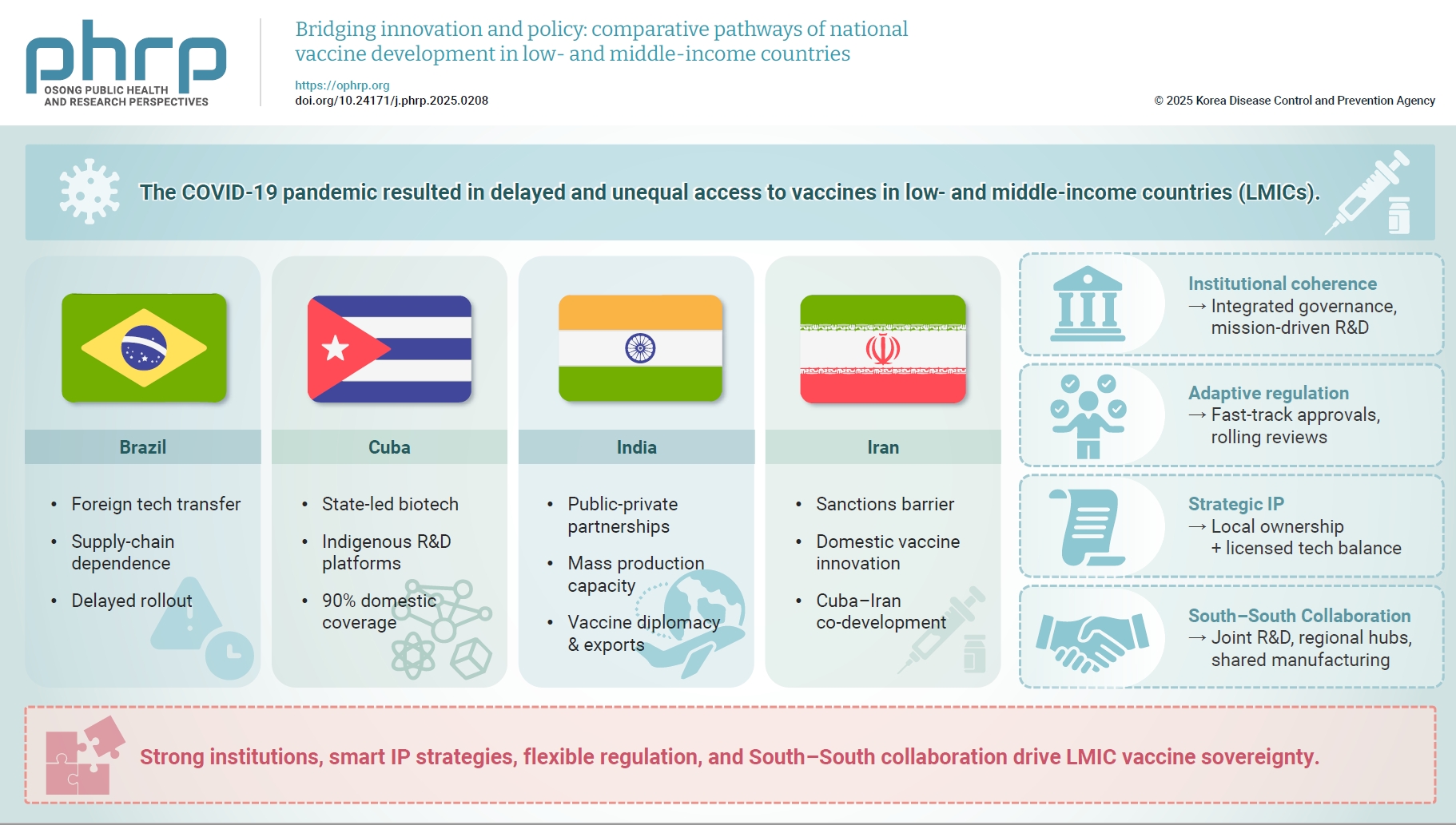
Objectives To examine how national innovation and policy configurations enabled vaccine development in Brazil, Cuba, India, and Iran, and to distil lessons for low- and middle-income country (LMIC) vaccine sovereignty.
Methods Narrative review of peer-reviewed and grey literature (2020–2023), guided by a structured search and screening approach; synthesis mapped to national and sectoral innovation system perspectives and technology readiness levels.
Results Cuba and Iran leveraged mission-oriented public research and development (R&D) and domestic platforms; India combined indigenous R&D with large-scale licensed manufacturing; Brazil’s scientific capacity was constrained by fragmented governance and supply-chain dependence. Adaptive regulation (e.g., emergency use authorization/conditional approvals), targeted technology transfer, and South–South partnerships accelerated progress but raised longer-term questions about intellectual property (IP) control and economic sustainability.
Conclusion Institutional coherence, strategic IP management, and regional manufacturing alliances are as critical as scientific capacity for LMIC vaccine self-reliance. Policy priorities include pre-negotiated tech-transfer frameworks, regulatory preparedness, and investment in public R&D linked to distributed manufacturing.
Citations
Citations to this article as recorded by
Next-Generation Vaccines Leveraging T Cell-Centric Design, Mucosal Immunity, and Trained Innate Immunity for Respiratory and Enteric Pathogens Md. Abdus Salam, Md. Yusuf Al-Amin, Kasireddy Sudarshan, Aidan Lynch, Victor Reyes, Madeline Stevenson Vaccines.2026; 14(5): 462. CrossRef
From Global Insights to Local Action: Bridging Vaccine Design and Manufacturing Gaps in H5N1 Pandemic Readiness María Alicia Delfino, Jimena Borgo, Luciano Chaneton, Natacha Cerny, Augusto Ernesto Bivona, Pierre Gsell, Fernando Lobos, Ike James, Martin Friede, German Sánchez Alberti, Andrés Sánchez Alberti Vaccines.2026; 14(6): 519. CrossRef
Harnessing trained immunity for next-generation vaccines: from rational adjuvant design to self-adjuvanting antigens Jing Wang, Xiao-Yong Fan, Zhidong Hu Expert Review of Vaccines.2026;[Epub] CrossRef
Vigilancia tecnológica de vacunas contra arbovirus en Latinoamérica Diana Priscila Estrella-Santiago, Rubén Oliver Espinoza Entreciencias diálogos en la Sociedad del Conocimi.2026; 14(28): 1. CrossRef
Role of Academia and Research Institutions in Advancing Indigenous Vaccine Development Saira Afzal, Muhammad Maaz Arif Pakistan BioMedical Journal.2026; : 01. CrossRef



 First
 Prev


