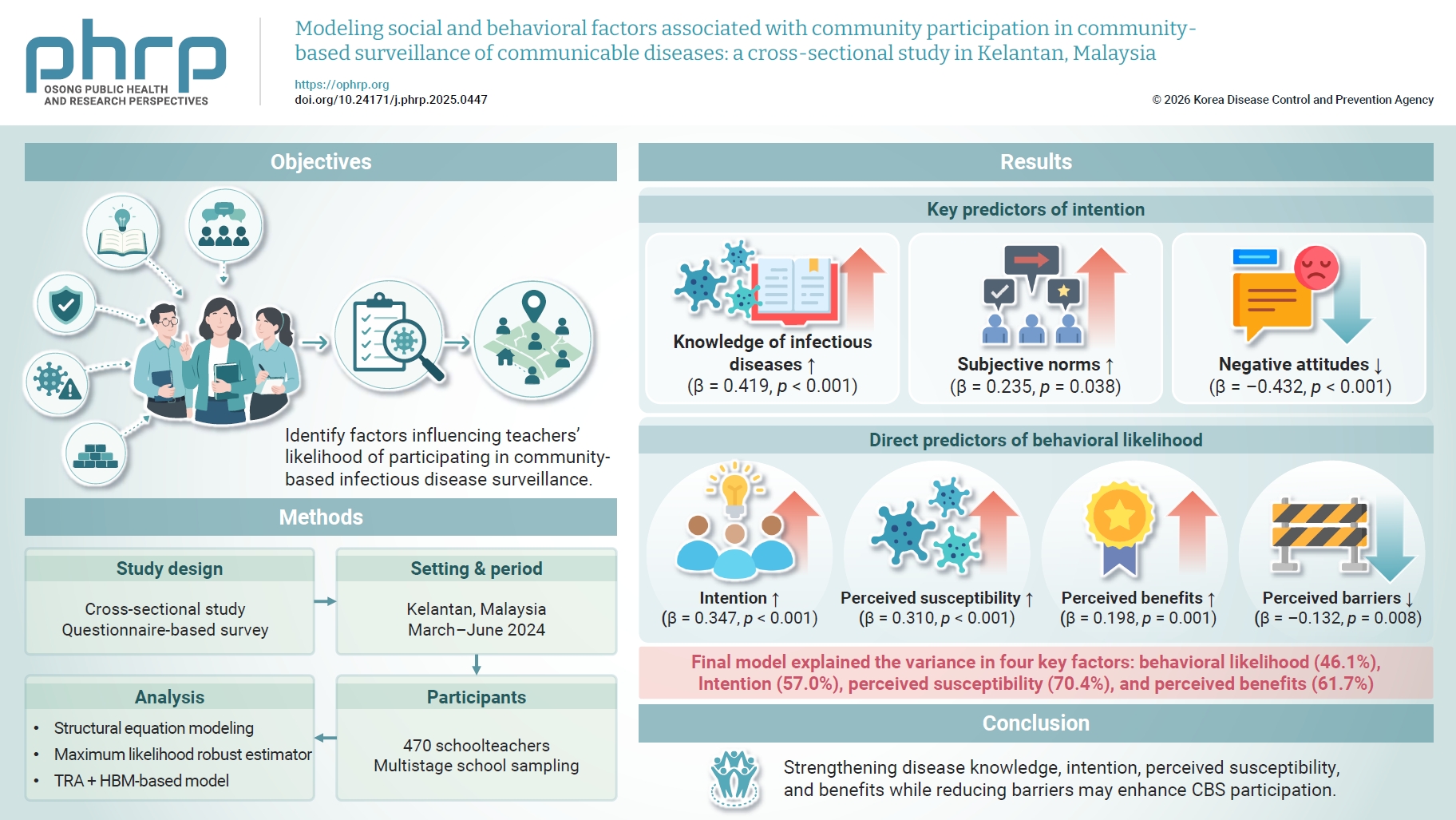
Objectives This study examined the social and behavioral factors influencing community leaders’ participation in community-based surveillance (CBS) of infectious diseases. We hypothesized that knowledge, attitudes, and perceptions significantly predict the behavioral likelihood of engaging in CBS activities. Methods: A cross-sectional study was conducted among 470 schoolteachers in Kelantan, Malaysia, from March to June 2024. Participants were selected using multistage sampling, with random selection of schools followed by convenience sampling of teachers. Data were collected using the validated KAP-CBS-ID questionnaire, which was based on the Theory of Reasoned Action and Health Belief Model. Structural equation modeling was used to analyze relationships among the study variables with the maximum likelihood robust estimator. Results: The final model demonstrated good fit (comparative fit index, 0.921; standardized root mean square residual, 0.071; root mean square error of approximation, 0.040 [90% confidence interval, 0.036–0.044]). Ten significant path relationships were identified, explaining 46.1% of the variance in behavioral likelihood. Knowledge of infectious diseases (β=0.419, p<0.001), subjective norms (β=0.235, p=0.038), and negative attitudes (β=–0.432, p<0.001) significantly influenced intention. Behavioral likelihood was directly predicted by intention (β =0.347, p<0.001), perceived susceptibility (β=0.310, p<0.001), perceived benefits (β=0.198, p=0.001), and perceived barriers (β=–0.132, p=0.008). Self-efficacy showed significant indirect effects through perceived benefits (β=0.785, p<0.001) and perceived susceptibility (β=0.765, p<0.001). Conclusion: Knowledge and psychosocial factors significantly inf luence community engagement in CBS of infectious diseases. Public health interventions should address these interconnected determinants to strengthen early disease detection and reporting systems.
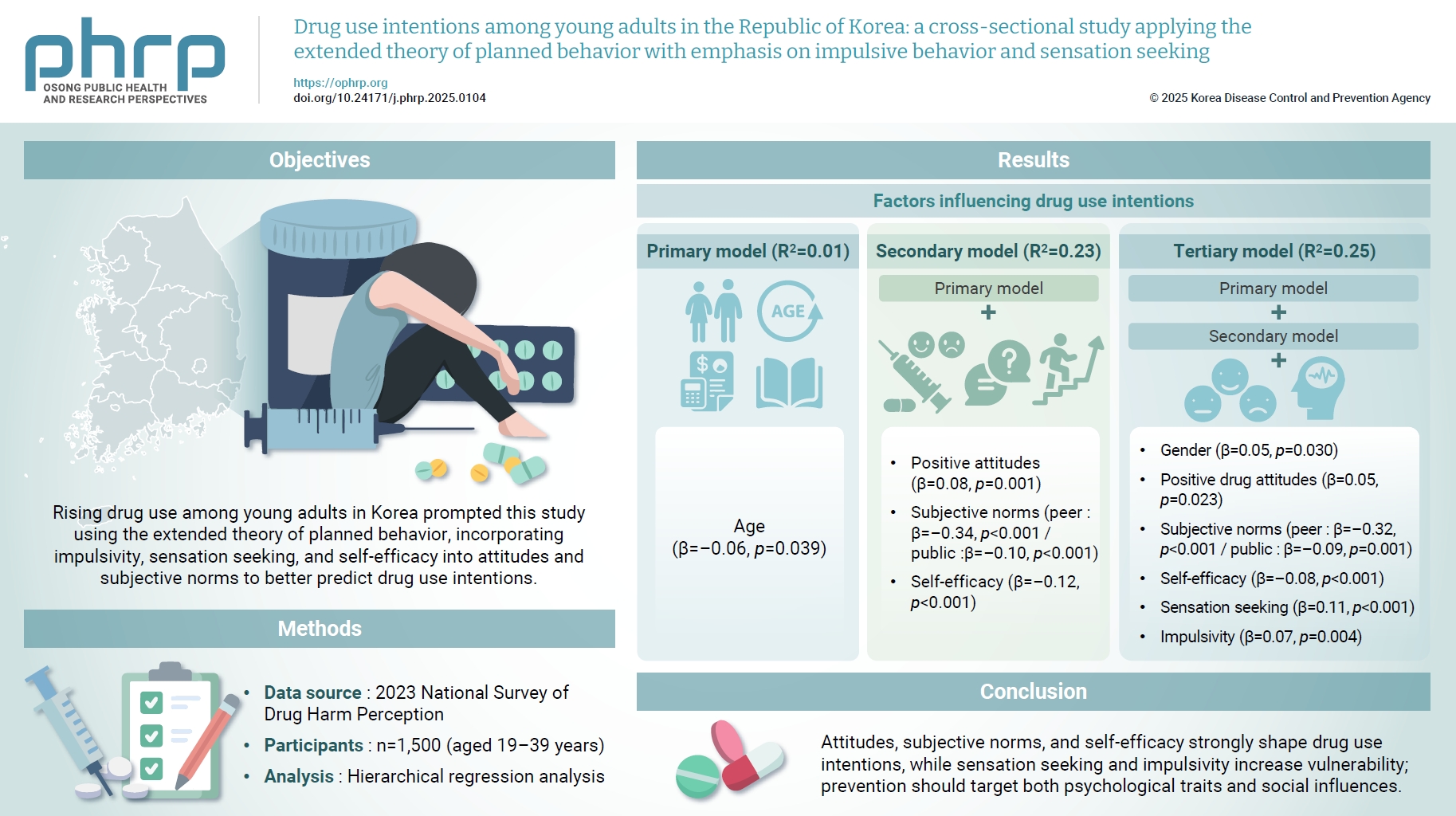
Objectives The increasing prevalence of drug use in the Republic of Korea has emerged as a significant social concern. This study applied the extended theory of planned behavior to investigate the factors influencing intentions to use drugs among young adults (aged 20–30 years) in the Republic of Korea. The study integrated personal traits—specifically, impulsivity, sensation seeking, and self-efficacy—into 2 core theory of planned behavior constructs: attitudes and subjective norms. The principal aim was to improve the prediction of drug use intentions by incorporating these variables. Methods: Data were obtained from the 2023 National Survey of Drug Harm Perception, which sampled 1,500 individuals aged 19 to 39 years. Hierarchical regression analysis was employed to assess the influence of psychological and social factors on intentions to use drugs. Results: In the primary model, age emerged as a significant predictor of drug use intentions (R2 =0.01). The secondary model showed that positive attitudes toward drugs, subjective norms, and lower self-efficacy significantly increased drug use intentions (R2 =0.23). In the final tertiary model, the addition of sensation seeking and impulsivity further amplified these intentions (R2 =0.25). Conclusion: The findings underscore the pivotal roles of attitudes, subjective norms, and selfefficacy in shaping intentions to use drugs. Sensation seeking and impulsivity were found to further elevate vulnerability. Effective prevention efforts must address both psychological traits and social influences. Future research should examine the long-term behavioral outcomes associated with these factors.
Citations
Citations to this article as recorded by
Beliefs and attitudes toward substance use and associated factors among University students in Eastern Turkey Pınar Eryılmaz, Gulpınar Aslan, Irfan Kaplan Journal of Substance Use.2026; : 1. CrossRef
Associations of Health Belief Model Constructs and Self-Control with Drug Avoidance Intention Among University Students in the Republic of Korea: A Cross-Sectional Study Jungmin Lee, Su Jung Lee Behavioral Sciences.2026; 16(9): 1653. CrossRef
Artificial intelligence and biohealth: the Republic of Korea’s emerging priorities in health care R&D Jong-Koo Lee Osong Public Health and Research Perspectives.2025; 16(4): 309. CrossRef



 First
 Prev


