Objectives The study aimed to examine health workers’ perceptions of the coronavirus disease 2019 (COVID-19) vaccine in Nigeria and their willingness to receive the vaccine when it becomes available.
Methods This multi-center cross-sectional study used non-probability convenience sampling to enroll 1,470 hospital workers aged 18 and above from 4 specialized hospitals. A structured and validated self-administered questionnaire was used for data collection. Data entry and analysis were conducted using IBM SPSS ver. 22.0.
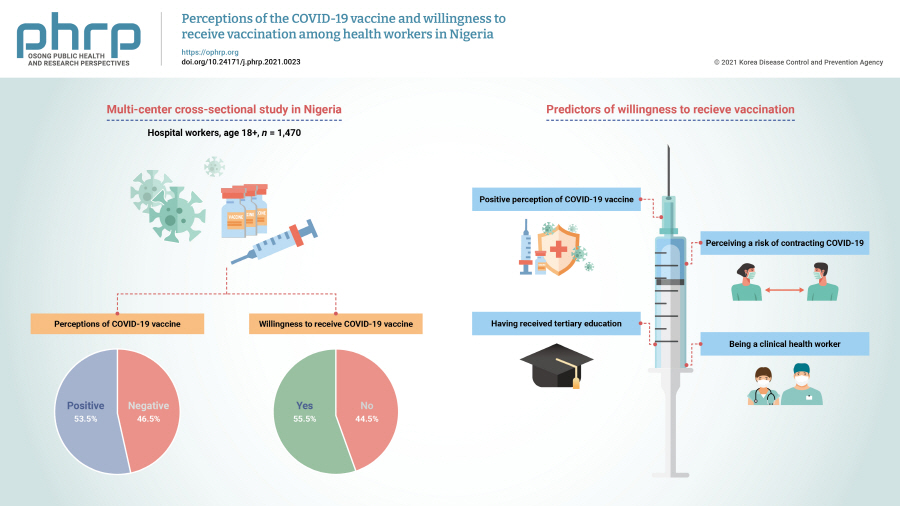
Results The mean age of respondents was 40±6 years. Only 53.5% of the health workers had positive perceptions of the COVID-19 vaccine, and only slightly more than half (55.5%) were willing to receive vaccination. Predictors of willingness to receive the COVID-19 vaccine included having a positive perception of the vaccine (adjusted odds ratio [AOR], 4.55; 95% confidence interval [CI], 3.50−5.69), perceiving a risk of contracting COVID-19 (AOR, 1.50; 95% CI, 1.25–3.98), having received tertiary education (AOR, 3.50; 95% CI, 1.40−6.86), and being a clinical health worker (AOR, 1.25; 95% CI, 1.01−1.68).
Conclusion Perceptions of the COVID-19 vaccine and willingness to receive the vaccine were sub-optimal among this group. Educational interventions to improve health workers' perceptions and attitudes toward the COVID-19 vaccine are needed.
Citations
Citations to this article as recorded by
Acceptance, hesitancy, and ethical challenges of the COVID-19 vaccine in sub-Saharan Africa: a systematic review and meta-analysis Denise P. Ilboudo, Abibou Simpore, Joseph Sawadogo, Abdoul Karim Ouattara, Alice R. Ouedraogo, Luc Zongo, Albert T. Yonli, Abdou Azaque Zouré, Théodora M. Zohoncon, Florencia W. Djigma, Dorcas Obiri-Yeboah, Charlemagne M. Ouedraogo, Jacques Simpore Vaccine.2026; 69: 127966. CrossRef
Willingness to COVID-19 Vaccination: Empirical Evidence from EU Arslan Austin, Imran Ur Rahman, Naveed Nelson SSRN Electronic Journal.2025;[Epub] CrossRef
Prevalence of COVID-19 Vaccine Hesitancy Among Healthcare Workers in Nigeria: A Systematic Review and Meta-Analysis Taagbara Jolly Abaate, Dabota Yvonne Buowari, Utchay A. Agiri, Tamunodiepiriye Inimgba, Vivian Ifeoma Ogbonna, Chizaram Onyeaghala, Glory Ovunda Worgu, Abiye Somiari, Emmanuella I. Ezebuiro, Ibe Arthur Onuah International Journal of Public Health.2025;[Epub] CrossRef
Sağlık Algısı ve COVID-19 Aşısına Yönelik Tutumların İncelenmesi: Sağlık Çalışanları Örneği Melek Seyhan Demir, Ozcan Aygun Sağlık Akademisi Kastamonu.2025; 10(1): 27. CrossRef
Lessons from COVID-19 vaccine hesitancy among healthcare workers in West Africa and strategies for future pandemic preparedness: a structured literature review Sunday Iphierohor Asasah, Emmanuel Edoghogho Imade, Ben Jesuorsemwen Enagbonma Journal of Public Health.2025; 47(3): 487. CrossRef
How did health service utilization and delivery change during the COVID-19 pandemic? Frontline healthcare workers’ perceptions from the Central African Republic, the Democratic Republic of Congo, and Bangladesh Chiara Altare, Madison Bates, Hannah Crockett, Gbètoho Fortuné Gankpe, Md Abul Hasan, Linda Matadi Basadia, Jogie Abucejo Agbogan, Marie Petry, Abdoul Azizi Almoustapha Abaradine, Brigitte Tonon, Sophie Bruneau, Caroline Antoine, Paul Spiegel BMC Health Services Research.2025;[Epub] CrossRef
COVID-19 vaccine hesitancy and its predictors among healthcare workers in a tertiary hospital in Ghana: A cross-sectional survey Israel Abebrese Sefah, Perry Ofori, Araba Hutton-Nyameaye, Peter Yamoah, Frank Baiden, Varsha Bangalee, Mubarick Nungbaso Asumah PLOS One.2025; 20(9): e0333412. CrossRef
Nigerians’ attitudes and perceptions towards vaccine acceptance during and after the COVID-19 pandemic Jonas Lotanna Ibekwe, Victor Oluwafemi Femi-Lawal, Jolly Akor Thomas, Faith Uzoamaka Okei, Moses Ojomakpenen Ojile, Oluwatobiloba Oladipupo Akingbulugbe Journal of Medicine, Surgery, and Public Health.2024; 2: 100066. CrossRef
Knowledge, attitudes, and factors determining the willingness for COVID-19 vaccination among students in Bangladesh: An online-based cross-sectional study Ashis Talukder, Soheli Sharmin, Chuton Deb Nath, Iqramul Haq, Md. Ismail Hossain, Md. Jakaria Habib, Sabiha Shirin Sara Journal of Public Health.2024; 32(4): 663. CrossRef
Knowledge, attitude, and perception towards COVID-19 vaccinations among the adults in Rwanda: a cross-sectional study Abakundana Nsenga Ariston Gabriel, Xiao-Yang Wang, Laila Jamil, Mulugeta Shegaze Shimbre, Gerard Bikorimana, Lin Zhao, Wu-Chun Cao BMC Public Health.2024;[Epub] CrossRef
Healthcare professionals’ perception and COVID-19 vaccination attitudes in North-Western Ghana: A multi-center analysis Augustine Ngmenemandel Balegha, Suburu Abdul-Aziz, Louis Mornah, Pracheth Raghuveer PLOS ONE.2024; 19(2): e0298810. CrossRef
Behavioral Insights from Vaccine Adoption in Nigeria: Cross-Sectional Survey Findings Sohail Agha, Ifeanyi Nsofor, Drew Bernard, Sarah Francis, Nandan Rao Interactive Journal of Medical Research.2024; 13: e47817. CrossRef
COVID-19 and COVID-19 vaccination experiences and perceptions among health workers during the pandemic in Ebonyi state, Nigeria: An analytical cross-sectional study Ugwu I. Omale, Cordis O. Ikegwuonu, Glory E. Nkwo, Ugochi I. A. Nwali, Olaedo O. Nnachi, Okechukwu O. Ukpabi, Ifeyinwa M. Okeke, Richard L. Ewah, Osarhiemen Iyare, Chidinma I. Amuzie, Onyinyechukwu U. Oka, Victor U. Uduma, Azuka S. Adeke, Ayi Vandi Kwaghe PLOS ONE.2024; 19(5): e0303172. CrossRef
COVID-19 vaccination intention among internally displaced persons in complex humanitarian emergency context, Northeast Nigeria Saheed Gidado, Melton Musa, Ahmed Ibrahim Ba’aba, Lilian Akudo Okeke, Patrick M. Nguku, Isa Ali Hassan, Ibrahim Muhammad Bande, Rabi Usman, Gideon Ugbenyo, Idris Suleman Hadejia, J. Pekka Nuorti, Salla Atkins, Sylvester Maleghemi Maleghemi PLOS ONE.2024; 19(8): e0308139. CrossRef
Predictors of the willingness to accept a free COVID-19 vaccine among households in Nigeria Oghenowede Eyawo, Uchechukwu Chidiebere Ugoji, Shenyi Pan, Patrick Oyibo, Amtull Rehman, Mishel Mahboob, Olapeju Adefunke Esimai Vaccine.2024; 42(23): 126225. CrossRef
COVID-19 hand hygiene practices and its barriers among health care workers in a low-resource setting: a cross-sectional study in Nigeria Ezinne Chika Ekediegwu, Ogochukwu Kelechi Onyeso, Chiamaka Nwanne, Ifeoma Blessing Nwosu, Chiedozie James Alumona, Kelechi Mirabel Onyeso, Echezona Nelson Domnic Ekechukwu, Ebere Yvonne Ihegihu, Ifeoma Adaigwe Amaechi, Okwukweka Emmanuela Aruma, Adesola C Discover Social Science and Health.2024;[Epub] CrossRef
COVID-19 Vaccination Uptake and Associated Factors in Selected Communities in Two Southwestern States in Nigeria Oluseye Ayodele Ajayi, Olabanjo Okunlola Ogunsola, Ajibola Idowu, Oluwaseun Kikelomo Ajayi, Kucheli Wudiri, Rita Ayoka-Ikechukwu, Prosper Okonkwo Advances in Infectious Diseases.2024; 14(01): 260. CrossRef
COVID-19 vaccine hesitancy in Latin America and Africa: a scoping review Bruna Aparecida Gonçalves, Camila Carvalho de Souza Amorim Matos, Jonathan Vicente dos Santos Ferreira, Renata Fortes Itagyba, Vinicius Rocha Moço, Marcia Thereza Couto Cadernos de Saúde Pública.2023;[Epub] CrossRef
Suspecting the Figures: What Church Leaders Think About Government’s Commitment to Combating COVID-19 in Nigeria Uchechukwu M. Agbo, George C. Nche Journal of Asian and African Studies.2023; 58(5): 725. CrossRef
Access to COVID-19 vaccines and testing in Africa: the importance of COVAX - Nigeria as a case study Rafaella Fortini Queiroz Grenfell, Oyetunde Timothy Oyeyemi Pathogens and Global Health.2023; 117(2): 152. CrossRef
COVID-19 vaccine acceptance prediction: The roles of students’ attitude towards science and mathematics and knowledge of COVID-19 pandemic Sunday Ogbu, Ogochukwu Ebere Emenike, Amaka Loretta Nwankwo Electronic Journal of Medical and Educational Tech.2023; 16(2): em2304. CrossRef
Factors associated with COVID-19 vaccine hesitancy among healthcare workers in Cameroon and Nigeria: a web-based cross-sectional study Jerry Brown Aseneh, Valirie Ndip Agbor, Benjamin Momo Kadia, Elvis Anyaehiechukwu Okolie, Chinelo Janefrances Ofomata, Christie Linonge Etombi, Domin Sone M Ekaney, Yvonne Walburga Joko Fru International Health.2023; 15(6): 702. CrossRef
Willingness to COVID-19 vaccination: Empirical evidence from EU Imran Ur Rahman, Arslan Austin, Naveed Nelson Heliyon.2023; 9(5): e15776. CrossRef
Radiographers’ knowledge, attitude and adherence to standard COVID-19 precautions and the policy implications: a national cross-sectional study in Nigeria Charles Ikechukwu Ezema, Okechukwu Felix Erondu, Ogochukwu Kelechi Onyeso, Chiedozie James Alumona, Andrew Wueseter Ijever, Charity Ndidiamaka Amarachukwu, Amaeze Augustine Amaeze Annals of Medicine.2023;[Epub] CrossRef
Declining trends in vaccine confidence across sub-Saharan Africa: A large-scale cross-sectional modeling study A. de Figueiredo, E. Temfack, R. Tajudeen, H. J. Larson Human Vaccines & Immunotherapeutics.2023;[Epub] CrossRef
Knowledge and acceptance of COVID-19 vaccine among healthcare workers in Enugu metropolis, Enugu state, Nigeria Kelechi U. Imediegwu, Jude C. Abor, Chiamaka Q. Onyebuchukwu, Hilary I. Ugwu, Ogechi I. Ugwu, Udo Ego Anyaehie, Oluchi A. Onyia Frontiers in Public Health.2023;[Epub] CrossRef
COVID-19 vaccination acceptance (uptake, hesitancy, intention to receive and timeliness of the intention to receive) and the determinants among health workers in Ebonyi state, Nigeria: an analytical cross-sectional study Ugwu I Omale, Onyinyechukwu U Oka, Chidinma I Amuzie, Victor U Uduma, Azuka S Adeke, Cordis O Ikegwuonu, Glory E Nkwo, Ugochi I A Nwali, Osarhiemen Iyare, Richard L Ewah, Olaedo O Nnachi, Okechukwu O Ukpabi, Ifeyinwa M Okeke BMJ Open.2023; 13(7): e068668. CrossRef
Hesitação vacinal contra a COVID-19 na América Latina e África: uma revisão de escopo Bruna Aparecida Gonçalves, Camila Carvalho de Souza Amorim Matos, Jonathan Vicente dos Santos Ferreira, Renata Fortes Itagyba, Vinicius Rocha Moço, Marcia Thereza Couto Cadernos de Saúde Pública.2023;[Epub] CrossRef
The Social Ecological Model: A Framework for Understanding COVID-19 Vaccine Uptake among Healthcare Workers—A Scoping Review Damian Naidoo, Anna Meyer-Weitz, Kaymarlin Govender Vaccines.2023; 11(9): 1491. CrossRef
Health service factors affecting the COVID-19 vaccination campaign in a Ghanaian metropolis: A qualitative exploratory study Susanna Aba Aba Abraham, John Oti Amoah, Dorcas Frempomaa Agyare, Deogratias Kaheeru Sekimpi, Diana Bosomtwe-Duker, Andrews Adjei Druye, Gifty Osei Berchie, Dorcas Obiri-Yeboah BMJ Open.2023; 13(12): e076184. CrossRef
Health workers’ knowledge, attitudes, and practices on reporting adverse events following immunization (AEFI) in Nigeria: a cross-sectional study Itse Olaoye, Fatiregun Akinola, Kyriaki Myrissa, Eirini Kelaiditi, Aniebet Ekong, Tsemaye Jacdonmi, Famokun Gboyega, Stephen Fagbemi Journal of Health Research.2023; 37(4): 224. CrossRef
Evaluation of Knowledge, Attitude, and Satisfaction after COVID-19 Vaccination among Healthcare Workers at Mashhad University of Medical Sciences Kiavash Hushmandi, Seyed Saeed Tabatabaee, Sam Saghari, Khaled Samiee Roudi, Rasoul Raesi The Open Public Health Journal.2023;[Epub] CrossRef
‘Why Should I Take the COVID-19 Vaccine after Recovering from the Disease?’ A Mixed-methods Study of Correlates of COVID-19 Vaccine Acceptability among Health Workers in Northern Nigeria Zubairu Iliyasu, Muhammad R. Garba, Auwalu U. Gajida, Taiwo G. Amole, Amina A. Umar, Hadiza M. Abdullahi, Aminatu A. Kwaku, Hamisu M. Salihu, Muktar H. Aliyu Pathogens and Global Health.2022; 116(4): 254. CrossRef
A Global Map of COVID-19 Vaccine Acceptance Rates per Country: An Updated Concise Narrative Review Malik Sallam, Mariam Al-Sanafi, Mohammed Sallam Journal of Multidisciplinary Healthcare.2022; Volume 15: 21. CrossRef
Knowledge, Attitudes, and Perception towards COVID-19 Vaccination among the Adult Population: A Cross-Sectional Study in Turkey Meliha Cagla Sonmezer, Taha Koray Sahin, Enes Erul, Furkan Sacit Ceylan, Muhammed Yusuf Hamurcu, Nihal Morova, Ipek Rudvan Al, Serhat Unal Vaccines.2022; 10(2): 278. CrossRef
Factors influencing COVID-19 vaccine uptake among adults in Nigeria Halimat Adedeji-Adenola, Olubusola A. Olugbake, Shakirat A. Adeosun, Ismaeel Yunusa PLOS ONE.2022; 17(2): e0264371. CrossRef
Perception and Prevention Practices Relating to Covid 19 Infection Among Elderly in Ogun State, Nigeria Adenitire G., Agbede C.O. International Journal of Public Health and Pharmac.2022; 2(1): 29. CrossRef
Predicting nursing students' intention to attend face‐to‐face classes on school reopening: A theory of planned behavior application Ryan Michael F. Oducado, Jerome V. Cleofas, Gil P. Soriano Nursing Forum.2022; 57(5): 733. CrossRef
COVID-19 vaccination in Nigeria: A rapid review of vaccine acceptance rate and the associated factors Oluwatosin Olu-Abiodun, Olumide Abiodun, Ngozi Okafor, Nusirat Elelu PLOS ONE.2022; 17(5): e0267691. CrossRef
COVID-19 vaccine acceptance among health care workers in Africa: A systematic review and meta-analysis Martin Ackah, Louise Ameyaw, Mohammed Gazali Salifu, Delali Pearl Afi Asubonteng, Cynthia Osei Yeboah, Eugene Narkotey Annor, Eunice Abena Kwartemaa Ankapong, Hosea Boakye, Muhammad Shahzad Aslam PLOS ONE.2022; 17(5): e0268711. CrossRef
A national survey of COVID-19 vaccine acceptance in Nigeria Ahmad Ibrahim Al-Mustapha, Ochulor Okechukwu, Ademola Olayinka, Oyeniyi Rasheed Muhammed, Muftau Oyewo, Samuel A. Owoicho, Ahmed Tijani Abubakar, Abdulsalam Olabisi, Aliyu Jibril, Simon Ereh, Oluwatosin Enoch Fakayode, Oluwaseun Adeolu Ogundijo, Nusirat E Vaccine.2022; 40(33): 4726. CrossRef
COVID-19 vaccine hesitancy in Africa: a scoping review Betty B. B. Ackah, Michael Woo, Lisa Stallwood, Zahra A. Fazal, Arnold Okpani, Ugochinyere Vivian Ukah, Prince A. Adu Global Health Research and Policy.2022;[Epub] CrossRef
COVID-19 Vaccine Acceptance and Associated Factors Among College Students in Dessie City, Northeastern Ethiopia Gete Berihun, Zebader Walle, Daniel Teshome, Leykun Berhanu, Mohammed Derso Journal of Multidisciplinary Healthcare.2022; Volume 15: 1735. CrossRef
Career Aspiration Fulfillment and COVID-19 Vaccination Intention among Nigerian Youth: An Instrumental Variable Approach Abayomi Samuel Oyekale International Journal of Environmental Research an.2022; 19(16): 9813. CrossRef
COVID-19 Vaccine Attitude and Its Predictors Among People Living With Chronic Health Conditions in Ibadan, Nigeria Lucia Yetunde Ojewale, Rotimi Felix Afolabi, Adesola Ogunniyi International Journal of Public Health.2022;[Epub] CrossRef
Associations between COVID-19 vaccine hesitancy and the experience of violence among women and girls living with and at risk of HIV in Nigeria Morenike Oluwatoyin Folayan, Olujide Arije, Amaka Enemo, Aaron Sunday, Amira Muhammad, Hasiya Yunusa Nyako, Rilwan Mohammed Abdullah, Henry Okiwu, Erik Lamontagne African Journal of AIDS Research.2022; 21(4): 306. CrossRef
Willingness to receive COVID-19 vaccine: A survey among medical radiation workers in Nigeria Grace Ben Inah, Samuel Archibong Efanga, Ekaete Vincent Ukpong, Christiana Ifeyinwa Obiora Calabar Journal of Health Sciences.2022; 6: 80. CrossRef
Acceptance of COVID-19 vaccine among healthcare workers in Africa, systematic review and meta-analysis Zerihun Figa, Tesfaye Temesgen, Addisu Getnet Zemeskel, Moges Ganta, Asrat Alemu, Mesfin Abebe, Zemachu Ashuro Public Health in Practice.2022; 4: 100343. CrossRef
Perception and willingness to accept COVID-19 Vaccines: A cross-sectional survey of the general population of Sokoto State, Nigeria Oche Mansur Oche, Habibullah Adamu, Musa Yahaya, Hudu Garba Illo, Abdulaziz Mohammad Danmadami, Adamu Ijapa, Asmau Mohammad Wali, Hamza Yusuf, Hafsat Muhammad, Abba Aji, Harapan Harapan PLOS ONE.2022; 17(12): e0278332. CrossRef
COVID-19 vaccination acceptance among community members and health workers in Ebonyi state, Nigeria: study protocol for a concurrent-independent mixed method analyses of intention to receive, timeliness of the intention to receive, uptake and hesitancy to Ugwu I Omale, Osarhiemen Iyare, Richard L Ewah, Chidinma I Amuzie, Onyinyechukwu U Oka, Victor U Uduma, Azuka S Adeke, Cordis O Ikegwuonu, Olaedo O Nnachi, Okechukwu O Ukpabi, Ifeyinwa M Okeke, Glory E Nkwo, Ugochi IA Nwali BMJ Open.2022; 12(12): e061732. CrossRef
Objectives
Tobacco is an important risk factor for tuberculosis (TB) infection and TB disease. Identifying tobacco users and providing tobacco cessation services is expected to reduce the burden of TB. We assessed tobacco use among presumptive TB patients attending a tertiary hospital and their willingness to attend tobacco cessation services. Methods
A cross-sectional study was conducted among presumptive TB patients attending a designated microscopy center of a tertiary hospital in South India. All presumptive TB patients aged ≥ 18 years attending the designated microscopy center were interviewed using a semistructured interview schedule. Data on presumptive TB patient's age, sex, tobacco use and forms of tobacco, attempts to quit tobacco since 1 year, and willingness to attend a smoking cessation clinic in tertiary hospital were captured. History of use of tobacco in the past 1 month was considered as “tobacco use.”. Results
A total of 424 presumptive TB patients aged ≥ 18 years were interviewed. Tobacco use in the past 1 month was reported by 176 (41.5%, 95% confidence interval: 36.9–46.3%) presumptive TB patients. In total, 78 (18%) presumptive TB patients were eventually diagnosed with smear-positive pulmonary TB, of them 63 (80%) were tobacco users. Presumptive TB patients aged ≥ 30 years, male sex, and < 10 years of education were significantly associated with tobacco use. Of 176, a majority of 132 (75%) used some form of smoking. Of a total of 132 smokers, 70 (53%) were willing to avail of tobacco cessation services. Conclusion
Tobacco use among presumptive TB patients was high. Considering the high willingness to quit among smokers, proven brief interventions to help quit smoking can be tried.
Citations
Citations to this article as recorded by
Effect of tobacco use and nicotine dependence on the quality of sleep among tuberculosis patients: A cross-sectional study Tukaram Kendre, Rajat Mishra, Priyanka Guha, Gulshan Singh Rana, Krishna Pandey, Sameer Dhingra Clinical Epidemiology and Global Health.2025; 31: 101870. CrossRef
Tobacco Troubles: Unraveling Tobacco's role in TB positivity among presumptive patients attending a taluka hospital in Karnataka, India Ankeeta Menona Jacob, Jeni Jacob, Avinash K. Shetty Clinical Epidemiology and Global Health.2025; 34: 102059. CrossRef
Use of smokeless tobacco by patients with drug-sensitive pulmonary tuberculosis: The need for strengthening tuberculosis–tobacco collaborative in India ANTARA BANIK, MIHIR P. RUPANI, ATULKUMAR V. TRIVEDI, JIGNA D. DAVE The National Medical Journal of India.2025; 38: 138. CrossRef
Prevalence of tobacco consumption among pulmonary tuberculosis patients and its correlation with tuberculosis incidence: a systematic review and meta-analysis in the Indian context Aninda Debnath, Ravindra Nath, Anubhav Mondal, Pankaj Chandrabhan Nathe, Jugal Kishore, Pranav Ish, Vidushi Rathi, Jagdish Kaur Monaldi Archives for Chest Disease.2025;[Epub] CrossRef
Smoking cessation interventions in South Asian Region: a systematic scoping review Sajid Iqbal, Rubina Barolia, Pammla Petrucka, Laila Ladak, Rameesha Rehmani, Abdul Kabir BMC Public Health.2022;[Epub] CrossRef
Influence of the systemic inflammatory response on the state of homeostasis of the body and its reactivity in patients with respiratory tuberculosis against the «background» of chronic obstructive pulmonary disease O. N. Brazhenko, A. V. Katicheva Tuberculosis and socially significant diseases.2021; 9(2): 38. CrossRef
Tobacco use and nicotine dependence among newly diagnosed pulmonary tuberculosis patients in Ballabgarh tuberculosis unit, Haryana Rakesh Kumar, Shashi Kant, Ankit Chandra, Anand Krishnan Journal of Family Medicine and Primary Care.2020; 9(6): 2860. CrossRef
A narrative review of facilitators and barriers to smoking cessation and tobacco-dependence treatment in patients with tuberculosis in low- and middle-income countries Kamila Zvolska, Alexandra Pankova, Iveta Nohavova, Rumana Huque, Helen Elsey, Melanie Boeckmann, Aziz Sheikh, Kamran Siddiqi, Eva Kralikova Tobacco Induced Diseases.2020;[Epub] CrossRef
Effective Counseling: A Major Challenge of Tuberculosis Control Programme in Tackling the Dual Disease Burden of Tobacco Consumption among Tuberculosis Patients in India Bidhata Khatri, K.K. Shyamala, Nehal LNU, Supriya Tiwari Indian Journal of Respiratory Care.2020; 9(1): 77. CrossRef
Characteristics and sputum conversion of tuberculosis (TB) patients in Kalutara, Sri Lanka Sumal Nandasena, Chaminda Senavirathna, Champa Munasinghe, Chapa Wijesena, Ridmi Sucharitharathna Indian Journal of Tuberculosis.2019; 66(1): 76. CrossRef
Tuberculosis and cigarette smoke exposure: An update ofin vitroandin vivostudies Y. López-Hernández, C. E. Rivas-Santiago, J. A. López, G. Mendoza-Almanza, R. Hernandez-Pando Experimental Lung Research.2018; 44(2): 113. CrossRef
Objectives
As the prevalence of tsutsugamushi disease has tripled over the past decade to affect 8307 people in October 2012, this study is conducted to estimate the willingness to pay (WTP) to avoid infection of tsutsugamushi disease in order to analyze the loss of value caused by climate change diseases. Methods
The double-bounded dichotomous choice of contingent valuation method was used to estimate the WTP to avoid infection of tsutsugamushi disease, through surveys conducted in the patient group (<i>n</i> = 120) and the control group (<i>n</i> = 240). Results
More young people in the family, higher level of awareness of risks caused by climate change, more male members (as opposed to female), higher income, lower suggested bid, and greater WTP, is better positioned to avoid infection of disease. The mean of the amount of WTP has been estimated to be 3689 Kwon per month. Conclusion
As people have become increasingly aware of climate change diseases, WTP to avoid infection of tsutsugamushi disease has increased accordingly. The implicit loss of value due to climate change diseases is becoming increasingly higher. Therefore, there should be stronger and more aggressive promotional activities to prevent people from being infected with tsutsugamushi disease and to build a healthier society free from climate change diseases.
Citations
Citations to this article as recorded by
Consumers's willingness to pay for avoiding Salmonella infection Á. Vajda, Cs. Mohácsi-Farkas, L. Ózsvári, Gy. Kasza Acta Alimentaria.2020; 49(1): 76. CrossRef
A Case of Scrub Typhus Related Encephalopathy Presenting as Rapidly Progressive Dementia Jeong Hoon Park, Jae-Won Jang, Seung-Hwan Lee, Won Sup Oh, Sam Soo Kim Dementia and Neurocognitive Disorders.2017; 16(3): 83. CrossRef
Geographical Distribution and Seasonal Indices of Chigger Mites on Small Mammals Collected on the East Coast of the Republic of Korea Gab-Man Park, Ho-Sung Shin Journal of Parasitology.2016; 102(2): 193. CrossRef
Integrated framework for the external cost assessment of nuclear power plant accident considering risk aversion: The Korean case Sang Hun Lee, Hyun Gook Kang Energy Policy.2016; 92: 111. CrossRef
Scrub typhus in hilly regions of north east India Siraj A. Khan, Vinotsole Khamo, Helen J. Uriah, Trishna Bora, Prafulla Dutta Indian Journal of Medical Research.2016; 144(1): 138. CrossRef
The Geographical and Economical Impact of Scrub Typus, the Fastest-growing Vector-borne Disease in Korea Hae-Wol Cho, Chaeshin Chu Osong Public Health and Research Perspectives.2013; 4(1): 1. CrossRef



 First
 Prev


