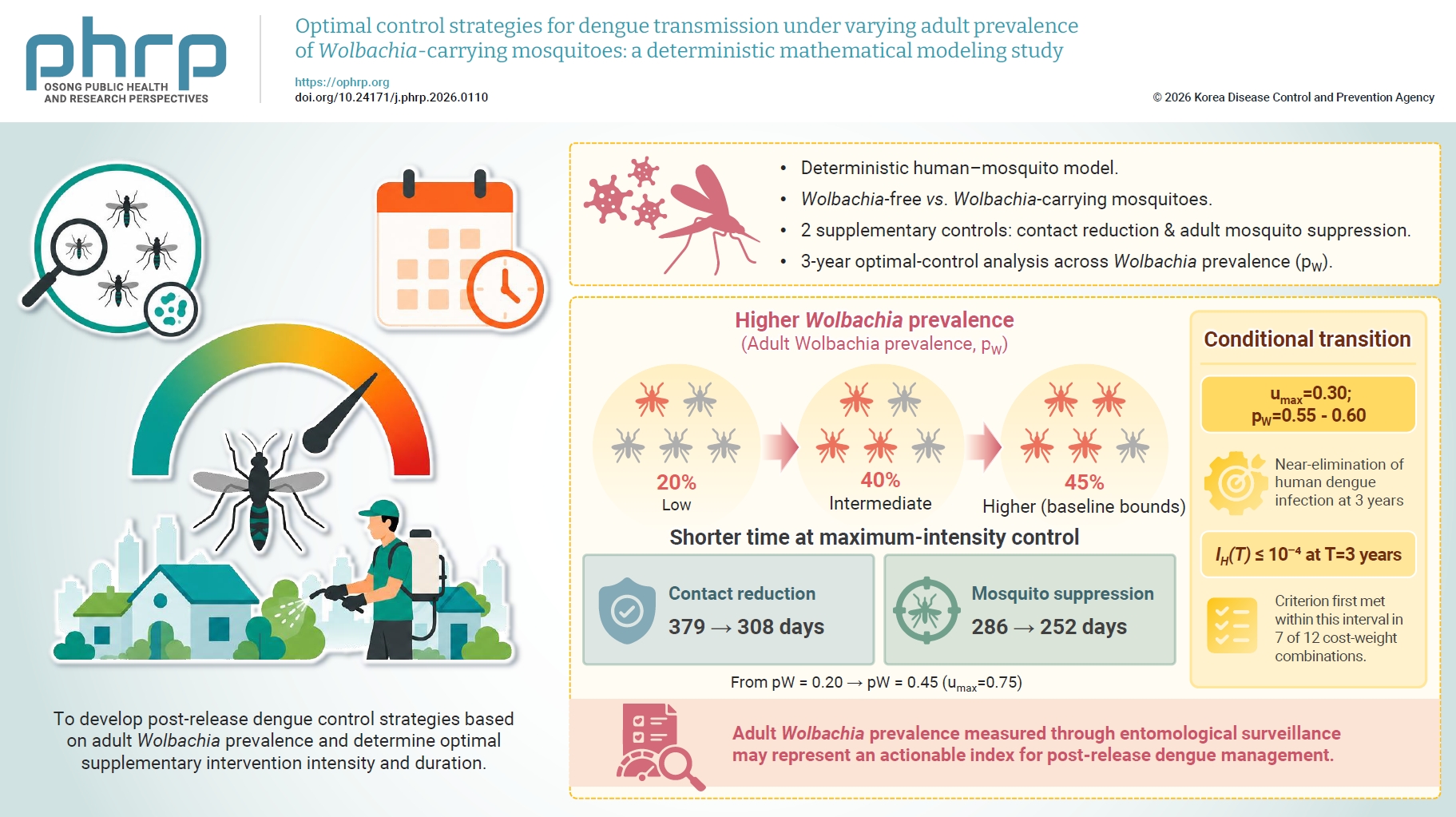
Objectives This study aimed to develop prevalence-informed post-release dengue control strategies for settings in which Wolbachia-carrying Aedes aegypti mosquitoes have become established through population replacement and to quantify how optimal supplementary intervention intensity and duration vary with adult Wolbachia prevalence, pW. Methods: A deterministic human–mosquito model was formulated that included Wolbachia-free and Wolbachia-carrying mosquitoes and incorporated cytoplasmic incompatibility, maternal transmission, and reduced vector competence. Two bounded supplementary controls were optimized over a 3-year horizon: reduction of effective human–mosquito contact and conventional adult mosquito suppression, represented by increased adult mortality. A quadratic-cost optimal-control problem was solved numerically using the Pontryagin maximum principle and a forward/backward sweep algorithm. Outcomes were compared across representative pW scenarios and prevalence scans. Results: The optimal policies applied high-intensity supplementary control early in the planning horizon and then relaxed control as infection pressure declined. Higher pW reduced the uncontrolled infection burden, decreased the incremental benefit of additional intervention, and shortened the duration of maximum control. In coarse scans with umax=0.30, the terminal dengue infection near-elimination indicator, defined as IH (T)≤10–4 at T=3 years, changed between pW=0.45 and pW=0.50 for all tested cost-weight combinations. A separate refined continuation example demonstrated non-monotonic mean control use and a sharp decrease in cumulative incidence. Conclusion: Adult Wolbachia prevalence measured through entomological surveillance may represent an actionable index for post-release dengue management. The identified transition band is a model-based planning indicator, not a universal field threshold or evidence of mosquito population elimination.
<sec><title>Objectives</title><p>The 2015 Middle East Respiratory Syndrome Coronavirus (MERS-CoV) outbreak in Korea caused major economic and social problems. The control intervention was conducted during the MERS-CoV outbreak in Korea immediately after the confirmation of the index case. This study investigates whether the early risk communication with the general public and mass media is an effective preventive strategy.</p></sec><sec><title>Methods</title><p>The SEIR (Susceptible, Exposed, Infectious, Recovered) model with estimated parameters for the time series data of the daily MERS-CoV incidence in Korea was considered from May to December 2015. For 10,000 stochastic simulations, the SEIR model was computed using the Gillespie algorithm. Depending on the time of control intervention on the 20th, 40th, and 60th days after the identification of the index case, the box plots of MERS-CoV incidences in Korea were computed, and the results were analyzed via ANOVA.</p></sec><sec><title>Results</title><p>The box plots showed that there was a significant difference between the non-intervention and intervention groups (the 20th day, 40th day, and 60th day groups) and seemed to show no significant difference based on the time of intervention. However, the ANOVA revealed that early intervention was a good strategy to control the disease.</p></sec><sec><title>Conclusion</title><p>Appropriate risk communication can secure the confidence of the general public in the public health authorities.</p></sec>
Citations
Citations to this article as recorded by
Healthcare-associated infections: the hallmark of Middle East respiratory syndrome coronavirus with review of the literature J.A. Al-Tawfiq, P.G. Auwaerter Journal of Hospital Infection.2019; 101(1): 20. CrossRef
Objectives
Deliberate self-harm (DSH) of a young person has been a matter of growing concern to parents and policymakers. Prevention and early eradication are the main interventional techniques among which prevention through reducing peer pressure has a major role in reducing the DSH epidemic. Our aim is to develop an optimal control strategy for minimizing the DSH epidemic and to assess the efficacy of the controls. Methods
We considered a deterministic compartmental model of the DSH epidemic and two interventional techniques as the control measures. Pontryagin's Maximum Principle was used to mathematically derive the optimal controls. We also simulated the model using the forward-backward sweep method. Results
Simulation results showed that the controls needed to be used simultaneously to reduce DSH successfully. An optimal control strategy should be adopted, depending on implementation costs for the controls. Conclusion
The long-term success of the optimum control depends on the implementation cost. If the cost is very high, the control could be used for a short term, even though it fails in the long run. The control strategy, most importantly, should be implemented as early as possible to attack a comparatively fewer number of addicted individuals.
Citations
Citations to this article as recorded by
A review of the use of optimal control in social models D. M. G. Comissiong, J. Sooknanan International Journal of Dynamics and Control.2018; 6(4): 1841. CrossRef
Adolescent self‐harm and risk factors Jixiang Zhang, Jianwei Song, Jing Wang Asia-Pacific Psychiatry.2016; 8(4): 287. CrossRef
Optimal Intervention Strategies for the Spread of Obesity Chunyoung Oh, Masud M A Journal of Applied Mathematics.2015; 2015: 1. CrossRef
Objectives
Now-a-days gambling is growing especially fast among older adults. To control the gratuitous growth of gambling, well-analyzed scientific strategies are necessary. We tried to analyze the adequacy of the health of society mathematically through immediate treatment of patients with early prevention. Methods
The model from Lee and Do was modified and control parameters were introduced. Pontryagin's Maximum Principle was used to obtain an optimal control strategy. Results
Optimal control can be achieved through simultaneous use of the control parameters, though it varies from society to society. The control corresponding to prevention needed to be implemented in full almost all the time for all types of societies. In the case of the other two controls, the scenario was greatly affected depending on the types of societies. Conclusion
Prevention and treatment for elderly people with ludomania are the main intervention strategies. We found that optimal timely implementation of the intervention strategies was more effective. The optimal control strategy varied with the initial number of gamblers. However, three intervention strategies were considered, among which, preventing people from engaging in all types of gambling proved to be the most crucial.
Citations
Citations to this article as recorded by
Roll the Dice Hae-Wol Cho, Chaeshin Chu Osong Public Health and Research Perspectives.2014; 5(5): 243. CrossRef
Objective
To investigate the optimal control strategy for Plasmodium vivax malaria transmission in Korea. Methods
A <i>Plasmodium vivax</i> malaria transmission model with optimal control terms using a deterministic system of differential equations is presented, and analyzed mathematically and numerically. Results
If the cost of reducing the reproduction rate of the mosquito population is more than that of prevention measures to minimize mosquito-human contacts, the control of mosquito-human contacts needs to be taken for a longer time, comparing the other situations. More knowledge about the actual effectiveness and costs of control intervention measures would give more realistic control strategies. Conclusion
Mathematical model and numerical simulations suggest that the use of mosquito-reduction strategies is more effective than personal protection in some cases but not always.
Citations
Citations to this article as recorded by
A systematic review of mathematical models with optimal control strategies for malaria management from 2010 to 2024 Furaha Michael Chuma, Gasper Godson Mwanga Research in Mathematics.2026;[Epub] CrossRef
Stochastic optimal control model for COVID-19: mask wearing and active screening/testing Mohcine El Baroudi, Hassan Laarabi, Samira Zouhri, Mostafa Rachik, Abdelhadi Abta Journal of Applied Mathematics and Computing.2024; 70(6): 6411. CrossRef
Multi-Cell Discrete-Time SIRI Epidemic Model with Travel Restrictions and Vaccination Controls Samira Zouhri, Mohcine El Baroudi, Hassan Laarabi International Journal of Applied and Computational.2024;[Epub] CrossRef
Numerical Investigation of Malaria Disease Dynamics in Fuzzy Environment Fazal Dayan, Dumitru Baleanu, Nauman Ahmed, Jan Awrejcewicz, Muhammad Rafiq, Ali Raza, Muhammad Ozair Ahmad Computers, Materials & Continua.2023; 74(2): 2345. CrossRef
New Trends in Fuzzy Modeling Through Numerical Techniques M. M. Alqarni, Muhammad Rafiq, Fazal Dayan, Jan Awrejcewicz, Nauman Ahmed, Ali Raza, Muhammad Ozair Ahmad, Witold Pawłowski, Emad E. Mahmoud Computers, Materials & Continua.2023; 74(3): 6371. CrossRef
Optimal control analysis of hepatocytic-erythrocytic dynamics of Plasmodium falciparum malaria Titus Okello Orwa, Rachel Waema Mbogo, Livingstone Serwadda Luboobi Infectious Disease Modelling.2022; 7(1): 82. CrossRef
Effects of climate change on Plasmodium vivax malaria transmission dynamics: A mathematical modeling approach Jung Eun Kim, Yongin Choi, Chang Hyeong Lee Applied Mathematics and Computation.2019; 347: 616. CrossRef
Optimal bed net use for a dengue disease model with mosquito seasonal pattern Bruno Buonomo, Rossella Della Marca Mathematical Methods in the Applied Sciences.2018; 41(2): 573. CrossRef
Optimal control in epidemiology Oluwaseun Sharomi, Tufail Malik Annals of Operations Research.2017; 251(1-2): 55. CrossRef
A new analysis of infection dynamics: multi-regions discrete epidemic model with an extended optimal control approach Omar Zakary, Mostafa Rachik, Ilias Elmouki International Journal of Dynamics and Control.2017; 5(4): 1010. CrossRef
On the analysis of a multi-regions discrete SIR epidemic model: an optimal control approach Omar Zakary, Mostafa Rachik, Ilias Elmouki International Journal of Dynamics and Control.2017; 5(3): 917. CrossRef
Bifurcation and Sensitivity Analysis of Malaria–Schistosomiasis Co-infection Model E. A. Bakare, C. R. Nwozo International Journal of Applied and Computational.2017; 3(S1): 971. CrossRef
Effect of awareness programs and travel-blocking operations in the control of HIV/AIDS outbreaks: a multi-domains SIR model Omar Zakary, Abdelilah Larrache, Mostafa Rachik, Ilias Elmouki Advances in Difference Equations.2016;[Epub] CrossRef
Transmission Dynamics and Optimal Control of Malaria in Kenya Gabriel Otieno, Joseph K. Koske, John M. Mutiso, Xiaohua Ding Discrete Dynamics in Nature and Society.2016;[Epub] CrossRef
Years of Epidemics (2009–2011): Pandemic Influenza and Foot-and-Mouth Disease Epidemic in Korea Hae-Wol Cho, Chaeshin Chu Osong Public Health and Research Perspectives.2013; 4(3): 125. CrossRef
Objective
To analyze the incidence of obesity in adults aged 19–59 years in Korea and predict its trend in the future. Methods
We considered a two-compartmental deterministic mathematical model Susceptible-Infected-Susceptible (SIS), a system of difference equations, to predict the evolution of obesity in the population and to propose strategies to reduce its incidence. Results
The prevention strategy on normal-weight individuals produced a greater improvement than that produced by treatment strategies. Conclusions
Mathematical model sensitivity analysis suggests that obesity prevention strategies are more effective than obesity treatment strategies in controlling the increase of adult obesity in Korea.
Citations
Citations to this article as recorded by
Quality Attributes of Fat-free Sausage Made of Chicken Breast and Liquid Egg White Hyun Jung Lee, Cheorun Jo, Ki Chang Nam, Kyung Haeng Lee The Korean Journal of Food And Nutrition.2016; 29(4): 449. CrossRef
Optimal Intervention Strategies for the Spread of Obesity Chunyoung Oh, Masud M A Journal of Applied Mathematics.2015; 2015: 1. CrossRef
Summing Up Again Hae-Wol Cho, Chaeshin Chu Osong Public Health and Research Perspectives.2014; 5(4): 177. CrossRef
Optimal Implementation of Intervention to Control the Self-harm Epidemic Byul Nim Kim, M.A. Masud, Yongkuk Kim Osong Public Health and Research Perspectives.2014; 5(6): 315. CrossRef
A NOTE ON THE OBESITY AS AN EPIDEMIC Chunyoung Oh Honam Mathematical Journal.2014; 36(1): 131. CrossRef
Journal Publishing: Never Ending Saga Hae-Wol Cho, Chaeshin Chu Osong Public Health and Research Perspectives.2014; 5(1): 1. CrossRef
Roll the Dice Hae-Wol Cho, Chaeshin Chu Osong Public Health and Research Perspectives.2014; 5(5): 243. CrossRef
Years of Epidemics (2009–2011): Pandemic Influenza and Foot-and-Mouth Disease Epidemic in Korea Hae-Wol Cho, Chaeshin Chu Osong Public Health and Research Perspectives.2013; 4(3): 125. CrossRef
A Tale of Two Fields: Mathematical and Statistical Modeling of Infectious Diseases Hae-Wol Cho, Chaeshin Chu Osong Public Health and Research Perspectives.2011; 2(2): 73. CrossRef
Objectives
To investigate the possible link between <i>Vibrio vulnificus</i> population size in seawater and water temperature. Methods
We collected incidence and water temperature data in coastal regions of Korea and constructed a mathematical model that consisted of three classes; susceptible fish, infected fish available to humans, and infected humans. Results
We developed a mathematical model to connect <i>V. vulnificus</i> incidence with water temperature using estimated bacterial population sizes and actual coastal water temperatures. Conclusion
Increased <i>V. vulnificus</i> population sizes in marine environments may increase the risk of infection in people who eat at coastal restaurants in Korea. Furthermore, we estimated the near-future number of infected patients using our model, which will help to establish a public-health policy to reduce the disease burden.
Citations
Citations to this article as recorded by
Antibacterial activity of food-derived lycopene against Vibrio vulnificus and its application potential for seafood safety via ferroptosis-like cell death Sujeong Kim, Dong Gun Lee International Journal of Food Microbiology.2027; 463: 112116. CrossRef
Predicting the Global Distribution of Vibrio vulnificus Under Changing Climate Scenarios Jan Andrew L. Bautista, Christine R. Hernaez, Jose Carlos L. Nicdao, Jed Miguel P. Santos, Loida M. Recopuerto-Medina, Nikki Heherson A. Dagamac EcoHealth.2026; 23(3): 556. CrossRef
mGem: A perfect storm in the era of global warming—the convergence between thermotolerant fungi and altered immunity Frederic Lamoth, Dimitrios P. Kontoyiannis, Anuradha Chowdhary mBio.2026;[Epub] CrossRef
Simulating Vibrio vulnificus in the Ala Wai Canal using a coupled microbial-hydrodynamic numerical model Emma S. Nuss, Brian Powell, Conor Jerolmon, Olivia D. Nigro, Andrian P. Gajigan, Shaun Giancaterino, Grieg F. Steward Estuarine, Coastal and Shelf Science.2025; 313: 109113. CrossRef
Impact of the future coastal water temperature scenarios on the risk of potential growth of pathogenic Vibrio marine bacteria Habiba Ferchichi, André St-Hilaire, Taha B.M.J. Ouarda, Benoît Lévesque Estuarine, Coastal and Shelf Science.2021; 250: 107094. CrossRef
Effect of Seawater Temperature Increase on the Occurrence of Coastal Vibrio vulnificus Cases: Korean National Surveillance Data from 2003 to 2016 Jungsook Kim, Byung Chul Chun International Journal of Environmental Research an.2021; 18(9): 4439. CrossRef
Spatiotemporal Dynamics of Vibrio spp. within the Sydney Harbour Estuary Nachshon Siboni, Varunan Balaraju, Richard Carney, Maurizio Labbate, Justin R. Seymour Frontiers in Microbiology.2016;[Epub] CrossRef
Genotypic Diversity and Population Structure of Vibrio vulnificus Strains Isolated in Taiwan and Korea as Determined by Multilocus Sequence Typing Hye-Jin Kim, Jae-Chang Cho, Paul J Planet PLOS ONE.2015; 10(11): e0142657. CrossRef
From canonical to non-canonical cyclic nucleotides as second messengers: Pharmacological implications Roland Seifert, Erich H. Schneider, Heike Bähre Pharmacology & Therapeutics.2015; 148: 154. CrossRef
Journal Publishing: Never Ending Saga Hae-Wol Cho, Chaeshin Chu Osong Public Health and Research Perspectives.2014; 5(1): 1. CrossRef
Roll the Dice Hae-Wol Cho, Chaeshin Chu Osong Public Health and Research Perspectives.2014; 5(5): 243. CrossRef
Summing Up Again Hae-Wol Cho, Chaeshin Chu Osong Public Health and Research Perspectives.2014; 5(4): 177. CrossRef
Years of Epidemics (2009–2011): Pandemic Influenza and Foot-and-Mouth Disease Epidemic in Korea Hae-Wol Cho, Chaeshin Chu Osong Public Health and Research Perspectives.2013; 4(3): 125. CrossRef
The Road Less Traveled Chaeshin Chu Osong Public Health and Research Perspectives.2011; 2(1): 1. CrossRef



 First
 Prev


