Objectives This study aimed to assess the impact of high-level versus low-level construal messages about the coronavirus disease 2019 (COVID-19) Vaccine Injury Compensation Program (CVICP) on public attitudes toward the program and COVID-19 vaccination.
Methods A randomized controlled experimental design was employed. Adults aged 18 to 64 residing in the Republic of Korea were randomly assigned to either an experimental group (high-level construal message) or a control group (low-level construal message). Both groups viewed a 2-minute video about the CVICP, with construal level as the sole variable. Pre- and post-intervention questionnaires evaluated attitudes toward the CVICP and COVID-19 vaccination, including satisfaction, perceived necessity, and perceived effectiveness in enhancing vaccine acceptance. Data were analyzed using the paired t-test, repeated measures 2-way analysis of variance, and multiple linear regression.
Results The experimental group showed statistically significant improvements across all 6 attitude measures following exposure to the high-level construal message. By contrast, the control group demonstrated significant improvement in only 3 attitudes: satisfaction with the CVICP, willingness to recommend vaccination, and willingness for future vaccination. A significant difference between groups was observed for perceived effectiveness of the CVICP in enhancing vaccine acceptance (p=0.01), with high-level construal messaging being more impactful.
Conclusion High-level construal messages are more effective than low-level messages in shaping public perceptions and addressing vaccine hesitancy. Policymakers and health authorities should incorporate high-level construal elements into communication strategies to build trust and support for vaccination programs.
Objectives Subacute sclerosing panencephalitis (SSPE) is a rare but fatal neurodegenerative disease caused by persistent measles virus infection. After a significant measles outbreak in 2000–2001, the Republic of Korea implemented a nationwide measles elimination program, which led to a dramatic reduction in measles incidence. This study aimed to evaluate the impact of these measles elimination efforts on the incidence of SSPE in the Republic of Korea.
Methods This nationwide, population-based retrospective cohort study identified patients newly diagnosed with measles and SSPE between 2007 and 2022, registered in the Health Insurance Review and Assessment Service (HIRA) and Korea Disease Control and Prevention Agency (KDCA) databases. Population-based incidence rates of measles and SSPE were calculated and compared annually.
Results A total of 236 measles cases (HIRA data) and 1,168 measles cases (KDCA data), along with 2,736 SSPE cases, were diagnosed during the study period. Measles incidence significantly declined, reaching zero cases in 2021, while SSPE incidence displayed an upward trend, peaking in 2014. The mean age at SSPE onset was 21.2 years, with a marked male-to-female ratio of 13.0:1.
Conclusion SSPE incidence was remarkably low in the post-outbreak period, likely attributable to successful measles control. This study underscores the critical importance of maintaining low measles incidence through sustained vaccination efforts, preventing SSPE and other measles-related complications.
Citations
Citations to this article as recorded by
Measles subacute sclerosing panencephalitis in children: past and present G. P. Ivanova, N. V. Skripchenko, E. Yu. Skripchenk, O. V. Goleva, A. V. Astapova Rossiyskiy Vestnik Perinatologii i Pediatrii (Russ.2026; 71(4): 14. CrossRef
Long-term survival (≥2 years) in subacute sclerosing panencephalitis: a systematic review of prolonged survivors Ravindra Kumar Garg, Shweta Pandey, Imran Rizvi, Sanjay Singhal encephalitis.2026; 6(4): 91. CrossRef
The Republic of Korea’s health system at a turning point: from infectious disease threats to comprehensive reform Jong-Koo Lee Osong Public Health and Research Perspectives.2025; 16(3): 193. CrossRef
Pan-Immune Inflammation Value and Clinical Outcomes in Subacute Sclerosing Panencephalitis: A Retrospective Study Bilge Özgör, Murat Çağlar Şahin, Işınsu Bıçakcıoğlu, Gül Yücel, Meral Karadağ, Serdal Güngör Viruses.2025; 18(1): 18. CrossRef
This study aimed to establish a foundation for future collaborations aimed at preparing for and responding to infectious diseases by examining the vaccine injury compensation programs (VICPs) of East Asian countries. We reviewed the current status of VICPs in the Republic of Korea, Japan, and Taiwan by searching national government websites and reviewing relevant literature. Additionally, we conducted email inquiries targeting experts from Japan and Taiwan. Through the comprehensive analysis of VICPs in these 3 countries covered various aspects, we identified several similarities and differences in the VICPs across these countries. While the governments of the Republic of Korea, Japan, and Taiwan play a central role in supporting investigations into vaccine injuries and managing compensation procedures based on legal statutes, they differ in terms of financial resources for compensation, the range of vaccines covered, and the criteria for assessing causality. In the Republic of Korea, Japan, and Taiwan, compensation is typically paid in a lump sum, although the specific benefits available vary by country. This study on VICPs in the Republic of Korea, Japan, and Taiwan provides valuable insights for the further development and management of domestic systems.
Citations
Citations to this article as recorded by
The Vaccine That Was Never Mentioned: A Comparative Medico-Legal Analysis of the Duty to Inform and Document Preventive Immunization, with Proposed Practice Guidelines Sanit Thongsriratch, Therdpong Thongseiratch, Saratis Pairoh, Puttichart Khantee Vaccines.2026; 14(8): 664. CrossRef
Local Vaccine Manufacturing in Saudi Arabia: Examining the Role of National Legal Frameworks and Strategic Policies Tareq S. Alshammari Beijing Law Review.2025; 16(04): 2147. CrossRef
Objectives This study aimed to comprehensively outline the methodological approaches used in published research comparing the vaccine effectiveness (VE) of coronavirus disease 2019 (COVID-19) vaccines.
Methods A systematic search was conducted on June 13, 2024, to identify comparative studies evaluating the effectiveness of mRNA versus non-mRNA and monovalent versus bivalent COVID-19 vaccines. We screened titles, abstracts, and full texts, collecting data on publication year, country, sample size, study population composition, study design, VE estimates, outcomes, and covariates. Studies that reported relative VE (rVE) were analyzed separately from those that did not.
Results We identified 25 articles comparing rVE between mRNA and non-mRNA COVID-19 vaccines, as well as between monovalent and bivalent formulations. Among the studies assessing VE by vaccine type, 126 did not provide rVE estimates. Comparative VE studies frequently employed retrospective cohort designs. Among the definitions of rVE used, the most common were hazard ratio and absolute VE, calculated as (1−odds ratio)×100. Studies were most frequently conducted in the United Kingdom and the United States, and the most common outcome was infection. Most targeted the general population and assessed the VE of mRNA vaccines using the AstraZeneca vaccine as a reference. A small proportion, 7.3% (n=11), did not adjust for any variables. Only 3 studies (2.0%) adjusted for all core confounding variables recommended by the World Health Organization.
Conclusion Few comparative studies of COVID-19 vaccines have incorporated rVE methodologies. Reporting rVE and employing a consistent set of covariates can broaden our understanding of COVID-19 vaccines.
Citations
Citations to this article as recorded by
Protection from second booster vaccines and natural immunity against SARS-CoV-2 infections, 2022–2023 Dritan Bejko, Anne Vergison, Saverio Stranges, Joël Mossong, Maurice Zeegers Epidemiology and Infection.2026;[Epub] CrossRef
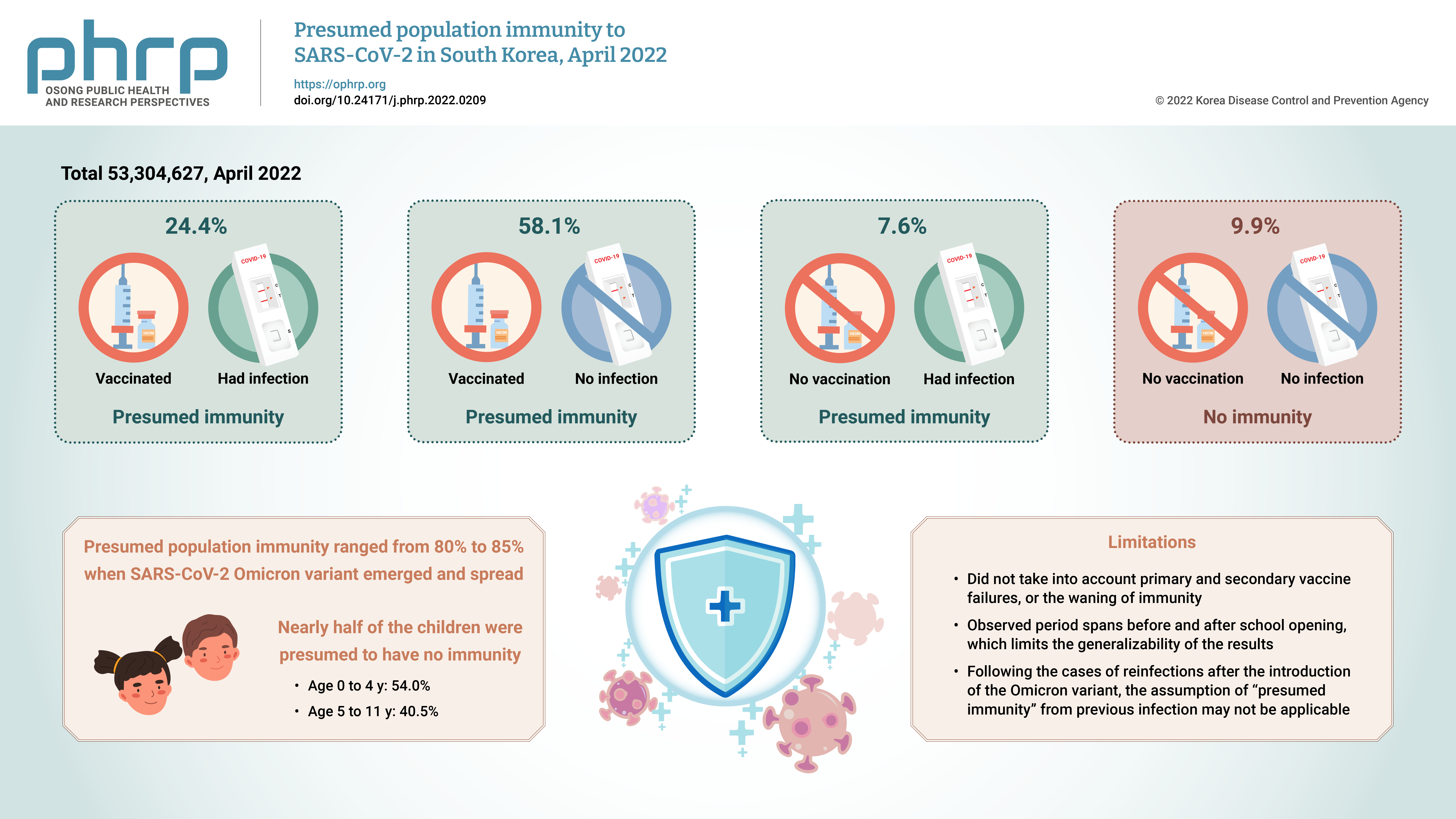
Objectives We estimated the overall and age-specific percentages of the Korean population
with presumed immunity against severe acute respiratory syndrome coronavirus 2 (SARSCoV-2) as of April 2022 using the national registry.
Methods We used the national coronavirus disease 2019 (COVID-19) infection and vaccination
registry from South Korea, as described to define individuals with a previous history of
COVID-19 infection, vaccination, or both, as persons with presumed immunity.
Results Of a total of 53,304,627 observed persons, 24.4% had vaccination and infection, 58.1%
had vaccination and no infection, 7.6% had infection and no vaccination, and 9.9% had no
immunity. The SARS-CoV-2 Omicron variant emerged at a time when the presumed population
immunity ranged from 80% to 85%; however, nearly half of the children were presumed to
have no immunity.
Conclusion We report a gap in population immunity, with lower presumed protection in
children than in adults. The approach presented in this work can provide valuable informed
tools to assist vaccine policy-making at a national level.
Citations
Citations to this article as recorded by
Realistic Estimation of COVID-19 Infection by Seroprevalence Surveillance of SARS-CoV-2 Antibodies: An Experience From Korea Metropolitan Area From January to May 2022 In Hwa Jeong, Jong-Hun Kim, Min-Jung Kwon, Jayoung Kim, Hee Jin Huh, Byoungguk Kim, Junewoo Lee, Jeong-hyun Nam, Eun-Suk Kang Journal of Korean Medical Science.2024;[Epub] CrossRef
Epidemiology of Coronavirus Disease 2019 in Infants and Toddlers, Seoul, South Korea JiWoo Sim, Euncheol Son, Young June Choe Pediatric Infection & Vaccine.2024; 31(1): 94. CrossRef
Predicting adherence to COVID-19 preventive measures among South Korean adults aged 40 to 69 Years using the expanded health empowerment model Su-Jung Nam, Tae-Young Pak SSM - Population Health.2023; 22: 101411. CrossRef
Acute COVID-19 in unvaccinated children without a history of previous infection during the delta and omicron periods Jee Min Kim, Ji Yoon Han, Seung Beom Han Postgraduate Medicine.2023; 135(7): 727. CrossRef
<p>A substantial, immediate healthcare burden for screening of Coronavirus disease 2019 (COVID-19) is created when large-scale outbreaks occur. There have been a series of measures to strengthen the screening process through robust public-private partnerships between Hanam City Public Health Center (PHC), the local medical association, and central/provincial government. A partnership between PHC and the local physician’s group in Hanam City established the Respiratory Clinic. The PHC provided the infrastructure for the Respiratory Clinic including medical facilities, supplies (i.e. personal protective equipment), and administrative support. A total of 11 registered physicians from the local physicians group agreed to participate in clinical service provided at the Respiratory Clinic. Any citizens with COVID-19 suspected respiratory symptoms call the COVID-19 hotline and visit the Respiratory Clinic if required. Responding to COVID-19 outbreaks will be a continual process, and the screening system is essential support to public health interventions, and crucial in the response to a surge in COVID-19 cases.</p>
Citations
Citations to this article as recorded by
Building of Pediatric COVID-19 Module Clinic: A Novel Operation Model in Response to COVID-19 Pandemic Young June Choe, Jue Seong Lee, Yoon Lee, Kyu Hyun Park, Young Yoo, Gi-Jung Im, Sung Woo Lee, Jun Eun Park Journal of Korean Medical Science.2023;[Epub] CrossRef
Service-learning under COVID-19: A scoping review of the challenges and opportunities for practicing service-learning in the ‘New Normal’ Paul Vinod Khiatani, Minnie Heep Ching She, Oriana Yi Yin Ho, Jacky Ka Kei Liu International Journal of Educational Development.2023; 100: 102813. CrossRef
A resposta da Coreia do Sul à pandemia de COVID-19: lições aprendidas e recomendações a gestores Thais Regis Aranha Rossi, Catharina Leite Matos Soares, Gerluce Alves Silva, Jairnilson Silva Paim, Lígia Maria Vieira-da-Silva Cadernos de Saúde Pública.2022;[Epub] CrossRef
Health, Economic and Social Development Challenges of the COVID-19 Pandemic: Strategies for Multiple and Interconnected Issues Sigamani Panneer, Komali Kantamaneni, Udhayakumar Palaniswamy, Lekha Bhat, Robert Ramesh Babu Pushparaj, Kesavan Rajasekharan Nayar, Hilaria Soundari Manuel, F. X. Lovelina Little Flower, Louis Rice Healthcare.2022; 10(5): 770. CrossRef
Role of Primary Care and Challenges for Public–Private Cooperation during the Coronavirus Disease 2019 Pandemic: An Expert Delphi Study in South Korea Woo-young Shin, Changsoo Kim, Sei Young Lee, Won Lee, Jung-ha Kim Yonsei Medical Journal.2021; 62(7): 660. CrossRef
Recurring Temporal Association Between Influenza A Epidemics and Subsequent Influenza B Dominance in Post‐Pandemic Korea, 2022−2026 Yoon Lee, Yoonsun Yoon, Ji Eun Park, Won Keun Kim, Youn Young Choi, Yun‐Kyung Kim, Changmin Kang, Young Yoo, Young June Choe Journal of Medical Virology.2026;[Epub] CrossRef
Short-term PM2.5 exposure among 3-year cancer survivors with incident cardiovascular disease before and during the COVID-19 pandemic period Hyun-Young Shin, Hyeokjong Lee, Jihun Song, Sun Jae Park, Jaewon Kim, Sangwoo Park, Hye Jun Kim, Jina Chung, Kyae Hyung Kim, Sang Min Park Atmospheric Pollution Research.2025; 16(9): 102574. CrossRef
Impact of COVID-19 on Severe Trauma Patients in Korea: A Nationwide Regional Subgroup Analysis Chung-Nyun Kim, Seok-Jun Yoon Disaster Medicine and Public Health Preparedness.2025;[Epub] CrossRef
Exploring the relationship between lifestyle factors and depressive symptoms in Korean adolescents amid the COVID-19 pandemic YoonJin Lee, Eunyeong Jang, Sejeong Park, Jinhee Lee BMC Psychiatry.2025;[Epub] CrossRef
Social Distancing in the COVID-19 Pandemic Jianghong Liu, Na Ouyang, Alina Mizrahi, Melanie L. Kornides Family & Community Health.2024; 47(1): 80. CrossRef
Effects of the coronavirus disease outbreak on the development of neurological disorders in children: A comparison of the incidence of febrile seizure and epilepsy using an interrupted time-series approach Ah-Young Kim, Ji-Hoon Na, Hye-Young Kang, Hankil Lee, Young-Mock Lee Journal of Infection and Public Health.2024; 17(1): 102. CrossRef
Application of the Time Derivative (TD) Method for Early Alert of Influenza Epidemics Seul-Ki Kang, Woo-Sik Son, Bryan Inho Kim Journal of Korean Medical Science.2024;[Epub] CrossRef
Impact of COVID-19 on the Incidence of Fragility Fracture in South Korea Seungjin Baek, Ye-Jee Kim, Beom-Jun Kim, Namki Hong Journal of Bone Metabolism.2024; 31(1): 31. CrossRef
Associations of social interactions during the COVID-19 pandemic with cognitive function among the South Korean older adults Il Yun, Yu Shin Park, Eun-Cheol Park, Hee-Won Jung, Jaeyong Shin BMC Geriatrics.2023;[Epub] CrossRef
Convolutional neural network-based crowd detection for COVID-19 social distancing protocol from unmanned aerial vehicles onboard camera Leonard Matheus Wastupranata, Rinaldi Munir Journal of Applied Remote Sensing.2023; 17(04): 1. CrossRef
Impact of non-pharmaceutical interventions targeted at the COVID-19 pandemic on the incidence of influenza-like illness in the UK Armed Forces George Otieno, Ngwa Niba Rawlings, Siew Ann Cheong PLOS ONE.2022; 17(12): e0270438. CrossRef
Impact of COVID-19 Social Distancing Mandates on Gastrointestinal Pathogen Positivity: Secondary Data Analysis Tanner Palmer, L Scott Benson, Christina Porucznik, Lisa H Gren JMIR Public Health and Surveillance.2022; 8(8): e34757. CrossRef
Exploring the drop in flu cases during the 2020–2021 season: The Italian case study Fabrizio Bert, Eleonora Cugudda, Giuseppina Lo Moro, Pietro Francesco Galvagno, Roberta Siliquini Annals of Epidemiology.2022; 76: 77. CrossRef
Effect of COVID-19-Related Interventions on the Incidence of Infectious Eye Diseases: Analysis of Nationwide Infectious Disease Incidence Monitoring Data Woo-Ri Lee, Li-Hyun Kim, Gyeong-Min Lee, Jooyoung Cheon, Young Dae Kwon, Jin-Won Noh, Ki-Bong Yoo International Journal of Public Health.2022;[Epub] CrossRef
Associations Between Conventional Healthy Behaviors and Social Distancing During the COVID-19 Pandemic: Evidence From the 2020 Community Health Survey in Korea Rang Hee Kwon, Minsoo Jung Journal of Preventive Medicine and Public Health.2022; 55(6): 568. CrossRef
Solidarity is for other people: identifying derelictions of solidarity in responses to COVID-19 Peter West-Oram Journal of Medical Ethics.2021; 47(2): 65. CrossRef
Impact of social distancing on incidence of vaccine‐preventable diseases, South Korea Hyo Eun Yun, Bo Young Ryu, Young June Choe Journal of Medical Virology.2021; 93(3): 1814. CrossRef
Nonpolio Enterovirus Activity during the COVID-19 Pandemic, Taiwan, 2020 Shu-Chen Kuo, Hsiao-Hui Tsou, Hsiao-Yu Wu, Ya-Ting Hsu, Fang-Jing Lee, Shu-Man Shih, Chao A. Hsiung, Wei J. Chen Emerging Infectious Diseases.2021; 27(1): 306. CrossRef
Impact of non-pharmaceutical interventions targeted at COVID-19 pandemic on influenza burden – a systematic review Lara Marleen Fricke, Stephan Glöckner, Maren Dreier, Berit Lange Journal of Infection.2021; 82(1): 1. CrossRef
Epidemiological dynamics of enterovirus D68 in the United States and implications for acute flaccid myelitis Sang Woo Park, Margarita Pons-Salort, Kevin Messacar, Camille Cook, Lindsay Meyers, Jeremy Farrar, Bryan T. Grenfell Science Translational Medicine.2021;[Epub] CrossRef
Qualitative Analysis of an influenza model with biomedical interventions S.A. Pedro, H. Rwezaura, A. Mandipezar, J.M. Tchuenche Chaos, Solitons & Fractals.2021; 146: 110852. CrossRef
The Impact of COVID-19 Interventions on Influenza and Mycobacterium Tuberculosis Infection Yiman Geng, Gang Li, Leiliang Zhang Frontiers in Public Health.2021;[Epub] CrossRef
Shifting Patterns of Respiratory Virus Activity Following Social Distancing Measures for Coronavirus Disease 2019 in South Korea Sangshin Park, Ian C Michelow, Young June Choe The Journal of Infectious Diseases.2021; 224(11): 1900. CrossRef
Asthma, Allergic Rhinitis, and Atopic Dermatitis Incidence in Korean Adolescents before and after COVID-19 Hyo Geun Choi, Il Gyu Kong Journal of Clinical Medicine.2021; 10(15): 3446. CrossRef
Impact of Social Distancing on Kawasaki Disease-associated Hospitalization, South Korea Jung Hwangbo, Jue Seong Lee, Seung Ah Choe, Young June Choe Pediatric Infectious Disease Journal.2021; 40(10): e383. CrossRef
Surveillance of seasonal respiratory viruses among Chilean patients during the COVID‐19 pandemic Luis A. Alonso‐Palomares, C. Joaquín Cáceres, Rodrigo Tapia, Paulina Aguilera‐Cortés, Santiago Valenzuela, Fernando Valiente‐Echeverría, Ricardo Soto‐Rifo, Aldo Gaggero, Gonzalo P. Barriga Health Science Reports.2021;[Epub] CrossRef
The Social Distance Scale (v1): A Screening Instrument to Assess Patient Adherence to Prevention Strategies during Pandemics Michaela Prachthauser, Jeffrey E. Cassisi, Thien-An Le, Andel V. Nicasio International Journal of Environmental Research an.2020; 17(21): 8158. CrossRef
Psychological Typhoon Eye Effect During the COVID-19 Outbreak Guixiang Wang, Yan Zhang, Simiao Xie, Pu Wang, Guanghui Lei, Yueran Bian, Fei Huang, Jingyuan Zhang, Xiaochen Cao, Na Luo, Mingyan Luo, Qiang Xiao Frontiers in Public Health.2020;[Epub] CrossRef
The Division of Vaccine-Preventable Disease Control and National Immunization Program of the Korea Centers for Disease Control and Prevention has prepared a plan of action as a guide for key actions that will be taken if a poliovirus outbreak occurs in the Republic of Korea. The history of poliomyelitis and vaccination against poliovirus in the nation was reviewed and the routine surveillance procedures that are currently in place were described. The principles and specific actions for an effective response to a poliovirus outbreak were prepared. The guidelines clearly outline the actions to be taken in case of a polio outbreak. When a suspected case of poliovirus infection is reported, an immediate epidemiological investigation is to be conducted. The response to a poliovirus outbreak includes case isolation, management of potential contacts and immunization. All stakeholders are to be made aware of what key actions should be taken at each stage of the response to a poliovirus outbreak in the nation.
Citations
Citations to this article as recorded by
Non-Polio Enteroviruses from Acute Flaccid Paralysis Surveillance in Korea, 2012–2019 Youngsil Yoon, Yong-Pyo Lee, Deog-Yong Lee, Hye-Jin Kim, June-Woo Lee, Sangwon Lee, Chun Kang, Wooyoung Choi, Joong Hyun Bin, Young Hoon Kim, Myung-Guk Han, Hae Ji Kang Viruses.2021; 13(3): 411. CrossRef
Estimation of the Direct Cost of Poliomyelitis Rehabilitation Treatment to Pakistani Patients: A 53-Year Retrospective Study Atta Abbas Naqvi, Syed Baqir Shyum Naqvi, Fatima Zehra, Ashutosh Kumar Verma, Saman Usmani, Sehrish Badar, Rizwan Ahmad, Niyaz Ahmad Applied Health Economics and Health Policy.2018; 16(6): 871. CrossRef
Revision of the National Action Plan in Response to Poliovirus Importation in Korea Young-Joon Park, Joon-Woo Kim, Yoon Hyung Kwon, Geun-Ryang Bae, Duk-Hyoung Lee Osong Public Health and Research Perspectives.2013; 4(2): 117. CrossRef
Fires in the Neighborhood Hae-Wol Cho, Chaeshin Chu Osong Public Health and Research Perspectives.2013; 4(2): 67. CrossRef
The Road Less Traveled Chaeshin Chu Osong Public Health and Research Perspectives.2011; 2(1): 1. CrossRef
Objectives
The aim of this study was to review the epidemiologic data of rubella and congenital rubella syndrome (CRS) supplied by surveillance systems from 2001 to 2009 and to propose measures to improve the quality of the surveillance system in the Republic of Korea. Methods
The epidemiological data for rubella and CRS cases reported to the Korea Centers for Disease Control and Prevention from 2001 to 2009 were retrospectively reviewed, and insurance reimbursement data from the Korea National Health Insurance Review Agency were collected for comparison. Results
The number of yearly reported rubella cases to the Korea Centers for Disease Control and Prevention from 2001 to 2009 was 128, 24, 8, 24, 15, 12, 35, 30, and 36, respectively. The occurrence of rubella shifted to a slightly higher age group during the 9-year period, i.e. from 0–9 years to 10–19 years. Among the 309 reported rubella cases, three were confirmed cases of CRS. In addition, according to data sourced from Health Insurance Review Agency, 24, 19, 19, 9, and 5 CRS cases were reported for medical insurance reimbursement from 2005 to 2009, respectively. Conclusion
According to available surveillance data, the reported cases of rubella and CRS were not high, but a more detailed surveillance with emphasis on susceptible women of childbearing age is necessary for better monitoring and control of rubella and CRS in the Republic of Korea.
Citations
Citations to this article as recorded by
Unveiling the Hidden Burden of TORCH Infections in HIV Patients: A Residual Serum Seroepidemiological Study in a Korean Metropolitan City Hye Jin Shi, Myung-Deok Kim-Jeon, Jung-Hee Kim, Kyung-Ae Kim, Yoonseon Park, Juyeong Lee, Shin Hee Hong, Jaeyong Song, Meyong Hee Kim, Munju Kwon, Joong Sik Eom Infection & Chemotherapy.2025; 57(4): 578. CrossRef
Rubella seroepidemiology among Korean women: Two decades after a combined vaccination strategy Seung-Ah Choe, Young June Choe, Jin Young Paek International Journal of Infectious Diseases.2020; 94: 25. CrossRef
Laboratory confirmation of congenital rubella syndrome in South Korea in 2017: A genomic epidemiological investigation Jin-Sook Wang, Hye Min Lee, Su Jin Kim, Jun-Sub Kim, Chun Kang, Chae won Jung, Hye kyung In, Dong Hee Seo, Dong Han Lee, Yoon-Seok Chung Vaccine.2020; 38(44): 6868. CrossRef
TORCH (toxoplasmosis, rubella, cytomegalovirus, and herpes simplex virus) screening of small for gestational age and intrauterine growth restricted neonates: efficacy study in a single institute in Korea Mi Hae Chung, Chan Ok Shin, Juyoung Lee Korean Journal of Pediatrics.2018; 61(4): 114. CrossRef
Does Rubella Cause Autism: A 2015 Reappraisal? Jill Hutton Frontiers in Human Neuroscience.2016;[Epub] CrossRef
Immunogenicity and safety of a tetravalent measles-mumps-rubella-varicella vaccine: an open-labeled, randomized trial in healthy Korean children Sung-Ho Cha, Seon-Hee Shin, Taek-jin Lee, Chang Hwi Kim, Michael Povey, Hwang Min Kim, Ouzama Nicholson Clinical and Experimental Vaccine Research.2014; 3(1): 91. CrossRef



 First
 Prev


