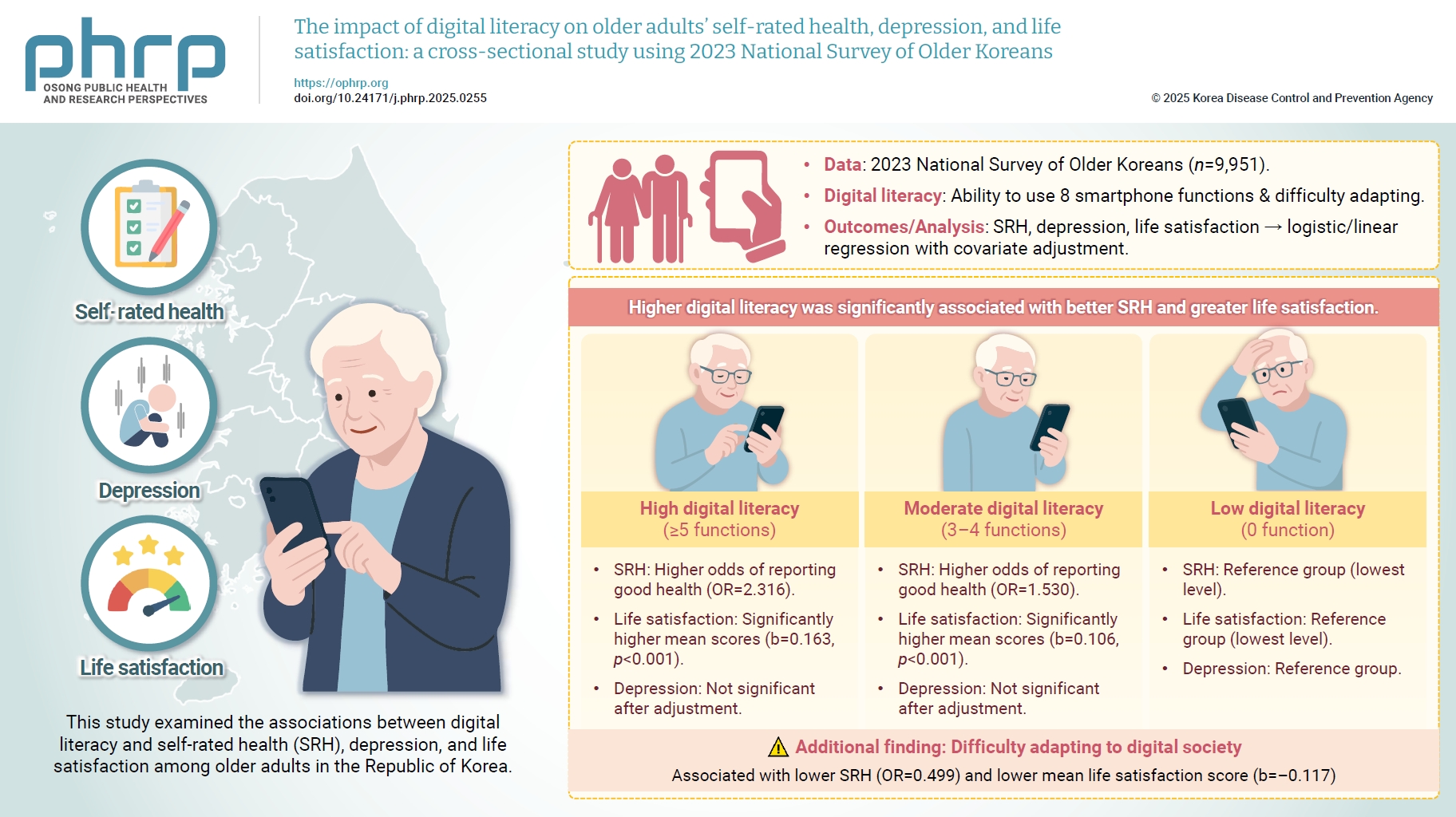
Objectives This study examined the associations between digital literacy and self-rated health (SRH), depression, and life satisfaction among older adults in the Republic of Korea.
Methods Data were obtained from the 2023 National Survey of Older Koreans (n=9,951). Digital literacy was evaluated based on participants’ ability to use 8 smartphone functions and their perceived difficulty adapting to a digital society. Dependent variables included SRH, depression (measured using the short form of Geriatric Depression Scale), and life satisfaction (assessed through a composite score across 7 domains). Multiple logistic regression was applied for SRH and depression, while linear regression was conducted for life satisfaction, adjusting for sociodemographic and health-related covariates.
Results Higher digital literacy was significantly associated with better SRH and greater life satisfaction. Compared to participants with no digital skills, those with moderate or high digital literacy had higher odds of reporting good SRH and significantly higher life satisfaction scores. Older adults who reported difficulty adapting to a digital society demonstrated significantly lower SRH and life satisfaction. However, after adjusting for covariates, the association between digital literacy and depression was not statistically significant.
Conclusion Higher digital literacy is linked to better SRH and greater life satisfaction. Moreover, digital literacy reduced the explanatory power of socioeconomic variables, suggesting that it serves as an important behavioral determinant. These findings underscore the importance of promoting digital literacy as a means of improving health equity and well-being in aging populations.
Citations
Citations to this article as recorded by
The Effect of Digital Literacy on Depression Among Older Adults With Chronic Diseases: The Moderating Role of Self-Rated Health Hyein Seo, Subin Yu The International Journal of Aging and Human Devel.2026; 103(4): 480. CrossRef
Digital device use and disparities in health literacy among older adults Heeran Chun, Cheong-Seok Kim, Il-Ho Kim Korean Journal of Health Education and Promotion.2026; 43(2): 87. CrossRef
Impact of an Interaction-Oriented, Information and Communication Technology-Based Community Care Service on Nutritional Status and Dietary Behavior of Community-Dwelling Older Adults: A Quasi-Experimental Study Seojin Yun, Seulgi Lee, Eun Young Lee, Kirang Kim Preventive Nutrition and Food Science.2026;[Epub] CrossRef
Predicting longitudinal depressive symptom trajectories among older Chinese adults with chronic health conditions: An interpretable machine learning study Zhan Yu, Anao Zhang, Kaipeng Wang, Qiuling An, Meiyan Chen, Yuting Wang, Zeqiang Wang International Psychogeriatrics.2026; : 100270. CrossRef
Sustaining Social Connection in a Super-Aged Society: Changes in the Association Between Social Ties and Life Satisfaction Among Korean Older Adults, 2011–2023 Seonmi Choi, Junghyun Kim Sustainability.2026; 18(18): 9449. CrossRef
Digital Ageism and Ageism Among Middle-Aged and Older Adults and the Mediating Role of Expectations Regarding Aging: A Cross-Sectional Study Gahye Kim, Aeri Jung Research in Community and Public Health Nursing.2026; 37: 403. CrossRef
Disaggregating Digital Competence: Social Activity Participation and Depressive Symptoms Among Korean Older Adults Young-Mi Jung, NakHyeok Choi Behavioral Sciences.2026; 16(10): 1742. CrossRef
The impact of digitalisation on the development of physical activity of older people (through the example of European Union countries) Zhaxat Kenzhin, Tursynzada Kuangaliyeva, Assem Aitkaliyeva, Yerbol Myrzabossynov, Aigerim Zhunussova, Odiljon Dadabayev Frontiers in Public Health.2026;[Epub] CrossRef
Objectives Social activities are important and influential factors for healthy aging. However, limited information is available regarding the associations of the type and intensity of social participation with health and well-being. This study aimed to investigate how various types of social activities are associated with several dimensions of health outcomes. Methods: This cross-sectional study utilized data from the Seventh Korean Longitudinal Study of Aging, which included 5,526 adults aged 60 years and older. Multivariate linear regression analysis was employed to analyze the associations of social activities with depression, self-rated health, and life satisfaction. Additionally, subgroup analyses by sex and age were performed. Results: Among the participants, 73.5% reported involvement in at least 1 of the 4 types of social engagement. After adjustment for all covariates, individuals who participated in any social activity reported better self-rated health and higher life satisfaction compared to those who did not participate. However, the intensity of engagement in different social activities had varying impacts on subjective health outcomes. An increased level of participation was associated with a lower rate of depression and improved self-rated health. However, no significant differences were observed in the relationship between the intensity of participation in activities (with the exception of alumni societies or family councils) and life satisfaction. Conclusion: This study suggests that to improve their health, older adults in the Republic of Korea should not only engage in social activities but also do so actively and regularly.
Citations
Citations to this article as recorded by
Impact of Depression on Self-Rated Health Status among Community-Dwelling Older Adults: Moderating Effects of Subjective Social Status and Formal Social Participation Using Data from the Ninth Korean Longitudinal Study of Aging (2022) Sohee Jung, Eunhee Yang, Soyoung Cha, Wonhee Baek Journal of Fundamental Nursing Science.2026; 33(1): 147. CrossRef
Disaggregating Digital Competence: Social Activity Participation and Depressive Symptoms Among Korean Older Adults Young-Mi Jung, NakHyeok Choi Behavioral Sciences.2026; 16(10): 1742. CrossRef
Gender differences in advanced activities of daily living: evidence from the longitudinal study of health and aging in Mexico 2012–2018 Martha A. Sánchez-Rodríguez, Mariano Zacarías-Flores, Lesly Estefanía Castañeda-Sánchez, Víctor Manuel Mendoza-Núñez Frontiers in Aging.2025;[Epub] CrossRef
The Associations Between Physical Activity, Body Perception, and Self-Rated Health in Korean Adults: An Analysis of the 2023 Korean Community Health Survey Geun-Kook Kim, Su-Yeon Roh, Sung-Ho Hwang Medicina.2025; 61(11): 1898. CrossRef
Objectives This study investigated the association between living arrangements and healthrelated quality of life (HRQoL) in older people. Methods: A secondary analysis was conducted of 6,153 participants (aged ≥60 years) from the seventh Korean National Health and Nutrition Examination Survey (2016 to 2018). HRQoL was measured using the 3-level version of the EuroQol 5-dimensional questionnaire. The chi-square test, t-test, and multiple regression were used, applying sampling weights for the analysis. Results: The proportion of respondents living alone was 18.0%, with a higher prevalence among women and older age groups (p<0.001). The overall HRQoL was lower in groups living alone than in groups living with others (p<0.001). Older people living alone showed higher impairments in all dimensions of the 3-level version of the European Quality of Life 5-Dimensional Questionnaire (EQ-5D-3L) than those living with others, including mobility (p<0.001), self-care (p<0.001), usual activities (p<0.001), pain/discomfort (p<0.001), and depression/anxiety (p<0.001). Problems with mobility were most prevalent (42.8%), followed by pain/ discomfort (41.9%) in respondents living alone. Living alone was significantly associated with a lower HRQoL index score (b=–0.048, p<0.001) after adjusting for age, gender, education, exercise, perceived stress, and perceived health status. Conclusion: Living alone was negatively associated with HRQoL. Based on this study, future care planning for older people should consider their living arrangements. The need to strengthen and expand care programs targeting those living alone should also be addressed.
Citations
Citations to this article as recorded by
Quality of life in later years: A comprehensive review of elderly well-being in India Sandhya Bharathi Shanmugasundaram, Pitchaimani Govindharaj, Srihari Ramamoorthy, Vijayalakshmi Purusothaman International Journal of Noncommunicable Diseases.2026; 11(2): 82. CrossRef
Factors Related to Quality of Life Among Older Adults with Family Care Vulnerability in Semi-Urban Areas of Thailand Arun Boonsang, Laksanee Boonkhao, Nittaya Chakhamrun, Aree Butsorn, Sanga Tubtimhin, Pongsak Rattanachaikunsopon, Sanguansin Ratanalert Journal of Multidisciplinary Healthcare.2026; Volume 19: 1. CrossRef
Occupational Balance, Quality of Life, and Recovery Among Older Mental Health Service Users—A Cross-Sectional Study Carina Tordai, Steven M. Schmidt, Elisabeth Argentzell, Mona Eklund Occupational Therapy In Health Care.2026; : 1. CrossRef
Association between health-related quality of life and noncommunicable diseases in South Korea Seungjae Byun, Kyeongeun Kim, Min Seong Kim, Guillaume Fond, Laurent Boyer, Guillermo F. López Sánchez, Jiseung Kang, Dong Keon Yon Medicine.2026; 105(37): e50564. CrossRef
Preventing depression in older adults with chronic illnesses through the SMART Elderly Program: a quasi-experimental study in Central Thailand Phongsakorn Toopboochakorn, Nanthawan Nilpayak, Phornphimon Hotarat, Wanida Jaroensuk, Phannathat Tanthanapanyakorn Korean Journal of Family Medicine.2026; 47(5): 405. CrossRef
Convergent validity, reliability and responsiveness of the AP-7D and EQ-5D-5L based on the survey for the general people in five countries: a new cultural-specific preference-based measure developed in east and southeast asia Yuta Suzuki, Takeru Shiroiwa, Tatsunori Murata, Emi Kamono, Yasuhiro Morii, Takashi Fukuda Health and Quality of Life Outcomes.2025;[Epub] CrossRef
<sec>
<title>Objectives</title>
<p>This study was designed to investigate factors affecting the discordance between body image and body mass index amongst Korean adults aged 19–39 years.</p></sec>
<sec>
<title>Methods</title>
<p>Data (<italic>N</italic> = 59,361) from the 2014 Korean Community Health Survey was analyzed using descriptive analysis, chi-square test, and logistic regression analysis.</p></sec>
<sec>
<title>Results</title>
<p>To examine the factors affecting body image discordance as observed in 43.1% of participants, the group was subdivided into underestimation and overestimation. There were 36.0% of participants that were body image discordant underestimators and 7.1% were overestimators. Multivariate logistic regression analysis showed that the underestimators tended to be men, graduated from high school, married, current/ex-smokers, ex-drinkers, had between 5 to 9 hours sleep (inclusive), had fair to good self-rated health, and demonstrated healthy weight control behavior, relative to the reference group. In comparison, overestimators tended to be in the 19–29 year group and had signs of depression. The OR of individuals who were men, married, and had healthy weight control behavior was significantly lower in the overestimators group.</p></sec>
<sec>
<title>Conclusion</title>
<p>These findings show that tailored interventions to promote accurate body awareness should be based on the type of body image discordance. In addition, it is necessary to develop and implement a program of body image improvement that considers the factors affecting body weight discordance.</p></sec>
Citations
Citations to this article as recorded by
Body image in adolescents Jelena Rakic, Biljana Kilibarda, Milos Maksimovic Hrana i ishrana.2025; 66(1): 1. CrossRef
Association of body image perception and (dis)satisfaction with adiposity in adults: The Pró-Saúde study Magno C. Cabral, Gabriela M. O. Coelho, Natalia Oliveira, Daniela S. Canella, Raiane L. O. Brasil, Tatiana A. M. Campos, Eduardo Faerstein, Flávia F. Bezerra, Neftali Eduardo Antonio-Villa PLOS ONE.2024; 19(6): e0304987. CrossRef
A Life-Stage Approach to Precision Nutrition: A Narrative Review Yeong Sook Yoon, Hye In Lee, Sang Woo Oh Cureus.2024;[Epub] CrossRef
Correlates of orthorexia nervosa in a sample of Lebanese adolescents: the co-moderating effect of body dissatisfaction and self-esteem between mental health issues and orthorexia nervosa Mariam Mhanna, Reine Azzi, Souheil Hallit, Sahar Obeid, Michel Soufia Vulnerable Children and Youth Studies.2023; 18(4): 610. CrossRef
Body Self-Perception, Dietary Self-Efficacy, and Body Mass Index in Young Adults: A Cross-Sectional Survey Diana Beatriz Ramirez Luque, Neirru L Rocha Huaman, Yaquelin E Calizaya-Milla, Sergio E Calizaya-Milla, Cristian Ramos-Vera, Jacksaint Saintila International Journal of General Medicine.2023; Volume 16: 193. CrossRef
Awareness of body mass index and its associated factors: A cross‐sectional study Yong Kang Cheah, Kuang Kuay Lim, Hasimah Ismail, Ruhaya Salleh, Chee Cheong Kee, Kuang Hock Lim, Yoon Ling Cheong Nursing & Health Sciences.2022; 24(3): 726. CrossRef
Gender differences in factors associated with body weight misperception Su Yeon Kye, Keeho Park Public Health Nutrition.2021; 24(9): 2483. CrossRef
Body Schema Self-Awareness and Related Dream Content Modifications in Amputees Due to Cancer Alessandra Giordano, Michele Boffano, Raimondo Piana, Roberto Mutani, Alessandro Cicolin Brain Sciences.2021; 11(12): 1625. CrossRef
Body image before and after coronary artery bypass graft surgery: comparison and its contributing factors Mohsen Adib-Hajbaghery, Sedigheh Miranzadeh, Mahsa Tahmouresi, Ismail Azizi-Fini BMC Psychology.2020;[Epub] CrossRef
Correlations between Excessive Body Mass Index, Body Perception, Physical Activity, and Respiratory Functions among Youths in an Urban Setting of Vietnam Lan. P. T. Nguyen, Bach X. Nguyen, Tam T. Ngo, Yen H. N. Nguyen, Hang T. Phan, Kazim Husain BioMed Research International.2020;[Epub] CrossRef
Weight underestimation linked to anxiety and depression in a cross-sectional study of overweight individuals in a Sami and non-Sami Norwegian population: the SAMINOR Study Kirsti Kvaløy, Marita Melhus, Anne Silviken, Ann Ragnhild Broderstad BMJ Open.2019; 9(11): e031810. CrossRef
<sec>
<title>Objectives</title>
<p>This study investigates investigated the relationship between social and physical environments, and moderate to vigorous physical activity (MVPA) amongst adults in both rural and urban areas within Korea.</p></sec>
<sec>
<title>Methods</title>
<p>A sample of 128,735 adults from the 2013 Community Health Survey (CHS) was analyzed using a multilevel logistic analysis.</p></sec>
<sec>
<title>Results</title>
<p>Urban residents with higher satisfaction in public transportation satisfaction and rural residents with more access to sports parks, hiking trails, and bike cycle paths were more likely to be active. The MVPA of adults from rural areas correlated urban adults was uncorrelatedwith neighborhood factors, but that of rural adults was whereas no correlations were observed in adults from urban areas.</p></sec>
<sec>
<title>Conclusion</title>
<p>These differences should be considered when developing interventions strategies to enhance adult physical activity in different communities.</p></sec>
Citations
Citations to this article as recorded by
Quality of life trajectories among frail older adults in Korea: the role of social network factors Yeonsoo Shin, Giyeon Kim Aging & Mental Health.2026; : 1. CrossRef
Multivariate analysis of frequency, duration and companionship in walking behaviors among adults over 50 Hyunjun Hwang, Angela J. Haddad, Chandra R. Bhat Journal of Transport & Health.2025; 44: 102161. CrossRef
The Associations Between Physical Activity, Body Perception, and Self-Rated Health in Korean Adults: An Analysis of the 2023 Korean Community Health Survey Geun-Kook Kim, Su-Yeon Roh, Sung-Ho Hwang Medicina.2025; 61(11): 1898. CrossRef
우리나라 성인 중강도 이상 신체활동 실천율의 변화 양상과 관련 요인 윤실 고, 도현 박, 효정 배, 윤미 황, 은경 김, 찬수 박 Public Health Weekly Report.2025; 18(43): 1652. CrossRef
Associations Between the Built Environment and Physical Activity in Urban Asia: A Systematic Review Thitikorn Topothai, Chompoonut Topothai, Sarah Martine Edney, Shenglin Zheng, Zoey Tay, Viroj Tangcharoensathien, Falk Müller-Riemenschneider Journal of Physical Activity and Health.2025; : 1. CrossRef
Built and natural environment correlates of physical activity of adults living in rural areas: a systematic review Christina Müller, Lisa Paulsen, Jens Bucksch, Birgit Wallmann-Sperlich International Journal of Behavioral Nutrition and .2024;[Epub] CrossRef
Work till old age: an analysis of self-employment’s impact on depression among the older adults in China Li He, Jinxu Zhao, Man Li, Zhiyong Song, Yanling Ma, Zhixiong Yang Frontiers in Psychiatry.2024;[Epub] CrossRef
Neighborhood Environmental Factors and Physical Activity Status among Rural Older Adults in Japan Kenta Okuyama, Takafumi Abe, Xinjun Li, Yuta Toyama, Kristina Sundquist, Toru Nabika International Journal of Environmental Research an.2021; 18(4): 1450. CrossRef
Youth’s Physical Activity and Fitness from a Rural Environment of an Azores Island João Pedro Gouveia, Pedro Forte, Eduarda Coelho Social Sciences.2021; 10(3): 96. CrossRef
The Changes in Obesity Prevalence and Dietary Habits in Korean Adults by Residential Area during the Last 10 Years — Based on the 4th (2007–2009) and the 7th (2016–2018) Korea National Health and Nutrition Examination Survey Data Da-Mee Kim, Kyung-Hee Kim Korean Journal of Community Nutrition.2021; 26(1): 37. CrossRef
Regional Disparity in Adult Obesity Prevalence, and Its Determinants Bongjeong Kim Journal of Health Informatics and Statistics.2021; 46(4): 410. CrossRef
Factors Affecting Activity Limitation in the Elderly: Data Processed from the Korea National Health and Nutrition Examination Survey, 2016
Jong-Hoon Moon Osong Public Health and Research Perspectives.2019; 10(3): 117. CrossRef
Corrigendum to “Associations between Social and Physical Environments, and Physical Activity in Adults from Urban and Rural Regions”[Osong Public Health Res Perspect 2018;9(1):16–24] Bongjeong Kim, Hye Sun Hyun Osong Public Health and Research Perspectives.2018; 9(5): 283. CrossRef
<sec><title>Objectives</title><p>This study aimed to determine the prevalence of suicidal ideation among young and middle-aged adults, and explore the risk factors that affect suicidal ideation.</p></sec><sec><title>Methods</title><p>A descriptive study design was used for secondary data analysis. A total sample of 5,214 was drawn from two waves (2012–2013) of the 7th Korea Health Panel (KHP) survey. The KHP data were collected by a well-trained interviewer using the face-to-face method during home visits as well as self-report method. Descriptive statistics of frequency, percentage, chi-square test, and logistic regression analysis were performed using SPSS 22.0.</p></sec><sec><title>Results</title><p>The prevalence of suicidal ideation in young and middle-aged adults was 4.4% and 5.6%, respectively. For young adults, suicidal ideation risk was higher among those with low income or heavy drinking habits. In middle-aged adults, low income, poor perceived health status, negative perception of peer-compared health status, and negative social perspective were the major risk factors.</p></sec><sec><title>Conclusion</title><p>There is considerable risk of suicidal ideation in adulthood. Opportunities for increased income, avoidance of heavy drinking, and the construction of positive subjective health status and social perspective should be considered in suicide prevention interventions for Korean young and middle-aged adults.</p></sec>
Citations
Citations to this article as recorded by
Socioeconomic Inequalities in the Continuum of Suicidal Ideation Minjae Choi, Yeaseul Yoon, Yo Han Lee, Hyun-Hee Heo, Myung Ki Crisis.2026; 47(3): 129. CrossRef
Psychosocial risk factors of youth suicide in the Western Pacific: a scoping review Mohammad Izzat Morshidi, Peter K. H. Chew, Lidia Suárez Social Psychiatry and Psychiatric Epidemiology.2024; 59(2): 201. CrossRef
Hospitalizations for Suicidal Events: Reiteration Risk—The Experience in the Veneto Region, Italy Silvia Cocchio, Giulia Tremolada, Nicola Cogo, Claudia Cozzolino, Mario Saia, Michele Tonon, Francesca Russo, Patrizia Furlan, Marco Fonzo, Vincenzo Baldo Psychiatry International.2024; 5(3): 434. CrossRef
Predictors of Suicidal Behavior in Young Adults: An Analysis of Korea National Health and Nutrition Examination Survey Data Using Propensity Score Matching Young Hwa Lee, Seon Young Hwang Journal of Korean Academy of psychiatric and Menta.2024; 33(4): 413. CrossRef
Spatial and temporal trends and risk factors for intentional carbon monoxide poisoning hospitalizations in England between 2002 and 2016 Aina Roca-Barceló, Helen Crabbe, Rebecca Close, Helena Fahie, Giovanni S. Leonardi, Frédéric B. Piel Journal of Affective Disorders.2023; 329: 168. CrossRef
Impact of COVID-19 pandemic on intensive care
admissions and mortality due to self-poisoning:
A retrospective comparative study from a tertiary care
hospital Aneela Α. Kidwai, Komal Fareed, Jamal Ara, Mahnoor Khalil, Shaista Ahmed, Syeda Urooj Riaz, Yumna Ahmed Public Health and Toxicology.2023; 3(3): 1. CrossRef
Spectrum and predictors of suicidal risk among incarcerated youth in a correctional facility in Kaduna, Northern Nigeria Marufah Dupe Lasisi, Folorunsho Tajudeen Nuhu, Femi Adebayo, Edwin Ehi Eseigbe, Taiwo Lateef Sheikh Vulnerable Children and Youth Studies.2022; 17(2): 147. CrossRef
Alcohol use and its association with suicide attempt, suicidal thoughts and non-suicidal self-harm in two successive, nationally representative English household samples Sarah Ledden, Paul Moran, David Osborn, Alexandra Pitman BJPsych Open.2022;[Epub] CrossRef
Associations between Suicidal Ideation and Relatives’ Physical and Mental Health among Community Residents: Differences between Family Members and Lineal Consanguinity Caifeng Li, Zhen Wei, Yifan Wang, Long Sun International Journal of Environmental Research an.2022; 19(23): 15997. CrossRef
Factors affecting suicidal ideation among premenopausal and postmenopausal women Go‐Un Kim, Hae Kyoung Son, Mi‐Young Kim Journal of Psychiatric and Mental Health Nursing.2021; 28(3): 356. CrossRef
Depression and suicidal ideation among HIV seropositive patients attending the special treatment clinic of the University of Calabar Teaching Hospital, Calabar, Nigeria Elvis Mbu Bisong, Chidi John Okafor, Agam Ebaji Ayuk, Udeme Essien Asibong, Henry Ohem Okpa Calabar Journal of Health Sciences.2021; 4: 64. CrossRef
The role of ageing in the wish to be dead: disentangling age, period and cohort effects in suicide ideation in European population M. Cabello, L. A. Rico-Uribe, J. C. Martinez-Ávila, A. Sánchez-Niubò, F. F. Caballero, G. Borges, B. Mellor-Marsá, J. M. Haro, M. Prina, S. Koskinen, J. L. Ayuso-Mateos Epidemiology and Psychiatric Sciences.2021;[Epub] CrossRef
Association Between Suicide Risk and Comorbidity of Mood Disorder and Alcohol Use Disorder: Using Common Data Model in Psychiatry Yong Hyuk Cho, Eunyoung Lee, Eun Sil Her, Gyubeom Hwang, Ki-Young Lim, Jai Sung Noh, Yunmi Shin, Chang Hyung Hong, Hyun Woong Roh, Dongyun Lee, Heirim Lee, Doyeop Kim, Rae Woong Park, Bumhee Park, Sang Joon Son Journal of Korean Neuropsychiatric Association.2021; 60(3): 232. CrossRef
Analysis of risk factors affecting suicidal ideation in South Korea by life cycle stage Ji-Young Hwang, Il-Su Park Osong Public Health and Research Perspectives.2021; 12(5): 314. CrossRef
Association of chronic diseases and lifestyle factors with suicidal ideation among adults aged 18–69 years in Eswatini: evidence from a population-based survey Mfundi President Sebenele Motsa, Hung-Yi Chiou, Yi-Hua Chen BMC Public Health.2021;[Epub] CrossRef
Cross-national prevalence and factors associated with suicide ideation and attempts in older and young-and-middle age people Maria Cabello, Marta Miret, José Luis Ayuso-Mateos, Felix Feliz Caballero, Somnath Chatterji, Beata Tobiasz-Adamczyk, Josep Maria Haro, Seppo Koskinen, Matilde Leonardi, Guilherme Borges Aging & Mental Health.2020; 24(9): 1533. CrossRef
Characteristics, causality, and suicidal behavior: a qualitative study of family members with suicide history in Wonogiri, Indonesia Susana Nurtanti, Sri Handayani, Nita Yunianti Ratnasari, Putri Halimu Husna, Tantut Susanto Frontiers of Nursing.2020; 7(2): 169. CrossRef
Risk Factors for Suicidal Ideation among Middle Class Korean: Focusing on Psychosocial Comparison - An Analysis of a Nationwide Survey of the 8th Korea Health Panel Data Ahra Jo, Bora Kang, Youngju Seo, Eunha Gil, Heeyoung Oh Journal of Korean Academy of Community Health Nurs.2018; 29(1): 1. CrossRef
The Function of Personality in Suicidal Ideation from the Perspective of the Interpersonal-Psychological Theory of Suicide Marc Baertschi, Alessandra Costanza, Alessandra Canuto, Kerstin Weber International Journal of Environmental Research an.2018; 15(4): 636. CrossRef
To Be or Not to Be Hae-Wol Cho, Chaeshin Chu Osong Public Health and Research Perspectives.2017; 8(3): 157. CrossRef
Objectives
The aim of this study was to identify the effects of community-based home healthcare projects that influence service performances with regard to Korean national long-term care insurance services in older adults. Methods
The project's applicants were 18 operational agencies in national long-term care institutions in Korea, and participants were care recipients (<i>n</i> = 2263) registered in long-term care institutions. We applied our healthcare system to the recruited participants for a 3-month period from October 2012 to December 2012. We measured the community-based home healthcare services such as long-term care, health and medical service, and welfare and leisure service prior to and after applying the community-based home healthcare system. Results
After the implementation of community-based home healthcare project, all community-based home healthcare services showed an increase than prior to the project implementation. The nutrition management service was the most increased and its increase rate was 628.6%. A comparison between the long-term care insurance beneficiaries and nonbeneficiaries showed that health and medical services’ increase rate of nonbeneficiaries was significantly higher than beneficiaries (<i>p</i> < 0.001). Conclusion
Our community-based home healthcare project might improve the service implementation for older adults and there was a difference in the increase rate of health and medical services between Korean national long-term care insurance beneficiaries and nonbeneficiaries.
Citations
Citations to this article as recorded by
Current status of family physicians’ practices in geriatric medicine and associated factors in the Republic of Korea: A cross-sectional study Hyun-Young Shin Medicine.2026; 105(2): e47142. CrossRef
Perceived availability of home‐ and community‐based services and self‐reported depression among Chinese older adults: A cross‐sectional study Yushan Yu, Jun Zhang, Chao Song, Mirko Petrovic, Xiaomei Pei, Wei‐Hong Zhang Health & Social Care in the Community.2022;[Epub] CrossRef
Community-based health financing: empirical evaluation of the socio-demographic factors determining its uptake in Awka, Anambra state, Nigeria Felix O. Iyalomhe, Paul O. Adekola, Giuseppe T. Cirella International Journal for Equity in Health.2021;[Epub] CrossRef
Factors Influencing Burnout in Primary Family Caregivers of Hospital-based Home Care Patients Ju Ok Yang, Hye Kyung Lee Journal of Korean Academy of Community Health Nurs.2018; 29(1): 54. CrossRef
A Systematic Literature Review Comparing Primary and Community Health Care Indicators and Measurement Frameworks Nour El Kadri, Liam Peyton Procedia Computer Science.2017; 113: 384. CrossRef
Economic Effect of Home Health Care Services for Community-dwelling Vulnerable Populations Eunhee Lee, Jinhyun Kim Journal of Korean Academy of Nursing.2016; 46(4): 562. CrossRef
Objectives
This study aims to examine the effectiveness of a 6-month lifestyle modification program on the improvement in metabolic syndrome (MetS) status and in stages of change for lifestyle behaviors associated with MetS among Korean older adults. Methods
A lifestyle modification program was developed based on the transtheoretical model. The program consisted of health counseling, education classes, a self-management handbook, newsletters and a health diary. Older adults aged ≥60 (<i>n</i> = 480) with MetS were randomly assigned to the intervention group (IG) or the comparison group (CG). The IG received a comprehensive 6-month lifestyle modification intervention, while the CG received minimal information on MetS and lifestyle modification. Health examination and selfadministered survey were conducted before and after the intervention to determine the effectiveness of the program. Results
After the intervention, the prevalence of MetS decreased to 38.1% in the IG and 52.4% in the CG (<i>p</i> = 0.046). The IG improved abdominal obesity (<i>p</i> = 0.016), blood pressure (<i>p</i> = 0.030), and triglyceride (<i>p</i> = 0.005) more than the CG did. The IG demonstrated significant improvements in the behavioral stages for portion control (<i>p</i> = 0.021), balanced diet (<i>p</i> < 0.001) and adequate intake of fruits and vegetables (<i>p</i> = 0.012). The IG reduced the prevalence of abdominal obesity (OR = 2.34) and improved MetS status (OR = 1.79) better than the CG. The IG were more likely to advance from preaction stages at baseline to action stage at post-intervention for portion control (OR = 3.29) and adequate intake of fruits and vegetables (OR = 2.06). Conclusion
Lifestyle modification can improve the MetS status and behavioral stages in older adults.
Citations
Citations to this article as recorded by
Rank ordering information on energy use can promote energy-conserving behavior in China Wenbo Li, Xiu Cheng, Ruyin Long, Jiaxin Huang, Chengjiang Li Communications Earth & Environment.2025;[Epub] CrossRef
Development and Evaluation of a Blended Self-Management Program for Metabolic Syndrome in Patients With Rheumatic Diseases BoAe Im, HyunSoo Oh, SooHyun Kim, HyeSun Jeong, WhaSook Seo Health Education & Behavior.2024; 51(4): 625. CrossRef
Comprehensive lifestyle modification interventions for metabolic syndrome: A systematic review and meta‐analysis Sungwon Park, Jiwon Lee, Jo Woon Seok, Chang Gi Park, Jin Jun Journal of Nursing Scholarship.2024; 56(2): 249. CrossRef
Obstructive sleep apnea and metabolic syndrome Sara Q. C. Giampá, Geraldo Lorenzi‐Filho, Luciano F. Drager Obesity.2023; 31(4): 900. CrossRef
Association of Maintaining Healthy Habits with Clinical Outcomes in Patients with Diabetes, Dyslipidemia or Hypertension Jeong Hyeon Kim, Young Ho Yun Korean Journal of Family Practice.2021; 11(1): 74. CrossRef
Eating control and eating behavior modification to reduce abdominal obesity: a 12-month randomized controlled trial Soo Kyoung Kim, Norma Patricia Rodriguez Rocha, Hyekyeong Kim Nutrition Research and Practice.2021; 15(1): 38. CrossRef
The Use of Behavior Change Theories in Dietetics Practice in Primary Health Care: A Systematic Review of Randomized Controlled Trials Roshan R. Rigby, Lana J. Mitchell, Kyra Hamilton, Lauren T. Williams Journal of the Academy of Nutrition and Dietetics.2020; 120(7): 1172. CrossRef
The Prevalence of Metabolic Syndrome and Health-Related Behavior Changes: The Korea National Health Examination Survey Eunshil Yim, Kyounga Lee, Ilsu Park, Sangjin Lee Healthcare.2020; 8(2): 134. CrossRef
Efectividad de las intervenciones para revertir el diagnóstico del síndrome metabólico: actualización de un metaanálisis de comparación mixta de tratamientos Adriana Guzmán, Esteban Navarro, Leidy Obando, Jorge Pacheco, Korina Quirós, Leticia Vásquez, Milena Castro, Fernando Ramírez Biomédica.2019; 39(4): 647. CrossRef
Effect of patient education on metabolic syndrome components among females in Zagazig University outpatient clinics, Egypt: An intervention study Noha Osman Frere, Saeed Salah Abduljalil Soliman, Mohammed Adel Foda, Tayssir Kamel Eyada, Nagwa Eid Sobhy Saad Diabetes & Metabolic Syndrome: Clinical Research &.2019; 13(3): 1897. CrossRef
Handgrip strength is associated with metabolic syndrome among middle-aged and elderly community-dwelling persons Ryuichi Kawamoto, Daisuke Ninomiya, Yoshihisa Kasai, Tomo Kusunoki, Nobuyuki Ohtsuka, Teru Kumagi, Masanori Abe Clinical and Experimental Hypertension.2016; 38(2): 245. CrossRef
Depression among Korean Adults with Type 2 Diabetes Mellitus: Ansan-Community-Based Epidemiological Study Chan Young Park, So Young Kim, Jong Won Gil, Min Hee Park, Jong-Hyock Park, Yeonjung Kim Osong Public Health and Research Perspectives.2015; 6(4): 224. CrossRef
Impact of Community-Based Integrated Traditional Chinese and Western Medicine Metabolic Syndrome Intervention Technology in Rural Residents in Southern Jiangsu, China Kaijin Zhang Medical Science Monitor.2015; 21: 2163. CrossRef
Routine Screening and Consultation Facilitate Improvement of Metabolic Syndrome Nan-He Yoon, Seunghyun Yoo, Hyekyeong Kim, Yoonjung Han Journal of Korean Medical Science.2015; 30(8): 1092. CrossRef
Effectiveness of a low-intensity telephone counselling intervention on an untreated metabolic syndrome detected by national population screening in Korea: a non-randomised study using regression discontinuity design Sang-Wook Yi, Soon-Ae Shin, Youn-Jung Lee BMJ Open.2015; 5(7): e007603. CrossRef
Composition of Metabolic Syndrome Among Korean Adults in a Lifestyle Modification Intervention Nan-He Yoon, Seunghyun Yoo, Hyekyeong Kim Osong Public Health and Research Perspectives.2014; 5(6): 370. CrossRef
Transtheoretical model stages of change for dietary and physical exercise modification in weight loss management for overweight and obese adults Nikolaos Mastellos, Laura H Gunn, Lambert M Felix, Josip Car, Azeem Majeed Cochrane Database of Systematic Reviews.2014;[Epub] CrossRef
Two Sides of Obesity: Metabolic Syndrome and Osteoporosis in Elderly Women, Gangwon-do, Korea Sungok Jang, Sungwha Lee, Jongseok Lee Korean Journal of Health Education and Promotion.2014; 31(1): 13. CrossRef
Short-term Effects of a Lifestyle Intervention Program on Eating Behaviors, Physical Activity and Cardiovascular Risks in Korean Adults Jiyeon Park, Hyekyeong Kim Korean Journal of Health Education and Promotion.2014; 31(4): 37. CrossRef
Motivational interviewing with the older adult Mirsad Serdarevic, Sonne Lemke International Journal of Mental Health Promotion.2013; 15(4): 240. CrossRef
Objectives
The present study investigated associations between income and intake of nutrients and food in adults (n = 11,063) from the fourth Korea National Health and Nutrition Examination Survey 2007–2009. Methods
To examine relationships between individual dietary intake and anthropometric measures and family income, multiple linear regression models were constructed for each outcome variable. All models were adjusted for age, education, energy intake, smoking, body mass index, and physical activity. Results
For men, intakes of protein, calcium, phosphorus, potassium, and vitamin C were lower in low-income compared to high-income groups. For women, intakes of protein and niacin were lower in low-income groups. Lowest income group ate less dairy products in men and less fruits and fishes or shellfishes in women. Conclusion
Low-income groups had severe food insecurity and low diet quality compared to high-income groups. The study results will provide direction for public health efforts regarding dietary intakes according to economic status among Korean men and women.
Citations
Citations to this article as recorded by
Food and nutrient intake in pregnant women with singletons or multiples and post-delivery changes in intake in Korea: an observational study Cheawon Lee, Dahyeon Kim, Yoon Ha Kim, Myeong Gyun Choi, Jong Woon Kim, Clara Yongjoo Park Korean Journal of Community Nutrition.2025; 30(1): 1. CrossRef
Development of the Food Systems–Related Greenhouse Gas Emissions Factor Database Using the Korea National Health and Nutrition Examination Survey (2016–2018) Jee Yeon Hong, Mi Kyung Kim Environmental Health Perspectives.2025;[Epub] CrossRef
Meat intake and breast cancer risk from the Health Examinees study Hyobin Lee, Woo-Kyoung Shin, Katherine De la Torre, Sukhong Min, Sung Hyun You, Wonshik Han, Jung Eun Lee, Daehee Kang Clinical Nutrition.2025; 53: 109. CrossRef
Time Trends in Income-related Differences in Food Group Intakes: The National Health and Nutrition Survey, Japan in 2010, 2014, and 2018 Ryoko Tajima, Mai Matsumoto, Aya Fujiwara, Xiaoyi Yuan, Chisa Shinsugi, Emiko Okada, Kayo Kurotani, Tetsuji Yokoyama, Hidemi Takimoto Journal of Epidemiology.2024; 34(2): 76. CrossRef
The nutrition transition, food retail transformations, and policy responses to overnutrition in the East Asia region: A descriptive review Oliver Huse, Erica Reeve, Phillip Baker, Daniel Hunt, Colin Bell, Anna Peeters, Kathryn Backholer Obesity Reviews.2022;[Epub] CrossRef
Relationship between Nutrient Intake and Hearing Loss According to the Income Level of Working-Aged Adults: A Korean National Health and Nutrition Survey Juhyung Lee, Ji-Hyeon Lee, Chulyoung Yoon, Chanbeom Kwak, Jae-Joon Ahn, Tae-Hoon Kong, Young-Joon Seo Nutrients.2022; 14(8): 1655. CrossRef
Association between Seafood Intake and Cardiovascular Disease in South Korean Adults: A Community-Based Prospective Cohort Study Gyu-Hee Park, Jung-Hee Cho, Donglim Lee, Yangha Kim Nutrients.2022; 14(22): 4864. CrossRef
Is It What They Eat or How Much They Eat That Matters More in Adults with Food Insecurity in a Wealthy-Country Context? Min Gyeong Kang, Sung-Min Yook, Ji-Yun Hwang Nutrients.2021; 13(3): 851. CrossRef
Association of Household Income Level with Vitamin and Mineral Intake Haegyu Oh, Juyeon Kim, Yune Huh, Seung Hoon Kim, Sung-In Jang Nutrients.2021; 14(1): 38. CrossRef
Household food insecurity and dental caries in Korean adults Min Hee Lee, Jeong‐Won Park, Yu‐Jin Kwon Community Dentistry and Oral Epidemiology.2020; 48(5): 371. CrossRef
The association between dietary sodium intake and the risk of cataract: data from Korean National Health and Nutrition Examination Survey 2012 Jeong-Hwa Choi, Young-Ran Heo Journal of Nutrition and Health.2019; 52(3): 277. CrossRef
Imbalanced Nutrient Intake in Cancer Survivors from the Examination from the Nationwide Health Examination Center-Based Cohort Boyoung Park, Jinhee Lee, Jeongseon Kim Nutrients.2018; 10(2): 212. CrossRef
A pilot study to investigate energy intake and food frequency among middle aged and elderly people in Mauritius Natasha Hurree, Dhandevi Pem, Suress Bhagwant, Rajesh Jeewon Mediterranean Journal of Nutrition and Metabolism.2017; 10(1): 61. CrossRef
Is yogurt intake associated with periodontitis due to calcium? Hye-Sung Kim, Young-Youn Kim, Jeong-Kyu Oh, Kwang-Hak Bae, Alberto G Passi PLOS ONE.2017; 12(10): e0187258. CrossRef
Association of Some Vitamins and Minerals with Periodontitis in a Nationally Representative Sample of Korean Young Adults Ji-A Park, Jung-Hwa Lee, Hyo-Jin Lee, Bo-Hyoung Jin, Kwang-Hak Bae Biological Trace Element Research.2017; 178(2): 171. CrossRef
Socioeconomic Disparities in the Prevalence of Blepharoptosis in the South Korean Adult Population Based on a Nationwide Cross-Sectional Study Eun Young Rha, Kyungdo Han, Yongkyu Park, Gyeol Yoo, David O. Carpenter PLOS ONE.2016; 11(1): e0145069. CrossRef
Estimation of dietary flavonoid intake and major food sources of Korean adults Shinyoung Jun, Sangah Shin, Hyojee Joung British Journal of Nutrition.2016; 115(3): 480. CrossRef
An Analysis of Contributors to Energy Intake Among Middle Aged and Elderly Adults Natasha Hurree, Rajesh Jeewon Current Research in Nutrition and Food Science Jou.2016; 4(Special-Is): 08. CrossRef
Age- and Sex-Specific Relationships between Household Income, Education, and Diabetes Mellitus in Korean Adults: The Korea National Health and Nutrition Examination Survey, 2008-2010 So-Ra Kim, Kyungdo Han, Jin-Young Choi, Jennifer Ersek, Junxiu Liu, Sun-Jin Jo, Kang-Sook Lee, Hyeon Woo Yim, Won-Chul Lee, Yong Gyu Park, Seung-Hwan Lee, Yong-Moon Park, C. Mary Schooling PLOS ONE.2015; 10(1): e0117034. CrossRef




 First
 Prev


