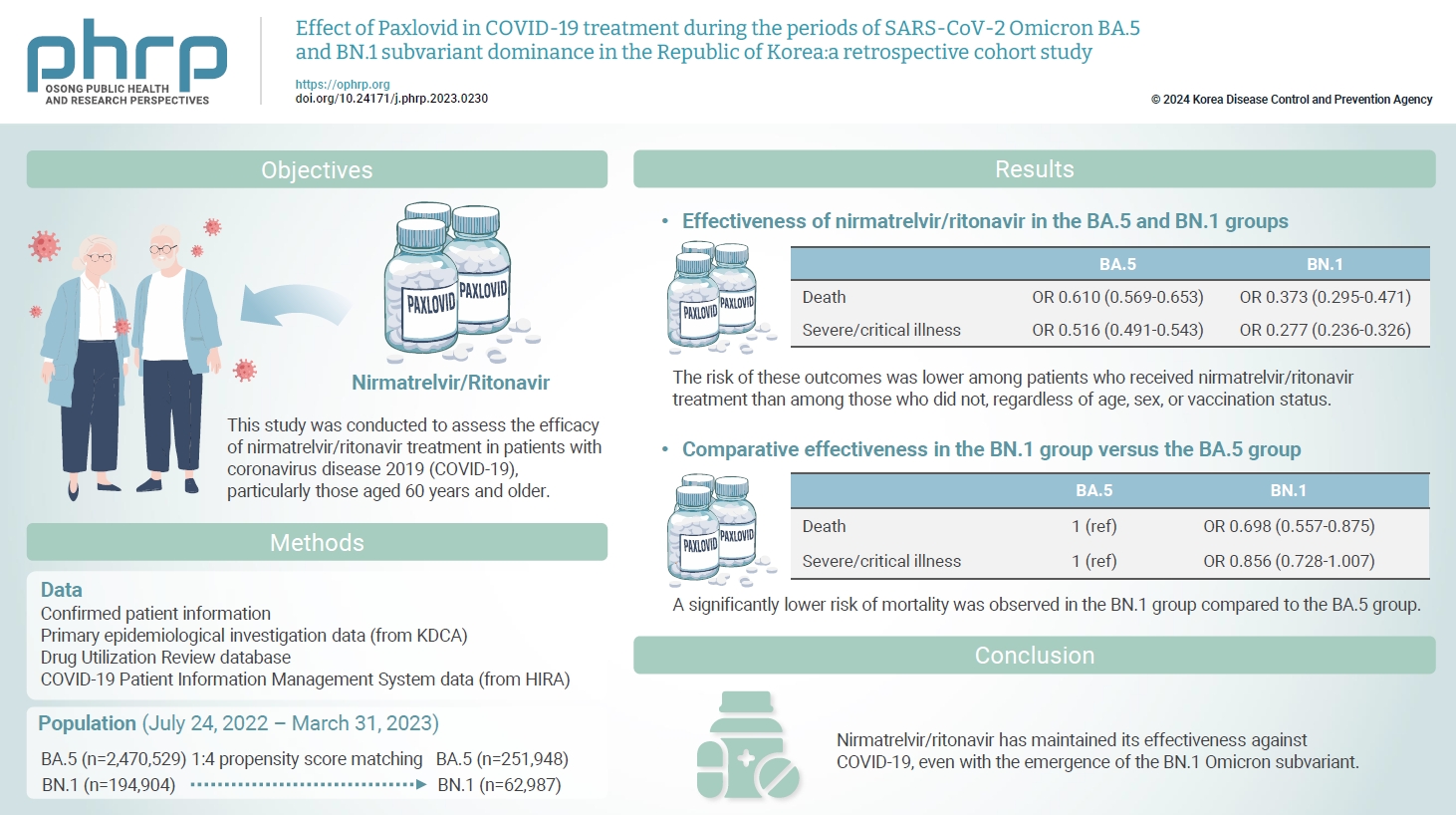
Objectives This study was conducted to assess the efficacy of nirmatrelvir/ritonavir treatment in patients with coronavirus disease 2019 (COVID-19), particularly those aged 60 years and older. Using real-world data, the period during which the BN.1 Omicron variant was dominant was compared to the period dominated by the BA.5 variant. Methods: In this retrospective cohort study, data were collected regarding 2,665,281 patients infected with severe acute respiratory syndrome coronavirus 2 between July 24, 2022, and March 31, 2023. Propensity score matching was utilized to match patients who received nirmatrelvir/ ritonavir in a 1:4 ratio between BN.1 and BA.5 variant groups. Multivariable logistic regression analysis was employed to assess the effects of nirmatrelvir/ritonavir within these groups. Results: Compared to the prior period, the efficacy of nirmatrelvir/ritonavir did not significantly differ during the interval of Omicron BN.1 variant dominance in the Republic of Korea. Among patients treated with nirmatrelvir/ritonavir, a significantly lower risk of mortality was observed in the BN.1 group (odds ratio [OR], 0.698; 95% confidence interval [CI], 0.557–0.875) compared to the BA.5 group. However, this treatment did not significantly reduce the risk of severe or critical illness, including death, for those in the BN.1 group (OR, 0.856; 95% CI, 0.728–1.007). Conclusion: Nirmatrelvir/ritonavir has maintained its effectiveness against COVID-19, even with the emergence of the BN.1 Omicron subvariant. Consequently, we strongly recommend the administration of nirmatrelvir/ritonavir to patients exhibiting COVID-19-related symptoms, irrespective of the dominant Omicron variant or their vaccination status, to mitigate disease severity and decrease the risk of mortality.
Citations
Citations to this article as recorded by
Effectiveness of Nirmatrelvir/Ritonavir for Outpatients in the Era of Omicron, Vaccination, and Previous Infection: A Meta-analysis Mark Ebell, Peter Kurotschka Journal of General Internal Medicine.2026; 41(12): 3516. CrossRef
Severity of COVID-19 Omicron Variants: A Global Systematic Review Deepa Malhotra, Rajeev M. Nepal, Irini Zografaki, Moe H. Kyaw, Pinelopi Nikolopoulou, Rodrigo Sini de Almeida, Santiago M. C. Lopez, Stephen Wiblin, Fraser Williams, Sophie Pope, Isabelle Whittle, Fiona Pearson, Daniel Curcio Infectious Diseases and Therapy.2026; 15(7): 1827. CrossRef
Nirmatrelvir/Ritonavir Efficacy in Immunocompetent Patients with Confirmed Omicron Variant of Severe Acute Respiratory Syndrome Coronavirus 2: An Updated Systematic Review and Meta-analysis Elnaz Khani, Hoda Afsharirad, Ali Taghizadeh Yadegari, Meysam Zarezadeh, Hila Asham, Hossein Bannazadeh-Baghi, Taher Entezari-Maleki Journal of Research in Pharmacy Practice.2026;[Epub] CrossRef
<sec>
<title>Objectives</title>
<p>To evaluate the impact of 3 treatment regimens upon health-related quality of life and work productivity using patient-reported outcomes (PROs) in chronic hepatitis C infected patients: sofosbuvir (SOF) + daclatasvir (DCV); SOF + DCV + ribavirin (RBV); SOF + simeprevir (SMV).</p></sec>
<sec>
<title>Methods</title>
<p>4 questionnaires were used to evaluate PROs before, during and after treatment: Short Form-36 (SF-36), Chronic Liver Disease Questionnaire (CLDQ) - hepatitis C virus (HCV), Work Productivity and Activity Index, Functional Assessment of Chronic Illness Therapy-Fatigue (FACIT-F).</p></sec>
<sec>
<title>Results</title>
<p>Of the global sample of 55 patients included in this study; SOF + DCV (<italic>n</italic> = 10); SOF + DCV + RBV (<italic>n</italic> = 29); SOF + SMV (<italic>n</italic> = 16) all had a statistically significant improvement in SF-36, CLDQ and FACIT-F scores during and post-treatment. No statistically significant differences in the PRO questionnaire values were observed between the distinct treatment regimens. The SOF and SMV patient groups presented higher mean PRO variations during and post-treatment, compared to the other groups: SF-36 functional capacity (16.1); SF-36 mental health (21.4); CLDQ activity (1.8); CLDQ emotional function (1.2); FACIT-F physical well-being (8.0); Total FACIT-F (21.6).</p></sec>
<sec>
<title>Conclusion</title>
<p>Treatment with SOF + DCV, with or without RBV, results in an improved PRO similar to treatment with SOF + SMV in chronic hepatitis C patients.</p></sec>
Citations
Citations to this article as recorded by
Health-related quality of life in people receiving opioid agonist treatment and treatment for hepatitis C virus infection Olav Dalgard, Alain H. Litwin, Oren Shibolet, Jason Grebely, Ronald Nahass, Frederick L. Altice, Brian Conway, Edward J. Gane, Anne F. Luetkemeyer, Cheng-Yuan Peng, David Iser, Isaias Noel Gendrano, Michelle M. Kelly, Barbara A. Haber, Heather Platt, Amy Journal of Addictive Diseases.2023; 41(3): 213. CrossRef
Impact of sofosbuvir and daclastavir on health-related quality of life in patients co-infected with hepatitis C and human immunodeficiency virus Evy Yunihastuti, Fhadilla Amelia, Arini Ika Hapsari, Bramantya Wicaksana, Veritea Natali, Alvina Widhani, Andri Sanityoso Sulaiman, Teguh Harjono Karjadi Health and Quality of Life Outcomes.2021;[Epub] CrossRef
Health-related quality of life and fatigue in patients with chronic hepatitis C with therapy with direct-acting antivirals agents interferon-free Raíssa Neves Fagundes, Lincoln Eduardo Villela Vieira de Castro Ferreira, Fábio Heleno de Lima Pace, Yury E. Khudyakov PLOS ONE.2020; 15(8): e0237005. CrossRef
Efficacy and safety of sofosbuvir-based pangenotypic direct-acting antiviral agents for chronic hepatitis C patients without genotype determination Juan Li, Dong-Bo Wu, Wei Jiang, Xue-Bin Chen, Gui-Bao Xiao, Yong-Hong Wang, Meng-Lan Wang, Ya-Chao Tao, En-Qiang Chen Medicine.2020; 99(43): e22726. CrossRef



 First
 Prev


