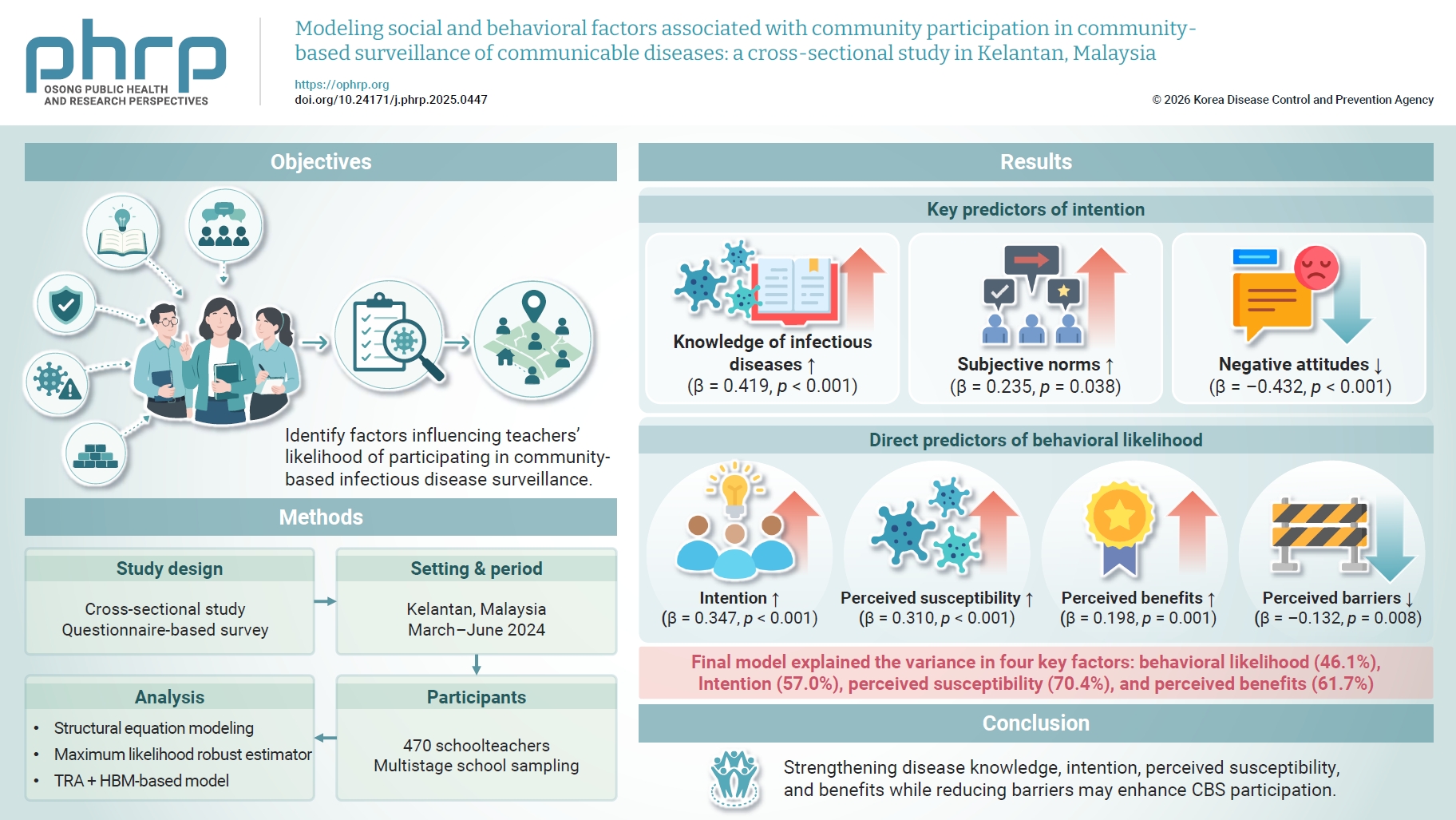
Objectives This study examined the social and behavioral factors influencing community leaders’ participation in community-based surveillance (CBS) of infectious diseases. We hypothesized that knowledge, attitudes, and perceptions significantly predict the behavioral likelihood of engaging in CBS activities. Methods: A cross-sectional study was conducted among 470 schoolteachers in Kelantan, Malaysia, from March to June 2024. Participants were selected using multistage sampling, with random selection of schools followed by convenience sampling of teachers. Data were collected using the validated KAP-CBS-ID questionnaire, which was based on the Theory of Reasoned Action and Health Belief Model. Structural equation modeling was used to analyze relationships among the study variables with the maximum likelihood robust estimator. Results: The final model demonstrated good fit (comparative fit index, 0.921; standardized root mean square residual, 0.071; root mean square error of approximation, 0.040 [90% confidence interval, 0.036–0.044]). Ten significant path relationships were identified, explaining 46.1% of the variance in behavioral likelihood. Knowledge of infectious diseases (β=0.419, p<0.001), subjective norms (β=0.235, p=0.038), and negative attitudes (β=–0.432, p<0.001) significantly influenced intention. Behavioral likelihood was directly predicted by intention (β =0.347, p<0.001), perceived susceptibility (β=0.310, p<0.001), perceived benefits (β=0.198, p=0.001), and perceived barriers (β=–0.132, p=0.008). Self-efficacy showed significant indirect effects through perceived benefits (β=0.785, p<0.001) and perceived susceptibility (β=0.765, p<0.001). Conclusion: Knowledge and psychosocial factors significantly inf luence community engagement in CBS of infectious diseases. Public health interventions should address these interconnected determinants to strengthen early disease detection and reporting systems.
Mona Gamal Mohamed, Eman Abdelaziz Ahmed Dabou, Fatma M. Ibrahim, Shaimaa Abdelsamad, Jibin Kunjavara, Kamaruddeen Mannethodi, Moayad Ahmad Wishah, Abdullah Y. Shihab, Khaled Mohammed Al-Sayaghi, Hammad Ali Fadlalmola, Mohammed Musaed Al-Jabri
Osong Public Health Res Perspect 2025;16(4):357-372. Published online June 25, 2025
Objectives This study aimed to (1) assess healthcare workers’ (HCWs) knowledge and attitudes toward mpox across 3 Gulf countries, and (2) examine factors influencing their acceptance of the mpox vaccine using the health belief model (HBM). This model evaluated perceptions related to susceptibility, severity, benefits, barriers, cues to action, and self-efficacy. Additionally, the study explored the impact of prior coronavirus disease 2019 (COVID-19) vaccination history on mpox vaccine acceptance. Methods: A cross-sectional study was conducted among 764 HCWs from the United Arab Emirates (UAE), Saudi Arabia, and Qatar. Data were collected through a structured online questionnaire based on HBM constructs. Logistic regression and structural equation modeling were employed to analyze predictors of vaccine acceptance. Results: Knowledge levels varied across the countries, with the highest proportion of good knowledge reported in the UAE (59%). UAE HCWs also demonstrated higher perceived susceptibility, perceived benefits, and intention to vaccinate compared to those in Saudi Arabia and Qatar (p<0.001). Receiving 4 doses of the COVID-19 vaccine was associated with greater acceptance of the mpox vaccine. Among the HBM constructs, perceived benefits and self-efficacy were identified as the strongest predictors of vaccine acceptance. Perceived barriers, such as fear of side effects and concerns about vaccine safety, were more prominent among HCWs in Saudi Arabia and Qatar. Conclusion: The HBM effectively explains the factors influencing mpox vaccine acceptance among Gulf HCWs. Targeted interventions that improve perceived benefits, reduce barriers, and improve self-efficacy may facilitate greater vaccine uptake and preparedness for emerging infectious diseases.
Citations
Citations to this article as recorded by
Determinants of Mpox vaccine uptake and hesitancy among healthcare workers in Port Harcourt, Nigeria Moore Ikechi Mike-Ogburia, Chiziyara Orluibna Obunwo, Elizabeth Efeelobari Letam, Ayebaemi Wilfred Dambo, Samuel Chima Agumagu, Tamunosaki Fubara-Manuel, Charles Henry Esukpa BMC Infectious Diseases.2026;[Epub] CrossRef
Knowledge and attitudes toward mpox among the Lebanese population during the second wave and their attitudes toward vaccination Mohammad Tanashat, Nour Fakih, Nour El Bizri, Mohamed Saad Rakab, Mohamed Abouzid, Karen Sleiman, Hadi Hassan, Moetasem Al Sayed, Zahraa Zibara, Ahmad Afyouni, Pascale Salameh Scientific Reports.2026;[Epub] CrossRef
Decoding Vaccine Hesitancy in Mpox Across Multiple Middle Eastern Countries: Public Knowledge, Attitudes, Worry, Conspiracy Beliefs, and Acceptance Mona Gamal Mohamed, Huda Mohamed Ali Rasheed, Manjula G. Bhagavathy, Moayad Ahmad Wishah, Dibbo Protim Ghosh, Md. Rabiul Islam, Ramya Kundayi Ravi Health Science Reports.2026;[Epub] CrossRef
Mpox Awareness and Infection Control Practices Among Hospital Nurses and Healthcare Workers in Bangladesh Hemayet Hossain, Md. Abdur Nur Sakib, Mostafizor Rahman, Zerin Tasnim Romana, Md. Hasan Ali, Snigdha Sharmin Binte Sayeed, Khadiza Akter Brishty, Md. Shahidur Rahman Chowdhury, Md. Mahfujur Rahman Public Health Challenges.2026;[Epub] CrossRef
Artificial intelligence and biohealth: the Republic of Korea’s emerging priorities in health care R&D Jong-Koo Lee Osong Public Health and Research Perspectives.2025; 16(4): 309. CrossRef
Nursing Students’ Knowledge, Attitudes, and Practices Toward Monkeypox Virus: A Cross-Sectional Survey at the University of Palermo, 2022 Barbara Ravazzolo, Francesco Leonforte, Letizia Cascio, Clara Ferrara, Federico Li Causi, Francesco Armetta, Maria Lampasona, Rinaldo Stefano Miceli, Carlo Fantini, Klara Komici, Alberto Firenze Zoonotic Diseases.2025; 6(1): 1. CrossRef
<sec>
<title>Objectives</title>
<p>This study aimed to assess medication use in pregnant women in Malaysia by measuring use, knowledge, awareness, and beliefs about medications.</p></sec>
<sec>
<title>Methods</title>
<p>This was an observational, cross-sectional study involving a total of 447 pregnant women who attended the Obstetrics and Gynecology Clinic, Hospital Kuala Lumpur (HKL), Malaysia. A validated, self-administered questionnaire was used to collect participant data.</p></sec>
<sec>
<title>Results</title>
<p>Most of pregnant women had taken medication during pregnancy and more than half of them (52.8%) showed a poor level of knowledge about the medication use during pregnancy. Eighty-three percent had a poor level of awareness and 56.5% had negative beliefs. Age and education level were significantly associated with the level of knowledge regarding medication use during pregnancy. Multiparous pregnant women, and pregnant women from rural areas were observed to have a higher level of awareness compared with those who lived in urban areas. Use of medication during pregnancy was determined to be significantly associated with education level, and race.</p></sec>
<sec>
<title>Conclusion</title>
<p>Although there was prevalent use of medication among pregnant women, many had negative beliefs, and insufficient knowledge and awareness about the risks of taking medication during pregnancy. Several sociodemographic characteristics were significantly associated with the use (race and education level), level of knowledge (age and education level), awareness (parity and place of residence), and beliefs (race, education level, and occupation status) towards medication use during pregnancy.</p></sec>
Citations
Citations to this article as recorded by
Knowledge, Attitude, and Practice Toward Medication Use During Pregnancy: A Hospital-Based Cross-Sectional Survey Narayana Goruntla, Neelima Ganzi, Mallika Otturu, Sai Nikhitha Vaddi, Sree Lakshmi Mood, M. Jyothi Suchitra, Kasturi Vishwanathasetty Veerabhadrappa, Joseph Obiezu Chukwujekwu Ezeonwumelu, Sarad Pawar Naik Bukke The Journal of Obstetrics and Gynecology of India.2025; 75(S1): 317. CrossRef
Knowledge, Attitude, and Practice of Medication Use During Pregnancy: A Cross‐Sectional Study in Western Uganda Musiime Brian, Narayana Goruntla, Bhavana Reddy Bommireddy, Bhavani Mopuri, Easwaran Vigneshwaran, Mohammad Jaffar Sadiq Mantargi, Vishnuvandana Bandaru, Joseph Obiezu Chukwujekwu Ezeonwumelu, Sarad Pawar Naik Bukke, Tadele Mekuriya Yadesa, Ebere Emilia A Health Science Reports.2025;[Epub] CrossRef
Assessment of Self-Medication Awareness During Pregnancy Among Saudi Women in Madinah: A Cross-Sectional Study Abdulhakim M Alhazmi, Mohammed A Elmuttalut, Faris M Elmahdi, Joman M Mahrous, Seba M Alahmadi, Shahad E Abutowaimah Cureus.2025;[Epub] CrossRef
Internet-based pregnancy information seeking in Lebanon: a cross-sectional study Mazen El Jamal, Ali Al Abed, Mustapha El Haj Hassan, Jana Traboulsi, Kassem Hamze, Samir Mansour, Abbas Hoballah, Rana El Haidari BMC Pregnancy and Childbirth.2025;[Epub] CrossRef
Research Progress on Drug Literacy in Pregnant Patients 俏亦 鲍 Nursing Science.2025; 14(11): 2257. CrossRef
Self-medication practice among pregnant and postpartum women attending the regional hospital center of Souss Massa, Morocco: a cross-sectional study Afaf Bouqoufi, Laila Lahlou, Fatima Ait El Hadj, Said Boujraf, Mohammed Abdessadek, Youssef Khabbal Frontiers in Pharmacology.2024;[Epub] CrossRef
A cross- sectional study to assess medication safety, knowledge, attitude, and practices regarding nutrition and medication among pregnant women R Gauthami, Bipin Shaji, MJS Twinkle, Krishnapriya Radhakrishnan, Reshma Kolar, Juno Jerold Joel Asian Pacific Journal of Reproduction.2024; 13(3): 115. CrossRef
Knowledge, attitude, and practice of medication use among pregnant women in Riyadh City: a cross-sectional study Alanoud Almuhareb, Abdullah Al Sharif, Peter Cahusac Frontiers in Global Women's Health.2024;[Epub] CrossRef
Insights and perceptions: Investigating pregnant women’s attitudes, understanding, and factors influencing knowledge regarding medication usage during pregnancy—A cross-sectional study Abdullah R. Al-khawlani, Qutaiba A. Qasim, Abdulsalam M. Halboup, Samar Thiab, Mohammed Zawiah, Fahmi Y. Al-Ashwal, Nur Aizati Athirah Daud PLOS ONE.2024; 19(10): e0311235. CrossRef
Prevalence of polypharmacy in pregnancy: a systematic review Astha Anand, Katherine Phillips, Anuradhaa Subramanian, Siang Ing Lee, Zhaonan Wang, Rebecca McCowan, Utkarsh Agrawal, Adeniyi Frances Fagbamigbe, Catherine Nelson-Piercy, Peter Brocklehurst, Christine Damase-Michel, Maria Loane, Krishnarajah Nirantharaku BMJ Open.2023; 13(3): e067585. CrossRef
A cross-sectional study on the knowledge, attitude, and practice of pregnant women regarding medication use and restriction during pregnancy. Ogechi C. Obi, Chibueze Anosike Exploratory Research in Clinical and Social Pharma.2023; 11: 100308. CrossRef
Neurological disorders in pregnant women in low- and middle-income countries—Management gaps, impacts, and future prospects: A review perspective Anastasia Fosuah Debrah, Favour Tope Adebusoye, Muhammad Hamza Shah, Wireko Andrew Awuah, Pearl Ohenewaa Tenkorang, Hareesha Rishab Bharadwaj, Jack Wellington, Shankhaneel Ghosh, Lydia Abiy, Carolina Fernandes, Toufik Abdul-Rahman, Volodymyr Lychko, Babar Women's Health.2023;[Epub] CrossRef
Knowledge, Attitude, and Beliefs of Medication Use in Pregnancy in an Urban Tertiary Care Center Jamil Kazma, Tarek Araji, Aneka Khilnani, John van den Anker, Homa K. Ahmadzia The Journal of Clinical Pharmacology.2022;[Epub] CrossRef
Intervention Effects in Using an Application Compared with a Module with Pictures on Knowledge, Attitude, and Practice of the Pregnant Women in North Sumatra, Indonesia Herna Rinayanti Manurung, Heru Santoso, Kintoko Rochadi, Juanita Juanita Open Access Macedonian Journal of Medical Sciences.2022; 10(E): 121. CrossRef
Modern drug self-medication and associated factors among pregnant women at Settat city, Morocco Samia Chergaoui, Omaima Changuiti, Abdelghafour Marfak, Elmadani Saad, Abderraouf Hilali, Ibtissam Youlyouz Marfak Frontiers in Pharmacology.2022;[Epub] CrossRef




 First
 Prev


