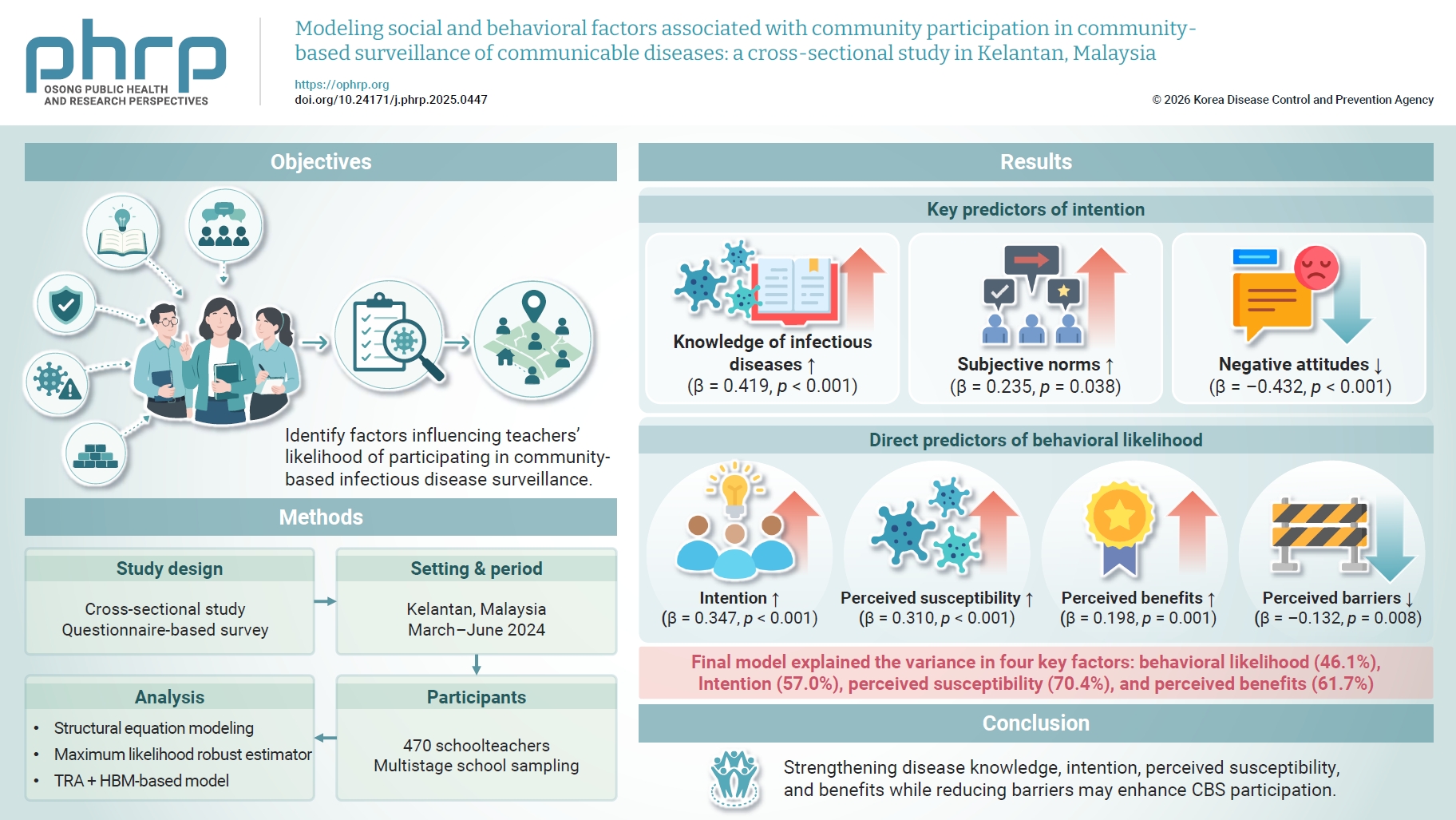
Objectives This study examined the social and behavioral factors influencing community leaders’ participation in community-based surveillance (CBS) of infectious diseases. We hypothesized that knowledge, attitudes, and perceptions significantly predict the behavioral likelihood of engaging in CBS activities. Methods: A cross-sectional study was conducted among 470 schoolteachers in Kelantan, Malaysia, from March to June 2024. Participants were selected using multistage sampling, with random selection of schools followed by convenience sampling of teachers. Data were collected using the validated KAP-CBS-ID questionnaire, which was based on the Theory of Reasoned Action and Health Belief Model. Structural equation modeling was used to analyze relationships among the study variables with the maximum likelihood robust estimator. Results: The final model demonstrated good fit (comparative fit index, 0.921; standardized root mean square residual, 0.071; root mean square error of approximation, 0.040 [90% confidence interval, 0.036–0.044]). Ten significant path relationships were identified, explaining 46.1% of the variance in behavioral likelihood. Knowledge of infectious diseases (β=0.419, p<0.001), subjective norms (β=0.235, p=0.038), and negative attitudes (β=–0.432, p<0.001) significantly influenced intention. Behavioral likelihood was directly predicted by intention (β =0.347, p<0.001), perceived susceptibility (β=0.310, p<0.001), perceived benefits (β=0.198, p=0.001), and perceived barriers (β=–0.132, p=0.008). Self-efficacy showed significant indirect effects through perceived benefits (β=0.785, p<0.001) and perceived susceptibility (β=0.765, p<0.001). Conclusion: Knowledge and psychosocial factors significantly inf luence community engagement in CBS of infectious diseases. Public health interventions should address these interconnected determinants to strengthen early disease detection and reporting systems.
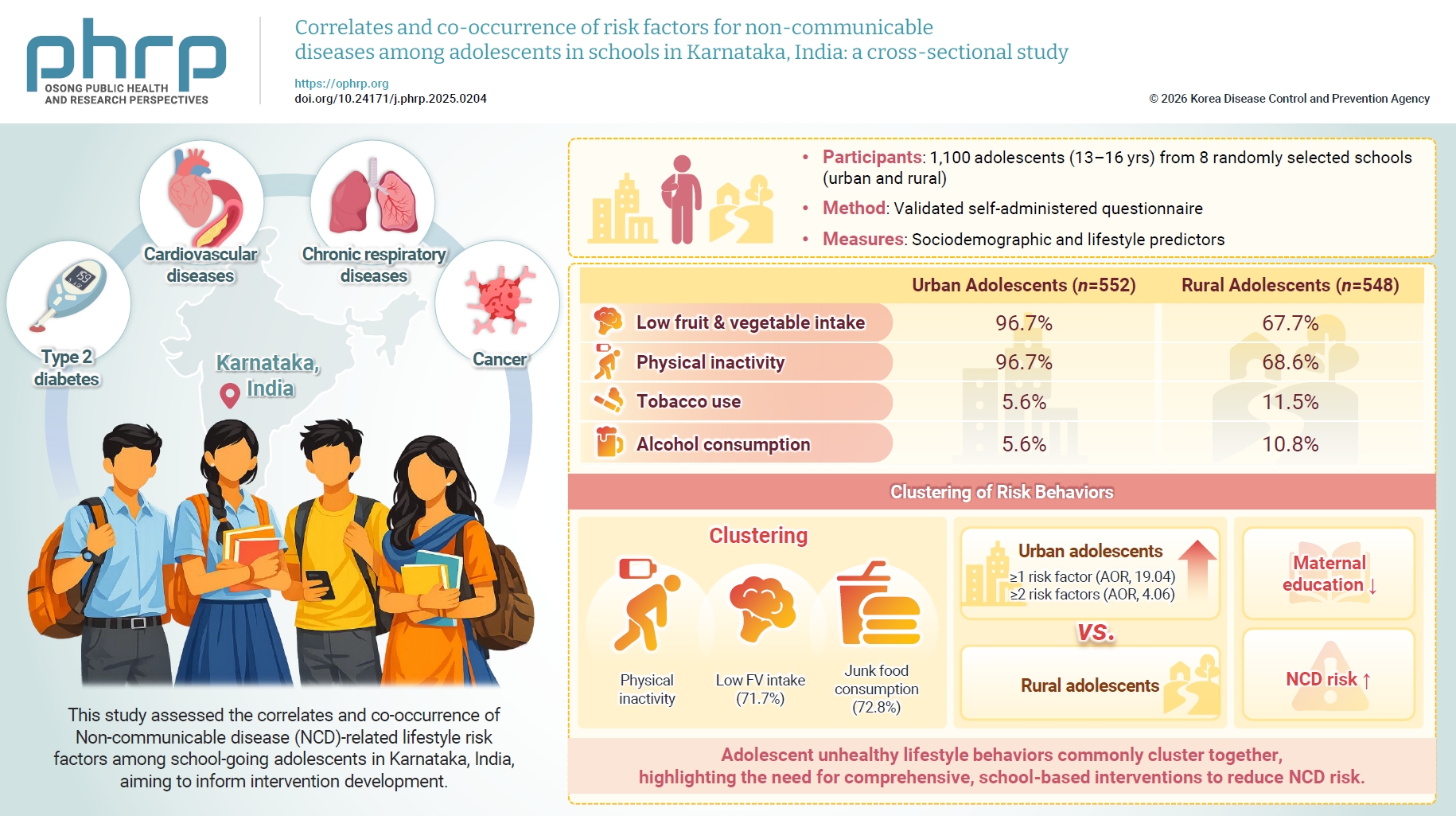
Objectives Non-communicable disease (NCD) risk among adolescents represents a growing concern due to modifiable, lifestyle-related behavioral risk factors. Early identification and control of these factors are essential for prevention. This study assessed the correlates and cooccurrence of NCD-related lifestyle risk factors among school-going adolescents in Karnataka, India, aiming to inform intervention development. Methods: Screening was conducted among 1,100 school adolescents aged 13–16 years from 8 randomly selected urban and rural schools in Karnataka. Data were collected using a validated self-administered questionnaire covering sociodemographic characteristics and social cognitive theory predictors of lifestyle practices. Descriptive statistics, chi-square tests, and logistic regression were employed. Results: Of the 1,100 adolescents surveyed, 552 and 548 were from urban and rural areas, respectively. Both groups reported high rates of insufficient fruit and vegetable (FV) intake (96.7% and 67.7%, respectively), inadequate physical activity (96.7% and 68.6%), tobacco use (5.6% and 11.5%), and alcohol consumption (5.6% and 10.8%). On logistic regression, urban adolescents were significantly more likely than rural peers to exhibit multiple behavioral risk factors, with 19-fold higher odds of having ≥1 factor (adjusted odds ratio [AOR], 19.04; p< 0.001) and 4-fold higher odds of having ≥2 (AOR, 4.06; p < 0.001). Parental (particularly maternal) education was associated with NCD risk (AOR, 1.82; p= 0.001). Physical inactivity significantly co-occurred with low FV intake (71.7%) and junk food consumption (72.8%). Conclusion: Unhealthy lifestyle behaviors among adolescents displayed significant cooccurrence, underscoring the critical need for comprehensive, theory-based school interventions to address multiple interconnected risk factors and mitigate the burden of NCDs.
Objectives
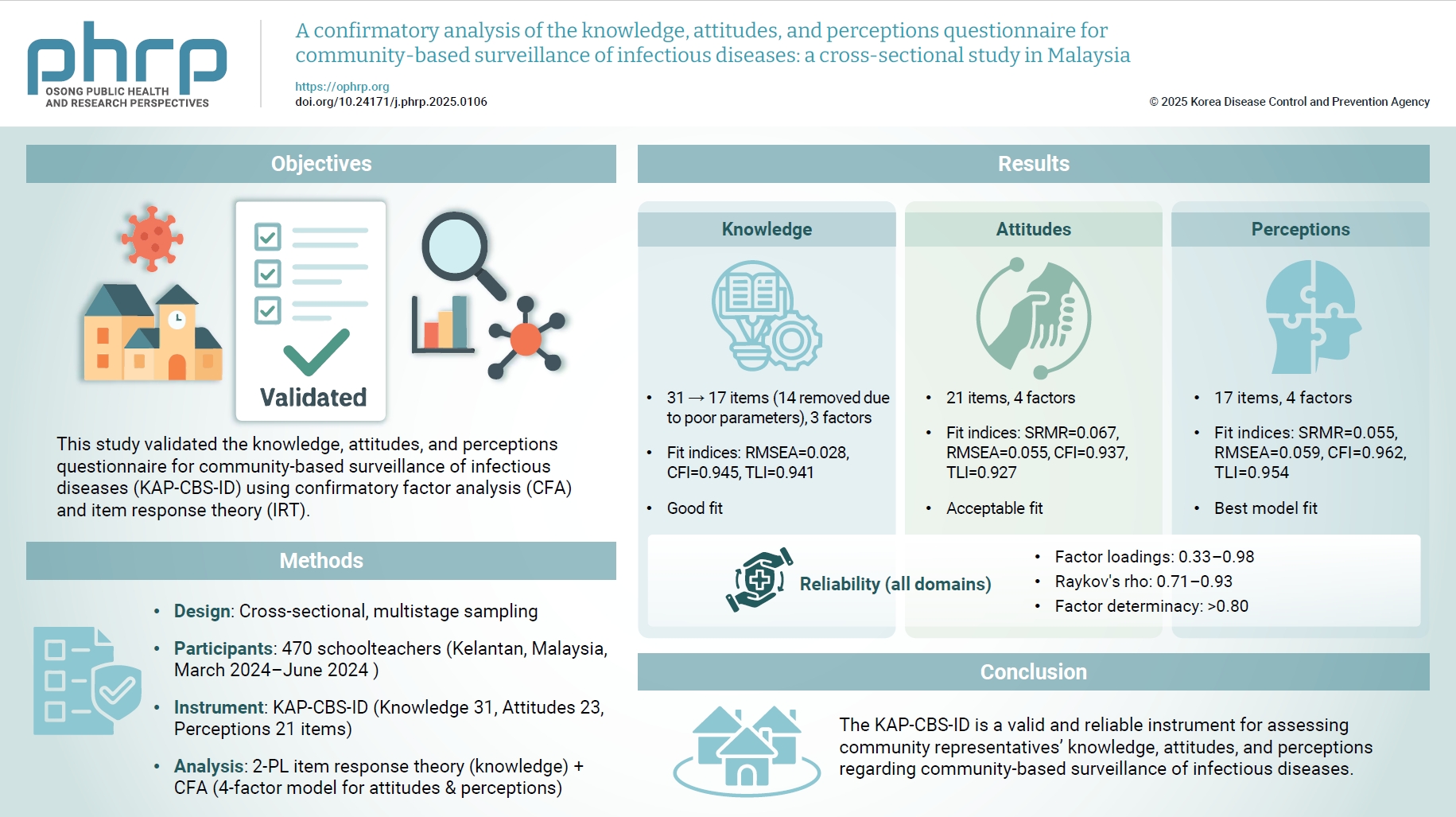
This study aimed to validate the psychometric properties of the recently developed knowledge, attitudes, and perceptions questionnaire for community-based surveillance of infectious diseases (KAP-CBS-ID questionnaire), using confirmatory factor analysis (CFA) and item response theory (IRT).
Methods
A cross-sectional study using multistage sampling recruited 470 schoolteachers from Kelantan, Malaysia. The self-administered KAP-CBS-ID questionnaire consists of 3 domains: knowledge (31 items), attitudes (23 items), and perceptions (21-items). Two-parameter logistic (2-PL) IRT analysis and CFA were performed to validate the knowledge section. For attitudes and perceptions sections, CFA proceeded using a 4-factor model to evaluate both model fit and construct validity.
Results
Two-PL IRT analysis of the knowledge section resulted in elimination of 14 items due to inadequate discrimination or difficulty parameters. The 3-factor CFA model demonstrated good fit indices for knowledge (root mean square error of approximation [RMSEA], 0.028; comparative fit index [CFI], 0.945; Tucker-Lewis index [TLI], 0.941) without any modifications. The attitudes section required re-specification, ultimately yielding 21 items across 4 factors with acceptable fit indices (standardized root mean square residual [SRMR], 0.067; RMSEA, 0.055; CFI, 0.937; TLI, 0.927). Similarly, the perceptions section was refined to 17 items across 4 factors, showing good model fit (SRMR, 0.055; RMSEA, 0.059; CFI, 0.962; TLI, 0.954). Factor loadings ranged from 0.33 to 0.98, while Raykov’s rho reliability estimates ranged from 0.71 to 0.93. Factor determinacy exceeded 80% for all factors.
Conclusion
The KAP-CBS-ID is a valid and reliable instrument for assessing community representatives’ knowledge, attitudes, and perceptions regarding community-based surveillance of infectious diseases.
Citations
Citations to this article as recorded by
Modeling social and behavioral factors associated with community participation in community-based surveillance of communicable diseases: a cross-sectional study in Kelantan, Malaysia Ahmed Azeez Hasan, Anis Kausar Ghazali, Norsa’adah Bachok, Najib Majdi Yaacob, Suhaily Mohd Hairon, Nur Amira Mohd Nadir, Fatimah Muhd Shukri Osong Public Health and Research Perspectives.2026; 17(3): 229. CrossRef
Objectives This study investigated the correlation between food insecurity and infectious diseases among toddlers in Indonesia.
Methods This research employed a cross-sectional study design using data from the 2021 Indonesian Nutrition Status Survey, which included a sample of 84,115 toddlers. Food insecurity levels were assessed using the food insecurity experience scale, developed by the Food and Agriculture Organization. The dependent variable, infectious disease, was defined as a toddler experiencing 1 or more of the following conditions: acute respiratory infections, diarrhea, pneumonia, measles, or worms. Multivariate analysis was conducted using multiple logistic regression to determine adjusted odds ratios (ORs).
Results The findings indicate that 23.78% of toddlers experienced at least 1 infectious disease. While more than half of the respondents were food secure, 26.5% faced mild food insecurity, 13.6% moderate food insecurity, and 6.5% severe food insecurity. Toddlers from households experiencing mild, moderate, and severe food insecurity had higher risks of infectious diseases compared to those from food-secure households, with adjusted ORs of 1.367 (95% confidence interval [CI], 1.308–1.428), 1.490 (95% CI, 1.399–1.588), and 1.500 (95% CI, 1.374–1.638), respectively.
Conclusion In conclusion, more severe food insecurity is correlated with an increased risk of toddlers suffering infectious diseases.
Citations
Citations to this article as recorded by
From pantry to physiology: A narrative review linking food insecurity to biological dysfunction Liahm Blank, Joshua Khorsandi, Nicole Kang, Kaloyan Momchilov, Itai Blank, Kavita Batra Dialogues in Health.2026; 8: 100308. CrossRef
Structural Equation Modelling of Socioeconomic Status on Malnutrition Among Urban Preschoolers: Multi-Group Analysis of Hungary and Indonesia Arie Dwi Alristina, Éva Kovács, Diyah Arini, Helga Judit Feith International Journal of Environmental Research an.2026; 23(7): 858. CrossRef
Implementasi Gerakan Kebun Gizi Keluarga (GK2) Sebagai Upaya Ketahanan Pangan dan Gizi Keluarga di Desa Gading Watu, Kabupaten Gresik Noveansyah Maskur Nurgah, Dhuha Nuri Samsiyah, Shafa Dwi Candra Syahputra, Aisyah Rahmah Maulidiyah , Rambu Breathy Salwasty Ananda Tamu Rambu, Intan Adinda Putri, Nabil Habib Abdillah, Devita Astrid Renata, Nurul I.A. Cahyo Wibowo, Muchammad Bachrul Ulu Journal of Community Development.2026; 7(2): 1. CrossRef
Prematurity and Low Birth Weight Among Food-Secure and Food-Insecure Households: A Comparative Study in Surabaya, Indonesia Arie Alristina, Nour Mahrouseh, Anggi Irawan, Rizky Laili, Alexandra Zimonyi-Bakó, Helga Feith Nutrients.2025; 17(15): 2479. CrossRef
Global health security threats in the post-coronavirus disease 2019 era include dense urban populations, increased human–animal proximity, migration driven by political or economic instability, climate change, humanitarian crises, antimicrobial resistance (AMR), and the misuse of biological research—including the accidental or intentional release of high-risk pathogens. The foundational preparation for these threats is to establish a robust, resilient public health system based on universal health coverage. The World Health Organization’s International Health Regulations must continue to promote global solidarity by maintaining core capacities such as surveillance, national laboratories, and epidemiological investigations of emerging infectious diseases, with timely reporting and information sharing within the global health security community. A One Health approach is essential for addressing AMR. Infection prevention and control must be enhanced to reduce healthcare-associated infections in medical facilities. Additionally, regulations concerning biosafety and biosecurity should address dual-use research of concern as well as the accidental or intentional release of highrisk pathogens from laboratories. Global health security is a collective responsibility because these threats know no borders and require coordinated action.
Citations
Citations to this article as recorded by
The Role of Environmental and Climatic Factors in Accelerating Antibiotic Resistance in the Mediterranean Region Nikolaos P. Tzavellas, Natalia Atzemoglou, Petros Bozidis, Konstantina Gartzonika Acta Microbiologica Hellenica.2026; 71(1): 1. CrossRef
Global health preparedness for biosecurity threats: a review of emerging technologies and solutions Omotade Adebimpe Ijarotimi, Adeyemi Akeem Amuda, Christopher Oluwatosin Omokanye, Mariam Amuda Frontiers in Public Health.2026;[Epub] CrossRef
Min Jei Lee, Myung-Jae Hwang, Dong Seob Kim, Seon Kyeong Park, Jihyun Choi, Ji Joo Lee, Jong Mu Kim, Young-Man Kim, Young-Joon Park, Jin Gwack, Sang-Eun Lee
Osong Public Health Res Perspect 2023;14(5):418-426. Published online October 19, 2023
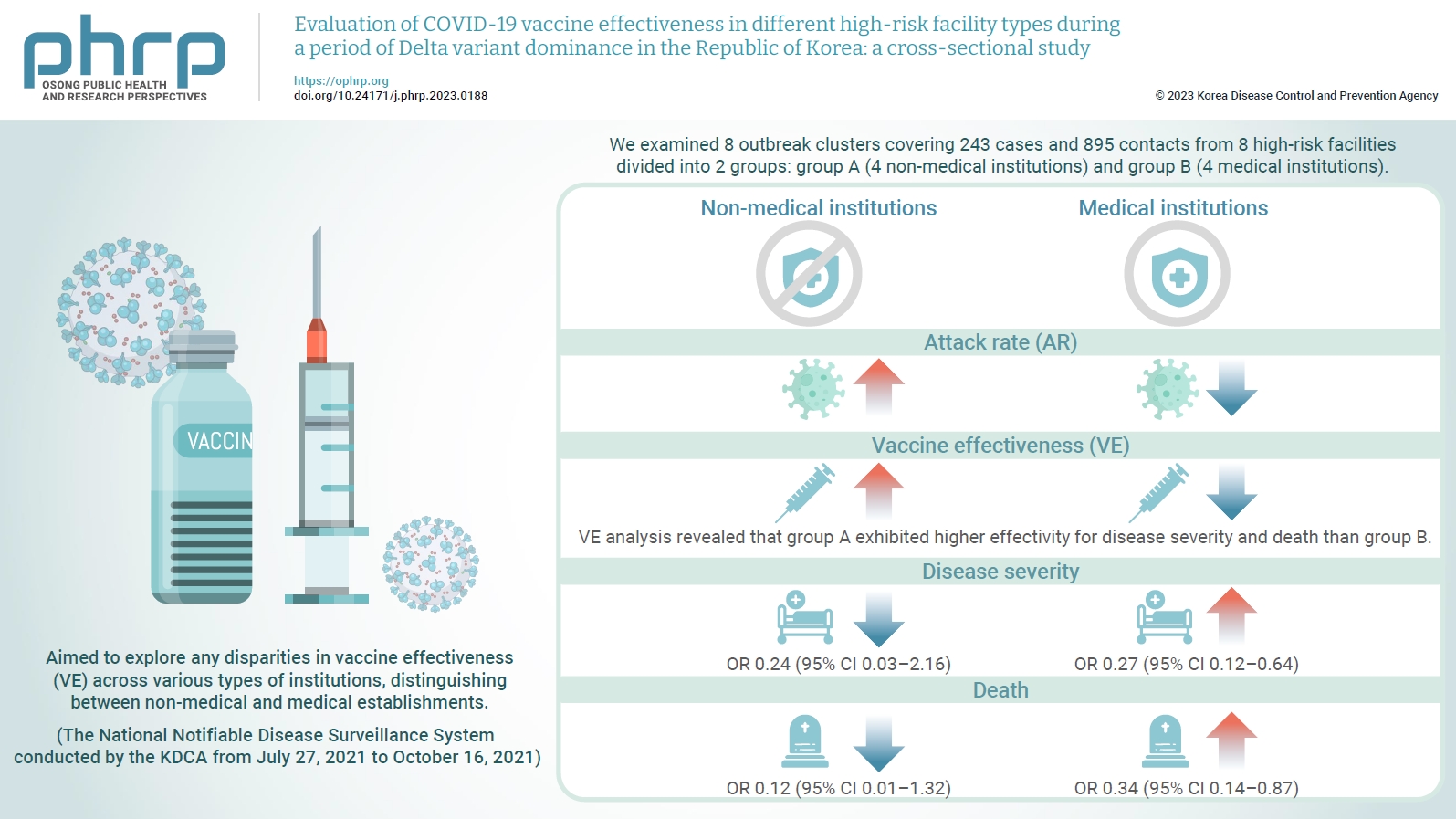
Objectives We evaluated the effectiveness of coronavirus disease 2019 vaccination in high-risk facilities in the Republic of Korea during the period when the highly transmissible Delta variant was prevalent. Additionally, we aimed to explore any disparities in vaccine effectiveness (VE) across various types of institutions, specifically distinguishing between non-medical and medical establishments. Methods: We examined 8 outbreak clusters covering 243 cases and 895 contacts from 8 high-risk facilities divided into 2 groups: group A (4 non-medical institutions) and group B (4 medical institutions). These clusters were observed from July 27, 2021 to October 16, 2021 for the attack rate (AR) and VE with respect to disease severity. A generalized linear model with a binomial distribution was used to determine the odds ratio (OR) for disease severity and death. Results: AR was notably lower in group B (medical institutions). Furthermore, VE analysis revealed that group A exhibited higher effectivity for disease severity and death than group B. The OR for disease severity was 0.24 (95% confidence interval [CI], 0.03–2.16) for group A and 0.27 (95% CI, 0.12–0.64) for group B, with the OR for death at 0.12 (95% CI, 0.01–1.32) in group A and 0.34 (95% CI, 0.14–0.87) in group B. Conclusion: Although VE may vary across institutions, our findings underscore the importance of implementing vaccinations in high-risk facilities. Customized vaccination programs, tailored response plans, and competent management personnel are essential for effectively addressing and mitigating public health challenges.
Objectives The global prevalence of psychiatric disturbances is rising, detrimentally affecting the quality of care and treatment outcomes for individuals, particularly those with diabetes.This study investigated the association of risk factors for psychiatric disturbances among productive-age patients with diabetes (ages 30−59 years), considering sociodemographic characteristics and co-existing diseases. The risk factors considered included sociodemographic factors (e.g., residence, age, sex, marital status, education, and occupation) and co-existing diseases (e.g., hypertension, heart disease, stroke, renal failure, rheumatism, asthma, and cancer). Methods: This cross-sectional study utilized data from the 2018 Indonesian National Health Survey (Riskesdas). The study population comprised respondents aged between 30 and 59 years who had diabetes and had completed the 20-question self-reporting questionnaire (SRQ-20). After the exclusion of incomplete SRQ-20 data, the sample included 8,917 respondents. Data were analyzed using logistic regression. Results: Approximately 18.29% of individuals with diabetes displayed symptoms indicative of psychiatric disturbances. After adjusting for sociodemographic factors such as age, sex, education level, occupation, marital status, and place of residence, patients with diabetes who had co-existing conditions such as hypertension, heart diseases, rheumatic disorders, asthma, or cancer had a higher risk for developing psychiatric disturbances than those with diabetes alone (adjusted odds ratio, 6.67; 95% confidence interval, 4.481−9.928; p<0.001). Conclusion: The elevated risk of psychiatric disturbances among patients with diabetes who had comorbidities underscores the importance of addressing mental health issues in the management of diabetes, especially in patients with concurrent disease conditions.
Citations
Citations to this article as recorded by
The impact of dietary consumption on hypertension in indonesia: An analysis of indonesian health survey 2023 Cici A. Yanti, Ratna Djuwita, Evi Martha, Besral, Debby Ratno Kustanto, Noor Mastura Mohd Mujar Journal of Education and Health Promotion.2025;[Epub] CrossRef
Investigating the association between physical fitness and blood pressure among healthcare workers in Indonesia Wahyu Sulistiadi, Riswandy Wasir, Astriana, Badra Al Aufa, Sri Rahayu, Wasir Thalib, Fadilah Aulia Rahma Discover Social Science and Health.2024;[Epub] CrossRef
Correction to “The risk associated with psychiatric disturbances in patients with diabetes in Indonesia (2018): a cross-sectional observational study” [Osong Public Health Res Perspect 2023;14(5):368–78] Siti Isfandari, Betty Roosihermiatie, Sulistyowati Tuminah, Laurentia Konadi Mihardja Osong Public Health and Research Perspectives.2023; 14(6): 530. CrossRef
Public health agencies (PHAs) have increasingly incorporated social media into their communication mix during successive pandemics in the 21st century. However, the quality, timing, and accuracy of their health messages have varied significantly, resulting in mixed outcomes for communication, audience engagement, and pandemic management. This study aimed to identify factors influencing the effectiveness of pandemic-related health messages shared by PHAs on social media and to report their impact on public engagement as documented in the literature. A scoping literature review was conducted following a predefined protocol. An electronic search of 7 relevant databases and 5 grey literature repositories yielded 9,714 papers published between January 2003 and November 2022. Seventy-three papers were deemed eligible and selected for review. The results underscored the insufficiency of social media guidance policies for PHAs. Six themes were identified: message source, message topic, message style, message timing, content credibility and reliability, and message recipient profile. These themes encompassed 20 variables that could inform PHAs’ social media public health communication during pandemics. Additionally, the findings revealed potential interconnectedness among the variables, and this study concluded by proposing a conceptual model that expands upon existing theoretical foundations for developing and evaluating pandemic-related health messaging.
Citations
Citations to this article as recorded by
Dynamics of public health messaging and healthcare activity in children during the 2022 iGAS surge: an observational study in England Alexandra L Creavin, Ruth Kipping, Alastair D Hay Journal of Public Health.2026; 48(1): 281. CrossRef
Using Humor to Promote Directives: Public Service Announcements During a Protracted Crisis Babatunde A. Balogun, Lin Yang, Nenagh Kemp, Maria Agaliotis, Anne Hogden Health Communication.2026; 41(11): 1941. CrossRef
Citizen engagement with information when adapting to health crises: four distinctive profiles Marilla Kortesalmi, Harri Jalonen, Valdemar R. V. Kallunki International Journal of Public Sector Management.2026; 39(5): 579. CrossRef
Ethnopharmacy of Medicinal Plants in the Production of Ma'jun as Traditional Medicine in Blang Dalam Village, Darul Hikmah District, Aceh Jaya Regency Vera Maulida, Muhammad Ridhwan, Rubiah, Husna, Cut Morina Zubainur Jurnal Penelitian Pendidikan IPA.2026; 12(3): 59. CrossRef
Planning and Implementing Social Media Communication in a Public Health Crisis: An Analytical Perspective Babatunde A. Balogun, A. Hogden, L. Yang, M. Agaliotis, N. Kemp Health Promotion Journal of Australia.2026;[Epub] CrossRef
Misinformation Through the Lens of Dutch News Media and Public Health Authorities: Content Analysis of Topics and Narratives Present in Pandemic-Related Misinformation During COVID-19 David Blanco-Herrero, Bas van den Putte, Toni G L A van der Meer JMIR Infodemiology.2026; 6: e91743. CrossRef
Mapping risk communication practices in public health emergencies: a scoping review and comparison with Italian regional pandemic plans Erica De Vita, Guglielmo Arzilli, Francesco Gesualdo, Virginia Casigliani, Milena Pasquale, Gianluca Cruschelli, Federico Tecchio, Filippo Tosi, Andrea Davide Porretta, Diana Romersi, Cesare Buquicchio, Caterina Rizzo BMC Public Health.2026;[Epub] CrossRef
Co‐Designing a Framework for Social Media Health Communication to Young People: A Participatory Research Study Melody Taba, Julie Ayre, Kirsten McCaffery, Diana Vassilenko, Ivan C. K. Ma, Tara Haynes, Julie Leask, Andrew Wilson, Carissa Bonner Health Expectations.2025;[Epub] CrossRef
Living health-promotion campaigns for communities in the United States: Decentralized content extraction and sharing through AI Man-pui Sally Chan, Haesung Jung, Alex Morales, Angela Zhang, Devlin O’Keefe, Sarah Joseph, Anthony Hron, Janet Davis, Tito Terry, Tiffany Peterson, Corey Herrman, Melissa Phillips, Jennifer Osborne, Kelley G McBride, Martin Hensley, Adriana Todorov, Alai PNAS Nexus.2025;[Epub] CrossRef
Paid Social Media Advertising on Vaping in Australia: A Descriptive Study Using Meta Ad Library Xiao Li, Robyn Gillespie, Alberto Nettel‐Aguirre, Lisa Gaye Smithers Health Promotion Journal of Australia.2025;[Epub] CrossRef
Objectives It is crucial to establish the characteristics of coronavirus disease 2019 (COVID-19) outbreaks at army training centers to develop preventive measures. Therefore, this study aimed to determine the COVID-19 transmission patterns and risk factors in a sequence of outbreaks at an army training center from June to August 2021.
Methods This study included 1,324 trainees at an army training center where outbreaks occurred from June to August 2021. The outbreak was qualitatively analyzed according to the period, attack rate, demographic characteristics, vaccination history, and living areas. An aerodynamic experiment was performed to evaluate aerosol transmission in living areas.
Results Three outbreaks occurred at the army training center from June to August 2021. The first, second, and third outbreaks lasted for 32, 17, and 24 days, and the attack rates were 12.8%, 18.1%, and 8.9%, respectively. Confirmed cases were distributed in all age groups. Recruits and the unvaccinated were at higher risk for COVID-19. The aerodynamic experiment verified the possibility of aerosol transmission within the same living area.
Conclusion COVID-19 transmission at army training centers should be minimized through quarantine and post-admission testing during the latency period as part of integrated measures that include facility ventilation, vaccination, indoor mask-wearing, and social distancing.
Citations
Citations to this article as recorded by
Socioecological Model-based Factors Influencing Respiratory Infection Prevention Behaviors among Soldiers in an Army Training Center Eunbin Jeong, Sookyung Hyun Journal of Korean Public Health Nursing.2024; 38(2): 176. CrossRef
COVID-19 outbreak in a religious village community in Republic of Korea and risk factors for transmission Jiae Shim, Eunju Lee, Eunyoung Kim, Yeonhwa Choi, Giseok Kang, Bryan Inho Kim Osong Public Health and Research Perspectives.2023; 14(2): 110. CrossRef
Epidemiological Characteristics of a COVID-19 Outbreak in a Psychiatric Hospital in Chung-buk Se-Hyuk Jang, Young-Joon Park, Ji-Joo Lee, Woo-Jin Jung Healthcare.2023; 11(16): 2332. CrossRef
Objectives
Healthcare workers (HCWs) are at a high risk of contracting severe acute respiratory syndrome coronavirus 2 (SARS-CoV-2) due to the increased likelihood of clinical exposure during patient management. The study objective was to determine the seroprevalence of antibodies to SARS-CoV-2 and its predictors among hospital employees.
Methods
The cross-sectional study was conducted at a teaching hospital from August 2020 to September 2020 among 1,401 employees, including 1,217 HCWs, in New Delhi, India. The serum samples were examined for immunoglobulin G (IgG) antibodies to SARS-CoV-2 using the COVID Kavach-Anti-SARS-CoV-2 IgG Antibody Detection enzyme-linked immunosorbent assay kit. Data were collected electronically using the EpiCollect mobile platform. A <italic>p</italic><0.05 was considered to indicate statistical significance.
Results
A total of 169 participants (12.1%) had detectable IgG antibodies to SARS-CoV-2. The highest seropositivity rate was observed in the administrative staff (20.1%), while it was lowest among medical doctors (5.5%, <italic>p</italic><0.001). Male sex and ever having lived in a containment zone were independently associated with past infection with SARS-CoV-2.
Conclusion
The seroprevalence of SARS-CoV-2 infection in health workers may be lower than in the general population in New Delhi. However, non-pharmaceutical interventions were not associated with a reduction in the risk of acquisition of SARS-CoV-2.
Citations
Citations to this article as recorded by
SARS-CoV-2 infection rates and associated risk factors in healthcare workers: systematic review and meta-analysis Amit Bansal, Mai-Chi Trieu, Emily M. Eriksson, Fan Zhou, Jodie McVernon, Karl Albert Brokstad, Rebecca Jane Cox Scientific Reports.2025;[Epub] CrossRef
Socio-demographic and behavioural risk factors of SARS- CoV-2 seropositivity in rural tribal population of Tripura: A population based cross-sectional study Subrata Baidya, Shampa Das, Biraj K. Kalita, Tapan Majumder, Puneet Misra Journal of Family Medicine and Primary Care.2025; 14(9): 4047. CrossRef
Serosurveillance of COVID-19 amongst health care workers in a teaching institution – A prospective cohort study in Puducherry district Muhamed Kamaludeen, Pajanivel Ranganadin, Agieshkumar Balakrishna Pillai, Arun Sugumaran Journal of Family Medicine and Primary Care.2024; 13(5): 1917. CrossRef
Assessment of potential risk factors for COVID-19 among health care workers in a health care setting in Delhi, India -a cohort study Mridu Dudeja, Aqsa Shaikh, Farzana Islam, Yasir Alvi, Mohammad Ahmad, Varun Kashyap, Vishal Singh, Anisur Rahman, Meely Panda, Neetu Shree, Shyamasree Nandy, Vineet Jain, Amitava Mukherjee PLOS ONE.2023; 18(1): e0265290. CrossRef
Seroprevalence of IgG antibodies against SARS-CoV-2 in India, March 2020 to August 2021: a systematic review and meta-analysis Nuzrath Jahan, Adarsha Brahma, Muthusamy Santhosh Kumar, Bhavani Shankara Bagepally, Manickam Ponnaiah, Tarun Bhatnagar, Manoj V Murhekar International Journal of Infectious Diseases.2022; 116: 59. CrossRef
Risk Factors for COVID-19 Infection Among Healthcare Workers. A First Report From a Living Systematic Review and meta-Analysis Tafadzwa Dzinamarira, Sphamandla Josias Nkambule, Mbuzeleni Hlongwa, Malizgani Mhango, Patrick Gad Iradukunda, Itai Chitungo, Mathias Dzobo, Munyaradzi Paul Mapingure, Innocent Chingombe, Moreblessing Mashora, Roda Madziva, Helena Herrera, Pelagia Makanda Safety and Health at Work.2022; 13(3): 263. CrossRef
Seroprevalence of SARS-CoV-2 and Risk Assessment Among Healthcare Workers at a Dedicated Tertiary Care COVID-19 Hospital in Delhi, India: A Cohort Study Pragya Sharma, Rohit Chawla, Saurav Basu, Sonal Saxena, Warisha Mariam, Pradeep Kumar Bharti, Shivani Rao, Neha Tanwar, Anisur Rahman, Mohammad Ahmad Cureus.2021;[Epub] CrossRef
Leading from the Forefront: Role of Indian Association of Preventive and Social Medicine during the COVID-19 Pandemic in India Suneela Garg, Bratati Banerjee, Neelam Anupama Toppo, Amiruddin Kadri Health and Population: Perspectives and Issues.2021; 44(3): 167. CrossRef
<sec>
<title>Objectives</title>
<p>It was supposed to analyze status and affecting factors in water and food-borne communicable disease by screening entrants with diarrhea symptom at the point of entry in Korea</p></sec>
<sec>
<title>Methods</title>
<p>Symptomatic travelers with water and food-borne communicable diseases who entered Korea were diagnosed by a health declaration and detection of causative agents in water and food using laboratory tests. Among those entered in 2017, the affecting factors in the incidence of communicable diseases among those who had diarrhea at the entry into Korea, were analyzed, with frequency and chi-square test.</p></sec>
<sec>
<title>Results</title>
<p>The number of travel entrants with gastrointestinal communicable diseases increased by 40.19% from 2013 to 2017. The percentage of causative agents of water and food-borne communicable diseases was the highest at 69.2% from July to September. The rate of detection of causative agents of communicable disease pathogens in travelers from Southeast Asia entering Korea was 70.2%, which was higher than people arriving from East Asia and Central Asia (57.5%; <italic>p</italic> < 0.001).</p></sec>
<sec>
<title>Conclusion</title>
<p>The positive ratio of causative agents of water and food-borne communicable diseases was high among travelers that had entered Korea from July to September, with a high number among entrants from Southeast Asia. Based on the positive detection of causative agents, the entry period and countries visited were statistically significant affecting factors (<italic>p</italic> < 0.001).</p></sec>






 First
 Prev


