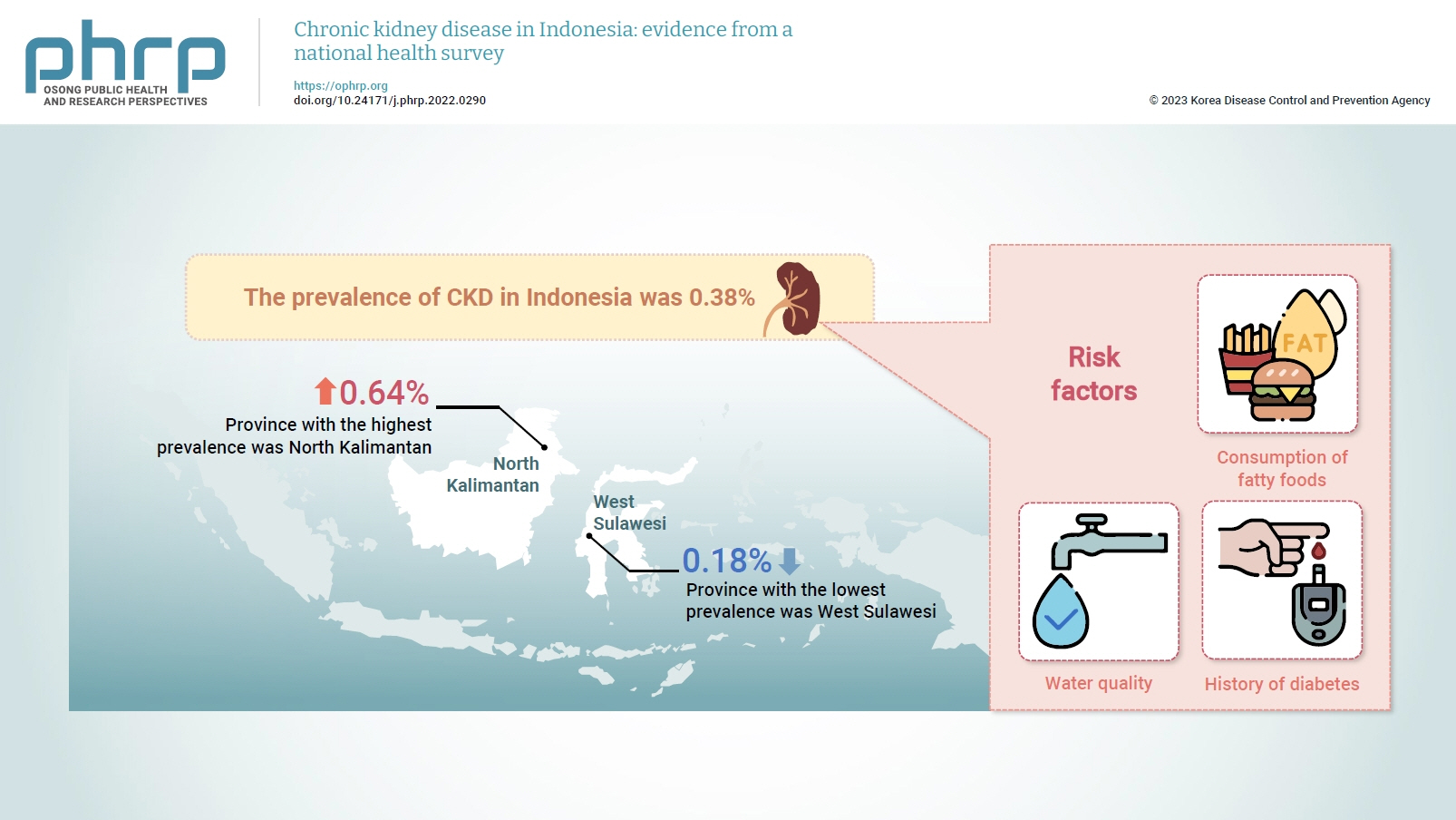
Objectives Several previous studies have stated that consuming certain foods and beverages might increase the risk of chronic kidney disease (CKD). This study aimed to examine the relationships of food and beverage consumption with other risk factors for CKD. Methods: Data sources included the 2018 Basic Health Research (Riskesdas) and the National Socio-Economic Survey (Susenas), which were analyzed using a cross-sectional design. The study samples were households from 34 provinces in Indonesia, and the analysis was performed with provincial aggregates. Data were analyzed using risk factor analysis followed by linear regression to identify relationships with CKD. Results: The prevalence of CKD in Indonesia was 0.38%. The province with the highest prevalence was North Kalimantan (0.64%), while the lowest was found in West Sulawesi (0.18%). Five major groups were formed from 15 identified risk factors using factor analysis. A linear regression model presented 1 significant selected factor (p=0.006, R2 =31%). The final model of risk factors included water quality, consumption of fatty foods, and a history of diabetes. Conclusion: Drinking water quality, fatty food consumption, and diabetes are associated with CKD. There is a need to monitor drinking water, as well as to promote health education and provide comprehensive services for people with diabetes, to prevent CKD.
Citations
Citations to this article as recorded by
Syndemic analysis of stroke in Indonesia Andi Alfian Zainuddin, Rais Reskiawan A. Kadir, Nurul Qalby, Hedi Kuswanto, Andi Afdal Abdullah, Takuro Furusawa, Haerani Rasyid, Irawan Yusuf The Lancet Regional Health - Western Pacific.2026; 69: 101849. CrossRef
Integrating Spirituality and Self-Transcendence in Chronic Kidney Disease Management: A Structural Equation Modeling Approach Siti Nurkholifah, Yurika Fauzia Wardhani, Minarti Minarti, Asep Hermawan, Eka Denis Machfutra, Doni Lasut Journal of Holistic Nursing.2026;[Epub] CrossRef
Clinical characteristics, medication use, and mortality outcomes in pediatric chronic kidney disease: A retrospective study at national hospital in Jakarta Aprilita Rina Yanti Eff, Selvia Yuliana, Nadiya Nurul Afifah, Ade Heryana Journal of Advanced Pharmaceutical Technology & Re.2026; 17(2): 108. CrossRef
Illness Perception and Social Support in Self-management Behavior of Older Adults with Chronic Diseases in Indonesia: A Cross-sectional Study Ira Suarilah, Joni Haryanto, Febi Fadilah Wanda Sari Zain, Intan Rismatul Azizah, Retno Indarwati, Dianis Wulan Sari Ageing International.2026;[Epub] CrossRef
Mixed Matrix Membrane Based on Cellulose Acetate and Activated Carbon from Plastic Waste for Urea Removal in Spent Dialysate Saiful Saiful, Mirzalisa Mirzalisa, Muliadi Ramli, Mutia Farida Jurnal Rekayasa Kimia & Lingkungan.2026; 21(1): 11. CrossRef
Enhanced detection of albumin-creatinine ratio in urine using gold nanoparticle-integrated 3D-connector microfluidic paper-based analytical devices for early diagnosis of chronic kidney disease Akhmad Sabarudin, Saidun Fiddaroini, Ahmad Luthfi Fahmi, Abdul Munir Roja’i, Isadora Evani Salsabila, Aulanni’am, Setyawan Purnomo Sakti, Hani Susianti Microchemical Journal.2025; 211: 113071. CrossRef
The Effect of Intravenous Oxyhydrogen Nanobubble on Chronic Kidney Disease: Case Series Olly Indrajani, Aditya T. Hernowo, Christyanita P. Ekasari, Ricki Yudhanata, Sutiman B. Sumitro Clinical Therapeutics.2025; 47(9): e13. CrossRef
Association between low-carbohydrate diet and chronic kidney disease in population with gestational diabetes mellitus history: based on the National Health and Nutrition Examination Survey database Junli Zhang, Youlian Dong Food & Nutrition Research.2025;[Epub] CrossRef
Hubungan Lama Hemodialisa dengan Kualitas Hidup Pasien Chronic Kidney Disease yang Menjalani Hemodialisa di Rumah Sakit TK II Kadek Dheana Novitayani W, Ni Putu Dita Wulandari, I Made Dwie Pradnya Susila, I Nyoman Sutresna Journal Center of Research Publication in Midwifer.2025; 9(2): 85. CrossRef
<sec>
<title>Objectives</title>
<p>This study aimed to identify differences in drinking norms, heavy drinking, and motives between types of drinkers (abstainers, solitary, and social drinkers) in a representative sample of Korean adults.</p></sec>
<sec>
<title>Methods</title>
<p>An online survey of people registered on the electoral roll were randomly invited to be part of the “National Korean Drinking Culture Study” conducted in 2018 (<italic>n</italic> = 3,015). Participants included 1,532 men and 1,469 women aged 19–60 years. Questions included the number of times they drank in the last month, what they drank, and the volume drank. The amount of pure alcohol consumed was calculated. Drinking norms, motives, and types were determined in the survey questions.</p></sec>
<sec>
<title>Results</title>
<p>Solitary drinkers were more likely to be divorced or separated, less educated, and marginally employed. Solitary drinking peaked in those in their 30s (18.5%) and social drinkers in their 50s (68.1%). Solitary drinkers drank more frequently compared with social drinkers (6.1 vs. 3.6 times per month, <italic>p</italic> < 0.001), and consumed a significantly larger quantity of alcohol (69.5 g vs. 46.8 g per week). Solitary drinkers were more accepting of drinking-related behaviors in diverse situations compared with social drinkers. The regression analysis revealed that personal drinking motives were the most important factor influencing the frequency and quantity of alcohol consumption in both solitary and social drinking.</p></sec>
<sec>
<title>Conclusion</title>
<p>Solitary drinkers may be more vulnerable to alcohol abuse than social drinkers.</p></sec>
Citations
Citations to this article as recorded by
Childhood Circumstances and Alcohol Consumption in Portuguese People Aged 50 and Over: An Analysis of the “Survey of Health, Ageing and Retirement in Europe” Project Carolina Martins Machado, Pedro Aguiar Acta Médica Portuguesa.2026; 39(3): 178. CrossRef
Reciprocal longitudinal relationship between depressive symptoms and problematic alcohol use: a random intercept cross-lagged panel model including a nationwide sample of Korean adults Seong-Uk Baek, Jin-Ha Yoon European Archives of Psychiatry and Clinical Neuro.2026; 276(5): 2207. CrossRef
Analysis of the Association between Health Literacy and Health Behaviors in Korean Adults Seongmin JEONG, Gee Youn SONG Korean Journal of Health Promotion.2026; 26(2): 56. CrossRef
Modeling clustered count data using mixed effect discrete Weibull regression model with cubic splines Hanna Yoo Communications in Statistics - Simulation and Comp.2025; 54(7): 2710. CrossRef
Impact of binge drinking on alcoholic liver disease Jisoo Kang, Seol Hee Park, Mushira Khanam, Seo Bhin Park, Sumin Shin, Wonhyo Seo Archives of Pharmacal Research.2025;[Epub] CrossRef
Age at first drink as a predictor of all-cause mortality of middle-aged Koreans Horim A Hwang, Dong Jun Kim, Seongju Kim, Hooyeon Lee International Journal of Epidemiology.2025;[Epub] CrossRef
Hypertriglyceridemic waist phenotype in relation to diabetes mellitus and cardiovascular diseases in the Indonesian and Korean populations: evidence from two national surveys Fathimah S. Sigit, Sinyoung Cho, Farid Kurniawan, Hye-Ryeong Jeon, Ratu Ayu Dewi Sartika, Dicky L. Tahapary, Hyuktae Kwon Diabetology & Metabolic Syndrome.2025;[Epub] CrossRef
Combined Effect of Alcohol Consumption Patterns and Marital Status on All-cause Mortality Among Middle- and Old-aged People: A Longitudinal Study From Korea Yoonjung Ji, Wonhee Baek, Suran Lee Asian Nursing Research.2024; 18(4): 377. CrossRef
Social Isolation Mediates the Effects of Negative Emotionality and Resilience on Drinking to Cope and Drinking Alone Chris Segrin, Jian Jiao, R. Amanda Cooper Substance Use & Misuse.2024; 59(13): 1860. CrossRef
Drinking as Leisure Activity among Working-Age Men Minhye Kim Journal of Social Science.2023; 34(1): 243. CrossRef
Development and Validation of a Questionnaire for Assessing Drug Use Motives in the General Population in South Korea Joon-Yong Yang, Minhye Kim, Aeree Sohn Healthcare.2023; 12(1): 86. CrossRef
Do Drinking Norms, Motives, and Drinking Behaviors Differ by Age Group among Korean Women? Aeree Sohn, Sarang Jang International Journal of Environmental Research an.2022; 19(6): 3345. CrossRef
Exploring Contributing Factors of Solitary Drinking among Hong Kong Chinese Adolescents and Young Adults: A Descriptive Phenomenology Ka-Yan Ho, Katherine-Ka-Wai Lam, Cynthia-Sau-Ting Wu, Man-Nok Tong, Lai-Ngo Tang, Yim-Wah Mak International Journal of Environmental Research an.2022; 19(14): 8371. CrossRef
<sec>
<title>Objectives</title>
<p>This study aimed to develop a high-risk drinking scorecard using cross-sectional data from the 2014 Korea Community Health Survey.</p></sec>
<sec>
<title>Methods</title>
<p>Data were collected from records for 149,592 subjects who had participated in the Korea Community Health Survey conducted from 2014. The scorecard model was developed using data mining, a scorecard and points to double the odds approach for weighted multiple logistic regression.</p></sec>
<sec>
<title>Results</title>
<p>This study found that there were many major influencing factors for high-risk drinkers which included gender, age, educational level, occupation, whether they received health check-ups, depressive symptoms, over-moderate physical activity, mental stress, smoking status, obese status, and regular breakfast. Men in their thirties to fifties had a high risk of being a drinker and the risks in office workers and sales workers were high. Those individuals who were current smokers had a higher risk of drinking. In the scorecard results, the highest score range was observed for gender, age, educational level, and smoking status, suggesting that these were the most important risk factors.</p></sec>
<sec>
<title>Conclusion</title>
<p>A credit risk scorecard system can be applied to quantify the scoring method, not only to help the medical service provider to understand the meaning, but also to help the general public to understand the danger of high-risk drinking more easily.</p></sec>
Citations
Citations to this article as recorded by
Risk score models for urinary tract infection hospitalization Nasrin Alizadeh, Kimia Vahdat, Sara Shashaani, Julie L. Swann, Osman Y. Özaltιn, Guillermo Pineda Villavicencio PLOS ONE.2024; 19(6): e0290215. CrossRef
Risk factors of passive suicidal ideation among outpatients in traditional medicine clinics: The case of Korean medicine in South Korea Ilsu Park, Tae-Hyeon Lee, Chan-Young Kwon Heliyon.2024; 10(17): e37181. CrossRef
A Study on ML-Based Sleep Score Model Using Lifelog Data Jiyong Kim, Minseo Park Applied Sciences.2023; 13(2): 1043. CrossRef
A Simple-to-Use Score for Identifying Individuals at High Risk of Denosumab-Associated Hypocalcemia in Postmenopausal Osteoporosis: A Real-World Cohort Study Kyoung Jin Kim, Namki Hong, Seunghyun Lee, Miryung Kim, Yumie Rhee Calcified Tissue International.2020; 107(6): 567. CrossRef
<sec><title>Objectives</title><p>This study was conducted to compare adolescents’ health behaviors and psychological status according to whether or not their mother was born in Korea.</p></sec><sec><title>Methods</title><p>This secondary analysis used nationally representative data from the 2015 Korean Youth Risk Behavior Web-based Survey. The self-administered questionnaire included computer measured socio-demographic variables, 15 health behaviors, and psychological status. Data from 65,426 middle school and high school students were analyzed. Multiple logistic regression, adjusting for socio-demographic variables, was used to analyze differences in health behaviors and psychological status between adolescents with a foreign-born mother and those with a Korean mother.</p></sec><sec><title>Results</title><p>Adolescents who have foreign-born mothers had a lower level of current drinking and subjective happiness, but a higher stress level.</p></sec><sec><title>Conclusion</title><p>The stress levels of the adolescents with foreign-born mothers could be affected by their multicultural background. It is necessary to analyze stress-influencing factors of multicultural adolescents by comparing them to adolescents from Korean parents. Additionally, our society should pay more attention to the mental health of multicultural adolescents. Schools should also make various efforts to protect multicultural adolescents by adopting mental health management programs led by school nurses and counselors.</p></sec>
Citations
Citations to this article as recorded by
Measuring Happiness in Adolescent Samples: A Systematic Review Justė Lukoševičiūtė, Gita Argustaitė-Zailskienė, Kastytis Šmigelskas Children.2022; 9(2): 227. CrossRef
Factors Related to Depressive Symptoms Among Multicultural Adolescents in Korea Kyoung Hwa Joung, Sung Suk Chung The Journal of School Nursing.2022; 38(2): 138. CrossRef
<i>Damunwha</i> in South Korea: A Case Study of Divergences in Cognition and Behavior Peter Frost Advances in Anthropology.2021; 11(02): 153. CrossRef
The Mental Health of Ethnic Minority Youths in South Korea and Its Related Environmental Factors: A Literature Review Yeeun Lee, Minji Lee, Subin Park Journal of the Korean Academy of Child and Adolesc.2019; 30(3): 88. CrossRef
Adolescents in Multi-Ethnic Families under Korean Ethnic Nationalism Hae-Wol Cho, Chaeshin Chu Osong Public Health and Research Perspectives.2017; 8(6): 367. CrossRef
Objectives
The aim of this study was to identify the correlation between adequate water intake and the prevalence of metabolic/heart diseases. Methods
We analyzed the data from the 2012 Korea National Health and Nutrition Examination Survey. All participants were divided into Group Above Adequate Intake (<i>n</i> = 736) and Group Below Adequate Intake (<i>n</i> = 4,819) according to water intake. The thresholds were 1.8 L for men and 1.4 L for women based on the World Health Organization report findings. Logistic regression analyses were performed to verify the correlation between water intake and prevalence of hypertension, diabetes mellitus, dyslipidemia, myocardial infarction, and angina pectoris. Results
There were significant differences between the two groups in terms of the following variables: age, smoking, alcohol, stress, dietary supplements, body weight, physical activity, total calorie intake, water intakes from food, and sodium intake. Participants in Group Above Adequate Intake showed a higher prevalence of hypertension [odds ratio (OR) = 1.22; 95% confidence interval (CI), 0.58–2.55], diabetes mellitus (OR = 1.38; 95% CI, 0.51–3.73), angina pectoris (OR = 0.94; 95% CI, 0.47–1.86), and myocardial infarction (OR = 5.36; 95% CI, 0.67–43.20) than those in Group Below Adequate Intake, whereas the latter showed a slightly higher prevalence of dyslipidemia (OR = 2.25; 95% CI, 0.88–57.84) than the former. Conclusion
There was no statistically significant association between water intake and any of the metabolic/heart diseases. However, further studies on water intake are needed to confirm our findings.
Citations
Citations to this article as recorded by
Association between water intake and abdominal obesity: the Korea National Health and Nutrition Examination Survey 2019–2021 Yun-Ji Kim, Si Nae Oh, Eun-Kyung Kong, Eun-Seong Seon Korean Journal of Family Medicine.2025; 46(4): 270. CrossRef
Sex differences in the associations of water, coffee and tea consumption with cardiovascular diseases: a prospective cohort study Dandan Ke, Yueqing Wang, Yabing Hou, Weihao Shao, Jiawen Ke, Xiaoxuan Zhang, Hongxi Yang, Zhong He, Zuolin Lu Frontiers in Nutrition.2025;[Epub] CrossRef
Carbonated Beverage, Fruit Drink, and Water Consumption and Risk of Acute Stroke: the INTERSTROKE Case-Control Study Andrew Smyth, Graeme J. Hankey, Albertino Damasceno, Helle Klingenberg Iversen, Shahram Oveisgharan, Fawaz Alhussain, Peter Langhorne, Dennis Xavier, Patricio Lopez Jaramillo, Aytekin Oguz, Clodagh McDermott, Anna Czlonkowska, Fernando Lanas, Danuta Rygle Journal of Stroke.2024; 26(3): 391. CrossRef
Low daily water intake profile—is it a contributor to disease? Lawrence E Armstrong, Michael F Bergeron, Colleen X Muñoz, Stavros A Kavouras Nutrition and Health.2024; 30(3): 435. CrossRef
Connecting the Dots: Hydration, Micronutrients, and Immunity Agam Vora, Sanjay Kalra, Priti Thakor, Harshad Malve, Vijay Chamle, Amol Patil Journal of the Association of Physicians of India.2024; 72(6): 25. CrossRef
Water intake and risk of type 2 diabetes: A systematic review and meta-analysis of observational studies Nasim Janbozorgi, Ramesh Allipour, Kurosh Djafarian, Sakineh Shab-Bidar, Mostafa Badeli, Maryam Safabakhsh Diabetes & Metabolic Syndrome: Clinical Research &.2021; 15(4): 102156. CrossRef
Changes in feed consumption and water intake among broiler chickens subjected to melatonin treatment during the hot-dry season Victor Olusegun Sinkalu, Joseph Olusegun Ayo, Joseph Olajide Hambolu, Alexander Babatunde Adelaiye, Friday Ocheja Zakari, Tagang Aluwong Tropical Animal Health and Production.2020; 52(2): 717. CrossRef
Evaluation of Dietary Habit and Nutritional Intake of Korean Elderly: Data from Korea National Health and Nutrition Examination Survey 2013∼2015 Gyusang Han, Eunju Yang Journal of the East Asian Society of Dietary Life.2018; 28(4): 258. CrossRef
Water intake from foods and beverages and risk of mortality from CVD: the Japan Collaborative Cohort (JACC) Study Renzhe Cui, Hiroyasu Iso, Ehab S Eshak, Koutatsu Maruyama, Akiko Tamakoshi Public Health Nutrition.2018; 21(16): 3011. CrossRef
Objectives
This study was conducted in order to determine any correlation between experience of harmful shops and adolescent smoking and alcohol drinking in middle and high school students. Methods
The survey was conducted using a self-administered questionnaire online via the homepage of the Ministry of Education student Health Information Center; 1888 and 1563 questionnaires were used for middle and high school students, respectively, for a total of 3451 questionnaires in the final analysis. The collected data were processed using SPSS version 21.0 and examined using frequency analysis and hierarchical linear regression. Results
In this research, 8.3% of all participants were found to have experienced smoking and 17.0% alcohol drinking. Regarding the types of harmful shops, 81.8% said they had been to a gaming place; 21.2% to a lodging place; 16.0% to a sex and entertainment place; and 6.8% to a harmful sex industry location. Sociodemographic variables had a significant effect on adolescent smoking and alcohol drinking. Regarding environmental variables, a significant difference was observed for living with parents and school location. Among adolescent experience of harmful shops, both smoking and alcohol drinking showed a significant association with harmful sex industry locations. Conclusion
National government-level management and supervision on this issue will be necessary to prevent adolescent access to harmful shops, along with more studies exploring methods for implementation of policies with more systematic control of harmful shops.
Citations
Citations to this article as recorded by
Relationship between menopausal status and suicidal behavior among the Korean population Jeongmin Son, Wanhyung Lee Maturitas.2025; 195: 108221. CrossRef
Evaluation of Individual and Community Factors Affecting Adolescents’ Mental Health: A Longitudinal Multilevel Analysis Bohye Lee, Myungsuk Choi, Mankyu Choi Applied Research in Quality of Life.2021; 16(3): 1187. CrossRef
Prevalence and Extrinsic Risk Factors for Dental Erosion in Adolescents Ana C Mafla, Ximena A Cerón-Bastidas, Maria E Munoz-Ceballos, Diana C Vallejo-Bravo, Maria C Fajardo-Santacruz Journal of Clinical Pediatric Dentistry.2017; 41(2): 102. CrossRef
Trend of Suicide Rates According to Urbanity among Adolescents by Gender and Suicide Method in Korea, 1997–2012 Kyung-Hwa Choi, Dong-Hyun Kim International Journal of Environmental Research an.2015; 12(5): 5129. CrossRef
The awareness of "School Environmental Sanitation and Cleanup Zone System" and harmful perception by shops among students, teachers and parents in Korea Aeree Sohn Korean Journal of Health Education and Promotion.2015; 32(5): 83. CrossRef
Substance Use and Sexual Behaviors of Adolescents in Multicultural Families in Korea Subin Park Psychiatry Investigation.2015; 12(4): 466. CrossRef
Health-related quality of life assessment according to socio-demographic characteristics and health behavior among Gyeonggi-do citizens: focused on gender difference Sun-Hee Joung, YeogSeon Hong, AeRee Sohn Korean Journal of Health Education and Promotion.2015; 32(3): 33. CrossRef
A Period of Storm and Stress Hae-Wol Cho, Chaeshin Chu Osong Public Health and Research Perspectives.2014; 5(3): 117. CrossRef
Characterizing Patterns of Experience of Harmful Shops among Adolescents Using Decision Tree Models Aeree Sohn Korean Journal of Health Education and Promotion.2014; 31(3): 15. CrossRef
Objectives
The aim of this study was to identify how the drinking patterns of a generation on the paternal side affect those of the next generations by estimating the number of high-risk drinkers by generation according to the Alcohol Use Disorder Identification Test. Methods
Data were selected from the 2009 Korea National Health and Nutrition Examination Survey conducted by the Korea Centers for Disease Control and Prevention and were analyzed using SPSS 18.0. Results
Later generations started drinking earlier (62.4%, 71.8% and 91.1%, respectively). The majority of the second generation consumed more than 2–4 drinks a month (83.7%), but only a small proportion experienced difficulty in everyday life (9.6%), felt repentance (9.6%), or experienced memory loss (17.9%) after drinking. Unmarried third-generation adults with high-risk-drinking fathers reported more frequent alcohol consumption [odds ratio (OR) 1.441), greater amounts on one occasion (>7 cups for men, OR 1.661; > 5 cups for women, OR 2.078), temperance failure (OR 2.377), and repentance after drinking (OR 1.577). Unmarried third-generation adults with high-risk-drinking grandfathers consumed greater amounts of alcohol on one occasion (OR 3.642), and unmarried third-generation women more frequently consumed large amounts of alcohol (>5 cups, OR 4.091). Unmarried third-generation adults with high-risk-drinking fathers were more likely to exhibit high-risk drinking patterns (OR 1.608). Second-generation individuals from a high-risk-drinking first generation were more likely to engage in high-risk drinking (OR 3.705). Conclusion
High-risk drinking by a generation significantly affects the high-risk drinking patterns of subsequent generations.
Citations
Citations to this article as recorded by
Age at onset of alcohol consumption and its association with alcohol misuse in adulthood Soo Y. Kim, Sung H. Jeong, Eun‐Cheol Park Neuropsychopharmacology Reports.2023; 43(1): 40. CrossRef
Alcohol consumption frequency or alcohol intake per drinking session: Which has a larger impact on the metabolic syndrome and its components? Sarah Soyeon Oh, Woorim Kim, Kyu-Tae Han, Eun-Cheol Park, Sung-In Jang Alcohol.2018; 71: 15. CrossRef



 First
 Prev


