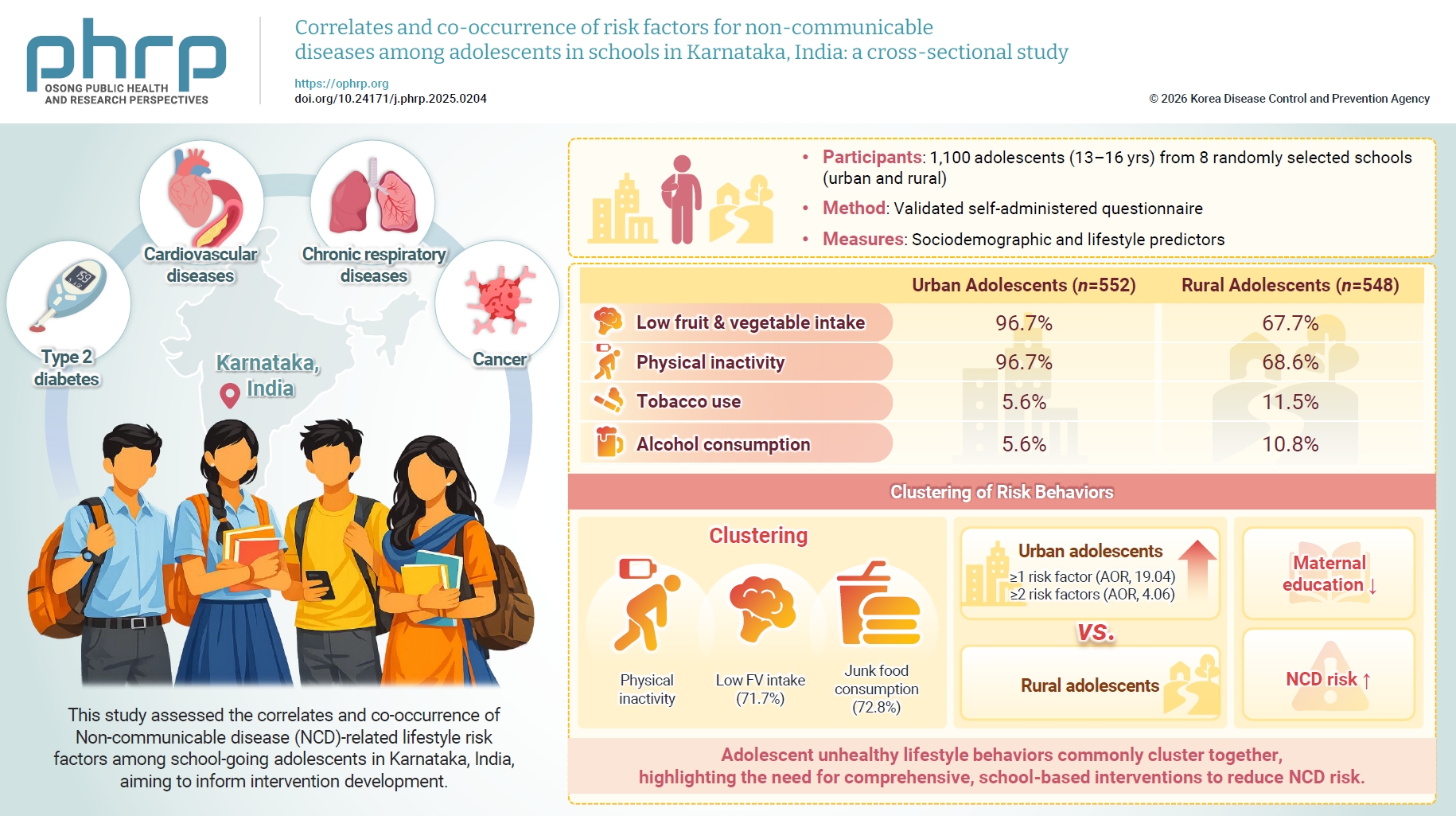
Objectives Non-communicable disease (NCD) risk among adolescents represents a growing concern due to modifiable, lifestyle-related behavioral risk factors. Early identification and control of these factors are essential for prevention. This study assessed the correlates and cooccurrence of NCD-related lifestyle risk factors among school-going adolescents in Karnataka, India, aiming to inform intervention development. Methods: Screening was conducted among 1,100 school adolescents aged 13–16 years from 8 randomly selected urban and rural schools in Karnataka. Data were collected using a validated self-administered questionnaire covering sociodemographic characteristics and social cognitive theory predictors of lifestyle practices. Descriptive statistics, chi-square tests, and logistic regression were employed. Results: Of the 1,100 adolescents surveyed, 552 and 548 were from urban and rural areas, respectively. Both groups reported high rates of insufficient fruit and vegetable (FV) intake (96.7% and 67.7%, respectively), inadequate physical activity (96.7% and 68.6%), tobacco use (5.6% and 11.5%), and alcohol consumption (5.6% and 10.8%). On logistic regression, urban adolescents were significantly more likely than rural peers to exhibit multiple behavioral risk factors, with 19-fold higher odds of having ≥1 factor (adjusted odds ratio [AOR], 19.04; p< 0.001) and 4-fold higher odds of having ≥2 (AOR, 4.06; p < 0.001). Parental (particularly maternal) education was associated with NCD risk (AOR, 1.82; p= 0.001). Physical inactivity significantly co-occurred with low FV intake (71.7%) and junk food consumption (72.8%). Conclusion: Unhealthy lifestyle behaviors among adolescents displayed significant cooccurrence, underscoring the critical need for comprehensive, theory-based school interventions to address multiple interconnected risk factors and mitigate the burden of NCDs.
Objectives
This study investigated suicidal ideation and its correlates among juvenile delinquents in South Korea. Methods
Suicidal ideation, psychological health status, and health-related behaviors were assessed using a self-administered questionnaire in 1682 juvenile offenders aged between 15 and 18 years in 2012. Results
The prevalence of suicidal ideation in juvenile delinquents was 15.2%. Girls were more likely to report suicidal thoughts than boys (30.3% vs. 12.7%). Suicidal ideation was more common among adolescents who were not living with their family prior to entering detention centers (22.6% vs. 13.2%) than their counterparts. The likelihood of suicidal ideation was significantly associated with problem drinking [odds ratio (OR) = 1.84], psychedelic drug use (OR = 2.04), feeling unhappy (OR = 3.05), feeling sad or depressed (OR = 13.37) after controlling for sociodemographic factors, other health behaviors and perceptions. Conclusion
The present study provides evidence for an association between suicidal ideation and psychological health and health risk behaviors among juvenile delinquents. It also highlights the importance of mental health and behavioral interventions for this population to prevent suicidality.
Citations
Citations to this article as recorded by
From judicial compliance to social inclusion: A systematic review of the effects of sport in juvenile justice Ekaitz Irujo-Compains, Javier Encina-Morentin, Belén Gutiérrez-de-Rozas Children and Youth Services Review.2026; 187: 109056. CrossRef
Public discourse on substance use behavior as a driver of public policy: a scoping review of South Korean academic and official literature Meekang Sung, Jihye Han, Carrie G. Wade, Vaughan W. Rees Addiction Research & Theory.2025; 33(4): 312. CrossRef
Spectrum and predictors of suicidal risk among incarcerated youth in a correctional facility in Kaduna, Northern Nigeria Marufah Dupe Lasisi, Folorunsho Tajudeen Nuhu, Femi Adebayo, Edwin Ehi Eseigbe, Taiwo Lateef Sheikh Vulnerable Children and Youth Studies.2022; 17(2): 147. CrossRef
Association between sleep insufficient type and suicidal ideation among Korean middle and high school student Soojeong Kim, Jin A Han, Eun-Ji Kim, Soon Young Lee Korean Journal of Health Education and Promotion.2021; 38(2): 15. CrossRef
Factors affecting health risk behaviors, suicidal ideation, suicidal plans and suicidal attempts in adolescents Min Kyung Kim, Kyoung Won Cho Korean Journal of Health Education and Promotion.2019; 36(3): 61. CrossRef
Psychiatric Disorders and Recidivism among Korean Adolescents on Probation or Parole Yooli Lim, Eun-Jin Park, Bongseog Kim Psychiatry Investigation.2018; 15(6): 561. CrossRef
Biopsychosocial Causes of Suicide and Suicide Prevention Outcome Studies in Juvenile Detention Facilities: A Review Kshamta Joshi, Stephen Bates Billick Psychiatric Quarterly.2017; 88(1): 141. CrossRef



 First
 Prev


