Abstract
-
Objectives
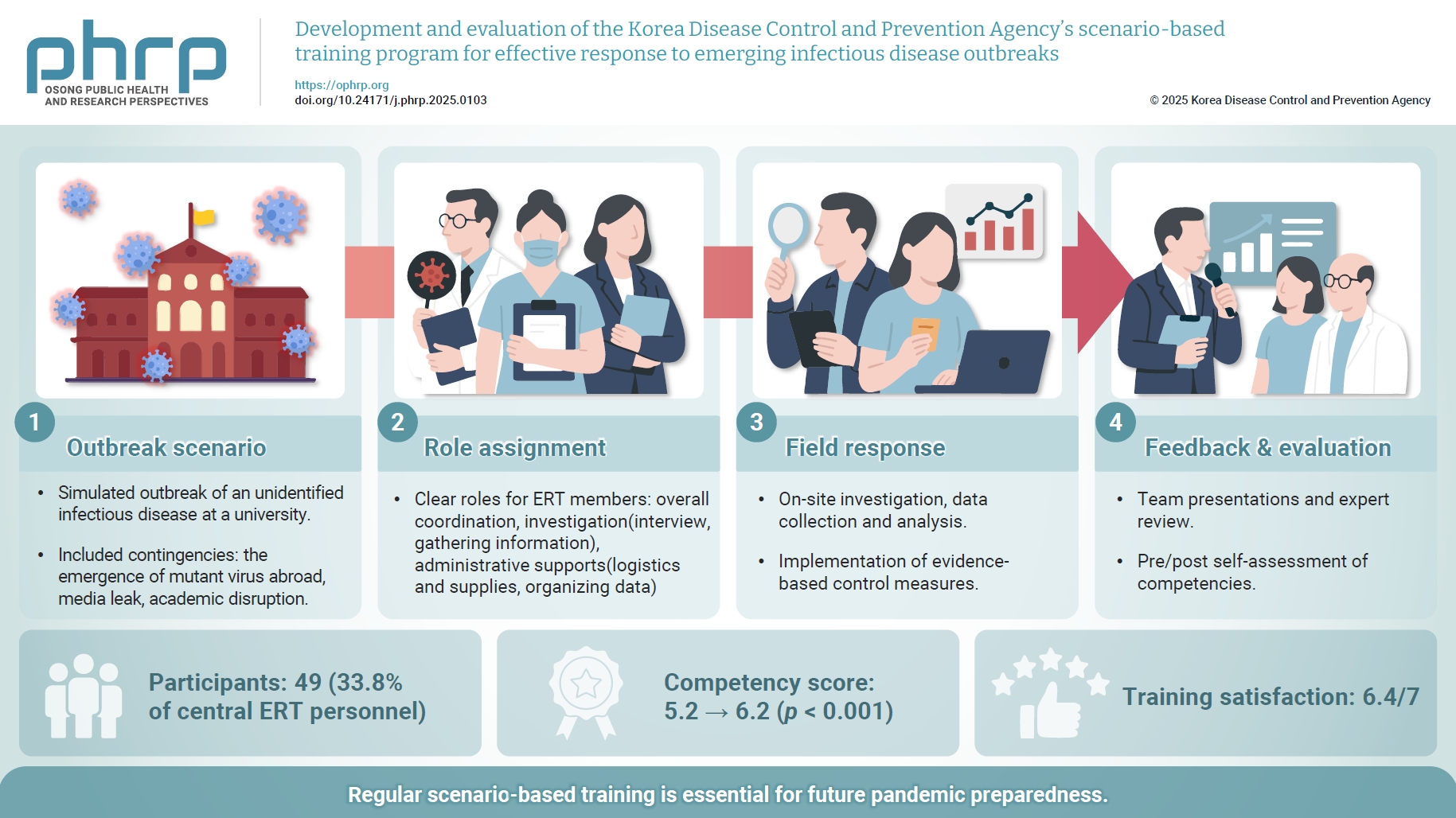
This study aimed to strengthen the core capabilities of epidemiological investigation and response teams (ERTs) at the Korea Disease Control and Prevention Agency, drawing on lessons learned from the Middle East respiratory syndrome and coronavirus disease 2019 pandemics. The primary objectives were to facilitate rapid and accurate data collection and analysis, improve communication skills, and simulate real-world on-site responses.
-
Methods
The training program was developed using a scenario involving a novel infectious disease from the World Health Organization priority list entering a community. ERTs collected and analyzed epidemiological data and implemented control measures as they addressed the missions of the scenario. Improvement in competencies was assessed through self-evaluation surveys completed before and after training.
-
Results
A total of 49 participants, including disease control officers, epidemiological investigation officers, researchers, and administrative officials, attended the training. Participant satisfaction with the training was high, scoring 6.4 out of 7, and the improvement in competency was statistically significant (pre-training score, 5.2; post-training score, 6.2; p<0.001).
-
Conclusion
Scenario-based training can effectively enhance the capabilities of ERTs. Such training is essential, as emerging and re-emerging infectious diseases can exhibit unpredictable spread and potentially severe impacts. Therefore, developing diverse scenarios and conducting regular training sessions are necessary to improve the capacities of ERTs.
-
Keywords: Disease; Epidemiology; Investigation; Outbreak response; Training; Unknown
Introduction
The expansion of cross-border trade and increased international travel have facilitated the spread of infectious diseases across national borders, increasing the risk of a global pandemic. Infectious disease pandemics impose heavy burdens on healthcare systems and have substantial social and economic impacts. In particular, the coronavirus disease 2019 (COVID-19) pandemic has caused millions of deaths globally and overwhelmed healthcare systems, underscoring the urgent need to strengthen the capacities of health authorities and healthcare organizations to effectively combat infectious diseases [
1,
2].
Significant past pandemics and outbreaks, including severe acute respiratory syndrome (2003), H1N1 influenza (2009), Zika virus infection (2014), Middle East respiratory syndrome (2015), COVID-19 (2020), and Mpox (2022, previously known as monkeypox), have exerted substantial socioeconomic effects. The frequency and scale of such epidemics have increased, and infectious disease specialists warn of a high likelihood of another global pandemic in the near future [
3–
5].
The increasingly frequent occurrence and significant impacts of infectious disease outbreaks have highlighted the necessity of on-site response training for emerging, re-emerging, and unidentified diseases. Unidentified infectious diseases pose challenges due to initial diagnostic difficulties and uncertainties regarding transmission and infection mechanisms, complicating prompt responses by health authorities [
6,
7]. In Korea, trainings and drills are regularly held for public officials to respond to emerging and re-emerging infectious diseases. However, the field capabilities of personnel directly involved in epidemiological investigations require improvement [
8]. Epidemiological investigation and response teams (ERTs), critical to managing disease crises, must swiftly reach outbreak sites and implement effective control measures. However, due to limited practical experience, such as in patient interviews and associated epidemiological data collection, rigorous scenario-based training is essential to hone their response skills. Therefore, this study aimed to develop a training scenario for responding to an unknown infectious disease outbreak and to evaluate its effectiveness in improving the practical skills of response personnel. Recognizing the critical role of ERTs in mitigating harm and controlling outbreaks, especially of emerging diseases, the Korea Disease Control and Prevention Agency (KDCA) has analyzed various domestic and international situations. Accordingly, the agency has developed scenarios to practice implementing preventive measures and integrated these into its training program [
9]. These scenarios are designed to simulate real-world situations, requiring trainees to navigate a wide range of variables and uncertainties. In the present study, after the training was administered, a self-evaluation was used to assess participants’ changes in awareness and response capabilities. Based on the results, this study aimed to identify areas for future improvement of outbreak response training.
Materials and Methods
Exercise Framework
The purpose of this exercise was to enhance the capacity of ERTs to effectively respond to infectious disease outbreaks in the field. Specifically, the training was designed to familiarize each ERT member with their roles and responsibilities when deployed for field epidemiological investigations and responses, develop their skills regarding information gathering and data collection (e.g., interviewing), familiarize them with response procedures, train them in implementing evidence-based control measures to curb the spread of infection, and strengthen their communication and teamwork skills.
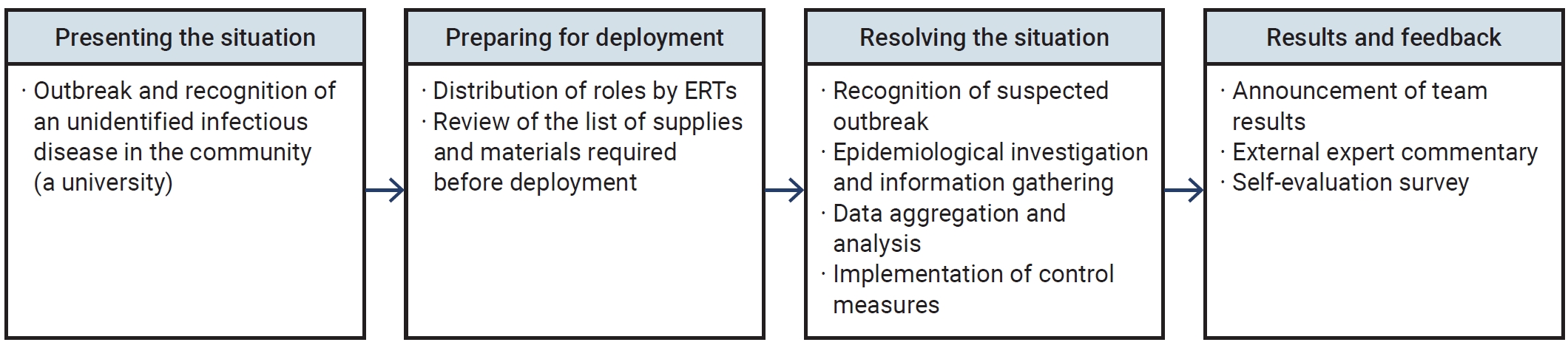
The training lasted 7 hours and was conducted in a hands-on format, utilizing hypothetical scenarios that closely mirrored real-world field situations. It covered the entire process, from pre-deployment to the implementation of disease control measures. Each participant was assigned a specific role and actively engaged in resolving scenario-based missions. After the training, outcomes from each team were presented and evaluated by external experts. At the end of the session, a self-evaluation survey was administered (
Figure 1).
Participants
The ERTs consisted of 145 public officials, including epidemiological investigation officers (EIOs) and administrative officials (as of July 24, 2024). A total of 49 participants (33.8% of the ERT personnel) attended this training. The trainees were divided into 6 teams, each with 7 to 8 members.
Materials
Exercise scenario
The scenarios in the exercise were developed internally to simulate a localized outbreak of an unidentified infectious disease. These scenarios covered the entire field-based information collection process, including data compilation and analysis, as well as the implementation of on-site control measures. The exercise was divided into a pre-deployment and a post-deployment mission, with 3 contingencies assigned during the second mission. The scenario involved an outbreak of an unidentified infectious disease at a university. Initially, a student developed symptoms including tingling in the hands and a cough, which were not immediately recognized as signs of an infectious disease. However, after a university festival, many more students at the university and its affiliated high school rapidly developed similar symptoms. In response, the KDCA mobilized an ERT to the site. The scenario included 3 contingencies: first, a mutated case of the Hendra virus was detected abroad, prompting the World Health Organization to declare it a serious public health threat; second, a suspected Hendra virus case was reported in Korea and information was leaked from laboratory testing conducted by public health authorities, resulting in unexpected media coverage; and third, the university expressed concerns that the outbreak might disrupt students’ upcoming final exams, both at the university and nationally. Further details of the scenario are provided in
Supplementary Material 1.
Self-evaluation survey for training
An evaluation survey was developed to assess the effectiveness of the training. The survey included 25 items, scored on a 7-point Likert scale (1=strongly disagree, 7=strongly agree), covering training satisfaction, pre-training understanding, and on-site response competencies. The survey tool was developed through internal discussions among the authors, ensuring that the items effectively reflected the extent to which training objectives were achieved. The tool was developed with reference to previous studies, which suggest that using a 7-point Likert scale, rather than a 5-point scale, tends to yield more accurate responses due to reduced central tendency bias. Additionally, the 7-point scale is associated with fewer careless or overly consistent responses, thus increasing the reliability of the assessment.
The items assessing pre-training understanding were intended to evaluate participants’ perceptions of the on-site response team’s role and their competencies in infectious disease response before training. Items related to data collection and assessment measured whether the exercise improved participants’ skills in information gathering and data assessment. Items on field investigation competencies evaluated participants’ understanding of defining investigation cases and conducting contact tracing during a suspected outbreak. Items assessing situation analysis and problem-solving skills measured participants’ abilities to apply evidence-based recommendations for control measures and to identify additional suspected cases. Lastly, items on communication and collaboration evaluated participants’ perceptions of the importance of communicating findings and their experiences collaborating with teammates.
Statistical analysis
Descriptive statistics were calculated for continuous variables, including mean, standard deviation, minimum, and maximum values. Frequencies and percentages were calculated for nominal variables. The difference between pre- and post-test competencies was analyzed using a paired samples t-test. Statistical analysis was performed using jamovi ver. 2.6.24 for Windows (
https://www.jamovi.org/).
Ethics Approval
This study qualifies for exemption from institutional review by the KDCA Institutional Review Board (IRB), in accordance with the agency’s IRB guidelines. The study used publicly available information and did not collect identifiable personal data from participants. It involved no direct manipulation of human participants, nor did it include research on individuals in vulnerable settings.
Results
General Characteristics of Exercise Participants
The mean age of the participants was 41.4 years, with a mean work experience of 4 years and 5 months. Of the participants, 18 (36.7%) were male and 31 (63.3%) were female. Seven were disease control officers (14.3%), 31 were EIOs (63.3%), 8 were public health researchers (16.3%), and 3 were administrative officials (6.1%). Regarding training, 32 participants (66.7%) had completed the Korea Field Epidemiology Training Program, 3 participants (6.3%) were currently enrolled, and for 13 participants (27.1%), the program was either not started or not applicable. For affiliations, 2 participants (4.1%) were from a quarantine station, 15 (30.6%) were from regional disease control centers, and 32 (65.3%) were from KDCA headquarters.
Regarding on-site response experience since January 2023, 23 participants (46.9%) had participated in 1 to 5 field responses, while 12 participants (24.5%) had no field response experience. Concerning prior central ERT training, first-time attendees were the largest group, totaling 20 participants (40.8%), followed by 14 participants (28.6%) with 2 prior training experiences and 9 participants (18.4%) who had attended once previously (
Table 1).
Exercise Task Performance Results
Mission 1: pre-deployment tasks
The first task was to define the scope of the initial field response debriefing. All teams emphasized the importance of collaboration among health officials, schools, and healthcare providers during an outbreak. Additionally, the Health and Environmental Research Institute, a diagnostic testing organization, was involved from the start of the project, highlighting the necessity of active diagnosis.
The second task was to request and collect necessary information prior to the meeting. Each member submitted requests to the healthcare center, university, and healthcare organizations regarding the first suspected cases. This included student enrollment lists for relevant courses, dormitory occupancy data, drug utilization review information, and patient movement data gathered via the KDCA Epidemiological Investigation Support System.
The third task was to organize the roles of the field response teams. Within each team, members were designated to conduct in-person interviews with the index case, healthcare workers, and a school health officer. Interviews with the index case were designed to determine patient movement routes, symptom onset dates, and post-interview control plans. Interviews with healthcare workers were used to verify patient medical records, including symptoms, test results, and diagnoses. They also assessed specimen availability, contacts within the healthcare organization, and protective equipment use among healthcare providers. Interviews with school health staff aimed to identify potential areas of exposure within the school, including lists of students who had contact with the patient, students who shared a dormitory with the patient, visitors to the health room, and shuttle bus users. The team leader coordinated task allocation, liaised with headquarters and relevant agencies, and thoroughly reviewed the investigation findings.
During the field epidemiological interviews, certain participants were tasked with inspecting their preparation lists for field investigation. Many teams listed personal protective equipment and laptops, while others emphasized accurate information gathering by including items such as recorders. Certain teams focused on specimen collection and analysis, incorporating environmental culture containers into their methodologies. Additionally, a few teams considered equipment such as ventilation measurement devices, while others prioritized simpler information-gathering tools.
Mission 2: outbreak control tasks
The first task involved discussing the criteria for identifying suspected cases to investigate, as well as the methodology for reporting any suspected cases or symptoms observed. All teams agreed that cases with observed symptoms and an epidemiological link should meet the selection criteria. Some teams proposed a broader approach, allowing symptomatic individuals and their family members to report directly.
The second task was establishing a framework to prioritize individuals for testing. Typically, individuals exhibiting symptoms and those who had close contact with confirmed cases were prioritized. Some teams prioritized healthcare workers who treated patients or individuals in communal settings such as dormitories, whereas others emphasized symptomatic individuals within schools or the broader community. Several sample collection options were proposed, including the use of negative-pressure rooms in healthcare facilities and the establishment of temporary testing stations at schools and public health centers.
The third task involved discussing control measures related to schools. While most teams concluded that school closures were unnecessary, some recommended closures due to potential community impact. Those favoring school closures advised a closure period of 16 days, considering the incubation period, or up to 18 days post-exposure to prevent additional cases. Additionally, given the widespread fear surrounding the unidentified infectious disease and its potential disruption of academic events like final and national exams, each team considered various alternative strategies. These included separating infected from non-infected students during exams and implementing non–face-to-face educational methods.
The fourth task was focused on identifying key criteria for selecting individuals for isolation or determining whether to implement active or passive surveillance. Given the disease’s high fatality rate and potential for person-to-person transmission, all teams stressed the importance of preventing further spread and reducing the severity of illness. Teams recommended adaptable surveillance intensity, particularly when no clear epidemiological link was evident. Isolation methods for quarantined individuals were chosen based on symptom severity, including inpatient isolation at a healthcare facility or home isolation.
The final task was centered on developing a tracking method to identify additional suspected cases. Teams proposed various surveillance and tracking strategies, such as expanding community surveillance networks, encouraging early reporting via short message service and press releases, strengthening border quarantine measures, and improving risk communication management. Additionally, some teams evaluated the epidemiological correlation between the index case’s overseas travel history and symptom onset, using this information to refine infection prevention strategies.
Self-Evaluation Results for Training
Each item in the self-evaluation survey was rated on a scale from 1 to 7. The mean score for pre-training understanding was 5.2, while the score for pre-training capacity was 4.9. Post-training scores, used to assess improvement in competencies, were as follows: 6.1 for field information gathering and management, 6.1 for field investigation, 6.2 for situation analysis and problem-solving skills, and 6.3 (the highest score) for communication and cooperation. The mean score for training satisfaction was 6.4 (
Table 2).
A comparison between pre-training understanding and post-training competency scores revealed a significant improvement from 5.2±1.4 to 6.2±0.8 (
p<0.001) (
Table 3).
Discussion
Unlike previous ERT exercises, this training closely simulated real field scenarios. Information collected through on-site interviews with the index case, healthcare workers, and school health staff was compiled and analyzed to inform the control measures implemented. Contingencies were developed to provide a framework for anticipating and managing potential challenges in the field. Notably, each interview site was designed to mimic a real-world situation, enabling the team to practice handling difficulties in gathering and addressing field information. Scenario-based training programs like this have become increasingly popular in healthcare education, promoting effectiveness in crisis response preparedness through repeated exposure to realistic scenarios [
10].
This training program was particularly meaningful because it involved not only EIOs but also disease control officers, scientific researchers, laboratory specialists, and administrative officials, thereby strengthening the communication capabilities of the entire organization during a crisis response. As response training is designed to improve preparedness by integrating various organizational components [
11,
12], this program aligns well with the goals of other major training initiatives.
Furthermore, as demonstrated by the ongoing contributions of Field Epidemiology Training Programs to COVID-19 responses and broader global infectious disease control efforts, structured and practice-oriented programs such as scenario-based exercises play a pivotal role in building frontline response capabilities [
13].
Importantly, we confirmed the effectiveness of the training through a comparison of pre-training understanding and post-training competency self-evaluation scores. One limitation of our analysis is that the pre- and post-training evaluations did not consist of identical questions, potentially hindering the direct comparability of the results. However, since both evaluations assessed overall competencies, we believe the comparison remains meaningful.
External experts who observed the entire training program noted that it appeared to closely replicate real-world outbreak responses, incorporating elements such as uncertainty and time constraints in the context of a mutant virus capable of person-to-person transmission. Additionally, they emphasized that responding to an unidentified infectious disease requires careful, rapid, and consistent decision-making, especially when scientific evidence about the emerging disease is limited. The group presentations also provided diverse learning opportunities by allowing teams to share results and insights.
ERTs consist of various professionals, including disease control officers; however, only 31% of disease control officers attended this training. Future training efforts should encourage and increase attendance to ensure a more integrated response across the agency.
Since an efficient response to a disease pandemic crisis requires a well-coordinated system involving multiple ministries [
14], future training programs should also expand to integrate ERTs with other relevant agencies.
The developed scenario has been officially registered as intellectual property with the Korea Copyright Commission (January 14, 2025). Moving forward, efforts will focus on developing diverse training topics and methods, incorporating these into training programs, and integrating them into an ERT scenario bank. The competencies of local governmental ERTs will be enhanced through standardized training based on these developed scenarios.
The KDCA will continue to strengthen response capabilities for infectious disease outbreaks to safeguard public health against future outbreaks caused by unidentified infectious agents. Strengthening preparedness and response mechanisms is essential for effectively managing future public health emergencies.
Conclusion
This training program was found to be highly effective, as it simulated a realistic response environment, enhanced participant competencies, and fostered greater communication and collaboration among disease control officers, EIOs, laboratory scientists, scientific researchers, and public officials. The notable improvement in participants’ self-assessed competency scores from pre- to post-training underscores the program’s success in preparing responders for crisis situations. Future training initiatives should expand to include other relevant ministries and refine scenarios to address emerging threats. Continued development of diverse training topics and scenarios will further strengthen the capabilities of both central and local ERTs, ensuring more effective responses to infectious disease emergencies.
HIGHLIGHTS
• This study aimed to improve the competencies of epidemiological investigation and response teams through scenario-based training, enabling rapid and accurate data collection and analysis.
• The scenario-based training program produced significant improvements in participant competencies, with self-evaluation scores increasing from 5.2 to 6.2 (p<0.001).
• Regular scenario-based training is crucial to effectively prepare for unpredictable infectious disease outbreaks.
Supplementary Material
Article information
Ethics Approval
Not applicable.
Conflicts of Interest
The authors have no conflicts of interest to declare.
Availability of Data
All study-related data are included in the publication or provided as supplementary information.
Authors’ Contributions
Conceptualization: MY, EKK, YK, KK; Formal analysis: MY; Software: JL, JHJ, SK; Supervision: EKK, YK; Validation: YK, SL, MY, EKK; Methodology: MY, YK, EKK, KK, JL, JHJ; Writing–original draft: MY, EKK, YK; Writing–review & editing: all authors. All authors read and approved the final manuscript.
Figure 1.Flowchart of the training process. ERT, epidemiological investigation and response team.
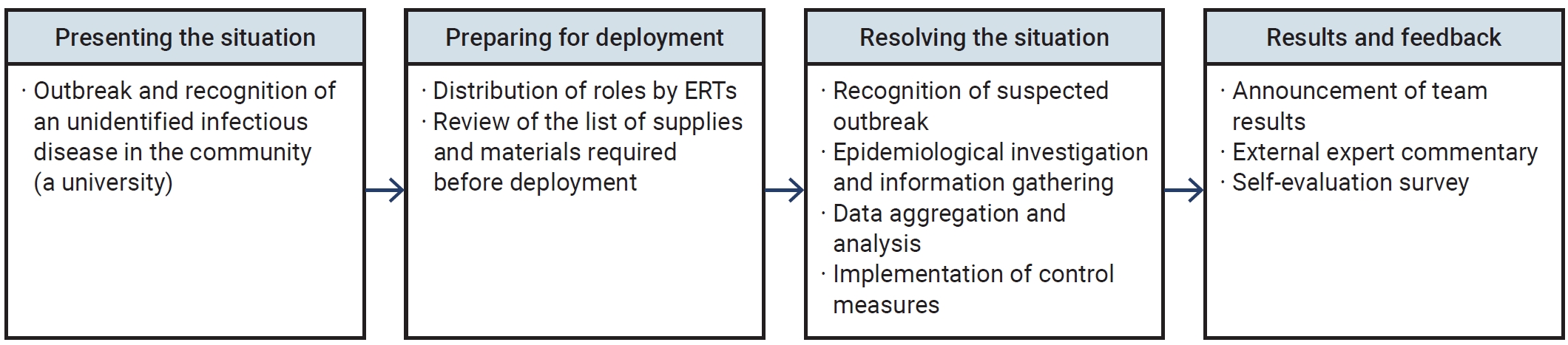
Table 1.General characteristics of training participants (n=49)
Table 1.
| Characteristic |
Value |
| Sex |
|
| Male |
18 (36.7) |
| Female |
31 (63.3) |
| Age (y) |
41.4±7.3 |
| Experience in infection disease control and response (mo) |
53.2±31.9 |
| Position |
|
| Disease control officers |
7 (14.3) |
| EIOs |
31 (63.3) |
| Public health researchers (senior researchers, laboratory scientists, etc.) |
8 (16.3) |
| Administrative and public health officials |
3 (6.1) |
| KFETP course |
|
| Completed |
33 (67.3) |
| In progress |
3 (6.1) |
| Not started or not applicable |
13 (26.5) |
| Affiliation |
|
| KDCA headquarters |
32 (65.3) |
| Regional disease control center |
15 (30.6) |
| Quarantine station |
2 (4.1) |
| No. of on-site response experiences (since January 2023) |
|
| 1–5 |
23 (46.9) |
| 6–10 |
5 (10.2) |
| ≥11 |
9 (18.4) |
| None |
12 (24.5) |
| Participation in previous central ERT training (since 2023) |
|
| None |
20 (40.8) |
| 1 |
9 (18.4) |
| 2 |
14 (28.6) |
| 3 |
6 (12.2) |
Table 2.Results of self-evaluation (7-point scale) (n=49)
Table 2.
|
Mean±SD |
Min–max |
| Pre-training understanding |
5.2±1.4 |
1.5–7 |
| Understanding of the role and mission of field response |
5.5±1.4 |
1–7 |
| Self-capacity of infectious disease field response |
4.9±1.6 |
1–7 |
| Post-training self-evaluation of competencies (1–4) |
6.2±0.8 |
4–7 |
| 1. On-site information gathering and management |
6.1±0.9 |
4–7 |
| Collecting necessary information more effectively than before |
6.1±1.0 |
4–7 |
| Managing collected data more systematically than before |
6.1±0.9 |
4–7 |
| 2. On-site investigation competencies |
6.1±0.9 |
4–7 |
| Understanding the process of case definition and case selection |
6.1±1.1 |
3–7 |
| Understanding and conducting contact investigation and tracing |
6.1±0.9 |
4–7 |
| 3. Situational analysis and problem solving |
6.2±1.0 |
4–7 |
| Evidence-based control measure suggestions |
6.2±0.9 |
4–7 |
| Understanding various methods to identify additional suspected cases |
6.1±1.1 |
3–7 |
| 4. Communication and collaboration competencies |
6.3±0.9 |
4–7 |
| Effectively communicating the results of investigations |
6.3±1.0 |
4–7 |
| Understanding the importance of collaborating effectively with colleagues |
6.4±0.9 |
4–7 |
| Satisfaction with the training |
6.4±0.8 |
4–7 |
| Usefulness of the training to infectious disease outbreak response |
6.2±1.3 |
1–7 |
| Attainment of the training goals |
6.5±0.8 |
4–7 |
| Adequate understanding of the training content |
6.4±0.8 |
4–7 |
| Usefulness of educational materials and method |
6.4±1.0 |
3–7 |
| Seamless provision of guidance and support for the training |
6.5±0.7 |
4–7 |
Table 3.Comparison of competencies between pre- and post-training (paired samples t-test)
Table 3.
|
Pre-training |
Post-training |
p |
| Self-evaluation of competencies |
5.2±1.4 |
6.2±0.8 |
<0.001 |
References
- 1. Chung H, Kim S, Choi H, et al. Trends and changes in social risks following the COVID-19. Korea Institute for Health and Social Affairs; 2023. Korean.
- 2. Gi YH, Ko M. A study on analyzing the results of non-pharmaceutical intervention of COVID-19 and suggesting policy countermeasures applicable to future, infectious disease epidemics. National Evidence-Based Healthcare Collaborating Agency; 2024. Korean.
- 3. Coulson M. Defining disease X [Internet]. Johns Hopkins Bloomberg School of Public Health; 2024 [cited 2024 Feb 15]. Available from: https://publichealth.jhu.edu/2024/what-is-disease-x.
- 4. Alfani G, Murphy TE. Plague and lethal epidemics in the pre-industrial world. J Econ Hist 2017;77:314−43.
- 5. Centers for Disease Control and Prevention (CDC) (US). Outbreaks [Internet]. CDC; 2024 [cited 2024 Feb 15]. Available from: https://www.cdc.gov/outbreaks/index.html.
- 6. Iserson KV. The next pandemic: prepare for “Disease X”. West J Emerg Med 2020;21:756−8.
- 7. World Health Organization (WHO) (CH). Research response to pathogen X during a pandemic [Internet]. WHO; 2024 [cited 2024 Feb 15]. Available from: https://www.who.int/news-room/events/detail/2024/01/19/default-calendar/Research-response-to-pathogen-X-during-a-pandemic.
- 8. Korea Disease Control and Prevention Agency (KDCA) (KR). Internal report, improvement plan for the operation of central and local epidemiological investigation teams. KDCA; 2024.
- 9. World Health Organization (WHO) (CH). WHO R&D roadmaps [Internet]. WHO; 2024 [cited 2024 Feb 15]. Available from: https://www.who.int/observatories/global-observatory-on-health-research-and-development/analyses-and-syntheses/who-r-d-blueprint/who-r-d-roadmaps.
- 10. Baek HJ, Kim YM, Jung SK, et al. Development and pilot applications of simulation-based emergency department crisis management team training program. J Korean Soc Emerg Med 2008;19:603−10.
- 11. Kim IH, Jang JH, Jo SK, et al. 2019 Tabletop exercise for laboratory diagnosis and analyses of unknown disease outbreaks by the Korea Centers for Disease Control and Prevention. Osong Public Health Res Perspect 2020;11:280−5.
- 12. Kim YS, Kim HM, So BH, et al. Experience of the simulation based hospital disaster preparation training program by the polls of before and after training program. J Korean Soc Emerg Med 2016;27:618−32.
- 13. Bell E, Mittendorf C, Meyer E, et al. Continuing contributions of field epidemiology training programs to global COVID-19 response. Emerg Infect Dis 2022;28:S129−37.
- 14. Choa M, Kang H. Education and training in disaster medicine. Hanyang Med Rev 2015;35:174−9.
Citations
Citations to this article as recorded by

- 중앙 및 지자체역학조사반의 현장 역학조사 훈련 수요 조사
유연 김, 미 유, 진 이, 호경 송, 은경 김
Public Health Weekly Report.2026; 19(31): 1324. CrossRef


 , Eun Kyoung Kim1