Introduction
Foodborne outbreaks have increased in scale and complexity because of changing dietary habits, climate change, and expanding interregional exchange [
1–
3]. These outbreaks can affect many people within a short period and impose substantial socioeconomic burdens.
Staphylococcus aureus is a major cause of foodborne illness because it produces staphylococcal enterotoxins (SEs) [
4–
6]. Genomic studies have also described the diversity, adaptive evolution, and antibiotic-resistant lineages of foodborne
S. aureus, supporting continued surveillance in food safety programs [
7].
SEs are resistant to heat and proteolytic enzymes and remain stable across a broad pH range, allowing them to persist in foods, ingredients, cooked meals, and contaminated utensils after cooking or reheating [
8,
9]. More than 20 SE genes have been identified [
5]. Among the classical SEs, SEA, SEB, SEC, SED, and SEE have been implicated in staphylococcal food poisoning outbreaks [
10,
11], with SEA reported most frequently [
4,
8,
12]. In the Republic of Korea, the
sea gene was identified in approximately 90% of outbreak-associated isolates collected between 1999 and 2002 [
12]. Staphylococcal food poisoning typically causes abdominal pain, vomiting, diarrhea, and fever after an incubation period of 0.5–8 hours [
5,
13].
In the Republic of Korea,
S. aureus food poisoning outbreaks are reported almost annually and are mainly associated with mass food preparation, including school meal services, industrial catering, and community events [
13,
14]. Contributing factors include inadequate hygiene during food preparation, improper storage, contaminated ingredients or utensils, and poor food-handler hygiene.
In April 2025, a large foodborne S. aureus outbreak occurred among attendees of a local festival in Chungcheong Province who had consumed boxed meals from a local supplier. This study characterized the outbreak-associated isolates using microbiological, molecular epidemiological, and whole-genome sequencing (WGS) analyses to describe their toxin profiles, genetic relatedness, virulence determinants, and antimicrobial resistance features.
Materials and Methods
Bacterial Isolation from Clinical, Food, and Environmental Samples
On April 16, 2025, during a public festival in Chungcheong Province, Republic of Korea, multiple attendees developed acute gastrointestinal symptoms after consuming lunch boxes from a local food supplier. Among 862 exposed individuals (819 festival participants, 38 industrial workers, and 5 food handlers), clinical specimens (stool samples or rectal swabs) were collected from 39 symptomatic individuals and 5 food handlers. In addition, 12 nonclinical specimens were obtained, including 5 cooking-utensil specimens (1 knife, 2 cutting boards, 1 dishcloth, and 1 pair of kitchen shears), 5 food items (stir-fried pork, rolled omelet, soybean paste soup with mallow, stir-fried anchovies, and braised tofu), and 2 water samples (drinking and cooking water). Clinical specimens were collected through local public health centers because symptomatic individuals resided in multiple areas. Food and environmental specimens were obtained from the City F supplier that delivered the implicated lunch boxes. All specimens were screened at the Chungcheongnam-do Institute of Health and Environmental Research according to standardized protocols for 18 bacterial and 7 viral intestinal pathogens. S. aureus was cultured on Mannitol Salt Agar and subcultured on Tryptic Soy Agar overnight at 37 °C. Ultimately, 24 S. aureus isolates were recovered: 18 from patients, 3 from food samples (rolled omelet, stir-fried anchovies, and braised tofu), and 3 from environmental sources (1 knife and 2 cutting boards). Isolates were stored at −20 °C until transfer to the Korea Disease Control and Prevention Agency for molecular and genomic analysis.
Identification of S. aureus and Detection of Toxin Genes
Isolates were identified using the VITEK II system (bioMérieux). Multiplex polymerase chain reaction targeting 8 SE genes (sea, seb, sec, sed, see, seg, seh, and sei) was performed using the PowerChek Staphylococcus aureus Toxin ID Detection Kit (Kogene Biotech).
Antimicrobial Susceptibility Testing
Antimicrobial susceptibility testing (AST) was performed using broth microdilution. Initial minimum inhibitory concentration (MIC) testing used a customized KRCDCM plate (Trek Diagnostic Systems) that included imipenem, meropenem, doripenem, ciprofloxacin, levofloxacin, cefoxitin, oxacillin, vancomycin, amikacin, tobramycin, and teicoplanin to screen for methicillin and vancomycin resistance. Expanded AST used the GPALL1F panel (Trek Diagnostic Systems) to determine MICs for chloramphenicol, daptomycin, gentamicin, linezolid, rifampin, trimethoprim-sulfamethoxazole, quinupristin-dalfopristin, tetracycline, erythromycin, oxacillin, ampicillin, penicillin, vancomycin, levofloxacin, tigecycline, moxifloxacin, clindamycin, streptomycin, ciprofloxacin, and nitrofurantoin. Results were interpreted according to Clinical and Laboratory Standards Institute guidelines [
15].
Pulsed-Field Gel Electrophoresis
Pulsed-field gel electrophoresis (PFGE) was performed according to the PulseNet International protocol to assess genetic relatedness among strains. Plug fragments were incubated with 40 U of SmaI (Roche Diagnostics) at 25 °C for 5 hours. Electrophoresis was performed at 6 V/cm for 18 hours with pulse times of 5.16–40.17 seconds. PFGE similarity was analyzed using the Dice coefficient with a 1.5% band tolerance in BioNumerics v7.5 (Applied Maths).
Whole-Genome Sequencing Analyses
WGS was performed on 17 isolates with the sea-sec enterotoxin profile. Genomic DNA was extracted using the DNeasy Blood & Tissue Kit (Qiagen). Libraries were prepared with the Nextera DNA Prep Kit (Illumina Inc.) and sequenced on an Illumina MiSeq platform. Reads were quality-checked using FastQC v0.12.0 (Babraham Bioinformatics) and processed, trimmed, and assembled de novo using CLC Genomics Workbench ver. 25 (Qiagen). Multilocus sequence typing (MLST), spa typing, and staphylococcal cassette chromosome mec (SCCmec) element detection were performed using MLST, spaTyper, and SCCmecFinder from the Center for Genomic Epidemiology. Virulence-associated genes were identified using VirulenceFinder and the Virulence Factor Database at a ≥90% identity threshold. WGS-based single nucleotide polymorphism (SNP) analysis was performed using CSI Phylogeny ver. 1.4 (Center for Genomic Epidemiology) for phylogenetic inference with the default settings: minimum depth at SNP positions, 10X; minimum relative depth at SNP positions, 10%; minimum distance between SNPs (prune), 10 bp; minimum SNP quality, 30; minimum read-mapping quality, 25; and minimum Z-score, 1.96. S. aureus subsp. aureus NCTC 8325 (GenBank accession NC_007795; 2,821,361 bp) was used as the reference genome. A total of 2,589,737 positions, corresponding to 91.79% of the reference genome, were shared and trusted across all 17 isolates and were used for pairwise SNP calling; the proportion of the reference genome covered by individual isolates ranged from 92.34% to 92.46%.
Results
Characteristics of Isolates
Laboratory-confirmed cases were reported in six counties or cities across Chungcheong Province: A (
n=4), B (
n=2), C (
n=4), D (
n=2), E (
n=3), and F (
n=3). Additional isolates were recovered in City F from environmental swabs (
n=3; 1 knife and 2 cutting boards) and food samples (
n=3; rolled omelet, stir-fried anchovies, and braised tofu) (
Table 1). In total, 24
S. aureus isolates were recovered: 18 from patient specimens, 3 from environmental swabs, and 3 from food samples. Among these, 17 had the
sea-sec profile, whereas 7 carried
seg and
sei. All isolates were susceptible to oxacillin, cefoxitin, and vancomycin and were classified as methicillin- and vancomycin-susceptible
S. aureus. Expanded AST was performed on two representative isolates, one from each enterotoxin-gene cluster, using GPALL1F panel. The
sea-sec–positive isolate was resistant to chloramphenicol and penicillin, intermediate to gentamicin, and susceptible to the other tested antibiotics; the
seg-sei–positive isolate was resistant to chloramphenicol and penicillin but susceptible to all other tested antibiotics.
PFGE Pattern Characterization
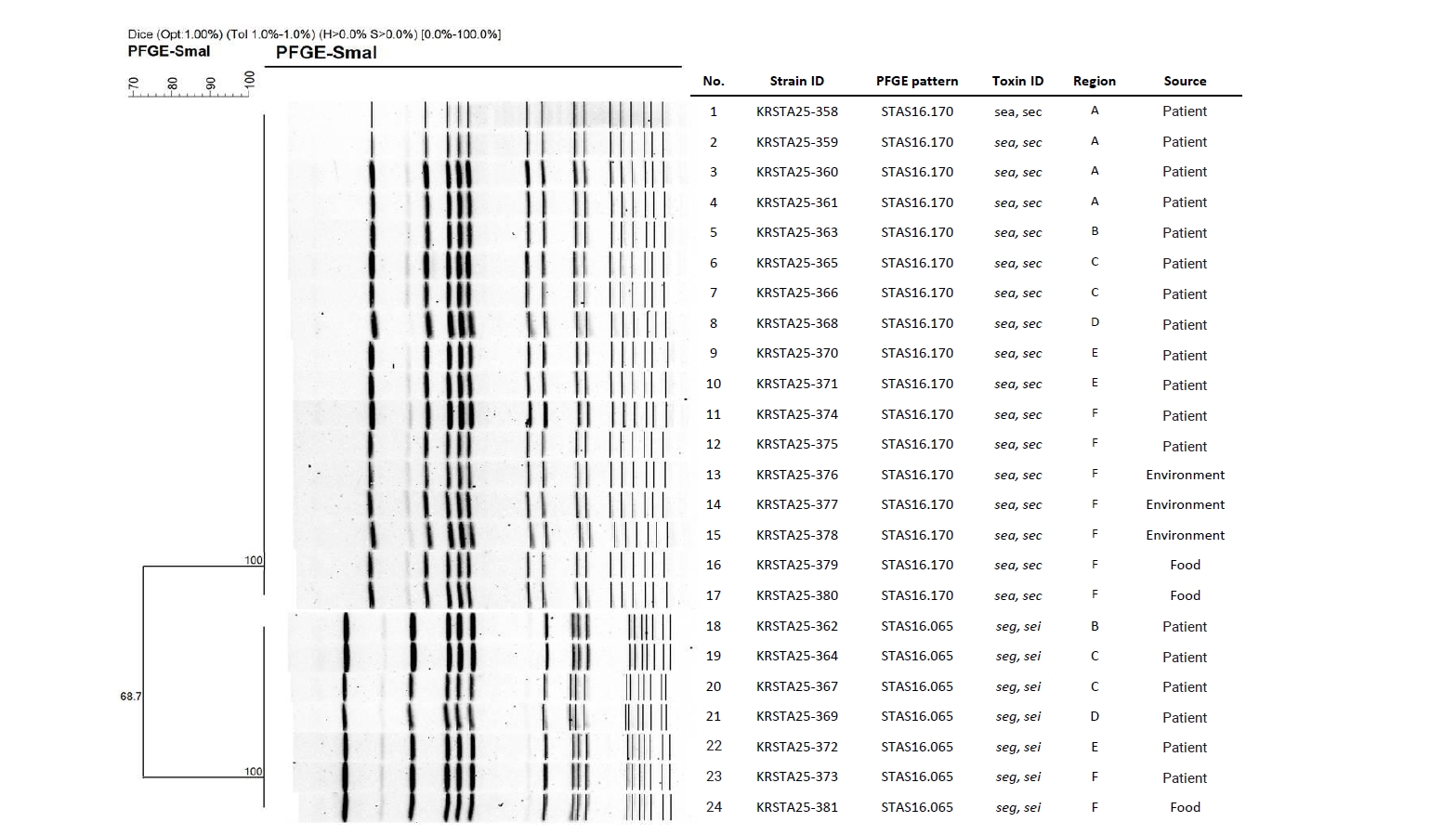
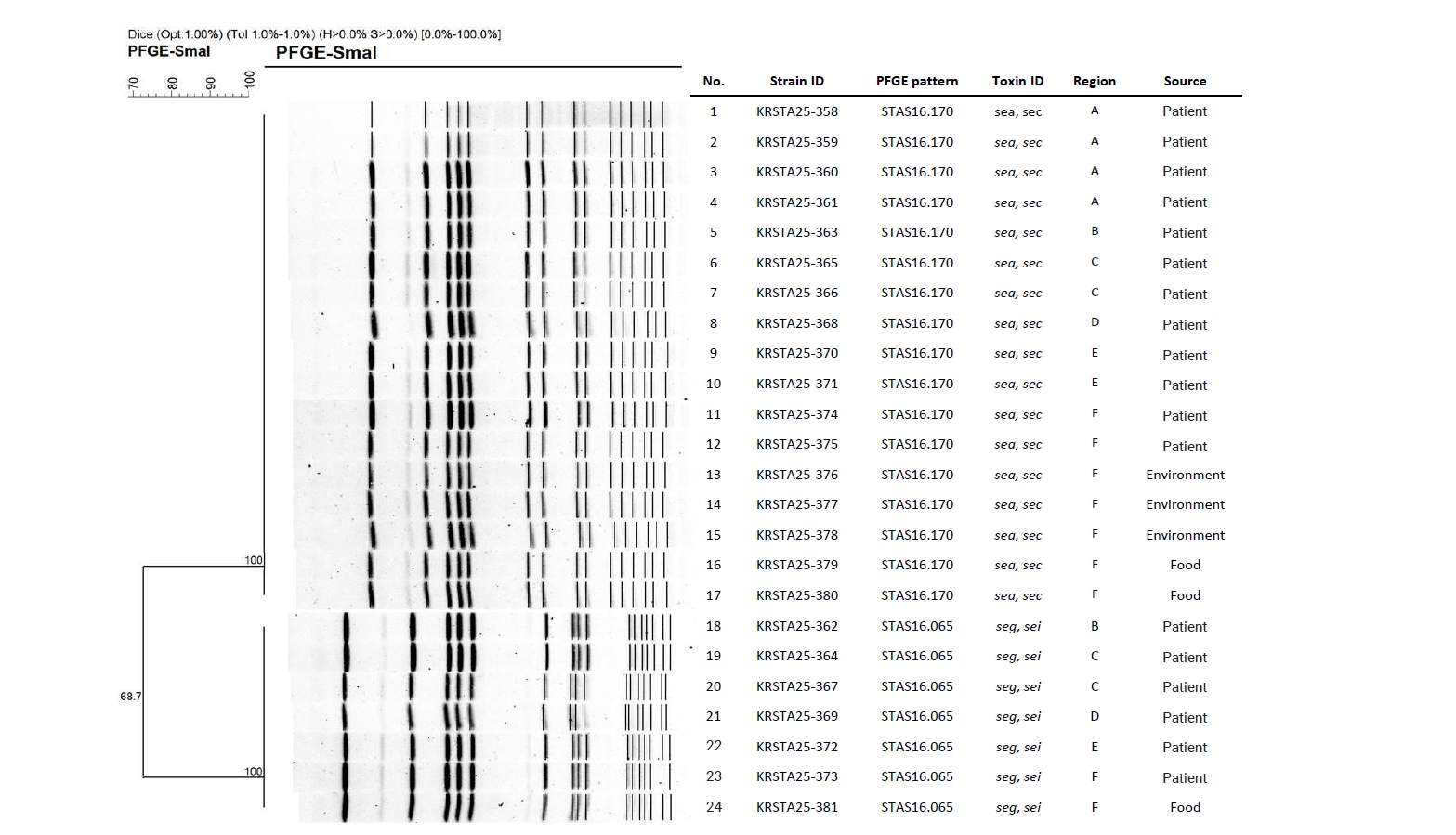
PFGE analysis identified two patterns among the 24 isolates: STAS16.170 (
n=17) and STAS16.065 (
n=7), with 68.68% similarity. The STAS16.170 isolates shared the
sea-sec profile and had not previously been reported in the Republic of Korea according to the national PulseNet Korea
S. aureus database (
Figure 1). The STAS16.065 isolates carried
seg and
sei. STAS16.170 was found in isolates from 12 patients, 2 food samples (rolled omelet and stir-fried anchovies), and 3 cooking utensils, whereas STAS16.065 was found in isolates from 6 patients and 1 food sample (braised tofu).
Genomic Characterization and SNP-Based Phylogenetic Relatedness
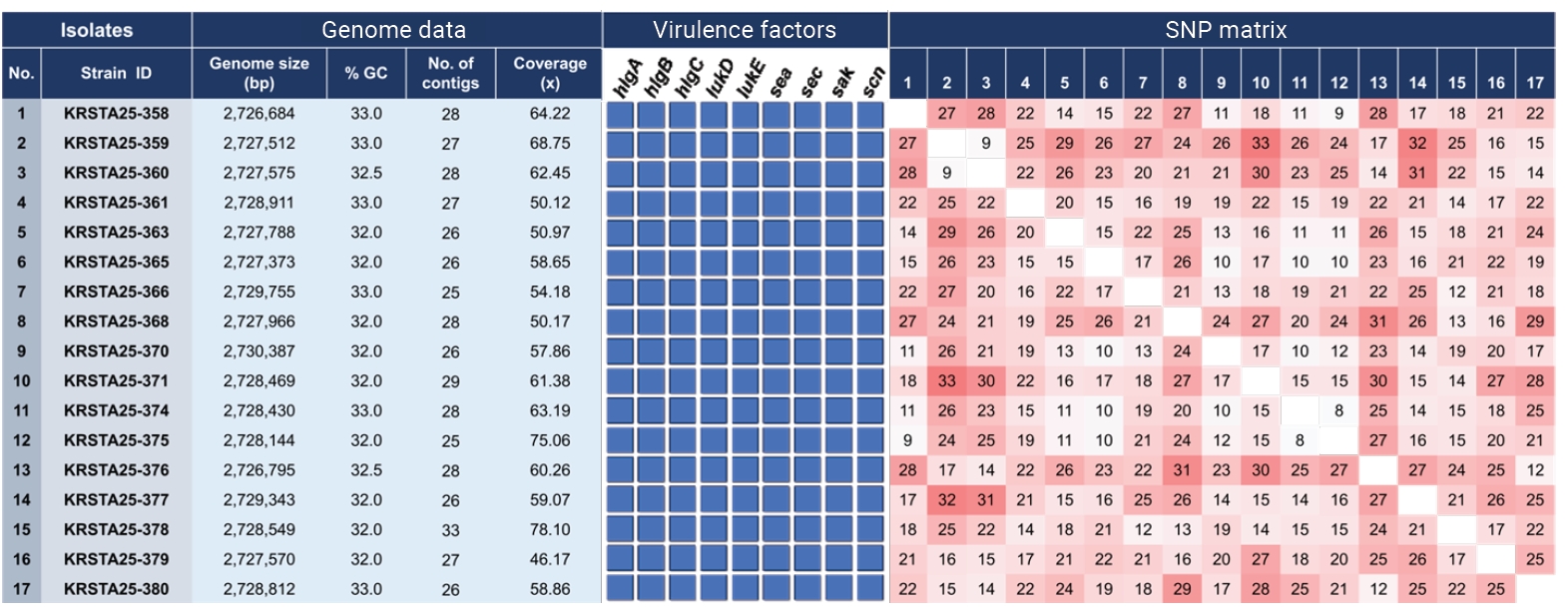
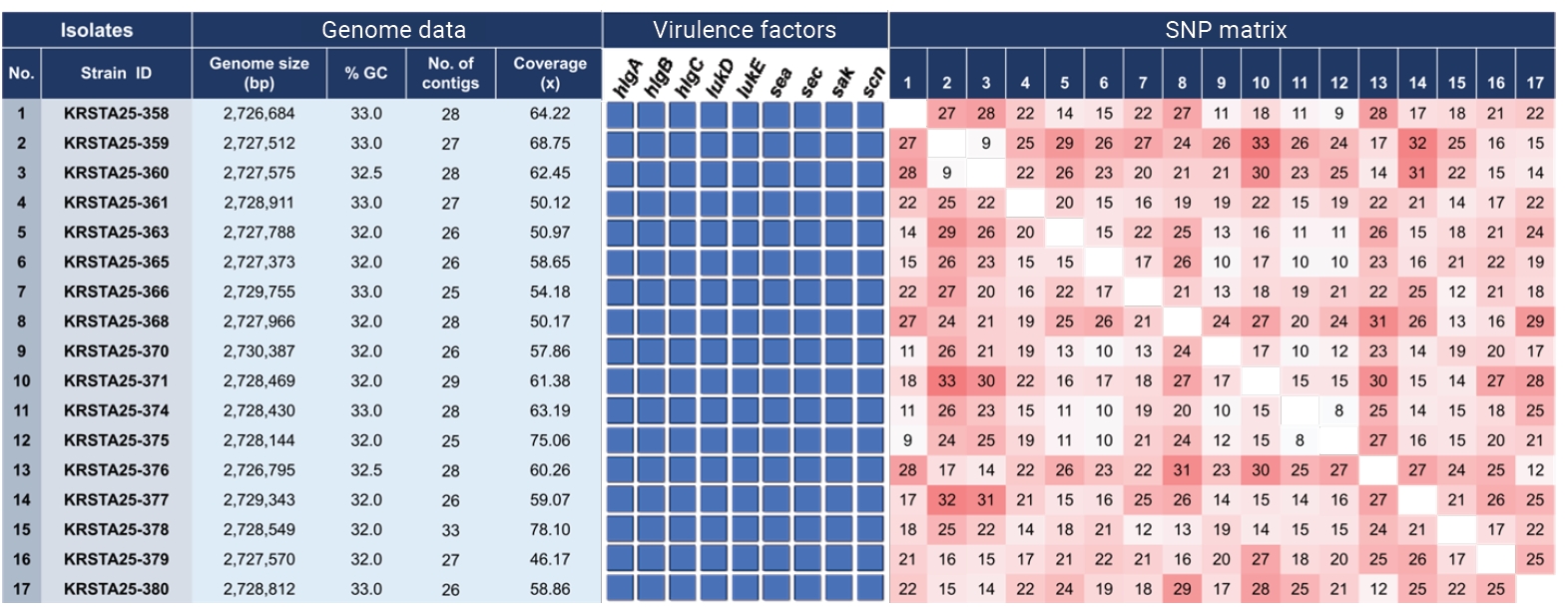
WGS analysis was performed on the 17 STAS16.170 isolates, the predominant PFGE cluster. All belonged to sequence type (ST) 1 and
spa type
t321. Genome-based screening identified virulence-associated genes
hlgA,
hlgB,
hlgC,
lukD,
lukE,
sak, and
scn in all 17 isolates. SNP analysis showed close genetic relatedness, with pairwise differences of 8–33 SNPs (
Figure 2).
Discussion
This study identified a large
S. aureus foodborne outbreak at a festival in Chungcheong Province. Patients had typical symptoms of
S. aureus food poisoning, including vomiting, abdominal pain, and diarrhea [
5]. Food samples from the City F supplier were implicated, and molecular epidemiological analysis grouped all isolates into two PFGE patterns detected among patient, food, and environmental isolates.
The 17 isolates in the major PFGE pattern, STAS16.170, carried
sea and
sec (
Figure 1). This finding is consistent with reports that SEA is the most frequent enterotoxin in staphylococcal food poisoning [
4,
13]. SEC, first identified in the 1960s [
16,
17], continues to be detected in recent outbreak studies [
18,
19]. Similar
sea- and
sec-positive
S. aureus outbreaks have been reported at a university festival in Japan involving crêpes [
20] and among more than 300 students in Vietnam who consumed chicken dishes [
21]. These cases indicate that
S. aureus strains carrying
sea and
sec can cause large outbreaks in mass catering or public-event settings.
In the present study, WGS confirmed that all 17 analyzed isolates belonged to ST1-
t321 and differed by only 8–33 SNPs, consistent with a clonal origin consistent with the PFGE results. SNP-level variation detected by WGS also revealed microevolutionary differences within the ST1 lineage that traditional subtyping could not resolve [
22,
23]. ST1 is one of the most frequently reported staphylococcal food poisoning clones in the Republic of Korea [
12]. Although ST1-
t321 has been reported sporadically in China, Kuwait, and Malaysia [
24–
26], it has not been reported in the Republic of Korea, possibly because WGS-based
spa typing data for domestically circulating
S. aureus remain limited. Thus, the strain may have been recently introduced or may have circulated at low levels before this outbreak. Continued genomic surveillance is needed to clarify the prevalence, geographic distribution, and enterotoxin-gene associations of ST1-
t321 and related ST1 clones.
Virulence gene analysis showed that all outbreak isolates carried hemolysin genes (
hlgA,
hlgB,
hlgC), leukocidin genes (
lukD/
lukE), and immune evasion cluster genes (
sak and
scn). These genes encode factors associated with erythrocyte and epithelial cell membrane damage, leukocyte pore formation, and immune evasion through complement interference and reduced opsonization [
27–
30]. Their presence indicates that the ST1-
t321 outbreak lineage carried multiple virulence-associated determinants.
AST results showed that all isolates were susceptible to oxacillin, cefoxitin, and vancomycin, and no
mecA or
mecC genes were detected, confirming that the isolates were methicillin-susceptible and vancomycin-susceptible
S. aureus Representative isolates were resistant to penicillin and chloramphenicol; however, because resistance to these 2 agents is relatively common in
S. aureus, these findings should be interpreted as supportive phenotypic information. Although antimicrobial resistance was not a defining feature of this outbreak, multidrug-resistant (MDR) and methicillin-resistant
S. aureus in food-related transmission settings remain public health concerns [
31,
32]. Continued AST-based monitoring can support surveillance for emerging MDR
S. aureus strains.
These findings should be interpreted in light of several limitations. Because this study was based on isolates from a single festival-associated outbreak, generalizability may be limited. In addition, individual-level food-consumption histories, exact symptom-onset times, and complete data on food preparation, storage, transport, and distribution were unavailable, preventing definitive matching of patients to specific contaminated foods. Although SNP-based genomic analysis showed close relatedness among isolates from patients, foods, and food-contact surfaces, these data alone could not determine the direction of contamination. Furthermore, WGS focused primarily on the predominant sea-sec–positive cluster; therefore, the epidemiological significance of the seg-sei–positive isolates requires further clarification. SNP distances were estimated against a non-ST1 reference genome (NCTC 8325) without recombination filtering, which may have inflated pairwise differences; the 8–33 SNP range should therefore be interpreted together with the concordant PFGE and sequence-typing results.
Despite these limitations, this study identified a clonal group of enterotoxin-producing S. aureus ST1-t321 strains associated with a festival-related foodborne outbreak. The isolates shared a PFGE pattern (STAS16.170) that had not previously been identified in the national PulseNet database used for routine S. aureus surveillance in the Republic of Korea. These findings show that mass food preparation at public gatherings requires strict hygiene control to reduce the risk of S. aureus foodborne outbreaks.
Continued PFGE- and WGS-based surveillance, supported by sequencing capacity, bioinformatics expertise, and genomic epidemiology training, can help detect emerging variants, monitor virulence and antimicrobial resistance, and guide outbreak control.


 , Joohyun Han1