Development of a survey and worry score to evaluate physician burnout and wellness interventions during COVID-19 in the Rio Grande Valley: A pilot study Victoria Jacobsen, Ericka A. Vazquez, Lauren Herrera, Ruth Escalera, Daniel Salinas, Bharathi S. Gadad, Juan Carlos Lopez-Alvarenga, Kelsey Potter-Baker, Abdelaziz Hendy PLOS One.2026; 21(3): e0342993. CrossRef
Streamlining emergency nursing care post-pandemic: A lean approach for reducing wait times and improving patient and staff satisfaction in the hospital Azza Hassan Mohamed Hussein, Ebtsam Aly Omer Abou Hashish, Basmaa Ahmed Abd-Elghaffar, Nancy Sabry Hassan Elliethey BMC Nursing.2025;[Epub] CrossRef
Parasitic infections are the most common diseases worldwide, and enterobiasis is a common parasitic infection in children. Various studies have reported on the prevalence of Enterobius vermicularis in different regions of the world. However, no study has gathered and analyzed this data systematically. Our systematic review and meta-analysis investigated the overall prevalence of E. vermicularis among children globally. Data were extracted from 4 available databases for studies published from January 2002 to April 2022. The quality of the included studies was scored based on the standard Strengthening the Reporting of Observational Studies in Epidemiology. A random-effect model was chosen to calculate the pooled prevalence and corresponding 95% confidence interval (CI) according to the degree of heterogeneity in the included studies. Thus, 40 publications (42 data sets) that included 3,279 children with enterobiasis met all criteria and were included in the analysis. The meta-analysis showed that heterogeneity among the included studies was high (Q=4,399.35, I2=99.96%; df=41; p<0.001). The pooled global prevalence of enterobiasis among the studied children was 12.9% (95% CI, 8.2%–17.7%). Our systematic review and meta-analysis estimated that, for the past 20 years, 12.9% of children around the world have been infected with E. vermicularis.
Citations
Citations to this article as recorded by
Review Article: The multifaceted role of nematodes in advancing the One Health approach Federica Semprucci, Fehmi Boufahja, Eleonora Grassi, Mohammed Al‐Zharani Annals of Applied Biology.2026; 188(1): 34. CrossRef
"Diagnostic challenges, atypical presentations, and therapeutic implications in ectopic Enterobius vermicularis infections: a global systematic review." Sadaf Roodbarani, Reza Ghasemikhah Diagnostic Microbiology and Infectious Disease.2026; 114(2): 117136. CrossRef
A Small‐Scale Survey of Pinworm (Enterobius vermicularis) Among Health Science Students in Lalitpur, Nepal Roshan Babu Adhikari, Diksha Ghimire, Hannah Wesley Advances in Public Health.2026;[Epub] CrossRef
A Retrospective Study of the Use of Biochemical Markers to Predict Enterobius vermicularis Infection in Paediatric Patients at the Time of Appendicectomy Harrison H Gregory, Baillie W Ferris, Michael C Auld Cureus.2026;[Epub] CrossRef
Pinworm in the Appendix: An Unusual Cause of Appendiceal Inflammation; A Case Report Mohammad Nabeel Aamir Syed, Muhammad Taha Arshad Sheikh, Fabeha Hilal Makhdoomi SN Comprehensive Clinical Medicine.2026;[Epub] CrossRef
Enterobius vermicularis in Paediatric Appendicectomy Patients in Far North Queensland, Australia: A Retrospective Study Sophia Chan, Elena Pilat, Juyong Cheong, Christian Beardsley Cureus.2026;[Epub] CrossRef
Genotypic Analysis of Enterobius vermicularis (Rhabditida: Oxyuridae, Linnaeus, 1758) Among Infected Individuals in Bulgaria: A First Phylogenetic Study Eleonora Kaneva, Reneta Dimitrova, Nina Tsvetkova, Rumen Harizanov, Desislava Velcheva, Aleksandra Ivanova, Mihaela Videnova, Raina Borisova, Maria Pavlova, Diana Jordanova, Ivailo Alexiev International Journal of Molecular Sciences.2026; 27(4): 2020. CrossRef
The Impact of Antiparasitic Therapy on the Dynamics of Inflammatory Periodontal Diseases in Patients with Chronic Intestinal Parasitoses Djeyna Magomed-Emievna Amirkhodzhieva, Aminat Isaevna Mustaeva, Aminat Abdulgamidovna Aliyeva, Luiza Gasanovna Ramazanova, Anzhela Aubovna Omarova, Zarema Myammaevna Akarazueva, Linda Rashidovna Yusupova, Maryam Ilyasovna Kodzoeva International Journal of Medical Parasitology and .2026; 7(1): 11. CrossRef
Helminths as architects of trained tolerance: implications for human health Quinn Moroz, Jorge Lucas Nascimento Souza, Neima Briggs Clinical & Translational Immunology.2026;[Epub] CrossRef
Burden and diagnostic capacity of intestinal parasitic infections in Argentina: Analysis of national surveillance and laboratory data Silvana Carnevale, María Fernanda Degese, María Fernanda Martin Aragón, Daniela Elena Guma, Bibiana Alba Ledesma, Carlos Giovacchini Revista Argentina de Microbiología.2026; 58(3): 100718. CrossRef
Enterobius vermicularis as a cause of acute appendicitis: a case report Francesca Carraturo, Roberta Colicchio, Claudia Di Mento, Leonardo Continisio, Annalisa Chiodi, Maria Escolino, Maria D’Armiento, Ciro Esposito, Paola Salvatore, Mariateresa Vitiello Frontiers in Medicine.2026;[Epub] CrossRef
Pinworm (Enterobius vermicularis) in children and adults: a practice-oriented narrative review and household–school algorithm Osama Albasheer, Gassem Gohal, Ali Al-Makramani, Mai Mustafa, Amani Abdelmola, Suhaila Ali, Fatma Ayish, Afnan Madkhali, Afaf Hakami, Hatim Alessa, Mohammed Muqri, Tahani Madkhali, Doaa Ayish, Ai Yahya Maashi, Elham Shabanh Frontiers in Public Health.2026;[Epub] CrossRef
Prevalence of Intestinal Parasitic Infections Among Students Attending Schools in La'elay Maichew District, Tigray Region, Ethiopia Teklay Abrha Yanshet, Gebremedhin Gebrezgabiher, Melese Birmeka Health Science Reports.2026;[Epub] CrossRef
Anthelmintic medication with focus on first-trimester exposure: an evaluation of pregnancy outcomes based on the Embryotox cohort Laura Heineke, Evelin Beck, Reinhold Kreutz, Katarina Dathe Scientific Reports.2026;[Epub] CrossRef
Regional genetic diversity and COI haplotype characterization of human-derived Enterobius vermicularis ısolates Hilal Bedir, Nurullah Çiftçi, Murat Öztürk, Ayşegül Önk, Masma Shahbazova, İlkay Bahçeci, Emine Baran Deniz, Neriman Mor, Mehmet Ezer, Uğur Arslan, Salih Maçin, Fatih Şaban Beriş, Muhammet Mustafa Akıner, Hülya Çakmur, Mükremin Özkan Arslan Molecular Biology Reports.2026;[Epub] CrossRef
Incidence of Enterobiasis in the Child Population of the Russian Federation in 2010–2024 Aleksandr N. Letyushev, Tatyana F. Stepanova, Anna P. Rebeshchenko, Kseniya B. Stepanova ЗДОРОВЬЕ НАСЕЛЕНИЯ И СРЕДА ОБИТАНИЯ - ЗНиСО / PUBL.2026; : 27. CrossRef
COMMUNITY-ACQUIRED PARASITOSES AMONG THE POPULATION OF BULGARIA Zornitsa Traykova, Rumen Harizanov PROBLEMS of Infectious and Parasitic Diseases.2026; 54(2): 38. CrossRef
Hemorragia ileocecal masiva asociada a Enterobius vermicularis con compromiso hemodinámico: reporte de un caso Miguel Soria-Alcívar, María Andrea Betancourt Ruiz, Julio Cevallos Quiroz Gaceta Médica de la Junta de Beneficencia de Guaya.2026;[Epub] CrossRef
Modelling international travel as risk of acquiring Dientamoeba fragilis: Comparison to Giardia duodenalis data Jukka-Pekka Pietilä, Tuuve A Häkkinen, Jukka Ollgren, Anu Kantele Travel Medicine and Infectious Disease.2025; 65: 102836. CrossRef
A Case of Appendiceal Pinworms in an Adolescent Patient Zachary S Kauffman, David L Stuart Cureus.2025;[Epub] CrossRef
Epidemiological and molecular characterization of Enterobius vermicularis cases in Mersin, Turkey: An analysis based on mitochondrial DNA cox1 gene sequences Harun Gülbudak, Seda Tezcan Ülger, Taylan Bozok, Gönül Aslan One Health.2025; 20: 101079. CrossRef
Enterobius vermicularis: Coming Soon to an Appendix Near You? Adam Heininger, John C Densmore Cureus.2025;[Epub] CrossRef
SURVEILLANCE OF PARASITIC DISEASES IN BULGARIA Rumen Harizanov, Violeta Yakimova, Mihaela Videnova, Ognyan Mikov, Aleksandra Ivanova, Eleonora Kaneva, Raina Borisova, Nina Tsvetkova, Iskra Rainova, Zornitca Traykova PROBLEMS of Infectious and Parasitic Diseases.2025; 52(3): 38. CrossRef
Evaluating the sensitivity and specificity of symptom-based screening for soil-transmitted helminth infections in children in coastal areas of Indonesia Irma Irma, Asnia Zainuddin, Marni Syahrani Ado, Swaidatul Masluhiya AF Healthcare in Low-resource Settings.2025;[Epub] CrossRef
Prevalence and Epidemiological Patterns of Enterobius vermicularis Infection in Thailand: A Systematic Review and Meta-Analysis Jurairat Jongthawin, Aongart Mahittikorn, Apiporn Thinkhamrop Suwannatrai, Chutima Rattanawan, Kinley Wangdi, Frederick Ramirez Masangkay, Manas Kotepui Medical Sciences.2025; 13(4): 207. CrossRef
Enhanced object detection of Enterobius vermicularis eggs using cumulative transfer learning algorithm Pongphan Pongpanitanont, Naparat Suttidate, Hiroshi Yamasaki, Wanchai Maleewong, Penchom Janwan PeerJ Computer Science.2025; 11: e3213. CrossRef
Improving Adherence to World Health Organization Guidelines for Pinworm Treatment in Two Primary Healthcare Centers in Misan Province: A Clinical Audit Ahmed Al-Dawoodi, Abbas Al-Elayawi, Samah Hameed Cureus.2025;[Epub] CrossRef
Unmasking the role of constipation in treatment-refractory enterobiasis in Bangladeshi children Md. Benzamin, Md Ziaur Rahman Chowdhury, Pranto Chakroborty, Akhlaq Ahmed, Md. Moulud Hussen, Rajib Kanti Dey, ASM Bazlul Karim BMC Gastroenterology.2025;[Epub] CrossRef
Beyond Bacterial Causes: A Case of Recurrent Urinary and Vulvovaginal Symptoms Due to Enterobius vermicularis—Case Report Momin Khan, Safeena Khan, Muhammad Haris Khan, Umar Tariq, Wajeeh Ur Rehman, Dawei Cui Case Reports in Infectious Diseases.2025;[Epub] CrossRef
Understanding the trends, clustering, and risk factors of pinworm infection in preschool settings: A repeated cross-sectional multi-center study between 2019 and 2024 Fanzhen Mao, Xuecheng Li, Sheng Ye, Feng Tang, Bixian Ni, Qiang Zhang, Jiayao Zhang, Yaobao Liu, You Li, Jun Cao, María Victoria Periago PLOS Neglected Tropical Diseases.2025; 19(12): e0013800. CrossRef
Development of a Machine Learning Model for the Classification of Enterobius vermicularis Egg Natthanai Chaibutr, Pongphan Pongpanitanont, Sakhone Laymanivong, Tongjit Thanchomnang, Penchom Janwan Journal of Imaging.2024; 10(9): 212. CrossRef
Global burden of soil-transmitted helminth infections, 1990–2021 Jin Chen, Yanfeng Gong, Qin Chen, Shizhu Li, Yibiao Zhou Infectious Diseases of Poverty.2024;[Epub] CrossRef
Studies on the significance of secretory IgA antibodies in the pathogenesis and clinical course of enterobiasis in infected persons from Bulgaria: preliminary findings E. Kaneva, R. Harizanov, D. Velcheva, N. Tsvetkova, M. Pavlova, I. Alexiev, R. Dimitrova, M. Videnova, R. Borisova, A. Ivanova Helminthologia.2024; 61(4): 277. CrossRef
Objectives The prognostic significance of CDC42 effector protein 2 (CDC42EP2) and its association with tumor-infiltrating immune cells (TIICs) have not been explored in liver hepatocellular carcinoma (LIHC). This study aims to assess the potential prognostic value of CDC42EP2 by conducting a comprehensive analysis of online databases pertaining to LIHC. Methods: We evaluated the potential of CDC42EP2 as a prognostic biomarker by utilizing online databases such as TIMER, GEPIA2, KM, OSlihc, HPA, and LinkedOmics. Results: In LIHC, we observed that the mRNA and protein expression of CDC42EP2 were upregulated compared to normal tissues. Upregulated CDC42EP2 expression was associated with a worse prognosis based on the clinicopathological characteristics of patients with LIHC. Furthermore, CDC42EP2 was positively associated with TIICs. In the co-expression and functional enrichment analyses of CDC42EP2, 11,416 genes showed positive associations with CDC42EP2 while 8,008 genes showed negative associations. CDC42EP2-related co-expression genes were involved in protein localization to the endoplasmic reticulum, translational initiation, and RNA catabolic processes in gene set enrichment analysis-Gene Ontology (GSEAGO), and regulated the ribosome, spliceosome, and primary immune deficiency in the GSEAKyoto Encyclopedia of Genes and Genomes (KEGG) pathway. In a survival map, 23 and 17 genes that exhibited positive associations with CDC42EP2 showed a significant hazard ratio (HR) for overall survival and disease-free survival, respectively. Conclusion: Our findings demonstrated that CDC42EP2 is a novel prognostic biomarker and a potential tumor immune therapeutic target in patients with LIHC.
Citations
Citations to this article as recorded by
miR-22-Galectin-1 as an integral signaling axis in regulating metabolism and immunity in HCC Ying Hu, Tahereh Setayesh, Prasant Kumar Jena, Yutong Ji, Trenton Testerman, Ruiwu Liu, Tsung-Chieh Shih, Xiao-Jing Wang, Fu-Tong Liu, Kit S. Lam, Yu-Jui Yvonne Wan Biomarker Research.2026;[Epub] CrossRef
Integrative Multi-Omics Analysis Identifies NUP205 as a Candidate Prognostic Biomarker in Liver Hepatocellular Carcinoma Eun-A Jeong, Jae-Ho Lee, Jongwan Kim International Journal of Molecular Sciences.2026; 27(6): 2860. CrossRef
Epigenetic and ncRNA Regulation of CBX2 in Liver Hepatocellular Carcinoma: A Comprehensive Multi-Omics Analysis for Understanding Biological Significance Kyu-Shik Lee, Jong-Heon Kim, Jongwan Kim Medicina.2026; 62(5): 842. CrossRef
Integrated Bioinformatics and Multi-Omics Analysis of ZBTB40 Expression, Prognostic Relevance, and Regulatory Networks in Hepatocellular Carcinoma Tae-Young Kim, Jae-Hee Park, Yong Wook Jung, Jae-Ho Lee, Jongwan Kim Medicina.2026; 62(7): 1244. CrossRef
VPS26A as a Prognostic Biomarker and Therapeutic Target in Liver Hepatocellular Carcinoma: Insights from Comprehensive Bioinformatics Analysis Hye-Ran Kim, Jongwan Kim Medicina.2025; 61(7): 1283. CrossRef
Multi-Omics and Functional Analysis of BFSP1 as a Prognostic and Therapeutic Target in Liver Hepatocellular Carcinoma Kyu-Shik Lee, Jongwan Kim Medicina.2025; 61(12): 2196. CrossRef
Nucleoporin 205 as a Novel Prognostic Biomarker in Head and Neck Squamous Cell Carcinoma from Comprehensive Bioinformatics Analysis Eun Jin Kim, Dasol Hwang, Yun-Seon Ko, Sang-Hyun Park, Kyung-Soo Chang, Hye-Ran Kim Biomedical Science Letters.2025; 31(4): 352. CrossRef
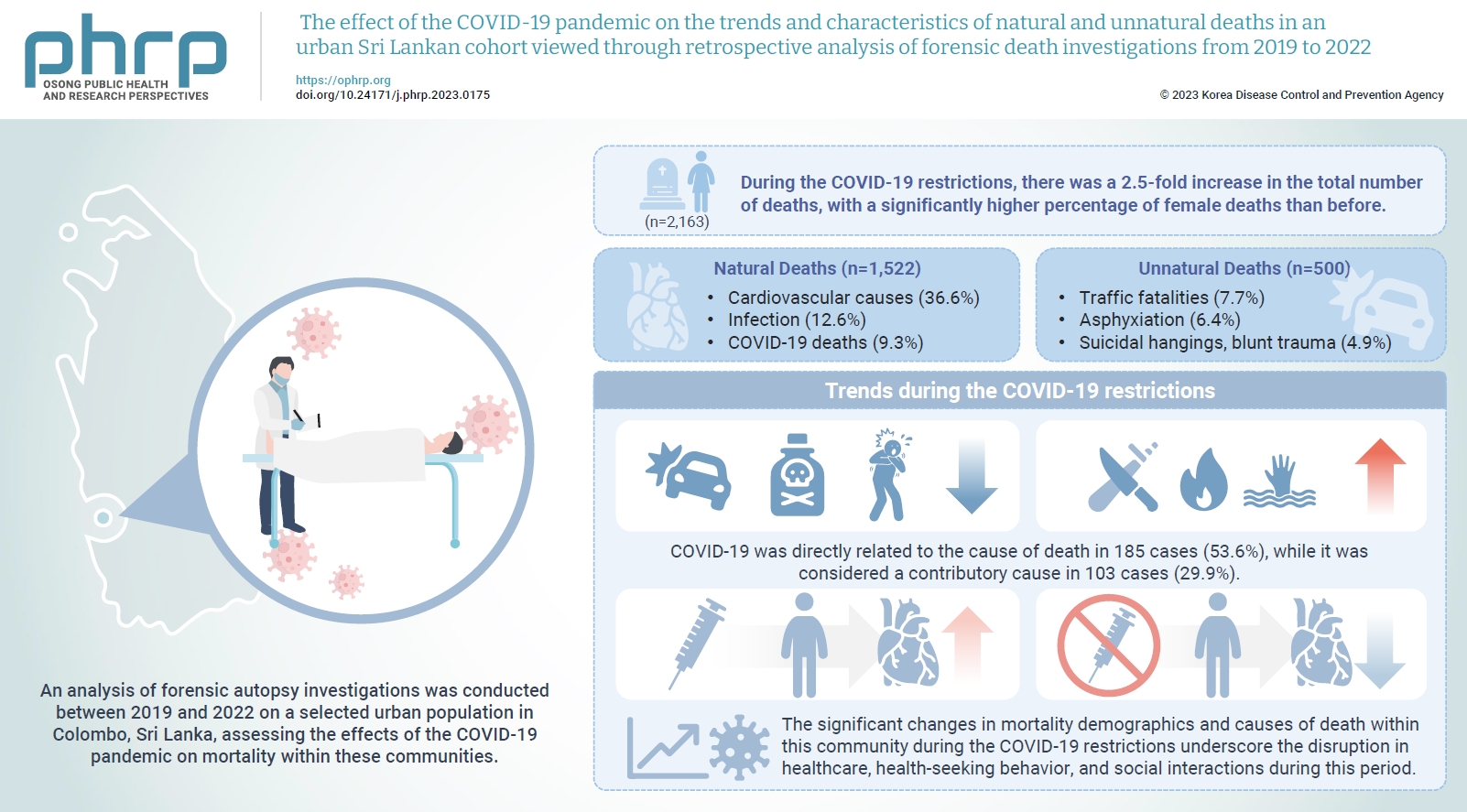
Objectives The coronavirus disease 2019 (COVID-19) pandemic has had a severe impact on global health. Apart from the disease itself, the strict restrictions and lockdowns enforced to minimize its spread have also substantially disrupted personal and public health. Methods: An analysis of forensic autopsy investigations was conducted between 2019 and 2022 on a selected urban population in Colombo, Sri Lanka, assessing the effects of the COVID-19 pandemic on mortality within these communities. Results: During the COVID-19 restrictions, there was a 2.5-fold increase in the total number of deaths, with a significantly higher percentage of female deaths than before. The majority of these deaths were due to cardiovascular causes, while COVID-19-related deaths ranked third overall. The highest proportion of COVID-19 deaths occurred among unvaccinated females. The monthly frequency of deaths from traffic accidents, poisoning, and asphyxiation decreased, while deaths from blunt trauma, sharp trauma, burns, and immersion increased. There was also a rise in blunt homicides and a greater number of femicides during the COVID-19 restrictions than in the pre-pandemic period. A significantly higher percentage of males who received the COVID-19 vaccine died from cardiovascular causes compared to those in the unvaccinated group. Conclusion: The significant changes in mortality demographics and causes of death within this community during the COVID-19 restrictions underscore the disruption in healthcare, healthseeking behavior, and social interactions during this period. The vulnerability of individuals residing in highly urbanized areas with lower socioeconomic status, particularly women, is brought into sharp focus.
Citations
Citations to this article as recorded by
The impact of the COVID-19 pandemic on forensic pathology services in Limpopo province, South Africa Thakadu A. Mamashela, Samuel T. Ntuli South African Family Practice.2025;[Epub] CrossRef
A nationwide forensic case-series of femicides in Italy – Part 1: Clues to the motives of the murder Rossana Cecchi, Anna Laura Santunione, Jessika Camatti, Alice Buzzelli, Alessandra De Martina, Alessandra Sannella, Marco Vinceti, Graziamaria Corbi, Carlo Pietro Campobasso, Matilde Sassani, Giovanna Laura De Fazio, Paolo Fais, Susi Pelotti, Arianna Gior Legal Medicine.2025; 78: 102703. CrossRef
Objectives The incidence of waterborne and foodborne infectious diseases (WFIDs) continues to increase annually, attracting significant global attention. This study examined trends in WFID outbreaks in the Republic of Korea over the 5-year period before and during the coronavirus disease 2019 (COVID-19) pandemic and provided foundational data to establish measures for the prevention and control of WFID outbreaks. Methods: We analyzed 2,541 WFID outbreaks from 2017 to 2021 (42,805 cases) that were reported through the Integrated Disease Surveillance System of the Korea Disease Control and Prevention Agency. Outbreaks were defined as the occurrence of gastrointestinal symptoms in ≥2 individuals within a group with temporal and regional epidemiological associations. The related factors associated with WFID outbreaks during the observation period were statistically analyzed. Results: The total number of WFID outbreaks significantly decreased in 2020 during the COVID-19 pandemic and increased to the pre-pandemic level in 2021. Different patterns were observed for each pathogen. The incidence of Salmonella outbreaks more than doubled, while norovirus outbreaks decreased significantly. Conclusion: WFID outbreaks in the Republic of Korea showed different patterns before and during the COVID-19 pandemic, influenced by infection control measures and changes in dietary consumption patterns. Outbreaks of some diseases increased, but the infection control measures applied during the pandemic resulted in a significant decrease in the overall number of WFID outbreaks. This highlights the importance of strengthening the management strategies for outbreak prevention through hygiene inspections, long-term monitoring, education, and promotion by conducting multidimensional analyses to understand the complex related factors.
Citations
Citations to this article as recorded by
Characteristics of Foodborne Outbreaks and Pathogen Distribution in Busan, 2025 Sohyun Park Journal of Food Hygiene and Safety.2026; 41(3): 199. CrossRef
Foodborne Illness-Related Diagnostic Coding and Healthcare-Utilization Patterns in South Korea, 2023: A Nationwide Claims-Based Descriptive Study Seeun Choi, Junjoeng Hwang, Min Sik Choi, Su-Jin Kang, Kiyon Rhew Healthcare.2026; 14(16): 2466. CrossRef
Changes in the Epidemiological Trends of Waterborne and Foodborne Bacterial Pathogens in the Republic of Korea: Before and After the COVID-19 Pandemic, 2017–2025 Mooneui Hong, Eunkyung Shin, Hyun Ju Jeong, Wooju Kang, Yeongeun Seo, Yu-Jin Park, Suyeon Kim, Junyoung Kim Journal of Infection and Public Health.2026; : 103402. CrossRef
Advancing Toward a Data-Driven Food Risk Prediction System: Strategic Directions for Preventive Risk Management Jun-Hyeok Ham, Yeon-Jung Lee, Yu Jin Na, Soyoung Gwon, Mun-Gi Sohn, Hae-Yeong Kim Journal of Food Hygiene and Safety.2025; 40(3): 183. CrossRef
Foodborne disease outbreaks before and during the COVID-19 pandemic in Jiangsu Province, China Qianrang Zhu, Wenqi Zong, Yucheng Wu, Ping Fu, Yue Dai One Health.2025; 21: 101154. CrossRef
Clinical Characteristics and Antimicrobial Resistance Patterns of Salmonella typhimurium Enteritis in 81 Hospitalized Children: A Single-Center Retrospective Study Yaqing Liu, Lihua Xiao, Hangyu Zhu, Sunhe Hu, Yan Peng Jundishapur Journal of Microbiology.2025;[Epub] CrossRef
Serotypes and antimicrobial resistance patterns of food-borne Salmonella isolates in the Jiaxing Region, China, from 2020 to 2024 Xiaoqin Niu, Liping Tu, Qinlong Yu, Binbin Lu, Junhua Tian, Wei Wang, Bailong Hou, Weifeng Shen Journal of Global Antimicrobial Resistance.2025; 45: 294. CrossRef
The One Health aspect of climate events with impact on foodborne pathogens transmission Igori Balta, Joanne Lemon, Ciara Murnane, Ioan Pet, Teodor Vintila, David McCleery, Todd Callaway, Alastair Douglas, Lavinia Stef, Nicolae Corcionivoschi One Health.2024; 19: 100926. CrossRef
Objectives The coronavirus disease 2019 (COVID-19) pandemic, caused by a dynamic virus, has had a profound global impact. Despite declining global COVID-19 cases and mortality rates, the emergence of new severe acute respiratory syndrome coronavirus 2 (SARS-CoV-2) variants remains a major concern. This study provides a comprehensive analysis of the genomic sequences of SARS-CoV-2 within the Bhutanese population during the pandemic. The primary aim was to elucidate the molecular epidemiology and evolutionary patterns of SARS-CoV-2 in Bhutan, with a particular focus on genetic variations and lineage dynamics. Methods: Whole-genome sequences of SARS-CoV-2 collected from Bhutan between May 2020 and February 2023 (n=135) were retrieved from the Global Initiative on Sharing All Influenza Database. Results: The SARS-CoV-2 variants in Bhutan were predominantly classified within the Nextstrain clade 20A (31.1%), followed by clade 21L (20%) and clade 22D (15.6%). We identified 26 Pangolin lineages with variations in their spatial and temporal distribution. Bayesian time-scaled phylogenetic analysis estimated the time to the most recent common ancestor as February 15, 2020, with a substitution rate of 0.97×10⁻³ substitutions per site per year. Notably, the spike glycoprotein displayed the highest mutation frequency among major viral proteins, with 116 distinct mutations, including D614G. The Bhutanese isolates also featured mutations such as E484K, K417N, and S477N in the spike protein, which have implications for altered viral properties. Conclusion: This is the first study to describe the genetic diversity of SARS-CoV-2 circulating in Bhutan during the pandemic, and this data can inform public health policies and strategies for preventing future outbreaks in Bhutan.
Citations
Citations to this article as recorded by
Integration of multi-omics and machine learning strategies identifies immune related candidate biomarkers in inflammation-associated hypertrophic cardiomyopathy Qingzhu Liang, Jin Wang, Qingxiao Nong, Shouwen Tao, Dalang Fang Frontiers in Immunology.2025;[Epub] CrossRef
Investigation of SARS-CoV-2 Genomic Variants in Two Patients: Insights into Initial Isolates from West Kalimantan, Indonesia Puji Astuti, Mahyarudin Mahyarudin, Delima Fajar Liana, Virhan Novianry, Sofi Siti Shofiyah, Puspa Amalia, Muhammad Faisal, Marinus Andre Reynaldi Infection Epidemiology and Microbiology.2025; 11(3): 285. CrossRef
Objectives This study aimed to identify factors associated with the onset time of diabetic complications in patients with type 2 diabetes mellitus (T2DM) and determine the best-fitted survival model. Methods: A retrospective cohort study was conducted among T2DM patients enrolled from October 1, 2016 to July 15, 2020 at the National Health Security Office (NHSO). In total, 388 T2DM patients were included. Cox proportional-hazard and parametric models were used to identify factors related to the onset time of diabetic complications. The Akaike information criterion, Bayesian information criterion, and Cox-Snell residual were compared to determine the best-fitted survival model. Results: Thirty diabetic complication events were detected among the 388 patients (7.7%). A 90% survival rate for the onset time of diabetic complications was found at 33 months after the first T2DM diagnosis. According to multivariate analysis, a duration of T2DM ≥42 months (time ratio [TR], 0.56; 95% confidence interval [CI], 0.33–0.96; p=0.034), comorbid hypertension (TR, 0.30; 95% CI, 0.15–0.60; p=0.001), mildly to moderately reduced levels of the estimated glomerular filtration rate (eGFR) (TR, 0.43; 95% CI, 0.24–0.75; p=0.003) and an eGFR that was severely reduced or indicative of kidney failure (TR, 0.38; 95% CI, 0.16–0.88; p=0.025) were significantly associated with the onset time of diabetic complications (p<0.05). Conclusion: Patients with T2DM durations of more than 42 months, comorbid hypertension, and decreased eGFR were at risk of developing diabetic complications. The NHSO should be aware of these factors to establish a policy to prevent diabetic complications after the diagnosis of T2DM.
Citations
Citations to this article as recorded by
Survival and predictors of mortality among adults with type 2 diabetes at a teaching hospital in Ghana: a retrospective cohort study Issah Haruna, Abdul-Rauf Sulemana, Emmanuel Kweku Nakua, Daniel Boateng BMC Public Health.2026;[Epub] CrossRef
Survival analysis of patients with chronic diseases: a statistical approach to mortality risk factors Vladimiro Ibañez Quispe, Juan Reinaldo Paredes Quispe, Remo Choquejahua Acero, Teresa Paola Alvarez Rozas, Edgar Eloy Carpio Vargas, Godofredo Quispe Mamani, Percy Huata Panc Journal of Advanced Pharmacy Education and Researc.2026; 16(1): 211. CrossRef
An elevated level of one-hour postprandial plasma glucose is an independent risk factor for developing chronic complications of type 2 diabetes mellitus Yanyan Jin, Jing Wei, Jie Yang, Hongxia Qian, Yan Wu, Mengmeng Liu Archives of Physiology and Biochemistry.2025; 131(6): 1025. CrossRef
Advanced age and elevated cholesterol predict diabetic neuropathy in patients with type II diabetes mellitus in Southern Ethiopia Fasika Merid, Habtamu Esubalew, Tamirat Gezahegn Guyo, Firdawek Getahun Cardiovascular Diabetology – Endocrinology Reports.2025;[Epub] CrossRef
Objectives This study investigated changes in the health behaviors of the elderly due to coronavirus disease 2019 (COVID-19), concerns due to COVID-19, depression, and healthrelated quality of life (HRQOL), and aimed to identify factors that affect depression and HRQOL in the elderly. Methods: This study was conducted using data from the 2021 Community Health Survey of the Korea Disease Control and Prevention Agency. From a total sample size of 229,242 individuals, 74,376 elderly people aged 65 or older were selected as subjects, and changes in health behaviors, concerns due to COVID-19, depression, and HRQOL were measured and analyzed. Results: The level of depression associated with sleep and fatigue was high. The lowest HRQOL was related to physical pain and discomfort, while the most common concerns were related to economic difficulties. Factors influencing depression included worries about infection and economic harm, while factors impacting HRQOL encompassed concerns about infection, economic harm, and criticism from others. Conclusion: If an infectious disease situation such as COVID-19 reoccurs in the future, it will be necessary to encourage participation in hybrid online and offline programs at senior welfare centers. This should also extend to community counseling institutions like mental health welfare centers. Additionally, establishing connections with stable senior job projects can help to mitigate the effects of social interaction restrictions, physical and psychological health issues, and economic difficulties experienced by the elderly.
Citations
Citations to this article as recorded by
A comparison of health-related quality of life using the World Health Organization Quality of Life–BREF and 5-Level EuroQol-5 Dimensions in the Malaysian population Andrian Liem, Hui Jun Chih, Vithya Velaithan, Richard Norman, Daniel Reidpath, Tin Tin Su Osong Public Health and Research Perspectives.2025; 16(2): 126. CrossRef
The impact of urban agglomeration planning on depression in older adults Ya Liu, Li Yan, Yujue Wang, Xiaotang Tang, Ming Gao, Jiayu Yang, Zuoyan Liu, Xiuying Hu Frontiers in Public Health.2024;[Epub] CrossRef





 First
 Prev


