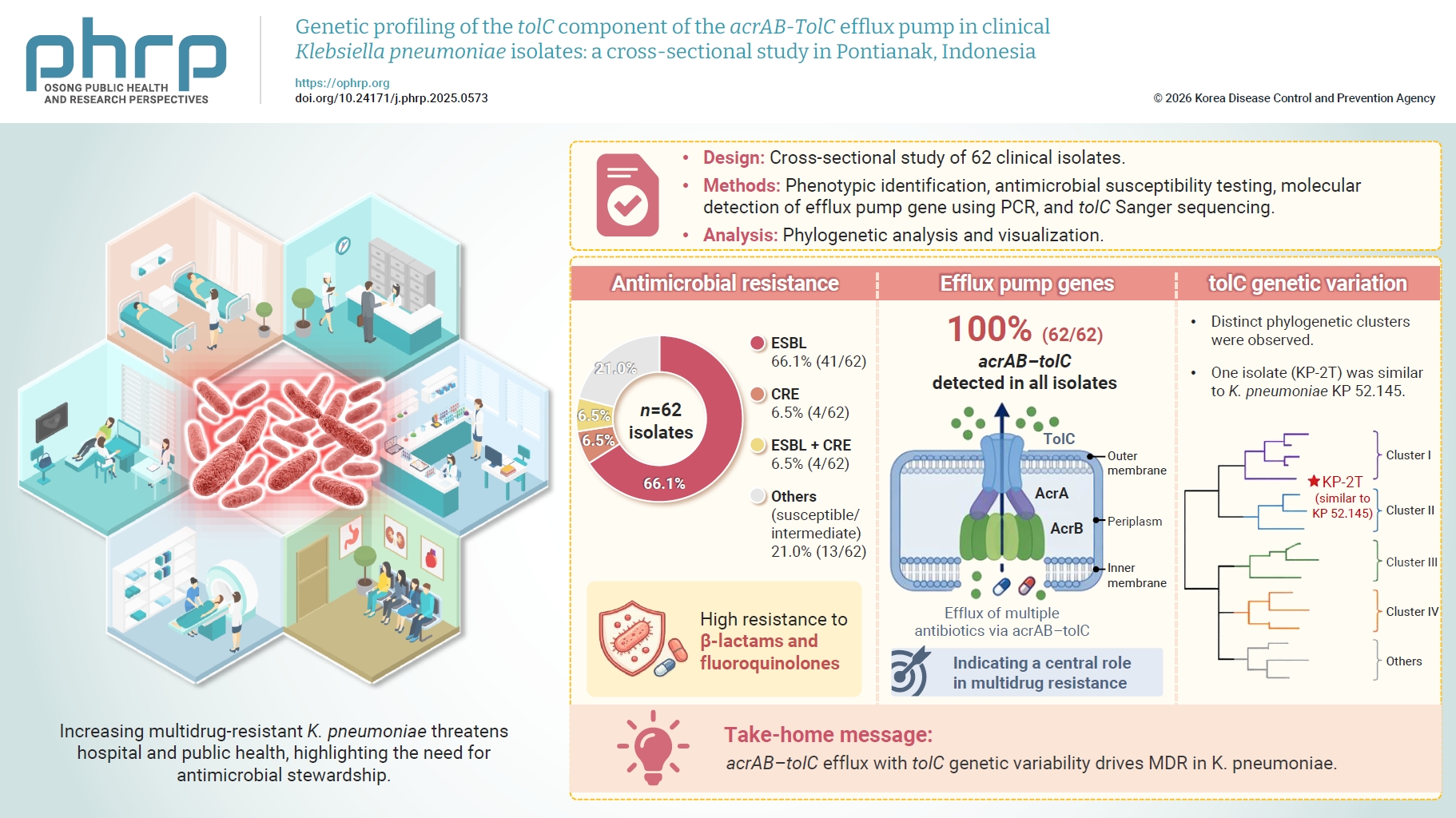
Objectives Klebsiella pneumoniae is a leading cause of hospital-acquired infections. Its increasing prevalence poses substantial challenges to both hospital and public health systems due to the emergence of multidrug-resistant strains. Understanding the epidemiology of K. pneumoniae and its antimicrobial resistance characteristics may support antimicrobial stewardship and infection control programs. A cross-sectional study was conducted from June to November 2025. Methods: A total of 62 isolates underwent phenotypic identification and antimicrobial susceptibility testing using the BD Phoenix system (Becton Dickinson), followed by molecular detection of K. pneumoniae and efflux pump genes. Sanger sequencing was performed on isolates positive for the tolC gene. Results: Among the isolates, 66.1% were classified as extended-spectrum β-lactamase (ESBL) producers, 6.5% as carbapenem-resistant Enterobacterales (CRE), and 6.5% as both ESBL and CRE producers. Most clinical isolates were resistant to ampicillin, cefazolin, ceftazidime, ceftriaxone, ciprofloxacin, and cefepime. The acrAB and tolC genes were detected in all 62 isolates. One isolate showed a genetic profile similar to that of the K. pneumoniae KP 52.145 strain. Conclusion: This study demonstrated a high prevalence of antibiotic resistance among K. pneumoniae isolates and confirmed the presence of efflux pump genes, including tolC, with observable genetic variability. Further investigation of tolC gene evolution is essential, as these genes play critical roles in antibiotic resistance mechanisms.
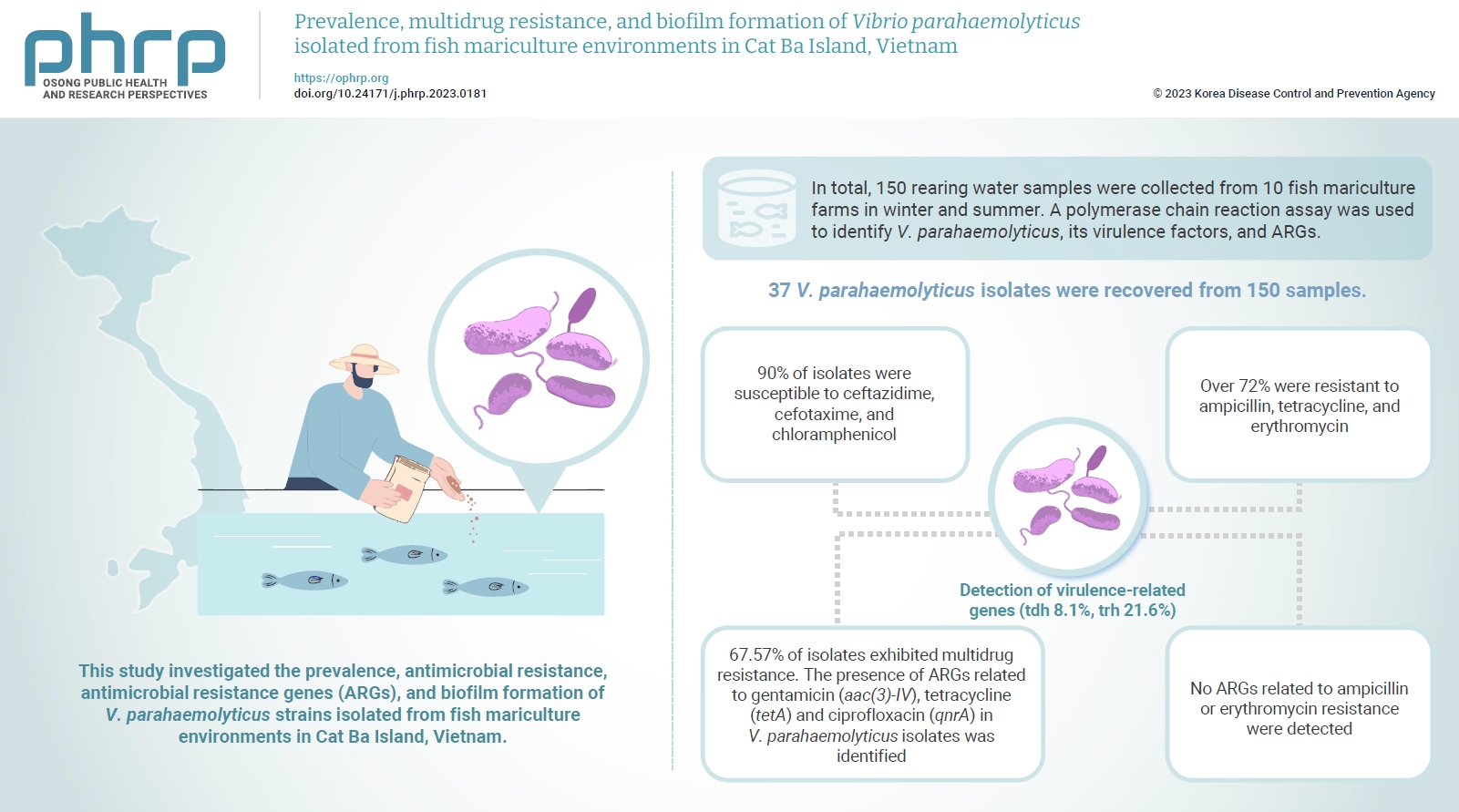
Objectives Vibrio parahaemolyticus is a major foodborne pathogen in aquatic animals and a threat to human health worldwide. This study investigated the prevalence, antimicrobial resistance, antimicrobial resistance genes (ARGs), and biofilm formation of V. parahaemolyticus strains isolated from fish mariculture environments in Cat Ba Island, Vietnam. Methods: In total, 150 rearing water samples were collected from 10 fish mariculture farms in winter and summer. A polymerase chain reaction assay was used to identify V. parahaemolyticus, its virulence factors, and ARGs. The antimicrobial resistance patterns and biofilm formation ability of V. parahaemolyticus strains were investigated using the disk diffusion test and a microtiter plate-based crystal violet method, respectively. Results: Thirty-seven V. parahaemolyticus isolates were recovered from 150 samples. The frequencies of the tdh and trh genes among V. parahaemolyticus isolates were 8.1% and 21.6%, respectively. More than 90% of isolates were susceptible to ceftazidime, cefotaxime, and chloramphenicol, but over 72% were resistant to ampicillin, tetracycline, and erythromycin. Furthermore, 67.57% of isolates exhibited multidrug resistance. The presence of ARGs related to gentamicin (aac(3)-IV), tetracycline (tetA) and ciprofloxacin (qnrA) in V. parahaemolyticus isolates was identified. Conversely, no ARGs related to ampicillin or erythromycin resistance were detected. Biofilm formation capacity was detected in significantly more multidrug-resistant isolates (64.9%) than non-multidrug-resistant isolates (18.9%). Conclusion: Mariculture environments are a potential source of antibiotic-resistant V. parahaemolyticus and a hotspot for virulence genes and ARGs diffusing to aquatic environments. Thus, the prevention of antibiotic-resistant foodborne vibriosis in aquatic animals and humans requires continuous monitoring.
Citations
Citations to this article as recorded by
The synthetic peptide GATR-3 shows significant antibacterial and biofilm-inhibition activity against shellfish- and oyster-associated bacteria Vibrio vulnificus and Vibrio parahaemolyticus Sabrina Hsin-Yin Tsai, Brett A. Froelich, Monique L. van Hoek Comparative Immunology Reports.2026; 10: 200266. CrossRef
Antimicrobial resistance in shrimp aquaculture: Pathways, ecosystem risks, and policy responses Lovely Akter, Neaz A. Hasan, Moshiur Rahman, Nasrullah Forajy, Mohammad Mahfujul Haque Environmental Challenges.2026; 22: 101401. CrossRef
Influence of environmental parameters on total and pathogenic Vibrio parahaemolyticus isolated from mussels and clams Görkem Cengiz, Özlem Küplülü Microbial Pathogenesis.2026; 213: 108352. CrossRef
Phenotypic and genomic characterization of Vibrio parahaemolyticus isolated from Pacific white shrimp (Litopenaeus vannamei) at wet markets and online retail channels Xiaoyu Wang, Jiayi Zhang, Yongheng Zhu, Jun Wang, Tian Ding, Xinyu Liao, Juhee Ahn Food Science and Biotechnology.2026; 35(5): 1319. CrossRef
The role of cortisol as a physiological stress indicator in fish contamination by Vibrio parahaemolyticus and its implications for human health Rzgar Farooq Rashid Italian Journal of Food Safety.2026;[Epub] CrossRef
Assessment of Antibiotic Susceptibility and Biofilm Formation in Bacteria Isolated from White-Leg Shrimp in Traditional Markets, Can Tho City, Vietnam Hau Huu Tran, Nhi Thao Huynh, Nam Van Be Tran, Thanh Uyen Le, Tam Ngoc Thanh Huynh World's Veterinary Journal.2026; 16(1): 259. CrossRef
New insights into the resistome-mobilome–biofilm relationship in Vibrio parahaemolyticus Antoine Régnier, Virginie Chesnais, Cecile Dumaire, Cecile Berdous, Romain Briandet, Sabine Debuiche, Virgile Guéneau, Graziella Midelet, Mélanie Gay, Thomas Brauge Food Microbiology.2026; 140: 105162. CrossRef
Molecular Epidemiology, Antibiotic Susceptibility, and Virulence Profiling of
Vibrio parahaemolyticus
Isolated from Aquatic Foods in Shenzhen, China
Fei Zha, Rui Luo, Longfei Hu, Weipeng Chen, Chun-Xu Xue Foodborne Pathogens and Disease.2026;[Epub] CrossRef
Interface-dependent V. parahaemolyticus biofilm under varying temperatures, media, and oxygen conditions: implications for seafood safety Hansani Nilupama Kumari Senarath Pathirana, Steve Flint, Jon Palmer Food Research International.2026; 242: 120008. CrossRef
Molecular epidemiology of multidrug-resistant, biofilm-producing Vibrio parahaemolyticus from a brackish water aquaculture-estuarine interface S.J. Abisha Juliet Mary, M. Petchimuthu, S. Deepika, G. Ferolin Jessina, S. Balasundari Environmental Pollution.2026; 409: 128990. CrossRef
Optimization of immune priming interval using Imuno-FS Plus enhances the efficacy of oral formalin-killed Vibrio parahaemolyticus vaccine in Pacific white shrimp (Litopenaeus vannamei) Annisa Widya Ananda, Sri Nuryati, Dinamella Wahjuningrum, Munti Yuhana, Ardana Kurniaji Comparative Immunology Reports.2026; 11: 200316. CrossRef
Exploring the antibiofilm efficacy of pyrimidines against Vibrio parahaemolyticus, mechanisms and their potential food processing applications Olajide Sunday Faleye, Jin-Hyung Lee, Jintae Lee LWT.2025; 215: 117229. CrossRef
The role of sea fish meat in the transmission of Vibrio parahaemolyticus to humans: An in-depth analysis of seasonal and species-specific variations Maged A. Al-Garadi, Dhary Alewy Almashhadany, Rasha N. Aziz, Dheyazan M. Ali Al-Qabili, Ohoud S. Alhumaidan, Hanouf Alnuwaysir, Al-Hammadi Mohammed Ali, Essam Sayed, A. M. Alabsi Veterinary World.2025; : 348. CrossRef
Multidrug Resistance, Biofilm-Forming Ability, and Molecular Characterization of Vibrio Species Isolated from Foods in Thailand Watcharapong Mitsuwan, Ratchadaporn Boripun, Phirabhat Saengsawang, Sutsiree Intongead, Sumaree Boonplu, Rawiwan Chanpakdee, Yukio Morita, Sumalee Boonmar, Napapat Rojanakun, Natnicha Suksriroj, Chollathip Ruekaewma, Titima Tenitsara Antibiotics.2025; 14(3): 235. CrossRef
Antimicrobial resistance of zoonotic bacteria isolated from shrimp aquaculture environments in Selangor, Malaysia S. Devadas, Z. Zakaria, M. Shariff, S. Bhassu, M. Karim, I. Natrah Aquaculture.2025; 604: 742480. CrossRef
Characterization of Virulence Genotypes and Prevalence of Vibrio parahaemolyticus from Fish Samples Collected from Thoothukudi Fish Landing Centres, India Selvamathi Veerabhadran Ragul, Fathiraja Parthiban, Rajendran Shalini, Sivasankar Panchavarnam, Thandapani Muthulakshmi, Mohamed Mansoor, Stephen Jerusha, Selvam Krishnakumar Thalassas: An International Journal of Marine Scie.2025;[Epub] CrossRef
Persistent Threats: A Comprehensive Review of Biofilm Formation, Control, and Economic Implications in Food Processing Environments Alexandra Ban-Cucerzan, Kálmán Imre, Adriana Morar, Adela Marcu, Ionela Hotea, Sebastian-Alexandru Popa, Răzvan-Tudor Pătrînjan, Iulia-Maria Bucur, Cristina Gașpar, Ana-Maria Plotuna, Sergiu-Constantin Ban Microorganisms.2025; 13(8): 1805. CrossRef
Southeast‑Asian landscape of antimicrobial resistance research (2014–2024): A bibliometric analysis Alex S. Borromeo, Allan M. Manaloto, Ronilo P. Antonio Journal of Global Antimicrobial Resistance.2025; 45: 125. CrossRef
A New Strategy: Antibiotic Circumstances for Rational Drug use Against Clinical Aeromonas hydrophila And Bacterial Properties of This Bacteria on Different Agars Nurdan Filik, Fethi Filik, Ayşegül Kubilay Acta Aquatica Turcica.2024; 20(4): 312. CrossRef
Passive immunoprophylaxis with Ccombodies against Vibrio parahaemolyticus in Pacific white shrimp (Penaeus vannamei) Wanna Sirimanapong, Prawporn Thaijongrak, Chiranan Sudpraseart, Dennis Berbulla Bela-ong, Abigail Joy D. Rodelas-Angelia, Mark Rickard N. Angelia, Seungbeom Hong, Jaesung Kim, Kim D. Thompson, Tae Sung Jung Fish & Shellfish Immunology.2024; 154: 109973. CrossRef
Isolation of H2S-generating Bacterium (Desulfovibrio sp.) and Vibrio parahaemolyticus From Aquatic Farming and In Vitro Evaluation of the Ability of Bacteriophages as Biocontrol Truong Thi Bich Van, Nguyen Thi Loan Anh, Nguyen Huu Tri , Chau Thanh Tuan Jurnal Ilmiah Perikanan dan Kelautan.2024; 17(1): 167. CrossRef
The emergence of antimicrobial resistance raises the fear of untreatable diseases. Antimicrobial resistance is a multifaceted and dynamic phenomenon that is the cumulative result of different factors. While Gram-positive pathogens, such as methicillin-resistant Staphylococcus aureus and Clostridium difficile, were previously the most concerning issues in the field of public health, Gram-negative pathogens are now of prime importance. The World Health Organization’s priority list of pathogens mostly includes multidrug-resistant Gram-negative organisms particularly carbapenem-resistant Enterobacterales, carbapenem-resistant Pseudomonas aeruginosa, and extensively drug-resistant Acinetobacter baumannii. The spread of Gram-negative bacterial resistance is a global issue, involving a variety of mechanisms. Several strategies have been proposed to control resistant Gram-negative bacteria, such as the development of antimicrobial auxiliary agents and research into chemical compounds with new modes of action. Another emerging trend is the development of naturally derived antibacterial compounds that aim for targets novel areas, including engineered bacteriophages, probiotics, metal-based antibacterial agents, odilorhabdins, quorum sensing inhibitors, and microbiome-modifying agents. This review focuses on the current status of alternative treatment regimens against multidrug-resistant Gram-negative bacteria, aiming to provide a snapshot of the situation and some information on the broader context.
Citations
Citations to this article as recorded by
Progress in Characterization of Lipopolysaccharides and Lipid A by Mass Spectrometry Amanda Helms, Jennifer S. Brodbelt Mass Spectrometry Reviews.2026; 45(5): 929. CrossRef
Effect of MgO/P2O5 ratio on the structure and antibacterial property of Ag2O doped zinc phosphate glass Jeongho Cho, Bongki Ryu, Jaeyeop Chung Journal of the Korean Ceramic Society.2026; 63(3): 440. CrossRef
Antimicrobial effect and safety of 228 nm far-UVC light-emitting diodes Honoka Fujikawa, Yuki Shimizu, Mane Nishimura, Tomohiro Fujii, Yu Okada, Keisuke Kawasaki, Kenji Watanabe, Yoichi Mizukami, Jun Nishikawa Journal of Photochemistry and Photobiology B: Biol.2026; 278: 113410. CrossRef
Role of novel β-lactam antibiotics in the treatment of bacterial pneumonia Susanna Esposito, Nicola Principi Expert Opinion on Pharmacotherapy.2026; 27(5): 423. CrossRef
Ten Year Review of Wound Culture Results and Antimicrobial Resistance Patterns in a Burn Center Gabrielle Bierlein-De La Rosa, Patrick Ten Eyck, Colette Galet, Shady Al Hayek Journal of Surgical Research.2026; 322: 35. CrossRef
RAGE in Neutrophils: A Sensor for Pathogen-Associated Structures and Beyond Ekaterina A. Golenkina, Sofia V. Navarnova, Galina M. Viryasova, Svetlana I. Galkina, Tatjana V. Gaponova, Yulia M. Romanova, Galina F. Sud’ina Biomedicines.2026; 14(5): 1128. CrossRef
Thermal degradation kinetics and multifunctional properties of gelatin/carrageenan films incorporating eugenol-loaded Pickering emulsions for active packaging applications Khadijah Husna Abd Hamid, Theja Sree Pothula Ganesh Kumar, Nasratun Masngut, Mohd Hafiz Arzmi, Nurul Aini Mohd Azman Journal of Food Measurement and Characterization.2026; 20(7): 13843. CrossRef
Synthesis and biological evaluation of novel carbazole derivatives as broad-spectrum antibacterial agents to fight antimicrobial resistance (AMR) Maria Grazia Martina, Francesca Barbieri, Sacha Michèle Idriss Cancade, Gioele Benocci, Alida Chittolina, Matteo Longo, Lisa Giannessi, Sara Rossi, Sandra Gemma, Giuseppe Campiani, Jean-Denis Docquier, Marco Radi European Journal of Pharmaceutical Sciences.2026; 224: 107595. CrossRef
A synergistic bio–electro–topological strategy based on an MXene/silk fibroin hydrogel and electrical stimulation for diabetic wound healing Wenli Du, Yuanyuan Xu, Yuecheng Peng, Zhiyu Chen, Zihan Yao, Junjie Wang, Xuefeng Hu, Jieyu Zhang, Yunbing Wang Materials Horizons.2026; 13(16): 8223. CrossRef
Outer membrane as a drug target for the treatment of GNB infections Urjoshi Chattoraj, Ayesha Fatima, Deepanshi Saxena, Sidharth Chopra Drug Discovery Today.2026; 31(5): 104768. CrossRef
Collateral sensitivity-harnessing microbial vulnerabilities as a solution to antimicrobial resistance Rishav Jana, Priyanka Bhowmik Molecular Biology Reports.2026;[Epub] CrossRef
Isolation, derivatization, and anti-microbial evaluation of secondary metabolites from
Garcinia dryobalanoides
Nur Fazlin Zafirah Zaine, Nor Hisam Zamakshshari, Ainaa Nadiah Abd Halim, Vivien Jong Yi Mian, Ngieng Ngui Sing Natural Product Research.2025; 39(22): 6383. CrossRef
Bioactive Potential and Chemical Composition of Vitex agnus-castus L. Leaf Extracts Collected in Algeria: A Combined In Vitro and In Silico Approach Amina Bramki, Ghozlane Barboucha, Ouided Benslama, Anna Andolfi, Fatima Zohra Makhlouf, Maria Smati, Djamila Benouchenne, Mohamed Moussaoui, Chawki Bensouici, Alessio Cimmino, Jesús G. Zorrilla, Maria Michela Salvatore, Marco Masi Molecules.2025; 30(3): 749. CrossRef
Viability and Surface Morphology of Human Erythrocytes upon Interaction with Chitosan Derivatives Evgeniya A. Bezrodnykh, Marina G. Holyavka, Tatyana N. Belyaeva, Svetlana M. Pankova, Valery G. Artyukhov, Yurij A. Antonov, Boris B. Berezin, Inesa V. Blagodatskikh, Vladimir E. Tikhonov ACS Applied Bio Materials.2025; 8(3): 1909. CrossRef
Effect of Mutations on the Evolution of Extended Spectrum β-lactamases (ESBL) Anirudha Dutta, Antarika Chowdhury, Parijat Roy, Priyanka Bhowmik The Protein Journal.2025; 44(5): 501. CrossRef
Membrane-targeting antibacterial isoniazid schiff base against S. aureus and biofilms Yaguang Liu, Lianzhi Hu, Binbin Liu, Zheng Qu Frontiers in Chemistry.2025;[Epub] CrossRef
Rapidez diagnóstica na detecção de carbapenemases como estratégia de políticas públicas no controle e prevenção de infecção hospitalar Ana Beatriz Nascimento Costa, Ana Carolina Cavalcante Tiburcio, Akemi Oshiro Guirelli, Andréia Moreira dos Santos Carmo, Vilma Dos Santos Menezes Gaiotto Daros, Ivana Barros de Campos, Jaqueline Maria Gerbase, Maria Edvania Ferreira Teodoro, Murilo Carlos BEPA. Boletim Epidemiológico Paulista .2025; 22: 81. CrossRef
Resistance of Gram-negative bacteria to aztreonam-avibactam: An evaluation of data from in vitro studies Matthew E. Falagas, Laura T. Romanos, Dimitrios S. Kontogiannis, Charalampos Filippou International Journal of Antimicrobial Agents.2025; 66(6): 107624. CrossRef
Facile Phyto fabrication of Mg interconnected ZrO2 nanocomposites for effective decontamination of infected water bodies M. Pushpa, S. Mageswari, S. Na Shereenaa, S. Surendhiran Journal of the Indian Chemical Society.2025; 102(11): 102193. CrossRef
Antibiotic Resistance: A Genetic and Physiological Perspective Rania G. Elbaiomy, Ahmed H. El‐Sappah, Rong Guo, Xiaoling Luo, Shiyuan Deng, Meifang Du, Xiaohong Jian, Mohammed Bakeer, Zaixin Li, Zhi Zhang MedComm.2025;[Epub] CrossRef
Interactive effects of environment on antimicrobial activity of extracts of the termite Macrotermes subhyalinus (Blattodea: Termitidae) Miriam Awuor Oluoch, Benson Odhiambo Onyango, Peter Bulli, Ellen Klinger Journal of Insect Science.2025;[Epub] CrossRef
Plasmon-enhanced photocatalysis and antimicrobial activity of Ag/LaVO4:Eu3+ nanoparticle gel for wound healing V.K. Klochkov, O.O. Sedyh, G.V. Grygorova, N.O. Karpenko, P.O. Maksimchuk, S.B. Pavlov, T.P. Osolodchenko, S.L. Yefimova Functional Materials.2025; 32(4): 663. CrossRef
Efficacy of new generation biosorbents for the sustainable treatment of antibiotic residues and antibiotic resistance genes from polluted waste effluent Barkha Madhogaria, Sangeeta Banerjee, Atreyee Kundu, Prasanta Dhak Infectious Medicine.2024; 3(1): 100092. CrossRef
Evaluation of Plant-Based Silver Nanoparticles for Antioxidant Activity and Promising Wound-Healing Applications Maria Qubtia, Shazia Akram Ghumman, Sobia Noreen, Huma Hameed, Shazia Noureen, Rizwana Kausar, Ali Irfan, Pervaiz Akhtar Shah, Hafsa Afzal, Misbah Hameed, Mohammad Raish, Maria Rana, Ajaz Ahmad, Katarzyna Kotwica-Mojzych, Yousef A. Bin Jardan ACS Omega.2024; 9(10): 12146. CrossRef
Progress and potentialities in wood extractives-based materials for active food packaging applications Eliana I. Fernández Sosa, Nanci Ehman, Fernando E. Felissia, M. Guadalupe Chaves, M. Cristina Area Food Bioscience.2024; 60: 104489. CrossRef
A comprehensive investigation of the anion inhibition profile of a β-carbonic anhydrase from
Acinetobacter baumannii
for crafting innovative antimicrobial treatments
Viviana De Luca, Simone Giovannuzzi, Claudiu T. Supuran, Clemente Capasso Journal of Enzyme Inhibition and Medicinal Chemist.2024;[Epub] CrossRef
Objectives
This study aimed to characterize the prevalence of antibiotic resistance in <i>Escherichia coli</i> isolates from the fecal samples of fishery workers who work in fish farms and often use antibiotics for the feeding fishes. Methods
Seventy-three <i>E. coli</i> strains isolated from the fecal samples of fishery workers and 180 isolates from a control group of restaurant workers were tested for antibiotic resistance by agar disk diffusion with 16 antimicrobial agents. Results
About 30% of isolates from each group showed antimicrobial resistance to ampicillin, and 60% of isolates from fishery workers and 41% from restaurant workers were resistant to tetracycline. The isolates showed higher resistance to cephalothin and cefoxitin than to other cephem antibiotics and to gentamicin than to other aminogycosides. Our data indicated that fecal <i>E. coli</i> isolates from fishery workers showed higher antibiotic resistance than those of non-fishery workers (restaurant workers), especially to cephalothin, tetracycline, and trimethoprim–sulfamethoxazole (<i>p</i> < 0.05). However, rates of multidrug resistance were similar among the fishery workers and restaurant workers. Conclusion
Frequent use of antibiotics may cause increased antibiotic resistance in the human microbiome.
Citations
Citations to this article as recorded by
The One Health concept: fate, risks, and countermeasures of antibiotics and ARGs in aquaculture Zongtang Li, Rohit Rathour, Jianguo He, Xinxu Zhang, Jinbo Xiong Water Biology and Security.2026; : 100647. CrossRef
The Trade-Off Between Sanitizer Resistance and Virulence Genes: Genomic Insights into E. coli Adaptation Vinicius Silva Castro, Yuri Duarte Porto, Xianqin Yang, Carlos Adam Conte Junior, Eduardo Eustáquio de Souza Figueiredo, Kim Stanford Antibiotics.2025; 14(3): 291. CrossRef
Enhanced catalytic performance of Cu2ZnSnS4/MoS2 nanocomposites based counter electrode for Pt-free dye-sensitized solar cells P. Baskaran, K.D. Nisha, S. Harish, H. Ikeda, J. Archana, M. Navaneethan Journal of Alloys and Compounds.2022; 894: 162166. CrossRef
Influence of Na2S treatment on CZTS/Mo interface in Cu2ZnSnS4 solar cells annealed in sulfur-free atmosphere Jie Guo, Shuaihui Sun, Bin Liu, Ruiting Hao, Licun Sun Optik.2021; 242: 166998. CrossRef
Evaluating antimicrobial resistance in the global shrimp industry Kelly Thornber, David Verner‐Jeffreys, Steve Hinchliffe, Muhammad Meezanur Rahman, David Bass, Charles R. Tyler Reviews in Aquaculture.2020; 12(2): 966. CrossRef
Antibiotic-resistant pathogens in the occupational environment Anna Ławniczek-Wałczyk, Rafał L. Górny Occupational Safety – Science and Practice.2019; 579(12): 9. CrossRef
Human, animal and environmental contributors to antibiotic resistance in low-resource settings: integrating behavioural, epidemiological and One Health approaches Emily K. Rousham, Leanne Unicomb, Mohammad Aminul Islam Proceedings of the Royal Society B: Biological Sci.2018; 285(1876): 20180332. CrossRef
Possibility of CTX-M-14 Gene Transfer from Shigella sonnei to a Commensal Escherichia coli Strain of the Gastroenteritis Microbiome Seung-Hak Cho, Soon Young Han, Yeon-Ho Kang Osong Public Health and Research Perspectives.2014; 5(3): 156. CrossRef




 First
 Prev


