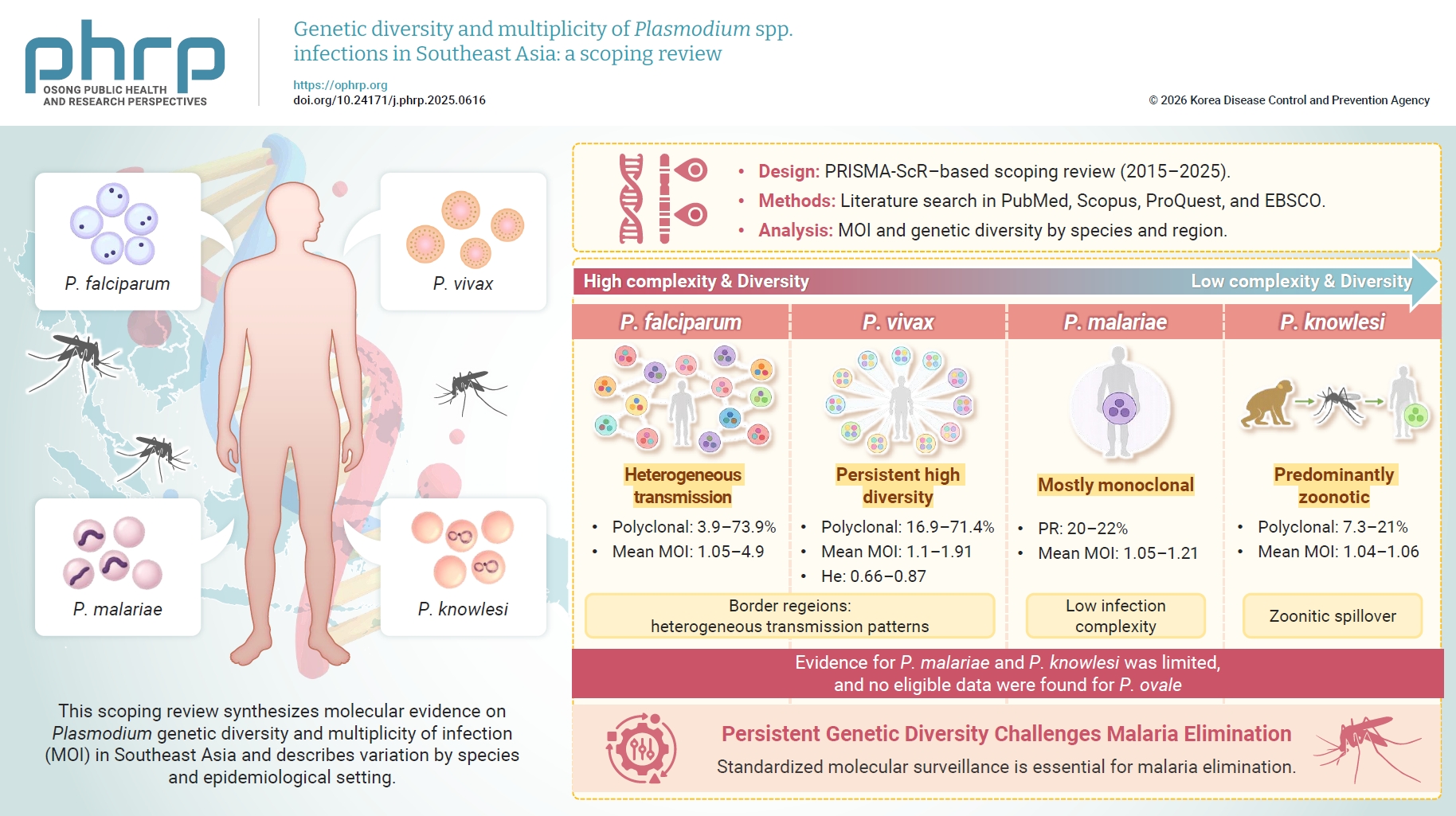
Objectives This scoping review synthesizes molecular evidence on Plasmodium genetic diversity and multiplicity of infection (MOI) in Southeast Asia and describes variation by species and epidemiological setting. Methods: Following Preferred Reporting Items for Systematic Reviews and Meta-Analyses Extension for Scoping Reviews guidelines, we searched PubMed, Scopus, ProQuest, and EBSCO for English language, open-access observational studies published between January 1, 2015 until October 11, 2025. Included studies involved laboratory-confirmed human malaria and reported MOI and genetic diversity data derived from appropriate molecular genotyping methods. Findings were summarized by species, geography, markers, and clinical categories. Results: Sixteen studies were included, comprising 1,609 genotyped Plasmodium falciparum infections, 1,526 Plasmodium vivax infections, 37 Plasmodium malariae infections, and 188 human Plasmodium knowlesi infections. P. falciparum exhibited marked heterogeneity, with polyclonal infection rates ranging from 3.9% to 73.9% and mean MOI ranging from 1.05 to 4.9. P. vivax consistently showed high diversity, with polyclonal infection rates ranging from 16.9% to 71.4% and mean MOI ranging from 1.1 to 1.91, alongside expected heterozygosity values of 0.66–0.87. P. malariae displayed low MOI, whereas P. knowlesi showed polyclonal infection rates ranging from 7.3% to 21% and mean MOI ranging from 1.04 to 1.06. No data were available for Plasmodium ovale. Conclusion: P. falciparum and P. vivax remain genetically diverse across Southeast Asia, with heterogeneous transmission patterns, particularly in border regions. Limited data on P. malariae, human P. knowlesi, and P. ovale highlight the need for standardized molecular surveillance to support targeted elimination efforts.
Objectives This review and meta-analysis examined the effectiveness of non-pharmacological therapies delivered through school-based interventions for smoking cessation among adolescents in South and Southeast Asian countries.
Methods A systematic search was conducted across PubMed, Scopus, Science Direct, BioMed Central, the Cochrane Library, and ProQuest Dissertations & Theses Global from inception to October 2024. Eligible studies comprised randomized controlled trials and quasi-experimental studies that compared non-pharmacological smoking cessation interventions delivered in schools or other educational institutions. Data on smoking abstinence outcomes were extracted from published studies, and odds ratios (ORs) with 95% confidence intervals (CIs) were pooled using a random-effects model via the Mantel-Haenszel estimator.
Results Seven studies involving 1,260 participants were included. The meta-analysis demonstrated that non-pharmacological school-based therapies significantly increased smoking abstinence compared to controls (OR, 2.83; 95% CI, 1.83–4.40; p<0.001. Subgroup analyzes revealed benefits across both randomized controlled trials and quasi-experimental studies with varying abstinence rates. Studies utilizing biochemical verification showed significant positive effects despite substantial heterogeneity, and short-term (<3 months) abstinence was significantly higher in intervention groups compared to controls. Overall, no differences were found between subgroups regarding intervention effectiveness.
Conclusion This meta-analysis indicates that non-pharmacological school-based interventions positively impact smoking abstinence rates, although effectiveness may vary based on study design, follow-up duration, and use of biochemical verification. The findings underscore the need for further research with larger sample sizes, extended follow-up periods, and improved methodological rigor in these regions.
Citations
Citations to this article as recorded by
Global disease burden of laryngeal cancer attributable to smoking from 1990 to 2021 Xiao Han, Shanchun Gong, Chao Wang, Yulin Zhang, Yufei Pan, Jing Li, Kai Liu, Zhenkun Yu European Journal of Cancer Prevention.2026; 35(4): 291. CrossRef
Adapting and Implementing a School-Based “Implementation Intentions” Program Within FRESHAIR4Life to Prevent Smoking Initiation Among Adolescents in Greece: A Study Protocol Izolde Bouloukaki, Antonios Christodoulakis, Sevasti Peraki, Floor A. Van Den Brand, Faraz Siddiqui, Theodoros Krasanakis, Antonia Aravantinou-Karlatou, Purva Abhyankar, Siân Williams, Julia van Koeveringe, Rianne MJJ van der Kleij, Ioanna Tsiligianni Healthcare.2026; 14(7): 938. CrossRef
This study aimed to establish a foundation for future collaborations aimed at preparing for and responding to infectious diseases by examining the vaccine injury compensation programs (VICPs) of East Asian countries. We reviewed the current status of VICPs in the Republic of Korea, Japan, and Taiwan by searching national government websites and reviewing relevant literature. Additionally, we conducted email inquiries targeting experts from Japan and Taiwan. Through the comprehensive analysis of VICPs in these 3 countries covered various aspects, we identified several similarities and differences in the VICPs across these countries. While the governments of the Republic of Korea, Japan, and Taiwan play a central role in supporting investigations into vaccine injuries and managing compensation procedures based on legal statutes, they differ in terms of financial resources for compensation, the range of vaccines covered, and the criteria for assessing causality. In the Republic of Korea, Japan, and Taiwan, compensation is typically paid in a lump sum, although the specific benefits available vary by country. This study on VICPs in the Republic of Korea, Japan, and Taiwan provides valuable insights for the further development and management of domestic systems.
Citations
Citations to this article as recorded by
The Vaccine That Was Never Mentioned: A Comparative Medico-Legal Analysis of the Duty to Inform and Document Preventive Immunization, with Proposed Practice Guidelines Sanit Thongsriratch, Therdpong Thongseiratch, Saratis Pairoh, Puttichart Khantee Vaccines.2026; 14(8): 664. CrossRef
Local Vaccine Manufacturing in Saudi Arabia: Examining the Role of National Legal Frameworks and Strategic Policies Tareq S. Alshammari Beijing Law Review.2025; 16(04): 2147. CrossRef
Objectives This study compared the research output of Association of Southeast Asian Nations (ASEAN) countries to understand research trends and clarify past, present, and future patterns using scientometric techniques.
Methods This scientometric study systematically mined health and social science publications from the Web of Science and Scopus databases using keywords associated with infectious disease. The analysis included only English-language articles and review articles by authors from any ASEAN country. Publication, citation, and text co-occurrence network analyses were performed. R Studio and VOSviewer enabled data management, analysis, and visualization.
Results Searches identified 12,511 articles published between 1925 and 2022, with a notable increase in research publications since 2003. The leading journals on infectious disease were associated with established publishing houses, including BMC, BMJ, and The Lancet. The most-cited articles were primarily global burden of disease studies, with 7,367 citations. Among ASEAN countries, Thailand, Malaysia, and Singapore had the most publications and collaborative efforts on the topic. Analysis of keyword co-occurrence revealed clusters related to global health, dengue, bacterial studies, non-dengue viral topics, and diagnostics. Most early studies examined diagnostics, gene and sequencing methodologies, and virology; later, the focus shifted toward herbal and alternative medicine.
Conclusion Recently, the research capacity of Southeast Asia has expanded dramatically, with substantial contributions from high-income countries. Intense cooperation between member states is essential, emphasizing the role of HICs in supporting their neighbors. Increased research efforts and collaboration must be dedicated to innovative approaches to combat persistent health conditions, along with emerging issues like climate change.
Citations
Citations to this article as recorded by
Epidemiological Trends and Predictive Modeling of Dengue Fever in the Association of Southeast Asian Nations (ASEAN) Countries Qian Ren, Ruoxi Li, Xiaojun Liu, Wei Hao, Xiaojie Zhou, Meide Liu, Hongjiang Zhang, Xinying Feng, Xiaogui Li, Ziwen Zhao, Weiwei Hu, Jianjun Zhang, Zhenjiang Xin Tropical Medicine and Infectious Disease.2025; 10(12): 329. CrossRef
Mangrove in Biodiversitas: A Systematic Review of Biodiversity, Blue Carbon, and Ecosystem Services in Southeast Asia (2020-2025) Rustam Anwar, Fitryane Lihawa, Dewi Wahyuni K Baderan, Marike Mahmud, Abdul Hafidz Olii, Hasim . International Journal of Research and Review.2020; : 51. CrossRef
Objectives This study aimed to estimate the transmission parameters, effective reproduction number, epidemic peak, and future exposure of coronavirus disease 2019 (COVID-19) in South Asian countries. Methods: A susceptible-exposed-infected-recovered-death (SEIRD) model programmed with MATLAB was developed for this purpose. Data were collected (till June 28, 2021) from the official webpage of World Health Organization, along with the Center for Systems Science and Engineering at Johns Hopkins University. The model was simulated to measure the primary transmission parameters. The reproduction number was measured using the next-generating matrix method. Results: The primary transmission rate followed an exponential Gaussian process regression. India showed the highest transmission rate (0.037) and Bhutan the lowest (0.023). The simulated epidemic peaks matched the reported peaks, thereby validating the SEIRD model. The simulation was carried out up to December 31, 2020 using the reported data till June 9, 2020. Conclusion: The information gathered in this research will be helpful for authorities to prevent the transmission of COVID-19 in the subsequent wave or in the future.
Citations
Citations to this article as recorded by
MODIFIED SEIRD MODEL: A NOVEL SYSTEM DYNAMICS APPROACH IN MODELLING THE SPREAD OF COVID-19 IN MALAYSIA DURING THE PRE-VACCINATION PERIOD Norsyahidah Zulkarnain, Nurul Farahain Mohammad, Ibrahim Shogar IIUM Engineering Journal.2023; 24(2): 159. CrossRef
<sec>
<title>Objectives</title>
<p>It was supposed to analyze status and affecting factors in water and food-borne communicable disease by screening entrants with diarrhea symptom at the point of entry in Korea</p></sec>
<sec>
<title>Methods</title>
<p>Symptomatic travelers with water and food-borne communicable diseases who entered Korea were diagnosed by a health declaration and detection of causative agents in water and food using laboratory tests. Among those entered in 2017, the affecting factors in the incidence of communicable diseases among those who had diarrhea at the entry into Korea, were analyzed, with frequency and chi-square test.</p></sec>
<sec>
<title>Results</title>
<p>The number of travel entrants with gastrointestinal communicable diseases increased by 40.19% from 2013 to 2017. The percentage of causative agents of water and food-borne communicable diseases was the highest at 69.2% from July to September. The rate of detection of causative agents of communicable disease pathogens in travelers from Southeast Asia entering Korea was 70.2%, which was higher than people arriving from East Asia and Central Asia (57.5%; <italic>p</italic> < 0.001).</p></sec>
<sec>
<title>Conclusion</title>
<p>The positive ratio of causative agents of water and food-borne communicable diseases was high among travelers that had entered Korea from July to September, with a high number among entrants from Southeast Asia. Based on the positive detection of causative agents, the entry period and countries visited were statistically significant affecting factors (<italic>p</italic> < 0.001).</p></sec>
Objectives
One of the most common head and neck cancers is nasopharynx cancer. Knowledge about the incidence and mortality of this disease and its distribution in terms of geographical areas is necessary for further study and better planning. Therefore, this study was conducted with the aim of determining the incidence and mortality rates of nasopharynx cancer and its relationship with the Human Development Index (HDI) in Asia in 2012. Methods
The aim of this ecologic study was to assess the correlation between age-specific incidence rate (ASIR) and age-specific mortality rate (ASMR) with HDI and its components, which include the following: life expectancy at birth, mean years of schooling, and gross national income per capita. Data about SIR and SMR for every Asian country for 2012 were obtained from the global cancer project. We used the correlation bivariate method for the assessment. Statistical significance was assumed if <i>p</i> < 0.05. All reported <i>p</i> values are two-sided. Statistical analyses were performed using SPSS (Version 15.0, SPSS Inc.). Results
A total of 68,272 cases (males, 71.02%; females, 28.97%; sex ratio, 2.45) and 40,530 mortalities (males, 71.63%; females, 28.36%; sex ratio, 2.52) were recorded in Asian countries in 2012. The five countries with the highest ASIR of nasopharynx cancer were Malaysia, Singapore, Indonesia, Vietnam, and Brunei, and the five countries with the highest ASMR were Indonesia, Vietnam, Singapore, Malaysia, and Brunei. The correlation between HDI and ASIR was 0.097 (<i>p</i> = 0.520) [0.105 in men (<i>p</i> = 0.488) and 0.119 in women (<i>p</i> = 0.901)]. The correlation between HDI and ASMR was –0.102 (<i>p</i> = 0.502) [–0.072 in men (<i>p</i> = 0.633) and –0.224 in women (<i>p</i> = 0.134)]. Conclusion
Nasopharynx cancer is native to Southeast Asia. The highest incidence and mortality rates are found in Malaysia, Singapore, Indonesia, Vietnam, and Brunei. No significant relation was found between the standardized incidence and mortality rates of nasopharynx cancer and the HDI components. Further studies are recommended in Southeast Asian countries in order to find the etiology of cancer, as well as its diagnosis and treatment.
Citations
Citations to this article as recorded by
Role of temporal variation of spatial inequality in epidemiology Soumendra Nath Ruz, Asim Ghosh Physica A: Statistical Mechanics and its Applicati.2026; 698: 131775. CrossRef
Nasopharynx Cancer in the United States: Racial and Ethnic Disparities in Stage at Presentation Edward Christopher Dee, Stephanie Wang, Frances Dominique V. Ho, Roshal R. Patel, Kaitlyn Lapen, Yingzhi Wu, Fan Yang, Tej A. Patel, Erin Jay G. Feliciano, Sean M. McBride, Nancy Y. Lee The Laryngoscope.2025; 135(3): 1113. CrossRef
WITHDRAWN: Clinical Characteristics and Mechanisms of Syncope in Nasopharyngeal Carcinoma: A Systematic Review Achmad Chusnu Romdhoni, Pandit Bagus Tri Saputra, Jannatin Nisa Arnindita, Ali Mustofa, Danial Habri Arsyi, Farizky Martriano Humardani, Nando Reza Pratama Heliyon.2025; : e42939. CrossRef
Potential toxicity benefit and inter-fraction robustness of proton arc therapy compared to IMPT and VMAT for nasopharyngeal cancer patients B A de Jong, A Maring, Werkman CI, J Sundström, D Cannavò, A van der Schaaf, D Scandurra, E Engwall, E W Korevaar, G Janssens, J A Langendijk, S Both Physics in Medicine & Biology.2025; 70(10): 105007. CrossRef
Incidence patterns of rare cancer in southeast Asian and western Pacific countries (RARECAREnet Asia project): a study using population-based cancer registry data, 2011–2015 Patumrat Sripan, Siti Norbayah Yusof, Donsuk Pongnikorn, Imjai Chitapanarux, Balqis Bahtiar, Nor Saleha Ibrahim Tamin, Karnchana Daoprasert, Narate Waisri, Young-Joo Won, RuRu Chun-Ju Chiang, Annalisa Trama, Hadrien Charvat, Kriengkrai Srithanaviboonchai, The Lancet Regional Health - Southeast Asia.2025; 41: 100670. CrossRef
From Viral Infection to Malignancy: The Dual Threat of EBV and COVID-19 in Cancer Development Moyed Alsaadawe, Bakeel A. Radman, Longtai Hu, Jingyi Long, Qingshuang Luo, Chushu Tan, Hadji Sitti Amirat, Mohenned Alsaadawi, Xiaoming Lyu Viruses.2025; 17(9): 1195. CrossRef
Nasopharyngeal Carcinoma and Head and Neck Cancer in Type 2 Diabetes after SGLT2I, DPP4I, and GLP1a Use Lifang Li, Oscar Hou-In Chou, Kar Kei Mak, Yifan Yang, Cheuk To Chung, Guoliang Li, Catherine Po Ling Chan, Wing Tak Wong, Tong Liu, Bernard Man Yung Cheung, Gary Tse, Jiandong Zhou Cancer Prevention Research.2025; 18(10): 625. CrossRef
Non-Invasive Detection of Nasopharyngeal Carcinoma Using Volatile Organic Compounds Chuan Hao Gui, Zhunan Jia, Alex Chengyao Tham, Khai Beng Chong, Zihao Xing, Fuchang Zhang, Fang Du, Yaw Khian Chong, Hao Li, Ernest Weizhong Fu, Jereme Yijin Gan, Agnes Si Qi Chew, Ming Yann Lim Metabolites.2025; 15(9): 632. CrossRef
Sound Progress? Asian Representation in Otolaryngology Residency Programs: A 5‐Year Update Amy Wang, Yuki Yoshiyasu, Brian McKinnon, Tyler Janz Laryngoscope Investigative Otolaryngology.2025;[Epub] CrossRef
Detection of 30bp deletion LMP1 oncogene as potential diagnostic and prognostic Biomarker among nasopharyngeal carcinoma patients Aseel Al-Hussien, Mai Abusalah, Yaqeen Rjoub, Khaled Al-Qaoud, Anwar Rjoop, Yasmin AlSaidat, Lubna H Khwaileh, Manal Abusalah, Naveed Ahmed Electronic Journal of General Medicine.2025; 22(6): em703. CrossRef
Development of machine learning models for survival prediction in nasopharyngeal carcinoma using population-based data Guoxiang Lin, Qiyan Mo, Lu Han, Shaohan Sun, Zhiqiang Xiao, Weiming Zhang Discover Oncology.2025;[Epub] CrossRef
Nasopharyngeal Carcinoma in Southeast Asia: Current Landscape and Future Priorities Suat Ming Chan, Ian C. Paterson, Lee Fah Yap British Journal of Biomedical Science.2025;[Epub] CrossRef
Regulatory role of miRNAs in nasopharyngeal cancer involving PTEN/PI3K/AKT, TGFβ/SMAD, RAS/MAPK, Wnt/β‐catenin and pRB‐E2F signaling pathways: A review Rabiatul Basria S. M. N. Mydin, Adam Azlan, Simon I. Okekpa, Nigel J. Gooderham Cell Biochemistry and Function.2024;[Epub] CrossRef
Rapid and sensitive detection of Epstein-Barr virus antibodies in nasopharyngeal carcinoma by chemiluminescence strips based on iron-porphyrin single atom nanozyme Daji Wang, Jie Wang, Dan Liu, Jiuyang He, Meiying Wang, Haibing Huang, Guohui Nie, Hui Ding, Xiyun Yan Nano Research.2024; 17(3): 1827. CrossRef
The association between chronic sinonasal inflammation and nasopharyngeal carcinoma - A systematic review and meta-analysis Yuxing Wang, Kylynn Kathleen Koh, Elizabeth Chua, Kimberley Liqin Kiong, Yu Heng Kwan, Tze Choong Charn American Journal of Otolaryngology.2024; 45(2): 104206. CrossRef
Factors influencing presentation delay among cancer patients: a cross-sectional study in Malaysia Tshewang Gyeltshen, Hoon Shien Teh, Ching Ee Loo, Nicholas Yee Liang Hing, Wei Yin Lim, Shridevi Subramaniam, Wen Jun Wong, Zoie Shui-Yee Wong, Wen Yea Hwong BMC Public Health.2024;[Epub] CrossRef
Correlation between socioeconomic indices and epidemiological indices of thyroid cancer from 1990 to 2019 year: a global ecologic study Zahra Maleki, Jafar Hassanzadeh, Haleh Ghaem BMC Cancer.2024;[Epub] CrossRef
Study on carotid artery stenosis after radiotherapy for nasopharyngeal carcinoma JunMei Song, Luo Lan, YuQing Lv, YaJing Wen, Min Kang, RenSheng Wang Journal of Cancer Research and Clinical Oncology.2024;[Epub] CrossRef
Nasopharyngeal cancer mortality in disaggregated Asian and non‐Asian Americans George A. Hung, Sanah Vohra, Gina Kim, Armaan Jamal, Malathi Srinivasan, Robert J. Huang, Gloria Kim, Latha Palaniappan, A. Dimitrios Colevas Head & Neck.2024; 46(12): 3046. CrossRef
Study of Three Potential Diagnostic Biomarkers in Nasopharyngeal Carcinoma Samples from Guilan, North of Iran Saghi Jani Kargar Moghaddam, Amaneh Mohammadi Roushandeh, Mehryar Habibi Roudkenar, Shadman Nemati, Nima Najafi-Ghalehlou, Toofan Pakzad, Masoud Hamidi International Archives of Otorhinolaryngology.2023; 27(03): e461. CrossRef
Oncogenic Viruses-Encoded microRNAs and Their Role in the Progression of Cancer: Emerging Targets for Antiviral and Anticancer Therapies Mahmoud Kandeel Pharmaceuticals.2023; 16(4): 485. CrossRef
Nasopharyngeal Carcinoma Subtype Discovery via Immune Cell Scores from Tumor Microenvironment Yanbo Sun, Yun Liu, Hanqi Chu, Zhen-Jian Zhuo Journal of Immunology Research.2023; 2023: 1. CrossRef
The application of Aptamer in biomarker discovery Yongshu Li, Winnie Wailing TAM, Yuanyuan Yu, Zhenjian Zhuo, Zhichao Xue, Chiman Tsang, Xiaoting Qiao, Xiaokang Wang, Weijing Wang, Yongyi Li, Yanyang Tu, Yunhua Gao Biomarker Research.2023;[Epub] CrossRef
Blood-based DNA methylation in advanced Nasopharyngeal Carcinoma exhibited distinct CpG methylation signature Koustav Chatterjee, Sudipa Mal, Monalisha Ghosh, Nabanita Roy Chattopadhyay, Sankar Deb Roy, Koushik Chakraborty, Syamantak Mukherjee, Moatoshi Aier, Tathagata Choudhuri Scientific Reports.2023;[Epub] CrossRef
Circular RNA circ_0008450 regulates the proliferation, migration, invasion, apoptosis and chemosensitivity of CDDP-resistant nasopharyngeal carcinoma cells by the miR-338-3p/SMAD5 axis Lin Liu, Bin Lu, Yan Li Anti-Cancer Drugs.2022; 33(1): e260. CrossRef
Hypermethylation of the RASSF1A gene promoter as the tumor DNA marker for nasopharyngeal carcinoma Thuan Duc Lao, Hue Hong Thieu, Dung Huu Nguyen, Thuy Ai Huyen Le The International Journal of Biological Markers.2022; 37(1): 31. CrossRef
miR-135b-5p Targets SIRT1 to Inhibit Deacetylation of c-JUN and Increase MMP7 Expression to Promote Migration and Invasion of Nasopharyngeal Carcinoma Cells Yali Cheng Molecular Biotechnology.2022; 64(6): 693. CrossRef
Trends in the Incidence of Nasopharyngeal Cancer in Saudi Arabia Across One Decade (2007 to 2016) Abdualrahman F Kabli, Khalil F Miyajan, Abdulmohsen S Alqurashi, Ammar K Mandili, Revan M Mujahed, Bayan F Hafiz, Roaa M Mandora, Ameen Z Herabi Cureus.2022;[Epub] CrossRef
Causes of Death in Long-Term Nasopharyngeal Carcinoma Survivors Shi-Ping Yang, Ming-Yue Rao, Qing-Shuang Chen, Ping Zhou, Chen-Lu Lian, San-Gang Wu Frontiers in Public Health.2022;[Epub] CrossRef
Epstein-Barr Virus (EBV) Is Mostly Latent and Clonal in Angioimmunoblastic T Cell Lymphoma (AITL) Racha Bahri, François Boyer, Mohamad Adnan Halabi, Alain Chaunavel, Jean Feuillard, Arnaud Jaccard, Sylvie Ranger-Rogez Cancers.2022; 14(12): 2899. CrossRef
Ferroptosis-related gene ATG5 is a novel prognostic biomarker in nasopharyngeal carcinoma and head and neck squamous cell carcinoma Ming Shi, Jiangnan Du, Jingjing Shi, Yunchuanxiang Huang, Yan Zhao, Lan Ma Frontiers in Bioengineering and Biotechnology.2022;[Epub] CrossRef
Platelet to Lymphocytes Ratio to Predict Nasopharyngeal Carcinoma Progressivity Goesti Yudistira, Yussy Afriani Dewi, Melati Sudiro Open Access Macedonian Journal of Medical Sciences.2022; 10(B): 2189. CrossRef
Skin Sparing in Intensity-Modulated Radiation Therapy of Nasopharyngeal Carcinoma Misba Hamid Baba, Benoy K Singh, Shaq ul Qamar Wani Journal of Medical Physics.2022; 47(3): 243. CrossRef
Assessment of Response to Chemoradiation and Radiation Therapy in Patients with Nasopharyngeal Carcinoma Sebastian Ario Susanto, Yussy Afriani Dewi, Raden Ayu Hardianti Saputri Open Access Macedonian Journal of Medical Sciences.2022; 10(B): 2307. CrossRef
Genetic variants in NKG2D axis and susceptibility to Epstein–Barr virus-induced nasopharyngeal carcinoma Nguyen Hoang Viet, Nguyen Quang Trung, Le Thanh Dong, Ly Quoc Trung, J. Luis Espinoza Journal of Cancer Research and Clinical Oncology.2021; 147(3): 713. CrossRef
Corticosteroid Therapy in Optic Neuropathy Secondary to Nasopharyngeal Carcinoma Zulaikha Wahab, Evelyn Tai, Wan-Hazabbah Wan Hitam, Khairy Shamel Sonny Teo Cureus.2021;[Epub] CrossRef
The Effect of Hispidulin, a Flavonoid from Salvia plebeia, on Human Nasopharyngeal Carcinoma CNE-2Z Cell Proliferation, Migration, Invasion, and Apoptosis Yiqun Dai, Xiaolong Sun, Bohan Li, Hui Ma, Pingping Wu, Yingping Zhang, Meilin Zhu, Hong-Mei Li, Minjian Qin, Cheng-Zhu Wu Molecules.2021; 26(6): 1604. CrossRef
δ-Tocotrienol induces apoptosis and inhibits proliferation of nasopharyngeal carcinoma cells Junjun Shen, Tao Yang, Yiping Tang, Tianyi Guo, Ting Guo, Tao Hu, Feijun Luo, Qinlu Lin Food & Function.2021; 12(14): 6374. CrossRef
WNT8B as an Independent Prognostic Marker for Nasopharyngeal Carcinoma Chawalit Ngernsombat, Pongphol Prattapong, Noppadol Larbcharoensub, Krittika Khotthong, Tavan Janvilisri Current Oncology.2021; 28(4): 2529. CrossRef
Nasopharyngeal Carcinoma and Its Association with Epstein-Barr Virus Harish N. Vasudevan, Sue S. Yom Hematology/Oncology Clinics of North America.2021; 35(5): 963. CrossRef
Association between stage and histopathological type of nasopharyngeal cancer on occurrence of postirradiation otitis media with effusion Lina Lasminingrum, Shinta Fitri Boesoeri, Sally Mahdiani, Eveline Sabrina Ranti International Journal of Surgery Open.2021; 36: 100376. CrossRef
Current Status and Future Perspectives about Molecular Biomarkers of Nasopharyngeal Carcinoma Pui Yan Siak, Alan Soo-Beng Khoo, Chee Onn Leong, Boon-Peng Hoh, Shiau-Chuen Cheah Cancers.2021; 13(14): 3490. CrossRef
Carcinomatous‑like mastitis due to axillary lymphadenopathy in a case of nasopharyngeal carcinoma: A case report Cristina Oprean, Nusa Segarceanu, Alexandra Stan, Cristian Suciu, Daciana Grujic, Ioana Rivis, Alis Liliana Dema, Ana Bredicean Experimental and Therapeutic Medicine.2021;[Epub] CrossRef
Dosimetric Comparison of Helical Tomotherapy, Volume-Modulated Arc Therapy, and Fixed-Field Intensity-Modulated Radiation Therapy in Locally Advanced Nasopharyngeal Carcinoma Shan Lu, Huiqi Fan, Xueyuan Hu, Xin Li, Yingying Kuang, Deyang Yu, Shanshan Yang Frontiers in Oncology.2021;[Epub] CrossRef
The dosimetric comparison between tomotherapy and RapidArc in normal tissue sparing for nasopharyngeal carcinoma Pubade Kaewpruk, Somvilai Chakrabandhu, Somsak Wanwilairat, Wannapha Nobnop Journal of Radiotherapy in Practice.2020; 19(3): 237. CrossRef
Combination of Plasma MIF and VCA-IgA Improves the Diagnostic Specificity for Patients With Nasopharyngeal Carcinoma Ning Xue, Shan Xing, Weiguo Ma, Jiahe Sheng, Zhiliang Huang, Qingxia Xu Technology in Cancer Research & Treatment.2020;[Epub] CrossRef
Pathological features of nasopharyngeal carcinoma: A single-center study in Vietnam Nguyen Cuong Pham, Thanh Xuan Nguyen, Nguyen Tuong Pham, Thanh Chinh Phan, Hai Thanh Phan Annals of Cancer Research and Therapy.2020; 28(2): 125. CrossRef
Association between variant alleles of major histocompatibility complex class II regulatory genes and nasopharyngeal carcinoma susceptibility Ping Zhou, Sha Liu, Nan-Nan Ji, Shuang Zhang, Peng Wang, Bing Lin, Ping Yang, Xian-Tao Lin, Yi-Zheng Cai, Zi-Ming Wang, Han Zhou, Shi-Yao Sun, Xin-Bao Hao European Journal of Cancer Prevention.2020; 29(6): 531. CrossRef
Hyperperfusion Syndrome and Baroreflex Failure following Carotid Artery Angioplasty and Stenting for Symptomatic Radiation-Associated Carotid Artery Stenosis Hui-Meng Chang Case Reports in Neurology.2020; 12(Suppl. 1): 76. CrossRef
Novel patterns of the Epstein-Barr nuclear antigen (EBNA-1) V-Val subtype in EBV-associated nasopharyngeal carcinoma from Vietnam LD Thuan, ND Kha, NT Minh, LHA Thuy Balkan Journal of Medical Genetics.2019; 22(1): 61. CrossRef
miR-29c regulates resistance to paclitaxel in nasopharyngeal cancer by targeting ITGB1 Limin Huang, Chaoquan Hu, Hui Chao, Rongpin Wang, He Lu, Hong Li, Hui Chen Experimental Cell Research.2019; 378(1): 1. CrossRef
Systematic review and meta-analysis of prognostic microRNA biomarkers for survival outcome in nasopharyngeal carcinoma Shanthi Sabarimurugan, Chellan Kumarasamy, Siddhartha Baxi, Arikketh Devi, Rama Jayaraj, Yukinori Takenaka PLOS ONE.2019; 14(2): e0209760. CrossRef
Epstein‐Barr virus strain variation and cancer Teru Kanda, Misako Yajima, Kazufumi Ikuta Cancer Science.2019; 110(4): 1132. CrossRef
Nasopharyngeal cancer in Saudi Arabia: Epidemiology and possible risk factors Abdullah Dakheel Alotaibi, Hussain Gadelkarim Ahmed, Abdelbaset Mohamed Elasbali Journal of Oncological Sciences.2019; 5(1): 23. CrossRef
Association BetweenLMP-1,LMP-2, and miR-155 Expression as Potential Biomarker in Nasopharyngeal Carcinoma Patients: A Case/Control Study in Vietnam Thuan Duc Lao, Thuy Ai Huyen Le Genetic Testing and Molecular Biomarkers.2019; 23(11): 815. CrossRef
Lapatinib sensitivity in nasopharyngeal carcinoma is modulated by SIRT2-mediated FOXO3 deacetylation Sathid Aimjongjun, Zimam Mahmud, Yannasittha Jiramongkol, Glowi Alasiri, Shang Yao, Ernesto Yagüe, Tavan Janvilisri, Eric W.-F. Lam BMC Cancer.2019;[Epub] CrossRef
PPARβ/δ Agonist GW501516 Inhibits Tumorigenicity of Undifferentiated Nasopharyngeal Carcinoma in C666-1 Cells by Promoting Apoptosis Yangyang Ji, Hui Li, Fang Wang, Linglan Gu Frontiers in Pharmacology.2018;[Epub] CrossRef
Pembrolizumab in Asia‐Pacific patients with advanced head and neck squamous cell carcinoma: Analyses from KEYNOTE‐012 Makoto Tahara, Kei Muro, Yasuhisa Hasegawa, Hyun Cheol Chung, Chia‐Chi Lin, Bhumsuk Keam, Kenichi Takahashi, Jonathan D. Cheng, Yung‐Jue Bang Cancer Science.2018; 109(3): 771. CrossRef
Childhood Nasopharyngeal Carcinoma (NPC): A Review of Clinical-Imaging Features and Recent Trends in Management Mark Yoi Sun Soo International Journal of Pediatrics and Child Heal.2018; 6: 1. CrossRef
KISS1gene suppresses metastasis of nasopharyngeal cancerviaactivation of the ERK1/2 pathway Tingting Li, Qian Sun, Yan Zhou, Zelai He, Hao Liu, Ping Xiang, Jin Xi, Xiazi Zhang, Hao Jiang RSC Advances.2017; 7(84): 53445. CrossRef
Objectives
Obesity is one of the most serious health problems in the world today. Asian Americans are usually less overweight and obese than African Americans and Hispanic Americans, but the rate of obesity in Asian Americans is still increasing, especially in younger generations. This research examines Asian American obesity using existing research, as a means of finding the need for greater emphasis on Asian American obesity intervention research. Methods
In this research literature review, Asian American obesity using existing research as a means of finding the need for greater emphasis on Asian American obesity intervention research is examined. A systematic review is done in order to find Asian American obesity research, due to the minimal amount of existing studies. In total, there were only nine papers which were not duplicates and which still met the criteria for inclusion, from an initial 106 papers. Results
There is very little research on obesity in Asian Americans. Although the rate of obesity among Asian Americans is increasing, there are few related articles, projects, and surveys, and there is little information. There is a need for more specific and in-depth analysis of Asian American obesity. Asian Americans are associated with a lower waist circumference (WC) and BMI, while Hawaiian/Pacific Islanders are associated with a higher WC and BMI. Typically, Asian Americans who were born in the United States (US) tend to be overweight and more obese than those born in foreign countries. Conclusion
Based on this literature review, it is concluded that there is a shortage of Asian American obesity research, even though there is an evident need for particular obesity intervention programs that target Asian Americans.
Citations
Citations to this article as recorded by
Turning the Health Equity Lens to Diversity in Asian American Health Profiles Lan N. Ðoàn, Michelle M. Chau, Naheed Ahmed, Jiepin Cao, Sze Wan Celine Chan, Stella S. Yi
Annual Review of Public Health
.2024; 45(1): 169. CrossRef
Southern California Asian Americans and the Obesity Epidemic: A Qualitative Study to Improve Understanding and Cultural Competence Alyssa Mae Carlos, Kathleen Doll American Journal of Health Education.2023; 54(6): 463. CrossRef
The posterior tibial artery free flap for head and neck reconstruction Alexandra E. Kejner Current Opinion in Otolaryngology & Head & Neck Su.2022; 30(5): 358. CrossRef
Heterogeneity in Obesity Prevalence Among Asian American Adults Nilay S. Shah, Cecily Luncheon, Namratha R. Kandula, Sadiya S. Khan, Liping Pan, Cathleen Gillespie, Fleetwood Loustalot, Jing Fang Annals of Internal Medicine.2022; 175(11): 1493. CrossRef
Fruit and Vegetable Consumption Behavior Among Asian Americans: A Thematic Analysis Chia-Liang Dai, Manoj Sharma, Taj Haider, Hema Sunchu Journal of Primary Care & Community Health.2021;[Epub] CrossRef
The effect of racial discrimination on mental and physical health: A propensity score weighting approach Shanting Chen, Allen B. Mallory Social Science & Medicine.2021; 285: 114308. CrossRef
Ethnic Enclaves and Pregnancy and Behavior Outcomes Among Asian/Pacific Islanders in the USA Andrew D. Williams, Lynne C. Messer, Jenna Kanner, Sandie Ha, Katherine L. Grantz, Pauline Mendola Journal of Racial and Ethnic Health Disparities.2020; 7(2): 224. CrossRef
Developing a Socioculturally Nuanced Systems Model of Childhood Obesity in Manhattan’s Chinese American Community via Group Model Building Ewelina Swierad, Terry T.-K. Huang, Ellis Ballard, Karen Flórez, Sheng Li Journal of Obesity.2020; 2020: 1. CrossRef
Healthy Living Behaviors Among Chinese–American Preschool-Aged Children: Results of a Parent Survey Virginia Rall Chomitz, Alison Brown, Victoria Lee, Aviva Must, Kenneth Kwan Ho Chui Journal of Immigrant and Minority Health.2018; 20(4): 926. CrossRef
Obesity Prevention Behaviors in Asian Indian Adolescent Girls: A Pilot Study Annie Thomas, Linda Janusek Journal of Pediatric Nursing.2018; 42: 9. CrossRef
RETRACTED: Filipinos Fit and Trim - A feasible and efficacious DPP-based intervention trial Melinda S. Bender, Bruce A. Cooper, Elena Flowers, Raymond Ma, Shoshana Arai Contemporary Clinical Trials Communications.2018; 12: 76. CrossRef
The neighborhood environment and obesity: Understanding variation by race/ethnicity Michelle S. Wong, Kitty S. Chan, Jessica C. Jones-Smith, Elizabeth Colantuoni, Roland J. Thorpe, Sara N. Bleich Preventive Medicine.2018; 111: 371. CrossRef
STRIVE, San Diego! Methodology of a Community-Based Participatory Intervention to Enhance Healthy Dining at Asian and Pacific Islander Restaurants Sarah Oropeza, Mary Grace Sadile, Chantine Nguyen Phung, Moana Cabiles, Sandy Spackman, Myleen Abuan, Fe Seligman, Maria Rosario Araneta Journal of Nutrition Education and Behavior.2018; 50(3): 297. CrossRef
Geographic differences in obesity prevalence and its risk factors among Asian Americans: findings from the 2013–2014 California Health Interview Survey Shaoqing Gong, Kesheng Wang, Ying Li, Arsham Alamian Scientific Reports.2018;[Epub] CrossRef
American Heart Association’s Ideal Cardiovascular Health Metrics in Under-Represented Asian Americans Freda Patterson, Guo Zhang, Adam Davey, Yin Tan, Grace X. Ma Journal of Community Health.2016; 41(6): 1282. CrossRef
Genes and the intergenerational transmission of BMI and obesity Timothy J. Classen, Owen Thompson Economics & Human Biology.2016; 23: 121. CrossRef
Shigellosis is a global disease as food poisoning by infection of <i>Shigella</i> spp (<i>S. dysenteriae</i>, <i>S. flexneri</i>, <i>S. boydii</i> and <i>S. sonnei</i>). In Korea, approximately 500 cases of shigellosis have reported every year since 2004, and imported shigellosis is increasing gradually from 2006 in particular. According to increase of numbers of overseas travelers, the numbers of patients diseased with imported shigellosis is also increasing. We need continuous surveillance studies network (SSN) for control of imported shigellosis. We studied epidemiological characteristic of imported shigellosis by using database of Korea Centers for Disease Control and Prevention (KCDC) from 2010 to 2011. The imported shigellosis is analyzed on correlation with variable factors such as sex, age, symptom, visited country as well as <i>Shigella</i> spp in the database. Total 399 patients diseased with shigellosis have been reported between 2010 and 2011, The 212 patients (53.1%) among them were disease with imported shigellosis and the 205 patients (96.7%) were diagnosed as definite shigellosis. <i>Shigella</i> sonnei (65.6%) and <i>Shigella flexneri</i> (20.3%) were isolated in order. Clinical symptoms of the shigellosis were diarrhea (96.5%), abdominal pain (54.7%), fever (52.8%), chill (31.6%), and weakness (21.7% etc) in order. Duration of diarrhea was 1 to 5 days, the number of diarrhea was mostly more than 10 times, and type of stool was almost yellow stool. Almost shigellosis was occurred in the travelers visited to Asia (98.1%). Particularly, the occurrence rate of shigellosis was highest in traveler visited to Southeast Asia which is India (21.7%), Cambodia (19.8%), Philippines (17.9%), and Vietnam (9.0%) in order. According to increase of traveler to Southeast Asia, imported Shigellosis also increased. We need to strengthen the public health and hygiene, which is infection prevention rules, eating properly-cook food, washing hands, drinking boiled water, for traveler to Asia. The quarantine and surveillance system to control imported shigellosis is need continually in Korea.
Citations
Citations to this article as recorded by
An in vivo acute toxicity and anti-shigellosis effect of designed formulation on rat Devendra Singh, Vishnu Agarwal Journal of Ayurveda and Integrative Medicine.2023; 14(1): 100536. CrossRef
Shigellosis in Southeast Asia: A systematic review and meta-analysis Basilua Andre Muzembo, Kei Kitahara, Debmalya Mitra, Ayumu Ohno, Januka Khatiwada, Shanta Dutta, Shin-Ichi Miyoshi Travel Medicine and Infectious Disease.2023; 52: 102554. CrossRef
Epidemic Trends of Imported Shigellosis Cases in Korea and Japan, 2016–2020 Won-Chang Lee, Myeon-Jin Lee, Kyu Sung Kim, Young Hwan Kwon The Korean Journal of Aerospace and Environmental .2023; 33(3): 71. CrossRef
History and Epidemiology of Bacillary Dysentery in Korea: from Korean War to 2017 Hyunjoo Pai Infection & Chemotherapy.2020; 52(1): 123. CrossRef
Principal Component Analysis for Clustering Probiotic-Fortified Beverage Matrices Efficient in Elimination of Shigella sp. Srijita Sireswar, Didier Montet, Gargi Dey Fermentation.2018; 4(2): 34. CrossRef
Importation of travel-related infectious diseases is increasing in South Korea: An analysis of salmonellosis, shigellosis, malaria, and dengue surveillance data Young-June Choe, Seung-Ah Choe, Sung-Il Cho Travel Medicine and Infectious Disease.2017; 19: 22. CrossRef
Current state on the development of nanoparticles for use against bacterial gastrointestinal pathogens. Focus on chitosan nanoparticles loaded with phenolic compounds Ana Raquel Madureira, Adriana Pereira, Manuela Pintado Carbohydrate Polymers.2015; 130: 429. CrossRef
Objectives
The epidemiological patterns of endemic hepatitis A virus (HAV) are unclear in northeastern Asia depending on the ethnicity of the country in question. The purpose of this study was to investigate the seroprevalence of HAV in northeastern China, South Korea, and Japan. Methods
A total of 1,500 serum samples were collected from five groups of inhabitants (300 each) who were over 40 years of age (Korean Chinese, indigenous Chinese, South Korean, Korean living in Japan, and indigenous Japanese). The samples were screened for antibodies to HAV using an enzyme-linked immunosorbent assay. Results
Positivity for HAV antibodies was 93.7% (95% confidence interval [CI]: 90.9–96.4) in Koreans living in northeastern China, 99.7% (95% CI: 99.0–100.3) in indigenous Chinese, 98.0% (95% CI: 96.4–99.6) in indigenous Koreans, 33.3% (95% CI: 28.0–38.7) in Koreans living in Japan, and 20.4% (95% CI: 15.8–25.0) in indigenous Japanese persons. The overall anti-HAV prevalence was not significantly different between northeastern China and South Korea, but it was different in Japan. Conclusions
These results indicate that differences in seroprevalence can be attributed to geological, environmental, and socioeconomic conditions rather than ethnicity.
Citations
Citations to this article as recorded by
Prevalence of Anti-Hav IgG Antibodies in the Population of the Łódź Macroregion by Age Group Gabriela Henrykowska, Kornelia Kotecka, Aleksandra Jabłkowska, Andrzej Buczyński, Joanna Woźny Polish Hyperbaric Research.2021; 76(3): 67. CrossRef
Sero-prevalence of viral hepatitis A in a district of Sri Lanka: a community based cross-sectional study Nalin Ariyarathna, Chrishantha Abeysena BMC Infectious Diseases.2019;[Epub] CrossRef
Seroprevalence of Hepatitis A among Children and Young Adults Residing in Tehran, Iran: Implication for HAV Vaccination Amitis Ramezani, Mohammad Reza Aghasadeghi, Setareh Mamishi, Shahram Sabeti, Farahnaz Bidari - Zerehpoosh, Mohammad Banifazl, Anahita Bavand, Sahar Shadanlou, Arezoo Aghakhani Hepatitis Monthly.2018;[Epub] CrossRef
Seroepidemiology of Hepatitis Viruses and Hepatitis B Genotypes of Female Marriage Immigrants in Korea Jae-Cheol Kwon, Hye Young Chang, Oh Young Kwon, Ji Hoon Park, In Soo Oh, Hyung Joon Kim, Jun Hyung Lee, Ha-Jung Roh, Hyun Woong Lee Yonsei Medical Journal.2018; 59(9): 1072. CrossRef
Seroprevalence of Helicobacter pylori and Hepatitis A Virus among Children in Rural Central Taiwan Meng-Che Wu, Chia-Hsing Sung, Yu-Chuan Chang, Chi-Lin Ho, Chih-Chiang Wu, Kuei-Hua Wu, Chun-Yi Lee, Kuen-Der Yang Japanese Journal of Infectious Diseases.2015; 68(6): 494. CrossRef




 First
 Prev


