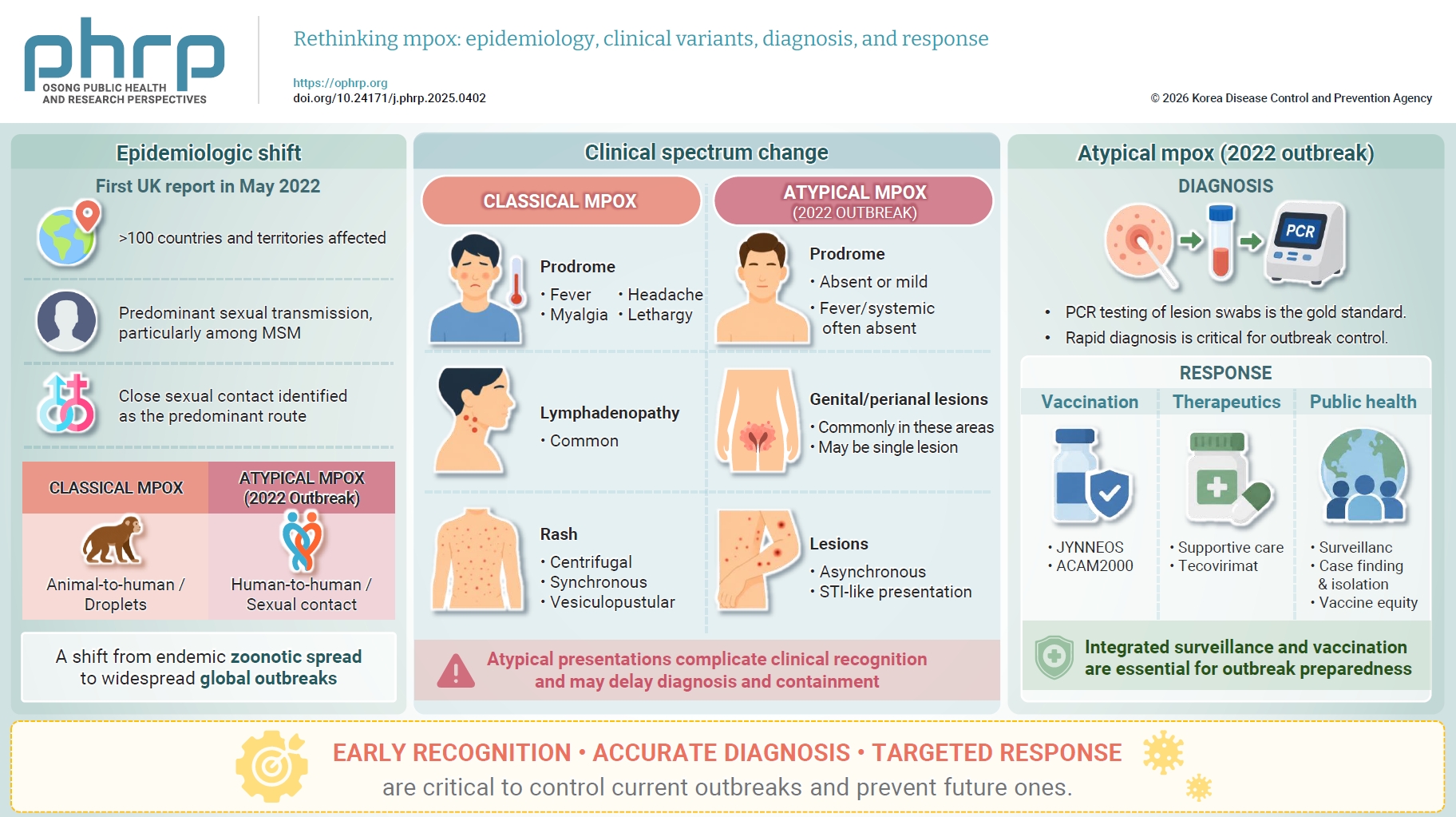
Monkeypox disease, now commonly referred to as mpox, was once considered a geographically restricted zoonotic disease but has emerged as a global public health concern. The 2022 multinational outbreak marked a turning point, with notable shifts in transmission dynamics, affected populations, and clinical manifestations. Classical cases typically involve fever, lymphadenopathy, and a centrifugal vesiculopustular rash; however, recent outbreaks have revealed atypical presentations, including genital and perianal lesions, minimal or absent prodromal symptoms, and asynchronous rash evolution. These variations have complicated early clinical recognition and may contribute to delayed diagnosis and onward transmission. This review synthesizes current evidence on the evolving epidemiology of mpox, highlights differences between endemic and non-endemic outbreaks, and describes the full spectrum of typical and atypical clinical features. It also assesses diagnostic approaches, including molecular and point-of-care techniques, and evaluates the efficacy and limitations of current and emerging vaccines, such as JYNNEOS and ACAM2000. Future priorities include improving global surveillance, refining case definitions, expanding diagnostic access, and ensuring equitable vaccine distribution. Understanding the expanding clinical and epidemiological profile of mpox is essential for timely diagnosis, containment, and preparedness against future outbreaks.
Objectives
We aimed at evaluating the virulence of atypical <i>Shigella flexneri</i> II:(3)4,7(8) by DNA microarray and invasion assay. Methods
We used a customized <i>S. flexneri</i> DNA microarray to analyze an atypical <i>S. flexneri</i> II:(3)4,7(8) gene expression profile and compared it with that of the <i>S. flexneri</i> 2b strain. Results
Approximately one-quarter of the atypical <i>S. flexneri</i> II:(3)4,7(8) strain genes showed significantly altered expression profiles; 344 genes were more than two-fold upregulated, and 442 genes were more than 0.5-fold downregulated. The upregulated genes were divided into the category of 21 clusters of orthologous groups (COGs), and the “not in COGs” category included 170 genes. This category had virulence plasmid genes, including the <i>ipa-mxi-spa</i> genes required for invasion of colorectal epithelium (type III secretion system). Quantitative reverse-transcription polymerase chain reaction results also showed the same pattern in two more atypical <i>S. flexneri</i> II:(3)4,7(8) strains. Atypical <i>S. flexneri</i> II:(3)4,7(8) showed four times increased invasion activity in Caco-2 cells than that of typical strains. Conclusion
Our results provide the intracellularly regulated genes that may be important for adaptation and growth strategies of this atypical <i>S. flexneri</i>.


 First
 Prev


