Objectives The incidence of waterborne and foodborne infectious diseases (WFIDs) continues to increase annually, attracting significant global attention. This study examined trends in WFID outbreaks in the Republic of Korea over the 5-year period before and during the coronavirus disease 2019 (COVID-19) pandemic and provided foundational data to establish measures for the prevention and control of WFID outbreaks. Methods: We analyzed 2,541 WFID outbreaks from 2017 to 2021 (42,805 cases) that were reported through the Integrated Disease Surveillance System of the Korea Disease Control and Prevention Agency. Outbreaks were defined as the occurrence of gastrointestinal symptoms in ≥2 individuals within a group with temporal and regional epidemiological associations. The related factors associated with WFID outbreaks during the observation period were statistically analyzed. Results: The total number of WFID outbreaks significantly decreased in 2020 during the COVID-19 pandemic and increased to the pre-pandemic level in 2021. Different patterns were observed for each pathogen. The incidence of Salmonella outbreaks more than doubled, while norovirus outbreaks decreased significantly. Conclusion: WFID outbreaks in the Republic of Korea showed different patterns before and during the COVID-19 pandemic, influenced by infection control measures and changes in dietary consumption patterns. Outbreaks of some diseases increased, but the infection control measures applied during the pandemic resulted in a significant decrease in the overall number of WFID outbreaks. This highlights the importance of strengthening the management strategies for outbreak prevention through hygiene inspections, long-term monitoring, education, and promotion by conducting multidimensional analyses to understand the complex related factors.
Citations
Citations to this article as recorded by
Characteristics of Foodborne Outbreaks and Pathogen Distribution in Busan, 2025 Sohyun Park Journal of Food Hygiene and Safety.2026; 41(3): 199. CrossRef
Foodborne Illness-Related Diagnostic Coding and Healthcare-Utilization Patterns in South Korea, 2023: A Nationwide Claims-Based Descriptive Study Seeun Choi, Junjoeng Hwang, Min Sik Choi, Su-Jin Kang, Kiyon Rhew Healthcare.2026; 14(16): 2466. CrossRef
Changes in the Epidemiological Trends of Waterborne and Foodborne Bacterial Pathogens in the Republic of Korea: Before and After the COVID-19 Pandemic, 2017–2025 Mooneui Hong, Eunkyung Shin, Hyun Ju Jeong, Wooju Kang, Yeongeun Seo, Yu-Jin Park, Suyeon Kim, Junyoung Kim Journal of Infection and Public Health.2026; : 103402. CrossRef
Advancing Toward a Data-Driven Food Risk Prediction System: Strategic Directions for Preventive Risk Management Jun-Hyeok Ham, Yeon-Jung Lee, Yu Jin Na, Soyoung Gwon, Mun-Gi Sohn, Hae-Yeong Kim Journal of Food Hygiene and Safety.2025; 40(3): 183. CrossRef
Foodborne disease outbreaks before and during the COVID-19 pandemic in Jiangsu Province, China Qianrang Zhu, Wenqi Zong, Yucheng Wu, Ping Fu, Yue Dai One Health.2025; 21: 101154. CrossRef
Clinical Characteristics and Antimicrobial Resistance Patterns of Salmonella typhimurium Enteritis in 81 Hospitalized Children: A Single-Center Retrospective Study Yaqing Liu, Lihua Xiao, Hangyu Zhu, Sunhe Hu, Yan Peng Jundishapur Journal of Microbiology.2025;[Epub] CrossRef
Serotypes and antimicrobial resistance patterns of food-borne Salmonella isolates in the Jiaxing Region, China, from 2020 to 2024 Xiaoqin Niu, Liping Tu, Qinlong Yu, Binbin Lu, Junhua Tian, Wei Wang, Bailong Hou, Weifeng Shen Journal of Global Antimicrobial Resistance.2025; 45: 294. CrossRef
The One Health aspect of climate events with impact on foodborne pathogens transmission Igori Balta, Joanne Lemon, Ciara Murnane, Ioan Pet, Teodor Vintila, David McCleery, Todd Callaway, Alastair Douglas, Lavinia Stef, Nicolae Corcionivoschi One Health.2024; 19: 100926. CrossRef
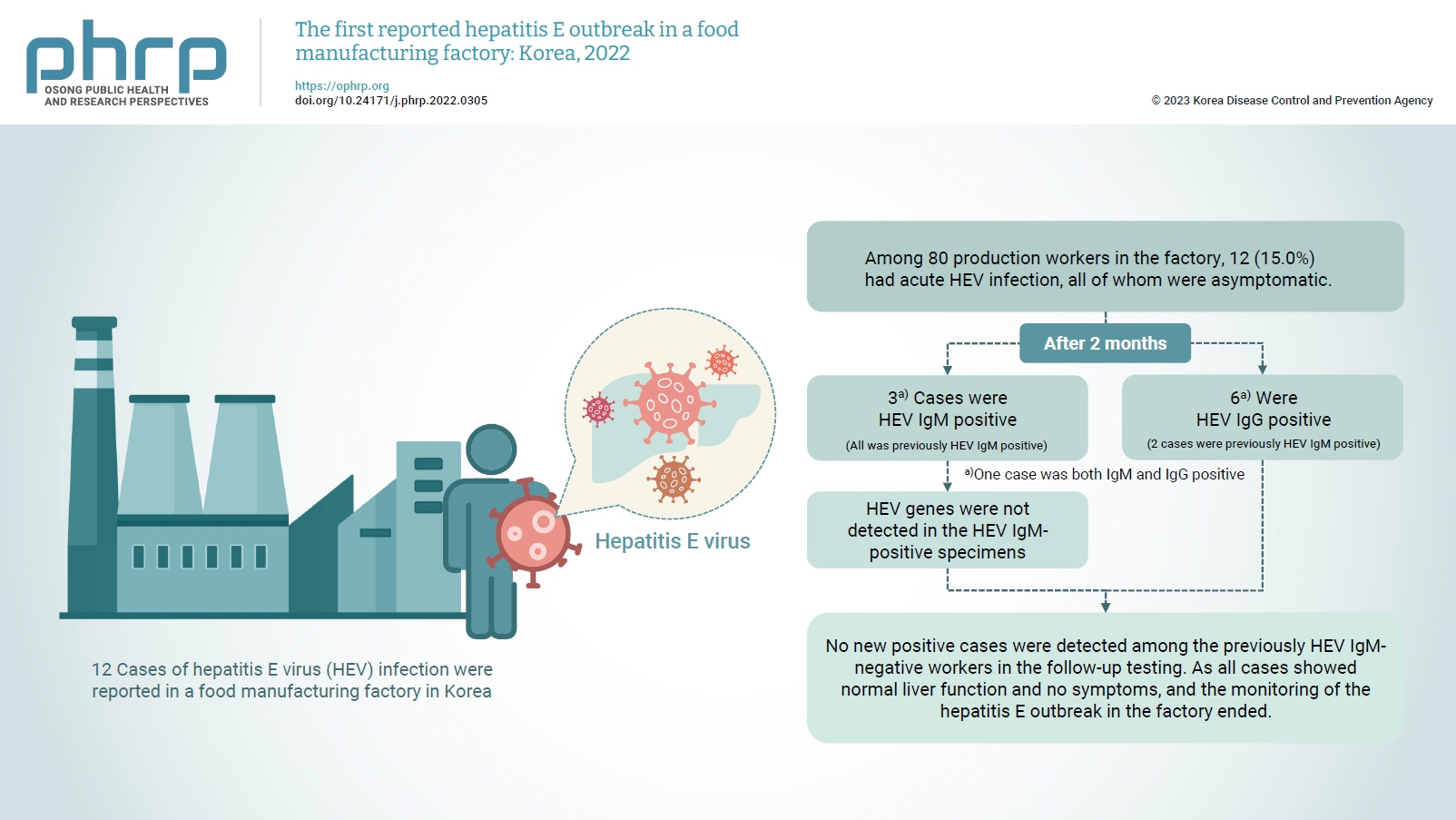
Objectives On February 16, 2022, 12 cases of hepatitis E virus (HEV) infection were reported in a food manufacturing factory in Korea. The aim of this study was to identify additional cases and to determine the source of this HEV outbreak. Methods: This study was an in-depth investigation of 12 HEV immunoglobulin M (IgM)-positive cases and their demographic, clinical, and epidemiological characteristics. On-site specimens were collected from the environment and from humans, and a follow-up investigation was conducted 2 to 3 months after the outbreak. Results: Among 80 production workers in the factory, 12 (15.0%) had acute HEV infection, all of whom were asymptomatic. The follow-up investigation showed that 3 cases were HEV IgMpositive, while 6 were HEV IgG-positive. HEV genes were not detected in the HEV IgM-positive specimens. HEV genes were not detected in the food products or environmental specimens collected on-site. HEV was presumed to be the causative pathogen. However, it could not be confirmed that the source of infection was common consumption inside the factory. Conclusion: This was the first domestic case of an HEV infection outbreak in a food manufacturing factory in Korea. Our results provide information for the future control of outbreaks and for the preparation of measures to prevent domestic outbreaks of HEV infection.
Citations
Citations to this article as recorded by
Current global estimates, risk factors, and knowledge gaps for Hepatitis E virus (HEV): A scoping review Md Koushik Ahmed, Hanna Maroofi, Madeleine Blunt, Alain Labrique, Carl Kirkwood, Kirsten Vannice, Kawsar R. Talaat, Julia Lynch, Brittany L. Kmush, David Safronetz PLOS Neglected Tropical Diseases.2026; 20(3): e0013980. CrossRef



 First
 Prev


