Objectives Monkeypox outbreaks in nonendemic countries have been reported since early May 2022. The first case of monkeypox in the Republic of Korea was confirmed in a patient who traveled to Europe in June 2022, and an attempt was made to isolate and identify the monkeypox virus (MPXV) from the patient’s specimens.
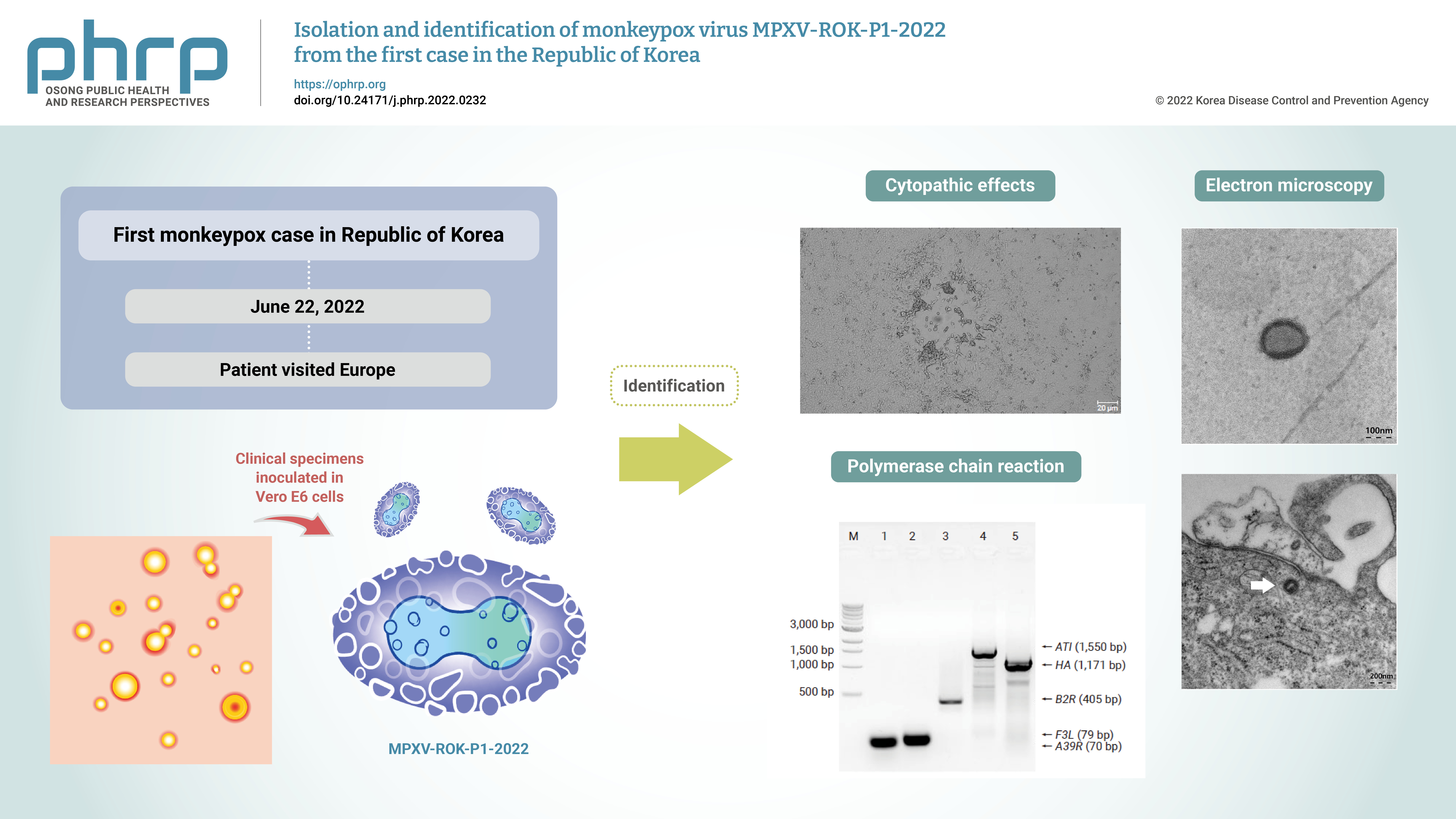
Methods Clinical specimens from the patient were inoculated in Vero E6 cells. The isolated virus was identified as MPXV by the observation of cytopathic effects on Vero E6 cells, transmission electron microscopy, conventional polymerase chain reaction
(PCR), and sequencing of PCR products.
Results Cytopathic effects were observed in Vero E6 cells that were inoculated with skin lesion swab eluates. After multiple passages from the primary culture, orthopoxvirus morphology was observed using transmission electron microscopy. In addition, both MPXV-specific (F3L and ATI) and orthopoxvirus-specific genes (A39R, B2R, and HA) were confirmed by conventional PCR and Sanger sequencing.
Conclusion These results indicate the successful isolation and identification of MPXV from the first patient in the Republic of Korea. The isolated virus was named MPXV-ROK-P1-2022.
Citations
Citations to this article as recorded by
MPXV: Update on Morphological and Morphogenesis Aspects Through Transmission and Scanning Electron Microscopies and 3D Reconstruction Debora Ferreira Barreto‐Vieira, Milene Dias Miranda, Marcos Alexandre Nunes da Silva, Andressa Santos de Almeida, Ana Luisa Teixeira de Almeida, Derick Mendes Bandeira, Vivian Neuza S. Ferreira, Alice Santos Rosa, Wendell Girard‐Dias, Bráulio Soares Archa Journal of Medical Virology.2025;[Epub] CrossRef
Ultrasensitive one-pot detection of monkeypox virus with RPA and CRISPR in a sucrose-aided multiphase aqueous system Yue Wang, Yixin Tang, Yukang Chen, Guangxi Yu, Xue Zhang, Lihong Yang, Chenjie Zhao, Pei Wang, Song Gao, Frederick S. B. Kibenge, Ruijie Deng, Wei Chen, Shuang Yang Microbiology Spectrum.2024;[Epub] CrossRef
Molecular Methods for Diagnosis of Monkeypox: A Mini-review Rodrigo Michelini de Oliveira Thomasi, Thais da Silva Correa, Dalise Silva do Carmo, Déborah Fernandes Rodrigues, Luiz Vinicius da Silva Correa, Sandra Rodrigues Xavier, Líria Souza Silva, Jonatas Oliveira da Silva, Michelli dos Santos, Alessandra da Silv Current Molecular Medicine.2024; 24(10): 1208. CrossRef
Factors Predicting the Intention to Engage in Self-Protective Behavior against Monkeypox Infection among Thai People Awirut Singkun, Wichan Phibarn, Wichaporn Intharachuti, Arunothai Derramon, Thitika Kimise Journal of Health Research.2024;[Epub] CrossRef
Epidemiological, Clinical, and Virological Investigation of the First Four Cases of Monkeypox in Cartagena during the 2022 Outbreak Steev Loyola, Mashiel Fernández-Ruiz, Doris Gómez-Camargo Pathogens.2023; 12(2): 159. CrossRef
원숭이두창바이러스의 분리 배양과 전장유전체 정보 분석 민지 이, 진원 김, 치환 최, 화철 신, 명민 최, 상은 이, 화중 이, 윤석 정 Public Health Weekly Report.2023; 16(15): 464. CrossRef
Overview of Diagnostic Methods, Disease Prevalence and Transmission of Mpox (Formerly Monkeypox) in Humans and Animal Reservoirs Ravendra P. Chauhan, Ronen Fogel, Janice Limson Microorganisms.2023; 11(5): 1186. CrossRef
How to cope with suspected mpox patients in the outpatient clinic Nam Joong Kim, Sun Huh Journal of the Korean Medical Association.2023; 66(5): 325. CrossRef
An Updated Review on Monkeypox Viral Disease: Emphasis on Genomic Diversity Ali Rabaan, Nada Alasiri, Mohammed Aljeldah, Abeer Alshukairiis, Zainab AlMusa, Wadha Alfouzan, Abdulmonem Abuzaid, Aref Alamri, Hani Al-Afghani, Nadira Al-baghli, Nawal Alqahtani, Nadia Al-baghli, Mashahed Almoutawa, Maha Mahmoud Alawi, Mohammed Alabdull Biomedicines.2023; 11(7): 1832. CrossRef
Monkeypox (Mpox) virus isolation and ultrastructural characterisation from a Brazilian human sample case Milene Dias Miranda, Gabriela Cardoso Caldas, Vivian Neuza Ferreira, Ortrud Monika Barth, Aline de Paula Dias da Silva, Mayara Secco Torres Silva, Beatriz Grinsztejn, Valdiléa Gonçalves Veloso, Thiago Moreno Souza, Edson Elias da Silva, Debora Ferreira Ba Memórias do Instituto Oswaldo Cruz.2023;[Epub] CrossRef
Isolation and Characterization of Monkeypox Virus from the First Case of Monkeypox — Chongqing Municipality, China, 2022 Baoying Huang, Hua Zhao, Jingdong Song, Li Zhao, Yao Deng, Wen Wang, Roujian Lu, Wenling Wang, Jiao Ren, Fei Ye, Houwen Tian, Guizhen Wu, Hua Ling, Wenjie Tan China CDC Weekly.2022; 4(46): 1019. CrossRef
Ae Kyung Park, Il-Hwan Kim, Junyoung Kim, Jeong-Min Kim, Heui Man Kim, Chae young Lee, Myung-Guk Han, Gi-Eun Rhie, Donghyok Kwon, Jeong-Gu Nam, Young-Joon Park, Jin Gwack, Nam-Joo Lee, SangHee Woo, Jin Sun No, Jaehee Lee, Jeemin Ha, JeeEun Rhee, Cheon-Kwon Yoo, Eun-Jin Kim
Osong Public Health Res Perspect 2021;12(1):37-43. Published online February 23, 2021
<p>Since a novel beta-coronavirus, severe acute respiratory syndrome coronavirus 2 (SARS-CoV-2) was first reported in December 2019, there has been a rapid global spread of the virus. Genomic surveillance was conducted on samples isolated from infected individuals to monitor the spread of genetic variants of SARS-CoV-2 in Korea. The Korea Disease Control and Prevention Agency performed whole genome sequencing of SARS-CoV-2 in Korea for 1 year (January 2020 to January 2021). A total of 2,488 SARS-CoV-2 cases were sequenced (including 648 cases from abroad). Initially, the prevalent clades of SARS-CoV-2 were the S and V clades, however, by March 2020, GH clade was the most dominant. Only international travelers were identified as having G or GR clades, and since the first variant 501Y.V1 was identified (from a traveler from the United Kingdom on December 22<sup>nd</sup>, 2020), a total of 27 variants of 501Y.V1, 501Y.V2, and 484K.V2 have been classified (as of January 25<sup>th</sup>, 2021). The results in this study indicated that quarantining of travelers entering Korea successfully prevented dissemination of the SARS-CoV-2 variants in Korea.</p>
Citations
Citations to this article as recorded by
2025년 공항만 오하수 기반 SARS-CoV-2 변이 바이러스 분석 현황 채영 이, 진선 노, 일환 김, 병수 강, 은진 김 Public Health Weekly Report.2026; 19(27): 1095. CrossRef
Wastewater-based surveillance for severe acute respiratory syndrome coronavirus 2 variants in Gwangju, Republic of Korea Chaeyoung Lee, Jungwook Park, Jin Sun No, Jongpil Kim, Jungmi Seo, Dongju Kim, Il-Hwan Kim, Eun-Jin Kim Frontiers in Microbiology.2025;[Epub] CrossRef
Replication kinetics and infectivity of SARS-CoV-2 Omicron variant sublineages recovered in the Republic of Korea Jeong-Min Kim, Dongju Kim, Jee Eun Rhee, Cheon Kwon Yoo, Eun-Jin Kim Osong Public Health and Research Perspectives.2024; 15(3): 260. CrossRef
Genomic Analysis and Tracking of SARS‐CoV‐2 Variants in Gwangju, South Korea, From 2020 to 2022 Yeong‐Un Lee, Kwangho Lee, Hongsu Lee, Jung Wook Park, Sun‐Ju Cho, Ji‐Su Park, Jeongeun Mun, Sujung Park, Cheong‐mi Lee, Juhye Lee, Jinjong Seo, Yonghwan Kim, Sun‐Hee Kim, Yoon‐Seok Chung Influenza and Other Respiratory Viruses.2024;[Epub] CrossRef
Dynamics of SARS-CoV-2 variants during the XBB wave in the Republic of Korea Jin Sun No, Ji Yeong Noh, Chae Young Lee, Il-Hwan Kim, Jeong-Ah Kim, Yu Jeong Ahn, Hyeokjin Lee, Jeong-Min Kim, Nam-Joo Lee, Dong-Wook Lee, Jeong-Hoon Kwon, JeeEun Rhee, Eun-Jin Kim Virus Research.2024; 350: 199471. CrossRef
Increased viral load in patients infected with severe acute respiratory syndrome coronavirus 2 Omicron variant in the Republic of Korea Jeong-Min Kim, Dongju Kim, Nam-Joo Lee, Sang Hee Woo, Jaehee Lee, Hyeokjin Lee, Ae Kyung Park, Jeong-Ah Kim, Chae Young Lee, Il-Hwan Kim, Cheon Kwon Yoo, Eun-Jin Kim Osong Public Health and Research Perspectives.2023; 14(4): 272. CrossRef
Rapid Emergence of the Omicron Variant of Severe Acute Respiratory Syndrome Coronavirus 2 in Korea Ae Kyung Park, Il-Hwan Kim, Chae Young Lee, Jeong-Ah Kim, Hyeokjin Lee, Heui Man Kim, Nam-Joo Lee, SangHee Woo, Jaehee Lee, JeeEun Rhee, Cheon-Kwon Yoo, Eun-Jin Kim Annals of Laboratory Medicine.2023; 43(2): 211. CrossRef
A Seroprevalence Study on Residents in a Senior Care Facility with Breakthrough SARS-CoV-2 Omicron Infection Heui Man Kim, Eun Ju Lee, Sang Won O, Yong Jun Choi, Hyeokjin Lee, Sae Jin Oh, Jeong-Min Kim, Ae Kyung Park, Jeong-Ah Kim, Chae young Lee, Jong Mu Kim, Hanul Park, Young Joon Park, Jeong-Hee Yu, Eun-Young Kim, Hwa-Pyeong Ko, Eun-Jin Kim Viral Immunology.2023; 36(3): 203. CrossRef
COVID-19 Cases and Deaths among Healthcare Personnel with the Progression of the Pandemic in Korea from March 2020 to February 2022 Yeonju Kim, Sung-Chan Yang, Jinhwa Jang, Shin Young Park, Seong Sun Kim, Chansoo Kim, Donghyok Kwon, Sang-Won Lee Tropical Medicine and Infectious Disease.2023; 8(6): 308. CrossRef
The COVID-19 pandemic and healthcare utilization in Iran: evidence from an interrupted time series analysis Monireh Mahmoodpour-Azari, Satar Rezaei, Nasim Badiee, Mohammad Hajizadeh, Ali Mohammadi, Ali Kazemi-Karyani, Shahin Soltani, Mehdi Khezeli Osong Public Health and Research Perspectives.2023; 14(3): 180. CrossRef
Online Phylogenetics with matOptimize Produces Equivalent Trees and is Dramatically More Efficient for Large SARS-CoV-2 Phylogenies than de novo and Maximum-Likelihood Implementations Alexander M Kramer, Bryan Thornlow, Cheng Ye, Nicola De Maio, Jakob McBroome, Angie S Hinrichs, Robert Lanfear, Yatish Turakhia, Russell Corbett-Detig, Olivier Gascuel Systematic Biology.2023; 72(5): 1039. CrossRef
Genomic epidemiology of SARS-CoV-2 variants in South Korea between January 2020 and February 2023 Il-Hwan Kim, Jin Sun No, Jeong-Ah Kim, Ae Kyung Park, HyeokJin Lee, Jeong-Min Kim, Nam-Joo Lee, Chi-Kyeong Kim, Chae Young Lee, SangHee Woo, Jaehee Lee, JeeEun Rhee, Eun-Jin Kim Virology.2023; 587: 109869. CrossRef
Genomic evidence of SARS‐CoV‐2 reinfection in the Republic of Korea Ae Kyung Park, Jee Eun Rhee, Il‐Hwan Kim, Heui Man Kim, Hyeokjin Lee, Jeong‐Ah Kim, Chae Young Lee, Nam‐Joo Lee, SangHee Woo, Jaehee Lee, Jin Sun No, Gi‐Eun Rhie, Seong Jin Wang, Sang‐Eun Lee, Young Joon Park, Gemma Park, Jung Yeon Kim, Jin Gwack, Cheon‐K Journal of Medical Virology.2022; 94(4): 1717. CrossRef
SARS-CoV-2 B.1.619 and B.1.620 Lineages, South Korea, 2021 Ae Kyung Park, Il-Hwan Kim, Heui Man Kim, Hyeokjin Lee, Nam-Joo Lee, Jeong-Ah Kim, SangHee Woo, Chae young Lee, Jaehee Lee, Sae Jin Oh, JeeEun Rhee, Cheon-Kwon Yoo, Eun-Jin Kim Emerging Infectious Diseases.2022; 28(2): 415. CrossRef
Humoral and Cellular Responses to COVID-19 Vaccines in SARS-CoV-2 Infection-Naïve and -Recovered Korean Individuals Ji-Young Hwang, Yunhwa Kim, Kyung-Min Lee, Eun-Jeong Jang, Chang-Hoon Woo, Chang-Ui Hong, Seok-Tae Choi, Sivilay Xayaheuang, Jong-Geol Jang, June-Hong Ahn, Hosun Park Vaccines.2022; 10(2): 332. CrossRef
Increase in Viral Load in Patients With SARS-CoV-2 Delta Variant Infection in the Republic of Korea Jeong-Min Kim, Jee Eun Rhee, Myeongsu Yoo, Heui Man Kim, Nam-Joo Lee, Sang Hee Woo, Hye-Jun Jo, Donghyok Kwon, Sangwon Lee, Cheon Kwon Yoo, Eun-Jin Kim Frontiers in Microbiology.2022;[Epub] CrossRef
Molecular Dynamics Studies on the Structural Stability Prediction of SARS-CoV-2 Variants Including Multiple Mutants Kwang-Eun Choi, Jeong-Min Kim, Jee Eun Rhee, Ae Kyung Park, Eun-Jin Kim, Cheon Kwon Yoo, Nam Sook Kang International Journal of Molecular Sciences.2022; 23(9): 4956. CrossRef
SARS-CoV-2 shedding dynamics and transmission in immunosuppressed patients Jee-Soo Lee, Ki Wook Yun, Hyeonju Jeong, Boram Kim, Man Jin Kim, Jae Hyeon Park, Ho Seob Shin, Hyeon Sae Oh, Hobin Sung, Myung Gi Song, Sung Im Cho, So Yeon Kim, Chang Kyung Kang, Pyoeng Gyun Choe, Wan Beom Park, Nam Joong Kim, Myoung-Don Oh, Eun Hwa Choi Virulence.2022; 13(1): 1242. CrossRef
Immunological and Pathological Peculiarity of Severe Acute Respiratory Syndrome Coronavirus 2 Beta Variant Sunhee Lee, Gun Young Yoon, Su Jin Lee, Young-Chan Kwon, Hyun Woo Moon, Yu-Jin Kim, Haesoo Kim, Wooseong Lee, Gi Uk Jeong, Chonsaeng Kim, Kyun-Do Kim, Seong-Jun Kim, Dae-Gyun Ahn, Miguel Angel Martinez Microbiology Spectrum.2022;[Epub] CrossRef
Clinical scoring system to predict viable viral shedding in patients with COVID-19 Sung Woon Kang, Heedo Park, Ji Yeun Kim, Sunghee Park, So Yun Lim, Sohyun Lee, Joon-Yong Bae, Jeonghun Kim, Seongman Bae, Jiwon Jung, Min Jae Kim, Yong Pil Chong, Sang-Oh Lee, Sang-Ho Choi, Yang Soo Kim, Sung-Cheol Yun, Man-Seong Park, Sung-Han Kim Journal of Clinical Virology.2022; 157: 105319. CrossRef
Model-informed COVID-19 exit strategy with projections of SARS-CoV-2 infections generated by variants in the Republic of Korea Sung-mok Jung, Kyungmin Huh, Munkhzul Radnaabaatar, Jaehun Jung BMC Public Health.2022;[Epub] CrossRef
Comparative analysis of mutational hotspots in the spike protein of SARS-CoV-2 isolates from different geographic origins Sanghoo Lee, Mi-Kyeong Lee, Hyeongkyun Na, Jinwoo Ahn, Gayeon Hong, Youngkee Lee, Jimyeong Park, Yejin Kim, Yun-Tae Kim, Chang-Ki Kim, Hwan-Sub Lim, Kyoung-Ryul Lee Gene Reports.2021; 23: 101100. CrossRef
Review of Current COVID-19 Diagnostics and Opportunities for Further Development Yan Mardian, Herman Kosasih, Muhammad Karyana, Aaron Neal, Chuen-Yen Lau Frontiers in Medicine.2021;[Epub] CrossRef
Locally harvested Covid-19 convalescent plasma could probably help combat the geographically determined SARS-CoV-2 viral variants Manish Raturi, Anuradha Kusum, Mansi Kala, Garima Mittal, Anita Sharma, Naveen Bansal Transfusion Clinique et Biologique.2021; 28(3): 300. CrossRef
Molecular Dynamics Studies on the Structural Characteristics for the Stability Prediction of SARS-CoV-2 Kwang-Eun Choi, Jeong-Min Kim, JeeEun Rhee, Ae Kyung Park, Eun-Jin Kim, Nam Sook Kang International Journal of Molecular Sciences.2021; 22(16): 8714. CrossRef
Management following the first confirmed case of SARS-CoV-2 in a domestic cat associated with a massive outbreak in South Korea Taewon Han, Boyeong Ryu, Suyeon Lee, Yugyeong Song, Yoongje Jeong, Ilhwan Kim, Jeongmin Kim, Eunjin Kim, Wonjun Lee, Hyunju Lee, Haekyoung Hwang One Health.2021; 13: 100328. CrossRef
Genomic epidemiology reveals the reduction of the introduction and spread of SARS-CoV-2 after implementing control strategies in Republic of Korea, 2020 Jung-Hoon Kwon, Jeong-Min Kim, Dong-hun Lee, Ae Kyung Park, Il-Hwan Kim, Da-Won Kim, Ji-Yun Kim, Noori Lim, Kyeong-Yeon Cho, Heui Man Kim, Nam-Joo Lee, SangHee Woo, Chae Young Lee, Jin Sun No, Junyoung Kim, JeeEun Rhee, Myung-Guk Han, Gi-Eun Rhie, Cheon K Virus Evolution.2021;[Epub] CrossRef
Il-Hwan Kim, Jun Hyeong Jang, Su-Kyoung Jo, Jin Sun No, Seung-Hee Seo, Jun-Young Kim, Sang-Oun Jung, Jeong-Min Kim, Sang-Eun Lee, Hye-Kyung Park, Eun-Jin Kim, Jun Ho Jeon, Myung-Min Choi, Boyeong Ryu, Yoon Suk Jang, Hwami Kim, Jin Lee, Seung-Hwan Shin, Hee Kyoung Kim, Eun-Kyoung Kim, Ye Eun Park, Cheon-Kwon Yoo, Sang-Won Lee, Myung-Guk Han, Gi-Eun Rhie, Byung Hak Kang
Osong Public Health Res Perspect 2020;11(5):280-285. Published online October 22, 2020
<sec>
<title>Objectives</title>
<p>The Korea Centers for Disease Control and Prevention has published “A Guideline for Unknown Disease Outbreaks (UDO).” The aim of this report was to introduce tabletop exercises (TTX) to prepare for UDO in the future.</p></sec>
<sec>
<title>Methods</title>
<p>The UDO Laboratory Analyses Task Force in Korea Centers for Disease Control and Prevention in April 2018, assigned unknown diseases into 5 syndromes, designed an algorithm for diagnosis, and made a panel list for diagnosis by exclusion. Using the guidelines and laboratory analyses for UDO, TTX were introduced.</p></sec>
<sec>
<title>Results</title>
<p>Since September 9<sup>th</sup>, 2018, the UDO Laboratory Analyses Task Force has been preparing TTX based on a scenario of an outbreak caused by a novel coronavirus. In December 2019, through TTX, individual missions, epidemiological investigations, sample treatments, diagnosis by exclusions, and next generation sequencing analysis were discussed, and a novel coronavirus was identified as the causal pathogen.</p></sec>
<sec>
<title>Conclusion</title>
<p>Guideline and laboratory analyses for UDO successfully applied in TTX. Conclusions drawn from TTX could be applied effectively in the analyses for the initial response to COVID-19, an ongoing epidemic of 2019 – 2020. Therefore, TTX should continuously be conducted for the response and preparation against UDO.</p></sec>
Citations
Citations to this article as recorded by
Use of a pathogen X tabletop exercise to assess the operational response preparedness of an emerging infectious diseases research network Rachael Lee, Jennifer Hemingway-Foday, Nefer Batsuli, L. Danielle Wagner, Aaron Macoubray, Robert F. Garry, Christine K. Johnson, Kathryn A. Hanley, Nikos Vasilakis, Souleymane Mboup, Hongying Li, Cecilia A. Sánchez, Peter M. Rabinowitz, Robert F. Breiman Frontiers in Public Health.2025;[Epub] CrossRef
Development and evaluation of the Korea Disease Control and Prevention Agency’s scenario-based training program for effective response to emerging infectious disease outbreaks Mi Yu, Eun Kyoung Kim, Kyungnam Kim, Jin Lee, Jin Hwan Jeon, Soyeon Kim, Sangwon Lee, Yunhyung Kwon Osong Public Health and Research Perspectives.2025; 16(4): 373. CrossRef
Development and evaluation of a hybrid capture-based NGS panel for comprehensive detection of respiratory pathogens Jeong-Ah Kim, Jeong-Min Kim, Chaeyoung Lee, Il-Hwan Kim, Daehwan Lee, Heesoo Lee, Jaehwan Jeong, Eun-Jin Kim Scientific Reports.2025;[Epub] CrossRef
Education Needs for Public Health Crisis Using an Importance-Performance Analysis and Borich Needs Assessment Model: Focused on Aircraft Quarantine Officials Jiyun Park, Gye Joung Yeom, Seok Hwan Kim Research in Community and Public Health Nursing.2025; 36: 361. CrossRef
Objective
Recombinant protective antigen (rPA) is the active pharmaceutical ingredient of a second generation anthrax vaccine undergoing clinical trials both in Korea and the USA. By using the rPA produced from <i>Bacillus brevis </i>pNU212 expression system, correlations of serological immune response to anthrax protection efficacy were analyzed in a guinea pig model. Methods
Serological responses of rPA anthrax vaccine were investigated in guinea pigs that were given single or two injections (interval of 4 weeks) of various amounts of rPA combined with aluminumhydroxide adjuvant. Guinea pigs were subsequently challenged by the intramuscular injection with 30 half-lethal doses (30LD<sub>50</sub>) of virulent <i>Bacillus anthracis </i>spores. Serumantibody titerswere determined by anti-PA IgGELISA and the ability of antibodies to neutralize the cytotoxicity of lethal toxin on J774A.1 cell was measured through the toxin neutralizing antibody (TNA) assay. Results
To examine correlations between survival rate and antibody titers, correlation between neutralizing antibody titers and the extent of protection was determined. Toxin neutralization titers of at least 1176 were sufficient to confer protection against a dose of 30LD<sub>50</sub> of virulent anthrax spores of the H9401 strain. Such consistency in the correlation was not observed from those antibody titers determined by ELISA. Conclusion
Neutralizing-antibody titers can be used as a surrogate marker.
Citations
Citations to this article as recorded by
A putative exosporium lipoprotein GBAA0190 of Bacillus anthracis as a potential anthrax vaccine candidate Jun Ho Jeon, Yeon Hee Kim, Kyung Ae Kim, Yu-Ri Kim, Sun-Je Woo, Ye Jin Choi, Gi-eun Rhie BMC Immunology.2021;[Epub] CrossRef
Construction of a bivalent vaccine against anthrax and smallpox using the attenuated vaccinia virus KVAC103 Deok Bum Park, Bo-Eun Ahn, Hosun Son, Young-Ran Lee, Yu-Ri Kim, Su Kyoung Jo, Jeong-Hoon Chun, Jae-Yon Yu, Myung-Min Choi, Gi-eun Rhie BMC Microbiology.2021;[Epub] CrossRef
Single-dose combination nanovaccine induces both rapid and durable humoral immunity and toxin neutralizing antibody responses against Bacillus anthracis Sean M. Kelly, Kristina R. Larsen, Ross Darling, Andrew C. Petersen, Bryan H. Bellaire, Michael J. Wannemuehler, Balaji Narasimhan Vaccine.2021; 39(29): 3862. CrossRef
Current Status and Trends in Prophylaxis and Management of Anthrax Disease Vladimir Savransky, Boris Ionin, Joshua Reece Pathogens.2020; 9(5): 370. CrossRef
Anthrax prevention through vaccine and post-exposure therapy Manish Manish, Shashikala Verma, Divya Kandari, Parul Kulshreshtha, Samer Singh, Rakesh Bhatnagar Expert Opinion on Biological Therapy.2020; 20(12): 1405. CrossRef
A therapeutic human antibody against the domain 4 of the Bacillus anthracis protective antigen shows protective efficacy in a mouse model Bo-Eun Ahn, Hee-Won Bae, Hae-Ri Lee, Sun-Je Woo, Ok-Kyu Park, Jun Ho Jeon, Jungchan Park, Gi-eun Rhie Biochemical and Biophysical Research Communication.2019; 509(2): 611. CrossRef
Vaccines against anthrax based on recombinant protective antigen: problems and solutions Olga A. Kondakova, Nikolai A. Nikitin, Ekaterina A. Evtushenko, Ekaterina M. Ryabchevskaya, Joseph G. Atabekov, Olga V. Karpova Expert Review of Vaccines.2019; 18(8): 813. CrossRef
A novel live attenuated anthrax spore vaccine based on an acapsular Bacillus anthracis Sterne strain with mutations in the htrA, lef and cya genes Theodor Chitlaru, Ma'ayan Israeli, Shahar Rotem, Uri Elia, Erez Bar-Haim, Sharon Ehrlich, Ofer Cohen, Avigdor Shafferman Vaccine.2017; 35(44): 6030. CrossRef
Expression and refolding of the protective antigen of Bacillus anthracis: A model for high-throughput screening of antigenic recombinant protein refolding María Elisa Pavan, Esteban Enrique Pavan, Fabián Martín Cairó, María Julia Pettinari Revista Argentina de Microbiología.2016; 48(1): 5. CrossRef
Protein- and DNA-based anthrax toxin vaccines confer protection in guinea pigs against inhalational challenge withBacillus cereusG9241 John Palmer, Matt Bell, Christian Darko, Roy Barnewall, Andrea Keane-Myers Pathogens and Disease.2014; : n/a. CrossRef



 First
 Prev


