Objectives This study assessed changes in the visibility of the National Health Information Portal (NHIP), operated by the Korea Disease Control and Prevention Agency, across conventional search portals and generative artificial intelligence (AI) platforms.
Methods We analyzed 150 health-related keywords derived from NHIP traffic data, Daum search logs, and chronic disease categories across 7 platforms: Naver, Google, Bing, Daum, ChatGPT, Perplexity, and Gemini. Searches were conducted in September 2025 and February 2026; Gemini was assessed only in the second survey. NHIP exposure was defined as appearance within the top 10 organic search results, whereas AI citation was defined as explicit source attribution. Changes were tested using McNemar's test.
Results Organic search exposure for the NHIP increased on Naver (64.0% to 73.3%, p=0.018) and decreased on Bing (72.0% to 61.3%, p=0.021). AI-summary citation rates increased more substantially on Naver AI Briefing (8.0% to 62.7%, p<0.001), Bing AI Summary (6.7% to 44.7%, p<0.001), Google AI Overview (30.0% to 48.0%, p=0.001), and ChatGPT (16.7% to 38.0%, p<0.001). Gemini cited the NHIP for 96.0% of keywords. For dyslipidemia-related keywords (n=10), Google and ChatGPT showed no NHIP exposure, whereas Gemini cited the NHIP for all keywords.
Conclusion AI citation represents a new dimension of health information accessibility. To address visibility gaps and marked platform divergence, public health portals should implement a 3-level optimization strategy encompassing machine-readable infrastructure, AI-friendly content formatting, and continuous multi-platform monitoring.
Han Thi Vo, Tien Duc Dao, Tuyen Van Duong, Tan Thanh Nguyen, Binh Nhu Do, Tinh Xuan Do, Khue Minh Pham, Vinh Hai Vu, Linh Van Pham, Lien Thi Hong Nguyen, Lan Thi Huong Le, Hoang Cong Nguyen, Nga Hoang Dang, Trung Huu Nguyen, Anh The Nguyen, Hoan Van Nguyen, Phuoc Ba Nguyen, Hoai Thi Thanh Nguyen, Thu Thi Minh Pham, Thuy Thi Le, Thao Thi Phuong Nguyen, Cuong Quoc Tran, Kien Trung Nguyen
Osong Public Health Res Perspect 2024;15(1):33-44. Published online February 19, 2024
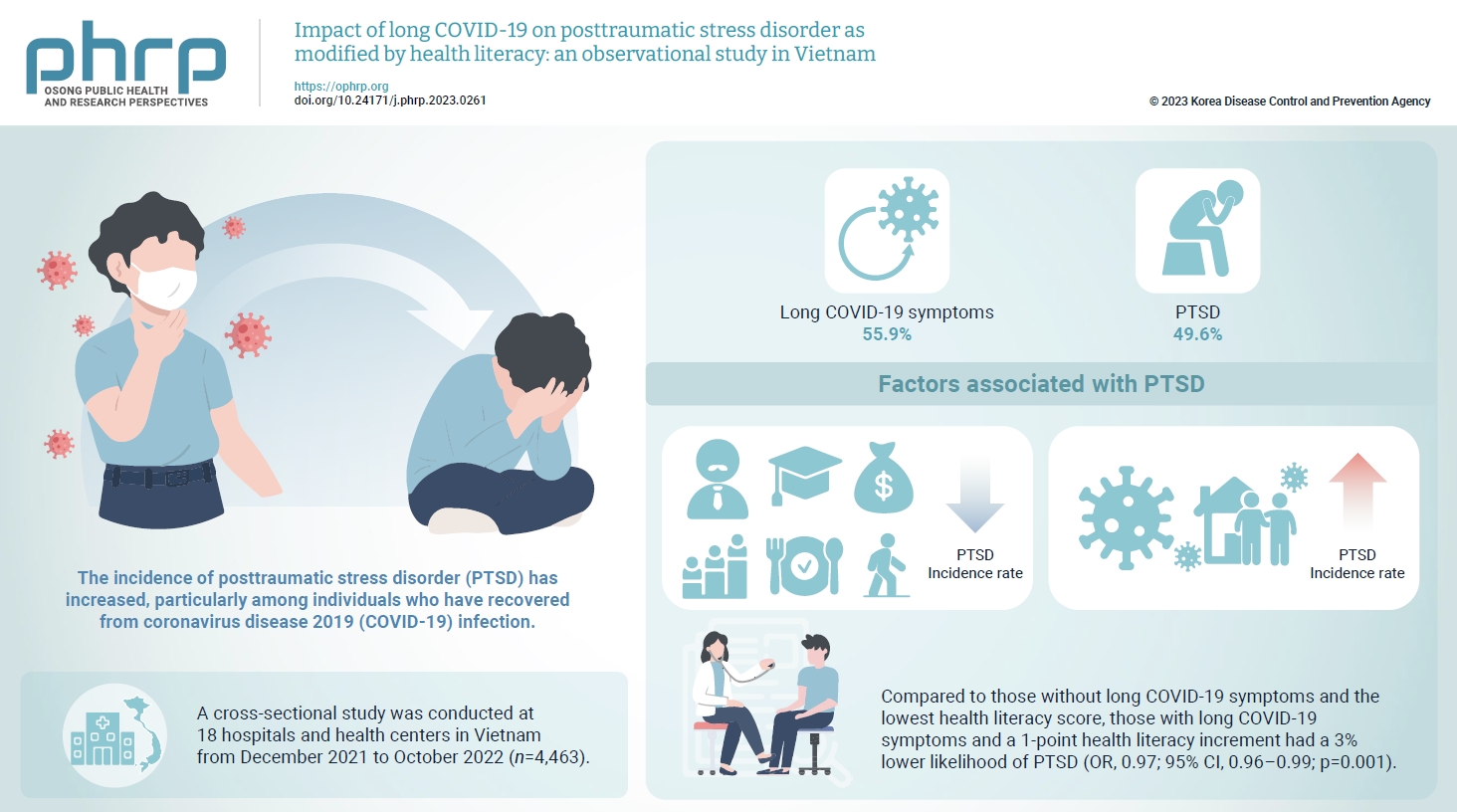
Objectives The prevalence of posttraumatic stress disorder (PTSD) has increased, particularly among individuals who have recovered from coronavirus disease 2019 (COVID-19) infection. Health literacy is considered a “social vaccine” that helps people respond effectively to the pandemic. We aimed to investigate the association between long COVID-19 and PTSD, and to examine the modifying role of health literacy in this association. Methods: A cross-sectional study was conducted at 18 hospitals and health centers in Vietnam from December 2021 to October 2022. We recruited 4,463 individuals who had recovered from COVID-19 infection for at least 4 weeks. Participants provided information about their sociodemographics, clinical parameters, health-related behaviors, health literacy (using the 12-item short-form health literacy scale), long COVID-19 symptoms and PTSD (Impact Event Scale-Revised score of 33 or higher). Logistic regression models were used to examine associations and interactions. Results: Out of the study sample, 55.9% had long COVID-19 symptoms, and 49.6% had PTSD. Individuals with long COVID-19 symptoms had a higher likelihood of PTSD (odds ratio [OR], 1.86; 95% confidence interval [CI], 1.63–2.12; p<0.001). Higher health literacy was associated with a lower likelihood of PTSD (OR, 0.98; 95% CI, 0.97–0.99; p=0.001). Compared to those without long COVID-19 symptoms and the lowest health literacy score, those with long COVID-19 symptoms and a 1-point health literacy increment had a 3% lower likelihood of PTSD (OR, 0.97; 95% CI, 0.96–0.99; p=0.001). Conclusion: Health literacy was found to be a protective factor against PTSD and modified the negative impact of long COVID-19 symptoms on PTSD.
Citations
Citations to this article as recorded by
Prospective association between long COVID and COVID-related post-traumatic stress disorder among a population-based cohort of adults diagnosed with COVID-19 in Michigan Akash Patel, Soomin Ryu, Blair Whittington, Christine Chyu, Emma Chrzanowski, Sameera Ahmed, Elizabeth Slocum, Nancy L. Fleischer Journal of Affective Disorders.2026; 410: 122009. CrossRef
Psychiatric symptoms of long COVID among adults: observational case–control study in Johannesburg, South Africa Andrew Wooyoung Kim, Someleze Swana, Simiso Sokhela, Samanta Lalla-Edward, Ncomeka Manentsa, Alexander C. Tsai, W. D. Francois Venter BJPsych Open.2026;[Epub] CrossRef
Mental health and post-traumatic stress among unprivileged people in the aftermath of COVID-19 pandemic in Southwest Bangladesh: a cross-sectional study Md. Salauddin Khan, Maliha Mahazabin, Ishita Shahid Sams, Lasker Ershad Ali, Umama Khan Cogent Mental Health.2025;[Epub] CrossRef
Exploring the psychological impact of long COVID: symptoms, mechanisms, and treatments Shi Shen, Xin Zhao, Jianxin Pei, Bijue Wang, Jingjing Hou, Ru Chai, Yiqiong Guo, Feiyu Li, Jian Hao, Zhonglan Wu Frontiers in Psychiatry.2025;[Epub] CrossRef
Pathophysiological, Neuropsychological, and Psychosocial Influences on Neurological and Neuropsychiatric Symptoms of Post-Acute COVID-19 Syndrome: Impacts on Recovery and Symptom Persistence Alex Malioukis, R Sterling Snead, Julia Marczika, Radha Ambalavanan Biomedicines.2024; 12(12): 2831. CrossRef



 First
 Prev


