Objectives The prevalence of hepatitis B in the Republic of Korea has declined, yet the disease burden persists. After various changes in targets and methods, the national hepatitis B surveillance system now exclusively monitors acute cases. We aimed to assess the alignment of this system with its intended purpose and to recommend improvements supporting the national strategic plan for viral hepatitis management.
Methods This study assessed acute hepatitis B cases reported to the Korean Disease Control and Prevention Agency’s mandatory surveillance system over a 10-year period (2013–2022). It evaluated 5 factors from the Centers for Disease Control and Prevention’s Updated Guidelines for Evaluating Public Health Surveillance Systems: simplicity, positive predictive value, data quality, timeliness, and usefulness.
Results The nonspecific nature of acute hepatitis B symptoms, along with the complexity of diagnostic criteria, indicated a high potential for misreporting. The surveillance system demonstrated a high positive predictive value (94.4%), with data quality and timeliness also rated high. However, data following the onset of the coronavirus disease 2019 pandemic indicate the need for improvement. Moreover, given the relative importance of specific characteristics of chronic infectious diseases, only limited interventions are implementable through the current surveillance system.
Conclusion The evaluation of the Republic of Korea’s acute hepatitis B surveillance system revealed high positive predictive value, data quality, and timeliness. However, improvements can be made in the misreporting of chronic cases and the system’s usefulness. More accurate reflection of the characteristics of acute hepatitis B cases is essential for better management of viral hepatitis.
Citations
Citations to this article as recorded by
International Infectious Disease Surveillance Systems and Implications for Korea: Case of Bacterial Gastroenteritis Minsol Jo, Yerin Heo, Dong-Sook Kim, Inmyung Song Journal of Health Informatics and Statistics.2026; 51(1): 1. CrossRef
The burden of chronic hepatitis B and C in 2022 and progress towards elimination: a global report Fuqiang Cui, Diana Faini, Devin Razavi-Shearer, Homie Razavi, Casimir Manzengo Mingiedi, Monica Alonso Gonzalez, Ahmed Sabry Alaama, Antons Mozalevskis, Polin Chan, Kiyohiko Izumi, Mohamed Amine Ghrabi, Meg Doherty, Lesi Olufunmilayo, Niklas Luhmann, Cath The Lancet Gastroenterology & Hepatology.2026; 11(6): 509. CrossRef
HepPlus: Protocol for a prospective multicenter observational study of a web-based platform to support Hepatitis B and C management in Thailand Pitchaya Chairuengjitjaras, Ketsarapohn Sudchit, Nattapat Boonsiripiyachok, Pisit Tangkijvanich Sage Open Chronic Disease.2026;[Epub] CrossRef
Identifying Gaps and Challenges in Acute Hepatitis B Surveillance in the Country of Georgia: Comprehensive Surveillance System Evaluation Lika Karichashvili, Ketevan Galdavadze, Khatuna Zakhashvili, Maia Tsereteli, Ekaterine Ruadze, Sophia Surguladze, Pawel Stefanoff JMIR Public Health and Surveillance.2025; 11: e72888. CrossRef
From Paper to Digital: Performance and Challenges of the Electronic Hepatitis B Surveillance System in Ninh Binh, Northern Vietnam (2017–2022) Hien T. Nguyen, Thai Q. Pham, Duc M. Hoang, Quang D. Tran, Giang T. Chu, Thuong T. Nguyen, Nam H. Le, Huyen T. Nguyen, Khanh C. Nguyen, Florian Vogt Tropical Medicine and Infectious Disease.2024; 9(12): 299. CrossRef
Effects of SARS-CoV-2 Spike S1 Subunit on the Interplay Between Hepatitis B and Hepatocellular Carcinoma Related Molecular Processes in Human Liver Giovanni Colonna Livers.2024; 5(1): 1. CrossRef
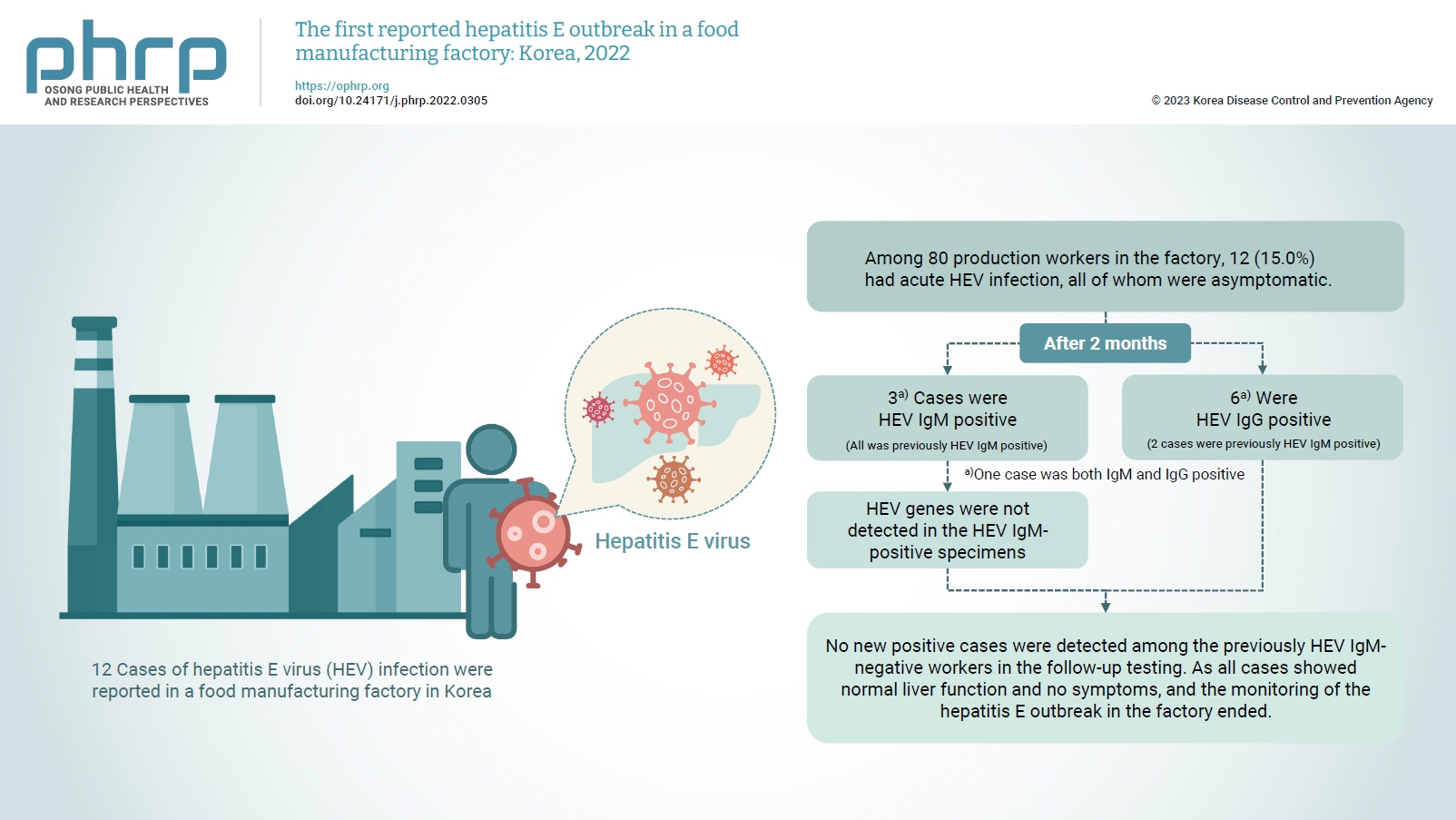
Objectives On February 16, 2022, 12 cases of hepatitis E virus (HEV) infection were reported in a food manufacturing factory in Korea. The aim of this study was to identify additional cases and to determine the source of this HEV outbreak. Methods: This study was an in-depth investigation of 12 HEV immunoglobulin M (IgM)-positive cases and their demographic, clinical, and epidemiological characteristics. On-site specimens were collected from the environment and from humans, and a follow-up investigation was conducted 2 to 3 months after the outbreak. Results: Among 80 production workers in the factory, 12 (15.0%) had acute HEV infection, all of whom were asymptomatic. The follow-up investigation showed that 3 cases were HEV IgMpositive, while 6 were HEV IgG-positive. HEV genes were not detected in the HEV IgM-positive specimens. HEV genes were not detected in the food products or environmental specimens collected on-site. HEV was presumed to be the causative pathogen. However, it could not be confirmed that the source of infection was common consumption inside the factory. Conclusion: This was the first domestic case of an HEV infection outbreak in a food manufacturing factory in Korea. Our results provide information for the future control of outbreaks and for the preparation of measures to prevent domestic outbreaks of HEV infection.
Citations
Citations to this article as recorded by
Current global estimates, risk factors, and knowledge gaps for Hepatitis E virus (HEV): A scoping review Md Koushik Ahmed, Hanna Maroofi, Madeleine Blunt, Alain Labrique, Carl Kirkwood, Kirsten Vannice, Kawsar R. Talaat, Julia Lynch, Brittany L. Kmush, David Safronetz PLOS Neglected Tropical Diseases.2026; 20(3): e0013980. CrossRef
Objectives
The purpose of this study was to investigate the seroprevalence of hepatitis A virus (HAV) and hepatitis E virus (HEV) in Korea during 2005. Methods
Study subjects were selected from across Korea using a stratified multistage probability sampling design, and HAV and HEV seroprevalence was compared on the basis of sex, age, and residency. A total of 497 rural and urban people aged 10–99 years of age (mean ± SD age = 28.87 ± 17.63 years) were selected by two-stage cluster sampling and tested serologically for anti-HAV and anti-HEV IgG using an enzyme-linked immunosorbent assay. Results
Among this population, the overall seroprevalence of HAV was 63.80% (55.21% aged in their 20s and 95.92% in their 30s, <i>p</i> < 0.01) and that of HEV was 9.40% (5.21% aged in their 20s and 7.14% in their 30s, <i>p</i> < 0.01). Seroprevalence also varied according to area of residence. HEV prevalence in rural areas was higher than that of urban regions based on the anti-HEV antibody, odds ratio 3.22 (95% confidence interval: 1.46–7.10, <i>p</i> < 0.01). There were no significant differences between male and female against anti-HAV/HEV antibodies. Conclusion
Our study suggested that the seropositive rates of HAV and HEV might be related to age and environmental conditions.
Citations
Citations to this article as recorded by
A Silent Outbreak of Hepatitis E Virus (HEV) Infection or False-Positive Reaction of Anti-HEV IgM after COVID-19 Vaccination? Epidemiological Investigation of an Outbreak in a Korean Factory Complex in 2022 Jeonghyeon Oh, Gwang Hyeon Choi, Yeonhwa Chang, Jina Kim, Kunhee Park, Hansol Yeom, Soonryu Seo, Jin Gwack, Sook-Hyang Jeong Gut and Liver.2024; 18(3): 531. CrossRef
A Report on a Nationwide Surveillance System for Pediatric Acute Hepatitis of Unknown Etiology in Korea Kyung Jae Lee, Jae Sung Ko, Kie Young Park, Ki Soo Kang, Kunsong Lee, Jeana Hong, Soon Chul Kim, Yoon Lee, Ben Kang, Yu Bin Kim, Hyun Jin Kim, Byung Wook Eun, Hye-Kyung Cho, Yae-Jean Kim, Mi Jin Kim, Jin Lee, Taek-Jin Lee, Seak Hee Oh, Sowon Park, Eun Ha Journal of Korean Medical Science.2023;[Epub] CrossRef
Factors associated with anti-hepatitis A virus immunoglobulin G seropositivity among Korean workers: a cross-sectional study Eunchan Mun, Yesung Lee, Byungseong Suh, Wonsul Kim, Jinsook Jeong, Hwanjin Park, Woncheol Lee, Boksoon Han, Soyoung Park, Changhwan Lee BMJ Open.2020; 10(6): e036727. CrossRef
Seroprevalence and risk factors of hepatitis E virus infection among the Korean, Manchu, Mongol, and Han ethnic groups in Eastern and Northeastern China Yanan Cai, Si-Yuan Qin, Aidong Qian, Peng Xu, Ying-Tian Xu, Lin-Hong Xie, Quan Zhao, Xiao-Xuan Zhang Journal of Medical Virology.2017; 89(11): 1988. CrossRef
Hepatitis E virus exposure in pregnant women in rural Durango, Mexico Cosme Alvarado-Esquivel, Luis F. Sánchez-Anguiano, Jesús Hernández-Tinoco Annals of Hepatology.2014; 13(5): 510. CrossRef
Epidemiologic Study on Hepatitis A Virus Seroprevalence in Busan Kyung-Soon Cho, So-Hyun Park Korean Journal of Clinical Laboratory Science.2014; 46(1): 17. CrossRef
A Systematic Review of Hepatitis E Virus Infection in Children V. P. Verghese, J. L. Robinson Clinical Infectious Diseases.2014; 59(5): 689. CrossRef
Hepatitis E Virus (HEV) Seroprevalence in the general population of the Republic of Korea in 2007–2009: a nationwide cross-sectional study Youngsil Yoon, Hye Sook Jeong, Haesun Yun, Hyeokjin Lee, Yoo-Sung Hwang, Bohyun Park, Chae Jin Lee, Sangwon Lee, Ji-Yeon Hyeon BMC Infectious Diseases.2014;[Epub] CrossRef
The Road Less Traveled Chaeshin Chu Osong Public Health and Research Perspectives.2011; 2(1): 1. CrossRef



 First
 Prev


